Species · Insects
Pandesma submurina
Pandesma submurina has no English name on record in the checklists used here. It is a species of insect in the family Erebidae (erebid moths), order Lepidoptera. The name dates from 1865.
- Scientific name
- Pandesma submurina Walker, 1865
- Genus
- Pandesma
- Family
- Erebidae (Erebid Moths)
- Order
- Lepidoptera
- Class
- Insecta
- Recorded in
- 1 country
- Name status
- accepted in the Catalogue of Life
Overview
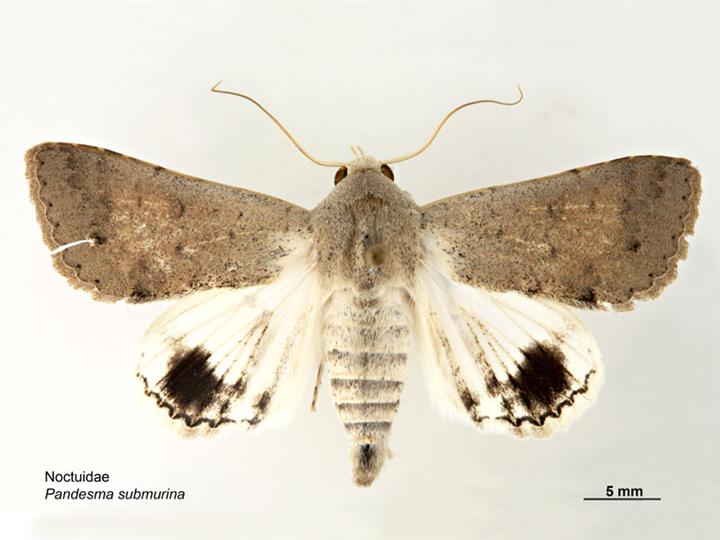
The species occurs in Australia, including New South Wales, the Northern Territory, Queensland and Western Australia. It is commonly known as the pale migrant and has a wingspan of approximately 50 mm.
Written 28 November 2026 from the sources listed below. Each statement was checked against the passage it cites; statements that could not be supported were removed.
Appearance
The species is commonly known as the pale migrant. Its wingspan is approximately 50 mm.[1][2]
Habitat
The species occurs in Australia, including New South Wales, the Northern Territory, Queensland and Western Australia.[3]
Diet
The larvae probably feed on plants belonging to the family Fabaceae.[4]
Classification of Pandesma submurina
| Kingdom | Animalia |
|---|---|
| Phylum | Arthropoda |
| Subphylum | Hexapoda |
| Class | Insecta (Insect) |
| Order | Lepidoptera |
| Superfamily | Noctuoidea |
| Family | Erebidae (Erebid Moths) |
| Subfamily | Calpinae |
| Genus | Pandesma |
| Species | Pandesma submurina Walker, 1865 |
Where Pandesma submurina is found
Checklists and occurrence records place Pandesma submurina in 1 country. GBIF holds 338 georeferenced records of it.
Countries
Regions and cities with the most records
- Queensland, Australia 105
- Western Australia, Australia 102
- Northern Territory, Australia 57
- New South Wales, Australia 55
- Cairns, Australia 8
- Victoria, Australia 6
- Mackay, Australia 4
- South Australia, Australia 4
- Alice Springs, Australia 3
A number beside a place is its count of GBIF occurrence records. A place without a number comes from a checklist alone. Records show where a species has been observed or collected, which can include escapes and vagrants.
Related species
-
 Robust TabbyPandesma robusta
-
 Pandesma anysa
-
 Pandesma muricolor
- Pandesma quenavadi
- Pandesma decaryi
- Pandesma partita
- Pandesma satanas
- Pandesma fasciata
Compare
Sources
Passages the profile rests on
- The species is commonly known as the pale migrant. Source passage: “Pandesma submurina, the pale migrant, is a moth of the family Erebidae” — English Wikipedia
- The species has a wingspan of approximately 50 mm. Source passage: “The wingspan is about 50 mm.” — English Wikipedia
- The species occurs in Australia, including New South Wales, the Northern Territory, Queensland and Western Australia. Source passage: “It is found in Australia in New South Wales, the Northern Territory, Queensland and Western Australia.” — English Wikipedia
- The larvae probably feed on plants belonging to the family Fabaceae. Source passage: “The larvae probably feed on Fabaceae species.” — English Wikipedia
Data
- Catalogue of Life, 2026-10-16 XR cc by
- Global Biodiversity Information Facility CC BY 4.0
- Wikidata CC0
- GeoNames CC BY 4.0
- Wikimedia Commons per image; credit shown with each image
- Within the Catalogue of Life, this name comes from Global Lepidoptera Index cc by
References
- Walker. (1865). List of the specimens of lepidopterous insects in the collection of the British Museum. (33). http://www.biodiversitylibrary.org/item/120100#page/302/mode/2up Link where the name was published
This species in other databases
Page built on 29 November 2026. See how the catalog is made and all sources and licences.
Cite this page
ScientificNames.org. (2026). Pandesma submurina. Retrieved November 29, 2026, from https://scientificnames.org/species/pandesma-submurina
“Pandesma submurina.” ScientificNames.org, 2026, scientificnames.org/species/pandesma-submurina. Accessed 29 Nov. 2026.
ScientificNames.org. “Pandesma submurina.” Accessed November 29, 2026. https://scientificnames.org/species/pandesma-submurina.
@misc{scientificnames_pandesma_submurina,
  author = {{ScientificNames.org}},
  title = {Pandesma submurina},
  year = {2026},
  url = {https://scientificnames.org/species/pandesma-submurina},
  note = {Accessed 2026-11-29}
}