Species · Fishes
Neon Tetra Paracheirodon innesi
The scientific name of the Neon Tetra is Paracheirodon innesi. It is a species of fish in the family Acestrorhamphidae (american tetras), order Characiformes. The name dates from 1936.
- Scientific name
- Paracheirodon innesi (Myers, 1936)
- Common name
- Neon Tetra
- Genus
- Paracheirodon
- Family
- Acestrorhamphidae (American Tetras)
- Order
- Characiformes
- Class
- Teleostei
- Environment
- freshwater
- Recorded in
- 4 countries
- Name status
- accepted in the Catalogue of Life

Overview
Neon Tetra (Paracheirodon innesi) is a fish in the family Acestrorhamphidae and the order Characiformes. It inhabits blackwater and clearwater streams in the Amazon basin. It is distinguished by iridescent blue and red horizontal stripes along its body.
Written 26 November 2026 from the sources listed below. Each statement was checked against the passage it cites; statements that could not be supported were removed.
Appearance
The Neon Tetra has a light-blue back and a silver-white abdomen. Each side bears an iridescent blue horizontal stripe extending from the nose to the base of the adipose fin, and an iridescent red stripe extending from the middle of the body to the base of the caudal fin.[1][2][3]
The body and fins are partially transparent apart from their coloured markings. Females have slightly larger bellies and more curved iridescent stripes than males.[4][5]
The blue and red markings become grey or black while the fish rests at night. The iridescent stripe appears blue-green under light-adapted conditions and indigo under dark-adapted conditions, with guanine crystals in the cells producing the colour changes by reflecting light.[6][7][8]
The species reaches approximately 4 cm in overall length.[9]
Habitat
The Neon Tetra inhabits blackwater and clearwater streams in the Amazon basin. It prefers acidic blackwater streams but also occurs in transparent clearwater streams, and is not found in whitewater rivers.[10][11][12]
Its recorded water temperature range is 20–28 °C. Wild populations inhabit very soft, acidic water with a pH of 4.0–4.8.[13][14]
Diet
The Neon Tetra is omnivorous. Aquarium diets can include brine shrimp, daphnia, freeze-dried bloodworms and tubifex.[15][16]
The species accepts suitably small flake foods. Micropellet food can supplement its diet in captivity.[17][18]
Behaviour
The Neon Tetra forms shoals and should be kept in groups of at least six individuals in aquariums. It is more active in groups of eight to twelve or more individuals.[19][20]
Reproduction and life cycle
The Neon Tetra can reach breeding age at approximately 12 weeks. Breeding in home aquariums is considered difficult.[21][22]
Aquarium breeding requires dim lighting, water hardness below one DH, a pH of approximately 5.5 and a temperature of 24 °C. High tannin concentrations in the water are also required.[23][24]
Uses
The Neon Tetra is widely kept by freshwater aquarium hobbyists because of its bright coloration. It is among the most widely kept tropical aquarium fish worldwide.[25][26]
Approximately two million individuals are sold in the United States each month. Most specimens sold in the United States are imported from Southeast Asian fish farms, while wild-caught specimens are sourced to a lesser extent from Colombia, Peru and Brazil.[27][28][29]
Similar species
Paracheirodon simulans is a distinct species commonly called the green neon tetra. Paracheirodon axelrodi is distinguished from the Neon Tetra by its more extensive red coloration.[30][31]
Classification of the Neon Tetra
| Kingdom | Animalia |
|---|---|
| Phylum | Chordata |
| Subphylum | Vertebrata |
| Infraphylum | Gnathostomata |
| Parvphylum | Osteichthyes |
| Gigaclass | Actinopterygii |
| Superclass | Actinopteri |
| Class | Teleostei (Teleost) |
| Order | Characiformes |
| Suborder | Characoidei |
| Family | Acestrorhamphidae (American Tetras) |
| Subfamily | Pristellinae |
| Genus | Paracheirodon |
| Species | Paracheirodon innesi (Myers, 1936) |
Where the Neon Tetra is found
Checklists and occurrence records place Paracheirodon innesi in 4 countries. GBIF holds 98 georeferenced records of it.
Countries
Regions and cities with the most records
- Vichada Department, Colombia 16
- Loreto, Peru 14
- Amazonas, Venezuela 12
- Amazonas, Brazil 11
- Amazonas Department, Colombia 6
- Guainía Department, Colombia 6
- Puerto Carreño, Colombia 4
- Leticia, Colombia 3
- Tabatinga, Brazil 3
- Tapauá, Brazil 3
1 more country has a few records outside this range
These countries hold a few records of Paracheirodon innesi but lie outside the range the checklists give for it. Such records are often zoo or garden specimens, museum material or vagrants, so the species is not counted as occurring there.
A number beside a place is its count of GBIF occurrence records. A place without a number comes from a checklist alone. Records show where a species has been observed or collected, which can include escapes and vagrants.
Common names
English
- Neon Tetra
- Blue Neon Tetra
- Piaba
Names in 21 other languages
- Afrikaans
- Neon-tetra, Neonvissie
- Breton
- Neon (pesk)
- Catalan
- Tetra neó
- Chinese
- 霓虹燈魚, 霓虹脂鯉
- Czech
- Neonka obecná, neónka obecná
- Danish
- Almindelig neon, Almindelig neonfisk
- French
- Neon, Néon bleu
- German
- Neonfisch, Neonsalmler
- Hebrew
- טטרה ניאון
- Hungarian
- Neonhal
- Japanese
- ネオンテトラ
- Latvian
- Neona tetra
- Lithuanian
- Neoninė tetra, Paprastasis neonas
- Mandarin Chinese
- 紅綠魮脂鯉, 红绿魮脂鲤
- Persian
- تترای نئون
- Polish
- Neon Innesa, Neon innesa a. bystrzyk neonowy
- Portuguese
- Bandeirinha, Cardinal, Néon (peixe ornamental), Tetra neon
- Russian
- Голубой неон, Неон голубой, Неон-тетра, Неоновая рыбка Иннеса, Обыкновенный неон
- Slovak
- Tetra neónová
- Spanish
- Mojarita, Pez tetra neón
- Ukrainian
- Неон звичайний
Synonyms
One other scientific name has been used for this species and is now treated as a synonym of Paracheirodon innesi.
- Hyphessobrycon innesi Myers, 1936
Related species
-
 Cardinal TetraParacheirodon axelrodi
-
 Green Neon TetraParacheirodon simulans
-
 Mexican TetraAstyanax mexicanus
-
 X-ray TetraPristella maxillaris
-
 Black Neon TetraHyphessobrycon herbertaxelrodi
-
 Ember TetraHyphessobrycon amandae
-
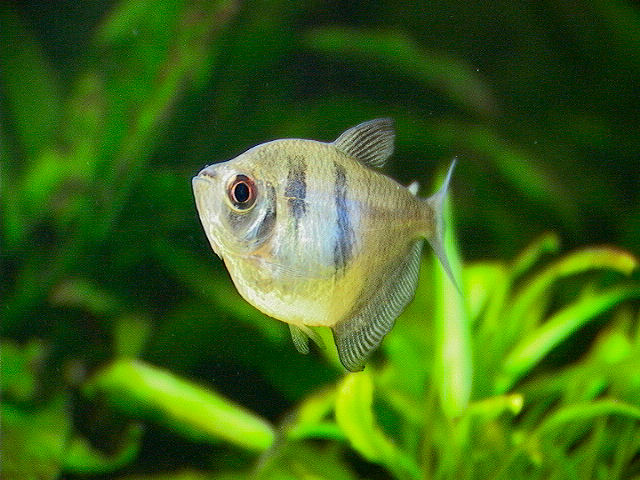 Black TetraGymnocorymbus ternetzi
-
 Glowlight TetraHemigrammus erythrozonus
Compare
Questions and answers
What is the scientific name of the Neon Tetra?
The scientific name of the Neon Tetra is Paracheirodon innesi. Written with its author, the full name is Paracheirodon innesi (Myers, 1936).
Which family does the Neon Tetra belong to?
Paracheirodon innesi belongs to the family Acestrorhamphidae, in the order Characiformes and the class Teleostei.
Where is the Neon Tetra found?
Checklists and occurrence records place Paracheirodon innesi in 4 countries: Colombia, Brazil, Peru and Venezuela.
What other names does the Neon Tetra have?
Paracheirodon innesi is also known in English as Blue Neon Tetra and Piaba.
Why are neon tetras so hard to keep?
Breeding the Neon Tetra in home aquariums is considered difficult. Aquarium breeding requires dim lighting, water hardness below one DH, a pH of approximately 5.5, a temperature of 24 °C and high tannin concentrations in the water.[22][23][24]
Are cardinal tetras and neon tetras the same thing?
The Neon Tetra is Paracheirodon innesi. It is distinguished from Paracheirodon axelrodi by the latter's more extensive red coloration.[31]
What is a neon tetra's natural habitat?
The Neon Tetra inhabits blackwater and clearwater streams in the Amazon basin. It prefers acidic blackwater streams but also occurs in transparent clearwater streams, and is not found in whitewater rivers.[10][11][12]
What type of food does a neon tetra eat?
The Neon Tetra is omnivorous. Aquarium diets can include brine shrimp, daphnia, freeze-dried bloodworms, tubifex, suitably small flake foods and micropellet food.[15][16][17][18]
Are tetras omnivores?
The Neon Tetra is omnivorous.[15]
Sources
Passages the profile rests on
- The species has a light-blue back and a silver-white abdomen. Source passage: “The neon tetra has a light-blue back over a silver-white abdomen.” — English Wikipedia
- Each side of the body bears an iridescent blue horizontal stripe extending from the nose to the base of the adipose fin. Source passage: “a bright iridescent blue horizontal stripe along each side of the fish from its nose to the base of the adipose fin” — English Wikipedia
- An iridescent red stripe extends from the middle of the body to the base of the caudal fin. Source passage: “an iridescent red stripe that begins at the middle of the body and extends posteriorly to the base of the caudal fin.” — English Wikipedia
- The body and fins are partially transparent apart from their coloured markings. Source passage: “The fish is partially transparent (including fins) except for these markings.” — English Wikipedia
- Females have slightly larger bellies and more curved iridescent stripes than males. Source passage: “the female having a slightly larger belly, and a bent iridescent stripe rather than the male's straight stripe.” — English Wikipedia
- The blue and red markings become grey or black while the fish rests at night. Source passage: “During the night, the blue and red become gray or black as the fish rests.” — English Wikipedia
- The iridescent stripe appears blue-green under light-adapted conditions and indigo under dark-adapted conditions. Source passage: “In a light-adapted state it is blue-green, likewise in a dark-adapted state its color changes to indigo.” — English Wikipedia
- Guanine crystals in the cells produce the colour changes by reflecting light. Source passage: “This change is produced by guanine crystals in their cells that reflect light.” — English Wikipedia
- The species reaches approximately 4 cm in overall length. Source passage: “The neon tetra grows to approximately 4 cm (1.6 in) in overall length.” — English Wikipedia
- The species inhabits blackwater and clearwater streams in the Amazon basin. Source passage: “It is native to blackwater and clearwater streams in the Amazon basin of South America.” — English Wikipedia
- The species prefers acidic blackwater streams but also occurs in transparent clearwater streams. Source passage: “It has a preference for acidic blackwater streams, but also occurs in transparent clearwater streams.” — English Wikipedia
- The species is not found in whitewater rivers. Source passage: “It is not found in the whitewater rivers.” — English Wikipedia
- Its recorded water temperature range is 20–28 °C. Source passage: “It lives in waters with a temperature between 20 and 28 °C (68–82 °F)” — English Wikipedia
- Wild populations inhabit very soft, acidic water with a pH of 4.0–4.8. Source passage: “In the wild they inhabit very soft, acidic waters (pH 4.0 to 4.8)” — English Wikipedia
- The species is omnivorous. Source passage: “Neon tetras are omnivores” — English Wikipedia
- Aquarium diets can include brine shrimp, daphnia, freeze-dried bloodworms and tubifex. Source passage: “some small foods such as brine shrimp, daphnia, freeze-dried bloodworms, tubifex” — English Wikipedia
- The species accepts suitably small flake foods. Source passage: “will accept most flake foods, if sufficiently small” — English Wikipedia
- Micropellet food can supplement its diet in captivity. Source passage: “and micropellet food to supplement their diets.” — English Wikipedia
- The species forms shoals and should be kept in groups of at least six individuals in aquariums. Source passage: “They are shoaling fish and must be kept in groups of at least six” — English Wikipedia
- The species is more active in groups of eight to twelve or more individuals. Source passage: “but will be more active in groups of eight to 12 or more.” — English Wikipedia
- The species can reach breeding age at approximately 12 weeks. Source passage: “Neon tetras are old enough to breed at 12 weeks.” — English Wikipedia
- Breeding in home aquariums is considered difficult. Source passage: “Breeding neon tetras is considered to be difficult in home aquariums.” — English Wikipedia
- Aquarium breeding requires dim lighting, water hardness below one DH, a pH of approximately 5.5 and a temperature of 24 °C. Source passage: “Neon tetras need dim lighting, a DH less than one, about 5.5 pH, and a temperature of 75 °F (24 °C) to breed.” — English Wikipedia
- High tannin concentrations in the water are also required for aquarium breeding. Source passage: “There also needs to be a lot of tannins in the water.” — English Wikipedia
- The species is widely kept by freshwater aquarium hobbyists because of its bright coloration. Source passage: “Its bright colouring makes the fish visible to conspecifics in the dark blackwater streams, and is also the main reason for its popularity among freshwater fish hobbyists” — English Wikipedia
- The species is among the most widely kept tropical aquarium fish worldwide. Source passage: “with neon tetras being one of the most widely kept tropical fish in the world.” — English Wikipedia
- Approximately two million individuals are sold in the United States each month. Source passage: “with about 2 million sold in the US each month.” — English Wikipedia
- Most specimens sold in the United States are imported from Southeast Asian fish farms. Source passage: “Most neon tetras available in the United States are imported from Southeast Asia, where they are farm-raised” — English Wikipedia
- Wild-caught specimens sold in the United States are sourced to a lesser extent from Colombia, Peru and Brazil. Source passage: “or to a lesser extent from Colombia, Peru, and Brazil, where they are collected from the wild.” — English Wikipedia
- Paracheirodon simulans is a distinct species commonly called the green neon tetra. Source passage: “The green neon tetra (P. simulans) and black neon tetra (Hyphessobrycon herbertaxelrodi) are distinct species” — English Wikipedia
- Paracheirodon axelrodi is distinguished from this species by its more extensive red coloration. Source passage: “The cardinal tetra (P. axelrodi) is also a similar species, but its greater extent of red coloring distinguishes it from the neon tetra.” — English Wikipedia
Data
- Catalogue of Life, 2026-10-16 XR cc by
- Global Biodiversity Information Facility CC BY 4.0
- Wikidata CC0
- GeoNames CC BY 4.0
- Wikimedia Commons per image; credit shown with each image
- Within the Catalogue of Life, this name comes from World Register of Marine Species cc by
This species in other databases
- Catalogue of Life 4CPDY
- Wikidata Q131431
- iNaturalist 172378
- WoRMS urn:lsid:marinespecies.org:taxname:1525327
- ITIS 163041
Page built on 29 November 2026. See how the catalog is made and all sources and licences.
Cite this page
ScientificNames.org. (2026). Paracheirodon innesi (Neon Tetra). Retrieved November 29, 2026, from https://scientificnames.org/species/paracheirodon-innesi
“Paracheirodon innesi (Neon Tetra).” ScientificNames.org, 2026, scientificnames.org/species/paracheirodon-innesi. Accessed 29 Nov. 2026.
ScientificNames.org. “Paracheirodon innesi (Neon Tetra).” Accessed November 29, 2026. https://scientificnames.org/species/paracheirodon-innesi.
@misc{scientificnames_paracheirodon_innesi_neon_tetra,
  author = {{ScientificNames.org}},
  title = {Paracheirodon innesi (Neon Tetra)},
  year = {2026},
  url = {https://scientificnames.org/species/paracheirodon-innesi},
  note = {Accessed 2026-11-29}
}