Species · Fishes
X-ray Tetra Pristella maxillaris
The scientific name of the X-ray Tetra is Pristella maxillaris. It is a species of fish in the family Acestrorhamphidae (american tetras), order Characiformes. The name dates from 1894.
- Scientific name
- Pristella maxillaris (Ulrey, 1894)
- Common name
- X-ray Tetra
- Genus
- Pristella
- Family
- Acestrorhamphidae (American Tetras)
- Order
- Characiformes
- Class
- Teleostei
- Red List category
- LC Least Concern
- Environment
- freshwater
- Recorded in
- 6 countries
- Name status
- accepted in the Catalogue of Life

Overview
The X-ray tetra (Pristella maxillaris) is a fish native to South America. It occurs in the Amazon and Orinoco river systems in Brazil and Venezuela, as well as in coastal rivers in the Guianas and Brazil. It has a typically translucent, fusiform-shaped body with yellowish-silver scales and coloured fins.
Written 26 November 2026 from the sources listed below. Each statement was checked against the passage it cites; statements that could not be supported were removed.
Appearance
The X-ray tetra has a fusiform-shaped body that is typically translucent, allowing its spine to be seen externally. Its scales are yellowish-silver and almost golden in colour.[1][2][3]
The caudal fin is red, while the anal and dorsal fins have black, yellow and white spots. The species also has a small, round humeral spot approximately the size of its pupil and a hyaline adipose fin.[4][5][6][7]
The species reaches a maximum total length of 4.5 cm.[8]
Habitat
The X-ray tetra inhabits slow-flowing and still waters, including habitats with abundant aquatic vegetation.[9][10]
Uses
The X-ray tetra is popular in the aquarium trade. It is regarded as hardy and easy to maintain, and is considered suitable for beginners in the aquarium hobby.[11][12][13]
Almost all individuals in the aquarium trade are captive-bred. Captive breeding for the aquarium trade is particularly prevalent in Eastern Europe.[14][15]
Classification of the X-ray Tetra
| Kingdom | Animalia |
|---|---|
| Phylum | Chordata |
| Subphylum | Vertebrata |
| Infraphylum | Gnathostomata |
| Parvphylum | Osteichthyes |
| Gigaclass | Actinopterygii |
| Superclass | Actinopteri |
| Class | Teleostei (Teleost) |
| Order | Characiformes |
| Suborder | Characoidei |
| Family | Acestrorhamphidae (American Tetras) |
| Subfamily | Pristellinae |
| Genus | Pristella |
| Species | Pristella maxillaris (Ulrey, 1894) |
Where the X-ray Tetra is found
Checklists and occurrence records place Pristella maxillaris in 6 countries. GBIF holds 754 georeferenced records of it.
Countries
Regions and cities with the most records
- Barima-Waini, Guyana 34
- Amapá, Brazil 31
- Pará, Brazil 29
- Sipaliwini District, Suriname 29
- Upper Demerara-Berbice, Guyana 29
- Oiapoque, Brazil 22
- Kourou, French Guiana 14
- Demerara-Mahaica, Guyana 13
- Marowijne District, Suriname 13
- Matoury, French Guiana 12
- Georgetown, Guyana 11
- Linden, Guyana 10
- Maranhão, Brazil 9
- Cayenne, French Guiana 8
- Rémire-Montjoly, French Guiana 8
- Meta Department, Colombia 6
- Para District, Suriname 6
- Saramacca District, Suriname 6
- Guárico, Venezuela 5
- Monagas, Venezuela 5
- Anzoátegui, Venezuela 4
- Bolívar, Venezuela 4
- Brokopondo District, Suriname 4
- Chapadinha, Brazil 4
- Potaro-Siparuni, Guyana 4
- Essequibo Islands-West Demerara, Guyana 3
- Muaná, Brazil 3
- Ponta de Pedras, Brazil 3
- Salvaterra, Brazil 3
2 more countries have a few records outside this range
These countries hold a few records of Pristella maxillaris but lie outside the range the checklists give for it. Such records are often zoo or garden specimens, museum material or vagrants, so the species is not counted as occurring there.
A number beside a place is its count of GBIF occurrence records. A place without a number comes from a checklist alone. Records show where a species has been observed or collected, which can include escapes and vagrants.
Common names
English
- X-ray Tetra
- Albino Pristella
- Gold Pristella Tetra
- Pristella Tetra
- Water Goldfinch
- X-ray Fish
Names in 12 other languages
- Belarusian
- Прыстэла
- Czech
- tetra průsvitná
- Danish
- Pristella-tetra, Røntgentetra
- Dutch
- Pristella
- Finnish
- Intiaaninsulka
- French
- Chardonneret d'eau, Poisson rayon-X
- German
- Sternflecksalmler, Wasserstieglitz
- Mandarin Chinese
- 細鋸脂鯉, 细锯脂鲤
- Polish
- Pirania, prystelka
- Portuguese
- Peixe raio x
- Russian
- Звездчатая пристелла, Пристелла Риддлея
- Spanish
- Tetra pristella, Tetra radiografía
Synonyms
6 other scientific names have been used for this species and are now treated as synonyms of Pristella maxillaris.
- Aphyocarax maxillaris Ulrey, 1894
- Aphyocharax maxillaris Ulrey, 1894
- Hemigrammus riddlei Meek, 1907
- Holopristes riddlei Meek, 1907
- Holopristis riddlei Meek, 1907
- Pristella riddlei (Meek, 1907)
Related species
- X-ray TetraPristella ariporo
- Pristella crinogi
-
 Neon TetraParacheirodon innesi
-
 Mexican TetraAstyanax mexicanus
-
 Cardinal TetraParacheirodon axelrodi
-
 Black Neon TetraHyphessobrycon herbertaxelrodi
-
 Ember TetraHyphessobrycon amandae
-
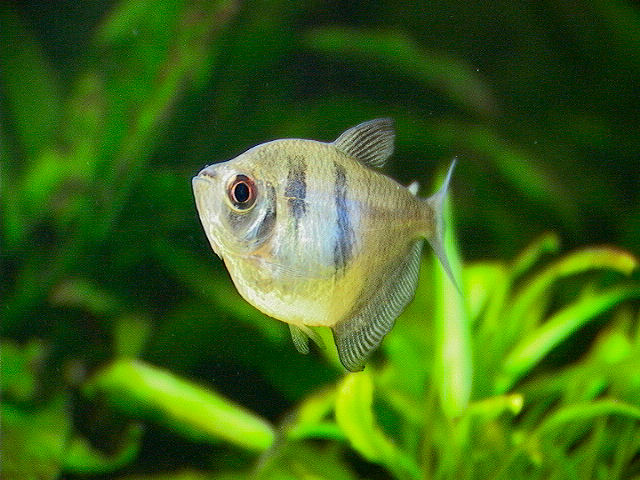 Black TetraGymnocorymbus ternetzi
Compare
Questions and answers
What is the scientific name of the X-ray Tetra?
The scientific name of the X-ray Tetra is Pristella maxillaris. Written with its author, the full name is Pristella maxillaris (Ulrey, 1894).
Which family does the X-ray Tetra belong to?
Pristella maxillaris belongs to the family Acestrorhamphidae, in the order Characiformes and the class Teleostei.
Where is the X-ray Tetra found?
Checklists and occurrence records place Pristella maxillaris in 6 countries: French Guiana, Guyana, Suriname, Brazil, Venezuela and Colombia.
What is the conservation status of the X-ray Tetra?
The IUCN Red List category recorded for Pristella maxillaris is Least Concern (LC).
What other names does the X-ray Tetra have?
Pristella maxillaris is also known in English as Albino Pristella, Gold Pristella Tetra, Pristella Tetra, Water Goldfinch and X-ray Fish.
What is an X-ray tetra?
The X-ray tetra (Pristella maxillaris) is a fish native to South America. It has a typically translucent body that allows its spine to be seen externally.[2][16]
How big do X-ray tetras get?
X-ray tetras reach a maximum total length of 4.5 cm.[8]
Sources
Passages the profile rests on
- The species has a fusiform-shaped body. Source passage: “Pristella maxillaris has a fusiform shaped body” — English Wikipedia
- The body is typically translucent, allowing the spine to be seen externally. Source passage: “This species typically has a translucent body with the spine being visible from the outside.” — English Wikipedia
- Its scales are yellowish-silver and almost golden in colour. Source passage: “Its scales are yellowish-silver, almost golden, in colour.” — English Wikipedia
- The caudal fin is red. Source passage: “The caudal fin is red” — English Wikipedia
- The anal and dorsal fins have black, yellow and white spots. Source passage: “the anal and dorsal fins are spotted with black, yellow and white.” — English Wikipedia
- The species has a small, round humeral spot approximately the size of its pupil. Source passage: “There is a small round, humeral spot similar in size to the pupil” — English Wikipedia
- The adipose fin is hyaline. Source passage: “the adipose fin is hyaline.” — English Wikipedia
- The species reaches a maximum total length of 4.5 cm. Source passage: “maximum total length of 4.5 cm (1.8 in).” — English Wikipedia
- The species inhabits slow-flowing and still waters. Source passage: “These tetras are found in slow flowing and still waters” — English Wikipedia
- Its habitat includes waters with abundant aquatic vegetation. Source passage: “with abundant aquatic vegetation.” — English Wikipedia
- The species is popular in the aquarium trade. Source passage: “Pristella maxillaris is a popular fish in the aquarium trade” — English Wikipedia
- The species is regarded as hardy and easy to maintain in aquariums. Source passage: “where it is considered to be hardy and easy to maintain” — English Wikipedia
- The species is considered suitable for beginners in the aquarium hobby. Source passage: “a good fish for beginners in the hobby.” — English Wikipedia
- Almost all individuals in the aquarium trade are captive-bred. Source passage: “Almost all the fish in the aquarium trade are captive bred” — English Wikipedia
- Captive breeding for the aquarium trade is particularly prevalent in Eastern Europe. Source passage: “especially in Eastern Europe.” — English Wikipedia
- The species is native to South America. Source passage: “This translucent fish is found in South America” — English Wikipedia
Data
- Catalogue of Life, 2026-10-16 XR cc by
- Global Biodiversity Information Facility CC BY 4.0
- Wikidata CC0
- GeoNames CC BY 4.0
- Wikimedia Commons per image; credit shown with each image
- Within the Catalogue of Life, this name comes from World Register of Marine Species cc by
This species in other databases
- Catalogue of Life 4MJ26
- Wikidata Q540539
- iNaturalist 484029
- WoRMS urn:lsid:marinespecies.org:taxname:1467890
- ITIS 163004
Page built on 27 November 2026. See how the catalog is made and all sources and licences.
Cite this page
ScientificNames.org. (2026). Pristella maxillaris (X-ray Tetra). Retrieved November 27, 2026, from https://scientificnames.org/species/pristella-maxillaris
“Pristella maxillaris (X-ray Tetra).” ScientificNames.org, 2026, scientificnames.org/species/pristella-maxillaris. Accessed 27 Nov. 2026.
ScientificNames.org. “Pristella maxillaris (X-ray Tetra).” Accessed November 27, 2026. https://scientificnames.org/species/pristella-maxillaris.
@misc{scientificnames_pristella_maxillaris_x_ray_tetra,
  author = {{ScientificNames.org}},
  title = {Pristella maxillaris (X-ray Tetra)},
  year = {2026},
  url = {https://scientificnames.org/species/pristella-maxillaris},
  note = {Accessed 2026-11-27}
}