Species · Fishes
Fine Flounder Paralichthys adspersus
The scientific name of the Fine Flounder is Paralichthys adspersus. It is a species of fish in the family Paralichthyidae (sand flounders), order Pleuronectiformes. The name dates from 1867.
- Scientific name
- Paralichthys adspersus (Steindachner, 1867)
- Common name
- Fine Flounder
- Genus
- Paralichthys
- Family
- Paralichthyidae (Sand Flounders)
- Order
- Pleuronectiformes
- Class
- Teleostei
- Red List category
- LC Least Concern
- Environment
- marine
- Recorded in
- 2 countries
- Name status
- accepted in the Catalogue of Life

Overview
Fine flounder (Paralichthys adspersus) is a flatfish in the family Paralichthyidae, order Pleuronectiformes and class Teleostei. It occurs in the eastern Pacific Ocean, with a documented continental shelf range from Ecuador to Peru. It is distinguished by its usually left-sided eyes, large canine teeth and strongly arched lateral line above the pectoral fin.
Written 27 November 2026 from the sources listed below. Each statement was checked against the passage it cites; statements that could not be supported were removed.
Appearance
The body height is approximately 45% of standard length, and the head measures approximately 30% of standard length. Both eyes are usually on the left side, although right-sided individuals occur occasionally, and they are separated by a flat area without a ridge.[1][2][3][4]
The mouth is approximately 44% of head length and extends to beneath the rear of the eye. Large canine teeth are present, particularly at the front of the mouth.[5][6]
The dorsal fin begins above the upper eye and has between 65 and 75 rays. The bases of the pelvic fins are symmetrical, and the urinary papilla is on the eyed side immediately behind the level of the anus.[7][8][9]
The lateral line extends onto the head, with branches leading to the upper and lower eyes. It arches strongly above the pectoral fin and has between 95 and 112 scales.[10][11][12]
The eyed side ranges in colour from brown to grey and may have pale or dark spots and blotches. The fins are lighter than the body, and the unpaired fins have markings similar to those of the body.[13][14][15]
The pectoral and pelvic fins have small dark spots, often arranged in rows on the pectoral fin.[16]
The fine flounder can reach a maximum length of 70 cm. Females are typically larger than males.[17][18]
Habitat
The species commonly inhabits gulfs and bays with sandy bottoms. It also occurs in soft-bottom environments including mud, sand, gravel, beaches, estuaries, mangroves and seagrass areas.[19][20]
The fine flounder is native to the eastern Pacific Ocean and its documented continental shelf range extends from Ecuador in the north to Peru in the south. Its geographical distribution extends from Paita in northern Peru at latitude 6° south to the Gulf of Arauco in Chile at latitude 36° south.[21][22][23]
The species is native to the Chilean coast and is associated primarily with the Peruvian province of the eastern Pacific.[24][25]
Diet
The fine flounder feeds on smaller fishes found in its habitat. Its recorded food items include octopuses, squids and cuttlefish.[26][27]
Its diet also includes mobile benthic crustaceans such as shrimps and crabs, as well as mobile benthic worms.[28][29]
Behaviour
The fine flounder is a predator.[30]
Reproduction and life cycle
Vibriosis is reported as the most common bacterial disease affecting the species during its early life stages.[31]
Uses
The fine flounder is a game fish caught by artisanal fisheries off the Peruvian coast and is of commercial interest.[32][33]
The species has been targeted for stock enhancement and aquaculture development.[34]
The intestinal microbiota of wild specimens is dominated by Proteobacteria, with an average relative abundance of 68.1 ± 15.4%. In aquaculture specimens, Firmicutes dominate, with an average relative abundance of 61.2 ± 28.4%.[35][36]
Classification of the Fine Flounder
| Kingdom | Animalia |
|---|---|
| Phylum | Chordata |
| Subphylum | Vertebrata |
| Infraphylum | Gnathostomata |
| Parvphylum | Osteichthyes |
| Gigaclass | Actinopterygii |
| Superclass | Actinopteri |
| Class | Teleostei (Teleost) |
| Order | Pleuronectiformes |
| Suborder | Pleuronectoidei |
| Family | Paralichthyidae (Sand Flounders) |
| Genus | Paralichthys (Summer Flounders) |
| Species | Paralichthys adspersus (Steindachner, 1867) |
Where the Fine Flounder is found
Checklists and occurrence records place Paralichthys adspersus in 2 countries. GBIF holds 3,616 georeferenced records of it.
Countries
Regions and cities with the most records
- Coquimbo, Chile 636
- La Serena, Chile 601
- San Antonio, Chile 191
- Cartagena, Chile 171
- El Quisco, Chile 127
- Valparaíso, Chile 80
- Concón, Chile 52
- Viña del Mar, Chile 47
- Quintero, Chile 44
- Quilpué, Chile 18
- Coquimbo Region, Chile 10
- Breña, Peru 9
- Callao, Peru 9
- Carmen De La Legua Reynoso, Peru 9
- Jesus Maria, Peru 9
- Lima, Peru 9
- San Francisco De Borja, Peru 9
- San Isidro, Peru 9
- Santa Anita - Los Ficus, Peru 9
- Ucayali, Peru 7
- Alto Hospicio, Chile 6
- Callao, Peru 6
- Iquique, Chile 6
- Villa Alemana, Chile 6
- Tarapacá, Chile 5
- Antofagasta, Chile 4
- Ica, Peru 4
- Moquegua Department, Peru 3
- Piura, Peru 3
1 more country has a few records outside this range
These countries hold a few records of Paralichthys adspersus but lie outside the range the checklists give for it. Such records are often zoo or garden specimens, museum material or vagrants, so the species is not counted as occurring there.
A number beside a place is its count of GBIF occurrence records. A place without a number comes from a checklist alone. Records show where a species has been observed or collected, which can include escapes and vagrants.
Common names
English
- Fine Flounder
Names in 4 other languages
- Chinese
- 多耙牙鮃
- Japanese
- Hunboruto-hirame, フンボルトヒラメ
- Portuguese
- Linguado-fino
- Spanish
- Lenguado, Lenguado Fino
Synonyms
2 other scientific names have been used for this species and are now treated as synonyms of Paralichthys adspersus.
- Hippoglossus kingii Jenyns, 1842
- Pseudorhombus adspersus Steindachner, 1867
Related species
-
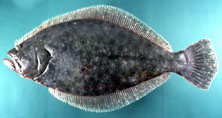 Summer FlounderParalichthys dentatus
-
 Olive FlounderParalichthys olivaceus
-
 Southern FlounderParalichthys lethostigma
-
 California HalibutParalichthys californicus
-
 Gulf FlounderParalichthys albigutta
-
 Brazilian FlounderParalichthys brasiliensis
-
 Small-eyed FlounderParalichthys microps
-
 Mud FlounderParalichthys orbignyanus
Compare
Questions and answers
What is the scientific name of the Fine Flounder?
The scientific name of the Fine Flounder is Paralichthys adspersus. Written with its author, the full name is Paralichthys adspersus (Steindachner, 1867).
Which family does the Fine Flounder belong to?
Paralichthys adspersus belongs to the family Paralichthyidae, in the order Pleuronectiformes and the class Teleostei.
Where is the Fine Flounder found?
Checklists and occurrence records place Paralichthys adspersus in 2 countries: Chile and Peru.
What is the conservation status of the Fine Flounder?
The IUCN Red List category recorded for Paralichthys adspersus is Least Concern (LC).
What do flounder's eat?
Fine flounder feed on smaller fishes, octopuses, squids, cuttlefish, mobile benthic crustaceans such as shrimps and crabs, and mobile benthic worms.[26][27][28][29]
What are the defining characteristics of a flounder fish?
The fine flounder is a flatfish with a body height approximately 45% of its standard length. Its eyes are usually positioned on the left side, and it has large canine teeth and a strongly arched lateral line above the pectoral fin.[1][3][6][11]
Sources
Passages the profile rests on
- The species is a flatfish with a body height approximately 45% of its standard length. Source passage: “Body height ~ 45% of SL” — biogeodb.stri.si.edu
- The head measures approximately 30% of the standard length. Source passage: “head length ~ 30% of SL” — biogeodb.stri.si.edu
- Both eyes are usually positioned on the left side, although right-sided individuals occur occasionally. Source passage: “eyes on left side (uncommonly on right side)” — biogeodb.stri.si.edu
- The eyes are separated by a flat area without a ridge. Source passage: “separated by a flat space without a ridge” — biogeodb.stri.si.edu
- The mouth is approximately 44% of the head length and extends to beneath the rear of the eye. Source passage: “mouth long, 44% of head length, ends under rear of eye” — biogeodb.stri.si.edu
- The species has large canine teeth, particularly at the front of its mouth. Source passage: “teeth are large canines, especially at front of mouth” — biogeodb.stri.si.edu
- Its dorsal fin begins above the upper eye and has between 65 and 75 rays. Source passage: “dorsal fin begins over upper eye, 65-75” — biogeodb.stri.si.edu
- The bases of the pelvic fins are symmetrical. Source passage: “bases of pelvics symmetric” — biogeodb.stri.si.edu
- The urinary papilla is located on the eyed side immediately behind the level of the anus. Source passage: “urinary papilla on eye side, immediately behind level of anus” — biogeodb.stri.si.edu
- The lateral line extends onto the head and has branches leading to the upper and lower eyes. Source passage: “lateral line extending onto head, with branches to upper eye and below lower eye” — biogeodb.stri.si.edu
- The lateral line arches strongly above the pectoral fin. Source passage: “strongly arched over pectoral fin” — biogeodb.stri.si.edu
- The species has between 95 and 112 lateral-line scales. Source passage: “lateral line scales 95-112” — biogeodb.stri.si.edu
- The eyed side ranges in colour from brown to grey and may have pale or dark spots and blotches. Source passage: “Eye side brown to grey, with or without pale and dark spots and blotches” — biogeodb.stri.si.edu
- The fins are lighter in colour than the body. Source passage: “fins lighter than body” — biogeodb.stri.si.edu
- The unpaired fins have markings similar to those of the body. Source passage: “unpaired ones marked like body” — biogeodb.stri.si.edu
- The pectoral and pelvic fins have small dark spots, which are often arranged in rows on the pectoral fin. Source passage: “pectoral and pelvic with small dark spots, often in rows on pectoral.” — biogeodb.stri.si.edu
- The fine flounder can reach a maximum length of 70 cm. Source passage: “growing up to 70 cm in length” — English Wikipedia
- Females are typically larger than males. Source passage: “with females typically being larger than males” — English Wikipedia
- The species commonly inhabits gulfs and bays with sandy bottoms. Source passage: “This flatfish is a common inhabitant of gulfs and bays with sandy bottoms” — pmc.ncbi.nlm.nih.gov
- The species occurs in soft-bottom environments including mud, sand, gravel, beaches, estuaries, mangroves and seagrass areas. Source passage: “Soft bottom (mud/sand/gravel/beach/estuary/mangrove/seagrass)” — biogeodb.stri.si.edu
- The species is native to the eastern Pacific Ocean. Source passage: “native to the eastern Pacific Ocean” — English Wikipedia
- Its documented continental shelf range extends from Ecuador in the north to Peru in the south. Source passage: “along the continental shelf from the coast of Ecuador in the north to the coast of Peru in the south.” — English Wikipedia
- Its geographical distribution extends from Paita in northern Peru at latitude 6° south to the Gulf of Arauco in Chile at latitude 36° south. Source passage: “from Paita, latitude 6° south, Perú, to Golfo de Arauco, latitude 36° south in Chile” — pmc.ncbi.nlm.nih.gov
- The species is native to the Chilean coast. Source passage: “is a flatfish of commercial interest that is native to the Chilean coast.” — pmc.ncbi.nlm.nih.gov
- The species is associated primarily with the Peruvian province of the eastern Pacific. Source passage: “Peruvian province, primarily” — biogeodb.stri.si.edu
- The species feeds on smaller fishes found in its habitat. Source passage: “feeding off smaller fishes in its habitat.” — English Wikipedia
- Its recorded food items include octopuses, squids and cuttlefish. Source passage: “Octopus/squid/cuttlefish” — biogeodb.stri.si.edu
- Its recorded food items include mobile benthic crustaceans such as shrimps and crabs. Source passage: “Mobile benthic crustacea (shrimps/crabs)” — biogeodb.stri.si.edu
- Its recorded food items include mobile benthic worms. Source passage: “Mobile benthic worms” — biogeodb.stri.si.edu
- The species is a predator. Source passage: “The species is a predator” — English Wikipedia
- Vibriosis is reported as the most common bacterial disease affecting the species during its early life stages. Source passage: “In the case of P. adspersus, vibriosis is the most common bacterial disease in early life stages” — pmc.ncbi.nlm.nih.gov
- The fine flounder is a game fish caught by artisanal fisheries off the Peruvian coast. Source passage: “It is a game fish, caught by an artisanal fishery off the Peruvian coast.” — English Wikipedia
- The species is of commercial interest. Source passage: “Fine flounder (Paralichthys adspersus) is a flatfish of commercial interest” — pmc.ncbi.nlm.nih.gov
- The species has been targeted for stock enhancement and aquaculture development. Source passage: “The high value of this flatfish has prompted the development of stock enhancement and aquaculture activities.” — pmc.ncbi.nlm.nih.gov
- The intestinal microbiota of wild specimens is dominated by Proteobacteria, with an average relative abundance of 68.1 ± 15.4%. Source passage: “The most abundant phylum in wild flounder was Proteobacteria, with an average relative abundance of 68.1 ± 15.4%” — pmc.ncbi.nlm.nih.gov
- The intestinal microbiota of aquaculture specimens is dominated by Firmicutes, with an average relative abundance of 61.2 ± 28.4%. Source passage: “the most abundant phylum in flounder aquaculture was Firmicutes, averaging 61.2 ± 28.4%” — pmc.ncbi.nlm.nih.gov
Data
- Catalogue of Life, 2026-10-16 XR cc by
- Global Biodiversity Information Facility CC BY 4.0
- Wikidata CC0
- GeoNames CC BY 4.0
- Wikimedia Commons per image; credit shown with each image
- Within the Catalogue of Life, this name comes from World Register of Marine Species cc by
This species in other databases
- Catalogue of Life 4CYV7
- Wikidata Q1885417
- iNaturalist 108559
- WoRMS urn:lsid:marinespecies.org:taxname:275806
- ITIS 616417
Page built on 29 November 2026. See how the catalog is made and all sources and licences.
Cite this page
ScientificNames.org. (2026). Paralichthys adspersus (Fine Flounder). Retrieved November 29, 2026, from https://scientificnames.org/species/paralichthys-adspersus
“Paralichthys adspersus (Fine Flounder).” ScientificNames.org, 2026, scientificnames.org/species/paralichthys-adspersus. Accessed 29 Nov. 2026.
ScientificNames.org. “Paralichthys adspersus (Fine Flounder).” Accessed November 29, 2026. https://scientificnames.org/species/paralichthys-adspersus.
@misc{scientificnames_paralichthys_adspersus_fine_flounder,
  author = {{ScientificNames.org}},
  title = {Paralichthys adspersus (Fine Flounder)},
  year = {2026},
  url = {https://scientificnames.org/species/paralichthys-adspersus},
  note = {Accessed 2026-11-29}
}