Species · Fishes
Southern Flounder Paralichthys lethostigma
The scientific name of the Southern Flounder is Paralichthys lethostigma. It is a species of fish in the family Paralichthyidae (sand flounders), order Pleuronectiformes. The name dates from 1884.
- Scientific name
- Paralichthys lethostigma Jordan & Gilbert, 1884
- Common name
- Southern Flounder
- Genus
- Paralichthys
- Family
- Paralichthyidae (Sand Flounders)
- Order
- Pleuronectiformes
- Class
- Teleostei
- Red List category
- NT Near Threatened
- Environment
- brackish, marine
- Recorded in
- 3 countries
- Name status
- accepted in the Catalogue of Life

Overview
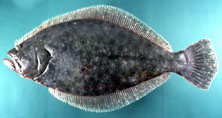
The southern flounder occurs along the eastern coast of the United States as far north as North Carolina and along the northern Gulf of Mexico southward to Tuxpan. The southern flounder has a brown body with diffuse spots and blotches that lack eye-like markings, and both eyes on its upward-facing side.
Written 26 November 2026 from the sources listed below. Each statement was checked against the passage it cites; statements that could not be supported were removed.
Appearance
The southern flounder has a brown body with diffuse spots and blotches that lack eye-like markings. Its left side is pigmented and oriented upward, and adult fish have both eyes on this side of the head.[1][2][3]
The pigmentation of the upper body can change to match the surrounding environment. The species has a small body cavity and lacks an air bladder.[4][5]
Habitat
Adult southern flounders inhabit coastal embayments and nearshore shelf waters during the warmer season. They can survive in low-salinity water and have been recorded in freshwater habitats.[6][7]
Young southern flounders initially occupy shallow grassy areas near Gulf passes. Some individuals enter coastal rivers and bayous as they grow.[8][9]
Southern flounders are frequently found around jetties and oyster reefs extending into bays. They are commonly associated with slightly silty or muddy bottoms.[10][11]
Diet
Larval and postlarval southern flounders feed on zooplankton. Juveniles feed on small invertebrates, mainly crustaceans.[12][13][14]
Adult southern flounders consume larger invertebrates and fish. They feed both on the seabed and within the water column.[15][16]
Behaviour
Southern flounders spend most of their lives lying and swimming sideways along the bottom. They do not swim continuously and tend to accumulate around structures such as jetties and oyster reefs.[17][18]
Adult southern flounders enter shallow water at night to wait for prey, often partially buried.[19]
Reproduction and life cycle
Southern flounders generally reach sexual maturity and first spawn at approximately two years of age. Adults migrate offshore during fall and winter to spawn in the Gulf of Mexico.[20][21][22][23]
Spawning occurs at depths of 50–100 feet, and the eggs are buoyant. Young southern flounders enter bays during late winter and early spring.[24][25][26]
As young southern flounders develop, the right eye migrates toward the left side of the head. Eye migration is complete when the fish reaches approximately half an inch in body length.[27][28]
Conservation
The southern flounder is classified as near threatened by the IUCN. Commercial and recreational overfishing, mortality associated with the shrimp trawl industry, and human-caused habitat destruction affect the species.[29][30][31][32]
Uses
Southern flounders are commercially and recreationally harvested in the Gulf of Mexico. In Texas, they are highly prized as food and recreationally harvested fish, accounting for more than 95 percent of the flounder harvest.[33][34][35]
Southern flounders are considered valuable for aquaculture because they tolerate varying water salinities.[36]
Classification of the Southern Flounder
| Kingdom | Animalia |
|---|---|
| Phylum | Chordata |
| Subphylum | Vertebrata |
| Infraphylum | Gnathostomata |
| Parvphylum | Osteichthyes |
| Gigaclass | Actinopterygii |
| Superclass | Actinopteri |
| Class | Teleostei (Teleost) |
| Order | Pleuronectiformes |
| Suborder | Pleuronectoidei |
| Family | Paralichthyidae (Sand Flounders) |
| Genus | Paralichthys (Summer Flounders) |
| Species | Paralichthys lethostigma Jordan & Gilbert, 1884 |
Where the Southern Flounder is found
Checklists and occurrence records place Paralichthys lethostigma in 3 countries. GBIF holds 15,593 georeferenced records of it.
Countries
Regions and cities with the most records
- Texas, United States 4,432
- Portland, United States 1,232
- Corpus Christi, United States 948
- Foley, United States 837
- Fairhope, United States 795
- Louisiana, United States 662
- Port Arthur, United States 643
- Groves, United States 622
- Alabama, United States 377
- Florida, United States 365
- Nederland, United States 283
- Orange, United States 264
- Tillmans Corner, United States 214
- North Carolina, United States 194
- Daphne, United States 164
- Mobile, United States 157
- Prichard, United States 155
- West Pensacola, United States 150
- Bellview, United States 145
- Myrtle Grove, United States 139
- Texas City, United States 121
- La Marque, United States 111
- Ensley, United States 110
- Pensacola, United States 108
- Brent, United States 106
- South Carolina, United States 101
- Galveston, United States 92
- Slidell, United States 79
- Dickinson, United States 77
- League City, United States 74
- La Porte, United States 65
- Mississippi, United States 61
- Sebastian, United States 53
- Deer Park, United States 51
- Gautier, United States 49
- Baytown, United States 47
1 more country has a few records outside this range
These countries hold a few records of Paralichthys lethostigma but lie outside the range the checklists give for it. Such records are often zoo or garden specimens, museum material or vagrants, so the species is not counted as occurring there.
A number beside a place is its count of GBIF occurrence records. A place without a number comes from a checklist alone. Records show where a species has been observed or collected, which can include escapes and vagrants.
Common names
English
- Southern Flounder
- Fluke
Names in 3 other languages
- Chinese
- 漠斑牙鮃
- French
- Cardeau de Floride
- Spanish
- Leguando limpio, Lenguado de florida, lenguado limpio
Synonyms
One other scientific name has been used for this species and is now treated as a synonym of Paralichthys lethostigma.
- Paralichthys letostigma Jordan & Gilbert, 1884
Related species
-
 Summer FlounderParalichthys dentatus
-
 Olive FlounderParalichthys olivaceus
-
 California HalibutParalichthys californicus
-
 Gulf FlounderParalichthys albigutta
-
 Fine FlounderParalichthys adspersus
-
 Brazilian FlounderParalichthys brasiliensis
-
 Small-eyed FlounderParalichthys microps
-
 Mud FlounderParalichthys orbignyanus
Compare
Questions and answers
What is the scientific name of the Southern Flounder?
The scientific name of the Southern Flounder is Paralichthys lethostigma. Written with its author, the full name is Paralichthys lethostigma Jordan & Gilbert, 1884.
Which family does the Southern Flounder belong to?
Paralichthys lethostigma belongs to the family Paralichthyidae, in the order Pleuronectiformes and the class Teleostei.
Where is the Southern Flounder found?
Checklists and occurrence records place Paralichthys lethostigma in 3 countries: United States, Mexico and Canada.
What is the conservation status of the Southern Flounder?
The IUCN Red List category recorded for Paralichthys lethostigma is Near Threatened (NT).
What other names does the Southern Flounder have?
Paralichthys lethostigma is also known in English as Fluke.
What do southern flounder eat?
Larval and postlarval southern flounders eat zooplankton. Juveniles feed on small invertebrates, mainly crustaceans, while adults consume larger invertebrates and fish.[12][13][15][14]
Where do southern flounder live?
Southern flounders occur along the eastern coast of the United States as far north as North Carolina and along the northern Gulf of Mexico southward to Tuxpan. They inhabit coastal embayments, nearshore shelf waters, coastal rivers, bayous, and freshwater habitats.[6][7][9][37][38]
Sources
Passages the profile rests on
- The species has a brown body with diffuse spots and blotches that lack eye-like markings. Source passage: “The body color is brown with diffuse, unocellated spots and blotches.” — English Wikipedia
- The species has its left side pigmented and oriented upward. Source passage: “It is a "left-eyed flounder", meaning the left side is pigmented and is the "up side".” — English Wikipedia
- Adult southern flounders have both eyes on the upward-facing side of their heads. Source passage: “Both eyes in adults are on the "up" side of the head” — tpwd.texas.gov
- The pigmentation of the upper body can change to match the surrounding environment. Source passage: “the pigmentation of the upper side of the body can be varied to match the surrounding environment.” — tpwd.texas.gov
- The species has a small body cavity and lacks an air bladder. Source passage: “A small body cavity and the absence of air bladder aid the flounder in maintaining its position on the bottom.” — tpwd.texas.gov
- Adult southern flounders inhabit coastal embayments and nearshore shelf waters during the warmer season. Source passage: “Adult fish breed and spend the warmer season in coastal embayments and nearshore shelf waters” — English Wikipedia
- The species can survive in low-salinity water and has been recorded in freshwater habitats. Source passage: “The southern flounder can survive in low salinity and has even been found in freshwater habitats” — English Wikipedia
- Young southern flounders initially occupy shallow grassy areas near Gulf passes. Source passage: “seek shallow grassy areas near the Gulf passes.” — tpwd.texas.gov
- Some individuals enter coastal rivers and bayous as they grow. Source passage: “Some will enter coastal rivers and bayous.” — tpwd.texas.gov
- Southern flounders are frequently found around jetties and oyster reefs extending into bays. Source passage: “it is more often productive to fish around jetties or oyster reefs that extend from shore into the bay.” — tpwd.texas.gov
- The species is commonly associated with slightly silty or muddy bottoms. Source passage: “a bottom that is slightly silty or muddy generally is better than a hard sand bottom.” — tpwd.texas.gov
- Larval and postlarval southern flounders feed on zooplankton. Source passage: “Larval and postlarval southern flounder feed on zooplankton.” — English Wikipedia
- Juveniles feed on small invertebrates. Source passage: “As a juvenile, the southern flounder's diet consists of small invertebrates” — English Wikipedia
- Juvenile southern flounders feed mainly on crustaceans. Source passage: “Juvenile flounder feed mainly on crustaceans” — tpwd.texas.gov
- Adult southern flounders consume larger invertebrates and fish. Source passage: “shifting to larger invertebrates and fish as the flounder reaches adult size.” — English Wikipedia
- Southern flounders feed both on the seabed and within the water column. Source passage: “Southern flounder feed on the bottom of the ocean and in the water column” — English Wikipedia
- Southern flounders spend most of their lives lying and swimming sideways along the bottom. Source passage: “spend most of their life lying and swimming along the bottom on their side.” — tpwd.texas.gov
- Southern flounders do not swim continuously and tend to accumulate around structures such as jetties and oyster reefs. Source passage: “Flounder do not swim continuously so they tend to accumulate in such places in their search for food.” — tpwd.texas.gov
- Adult southern flounders enter shallow water at night to wait for prey, often partially buried. Source passage: “Adult flounder enter shallow water at night where they lie, often partially buried, and wait for prey.” — tpwd.texas.gov
- Southern flounders generally reach sexual maturity at approximately two years of age. Source passage: “Southern flounder reach sexual maturity around two years of age.” — English Wikipedia
- Adult southern flounders migrate offshore to spawn during fall and winter. Source passage: “most leave to spawn offshore during the fall and winter as adults.” — English Wikipedia
- Adult southern flounders leave bays during fall to spawn in the Gulf of Mexico. Source passage: “Adult southern flounder leave the bays during the fall for spawning in the Gulf of Mexico.” — tpwd.texas.gov
- Southern flounders first spawn at approximately two years of age. Source passage: “They spawn for the first time when two years old” — tpwd.texas.gov
- Spawning occurs at depths of 50–100 feet. Source passage: “at depths of 50 to 100 feet.” — tpwd.texas.gov
- Southern flounder eggs are buoyant. Source passage: “The eggs are buoyant.” — tpwd.texas.gov
- Young southern flounders enter bays during late winter and early spring. Source passage: “The young fish enter the bays during late winter and early spring.” — tpwd.texas.gov
- The right eye migrates toward the left side of the head as young southern flounders develop. Source passage: “the right eye begins to "migrate" to the left side of the head.” — tpwd.texas.gov
- Eye migration is complete when the young fish reaches approximately half an inch in body length. Source passage: “When body length of about one-half inch has been attained, the eye migration is complete” — tpwd.texas.gov
- The species is classified as near threatened by the IUCN. Source passage: “This species is listed by the IUCN as near threatened” — English Wikipedia
- Commercial and recreational overfishing contribute to threats facing the species. Source passage: “due to both commercial and recreational overfishing” — English Wikipedia
- Mortality associated with the shrimp trawl industry is another threat to the species. Source passage: “and mortality from the shrimp trawl industry.” — English Wikipedia
- Human-caused habitat destruction also affects southern flounders. Source passage: “This species is also affected by habitat destruction from human causes.” — English Wikipedia
- Southern flounders are commercially and recreationally harvested in the Gulf of Mexico. Source passage: “Southern flounders are a major and valuable species in the highly important commercial and recreational flounder fishery in the Gulf of Mexico.” — English Wikipedia
- Southern flounders are highly prized as food and recreationally harvested fish in Texas. Source passage: “It is highly prized as both food and a recreationally harvested fish” — tpwd.texas.gov
- Southern flounders account for more than 95 percent of the flounder harvest in Texas. Source passage: “accounts for more than 95 percent of the flounder harvest in the state.” — tpwd.texas.gov
- Southern flounders are considered valuable for aquaculture because they tolerate varying water salinities. Source passage: “Southern flounder are also considered valuable as an aquaculture species because of their ability to live in water of varying salinities.” — English Wikipedia
- The species occurs along the eastern coast of the United States as far north as North Carolina. Source passage: “north to North Carolina” — English Wikipedia
- The species occurs along the northern Gulf of Mexico southward to Tuxpan. Source passage: “along the northern Gulf of Mexico, south to Tuxpan” — English Wikipedia
Data
- Catalogue of Life, 2026-10-16 XR cc by
- Global Biodiversity Information Facility CC BY 4.0
- Wikidata CC0
- GeoNames CC BY 4.0
- Wikimedia Commons per image; credit shown with each image
- Within the Catalogue of Life, this name comes from World Register of Marine Species cc by
References
- Jordan, D. S., & Meek, S. E. (1884). List of fishes observed in the Saint John’s River at Jacksonville, Florida. Proceedings of the United States National Museum, v. 7 (no. 427): 235–237. https://doi.org/10.5479/si.00963801.7-427.235 Link where the name was published
This species in other databases
- Catalogue of Life 4CYVM
- Wikidata Q7134909
- iNaturalist 108562
- WoRMS urn:lsid:marinespecies.org:taxname:158829
- ITIS 172738
Page built on 27 November 2026. See how the catalog is made and all sources and licences.
Cite this page
ScientificNames.org. (2026). Paralichthys lethostigma (Southern Flounder). Retrieved November 27, 2026, from https://scientificnames.org/species/paralichthys-lethostigma
“Paralichthys lethostigma (Southern Flounder).” ScientificNames.org, 2026, scientificnames.org/species/paralichthys-lethostigma. Accessed 27 Nov. 2026.
ScientificNames.org. “Paralichthys lethostigma (Southern Flounder).” Accessed November 27, 2026. https://scientificnames.org/species/paralichthys-lethostigma.
@misc{scientificnames_paralichthys_lethostigma_southern_flounder,
  author = {{ScientificNames.org}},
  title = {Paralichthys lethostigma (Southern Flounder)},
  year = {2026},
  url = {https://scientificnames.org/species/paralichthys-lethostigma},
  note = {Accessed 2026-11-27}
}