Species · Reptiles
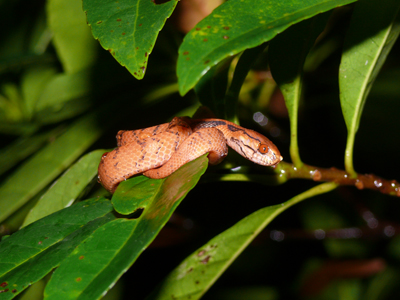
Formosa Slug Snake Pareas formosensis
The scientific name of the Formosa Slug Snake is Pareas formosensis. It is a species of reptile in the family Pareidae (slug snakes & wood snakes), order Squamata. The name dates from 1909.
- Scientific name
- Pareas formosensis (Van Denburgh, 1909)
- Common name
- Formosa Slug Snake
- Genus
- Pareas
- Family
- Pareidae (Slug Snakes & Wood Snakes)
- Order
- Squamata
- Class
- Reptilia
- Red List category
- LC Least Concern
- Environment
- terrestrial
- Recorded in
- 5 countries
- Name status
- accepted in the Catalogue of Life

Overview
Formosa slug snake or Taiwan slug snake (Pareas formosensis) is a species of non-venomous snake in the family Pareatidae. It is endemic to Taiwan.
Classification of the Formosa Slug Snake
| Kingdom | Animalia |
|---|---|
| Phylum | Chordata |
| Subphylum | Vertebrata |
| Infraphylum | Gnathostomata |
| Parvphylum | Osteichthyes |
| Megaclass | Tetrapoda |
| Class | Reptilia (Reptile) |
| Order | Squamata (Snakes) |
| Suborder | Serpentes (Snakes) |
| Infraorder | Alethinophidia |
| Family | Pareidae (Slug Snakes & Wood Snakes) |
| Genus | Pareas (Oriental Slug-eating Snakes) |
| Species | Pareas formosensis (Van Denburgh, 1909) |
Where the Formosa Slug Snake is found
Checklists and occurrence records place Pareas formosensis in 5 countries across Asia. GBIF holds 734 georeferenced records of it.
Countries
Regions and cities with the most records
- Taiwan, Taiwan 242
- Guangdong, China 64
- Lugu, Taiwan 53
- Zhushan, Taiwan 50
- Fanling, Hong Kong 48
- Gangxia, China 47
- Hong Lok Yuen, Hong Kong 47
- Pat Heung, Hong Kong 47
- San Tin, Hong Kong 47
- Shawei, China 47
- Shenzhen, China 47
- Shenzhen City Centre, China 47
- Sheung Shui, Hong Kong 47
- Tai Po, Hong Kong 47
- Shuen Wan, Hong Kong 46
- Tai Mei Tuk, Hong Kong 46
- Fairview Park, Hong Kong 44
- Zhuzilin, China 43
- Kam Tin, Hong Kong 42
- Shap Pat Heung, Hong Kong 42
- Yuen Long San Hui, Hong Kong 42
- Discovery Park, Hong Kong 41
- Fo Tan, Hong Kong 41
- Ha Tsuen, Hong Kong 41
- Ping Shan, Hong Kong 41
- Tin Shui Wai, Hong Kong 41
- Tsuen Wan, Hong Kong 41
- Yeung Uk Tsuen, Hong Kong 41
- Yuen Long, Hong Kong 41
- Yuen Long Kau Hui, Hong Kong 41
- Kam Ying, Hong Kong 40
- Lee On, Hong Kong 40
- Tai Shui Hang, Hong Kong 40
- Wu Kai Sha, Hong Kong 40
- Ma On Shan, Hong Kong 39
- Sham Tseng, Hong Kong 39
Range as the checklists state it
Taiwan, China, Vietnam, Laos (Xékong, Champasak, Khammouan)
A number beside a place is its count of GBIF occurrence records. A place without a number comes from a checklist alone. Records show where a species has been observed or collected, which can include escapes and vagrants.
Common names
English
- Formosa Slug Snake
- Taiwan Slug Snake
Names in 4 other languages
- Chinese
- 台湾钝头蛇, 台灣鈍頭蛇, 脊高蛇, 臺灣鈍頭蛇, 阿里山鈍頭蛇
- Danish
- Taiwansk Rødøjet Sneglesnog
- Portuguese
- Papa-lesmas-de-formosa
- Vietnamese
- Rắn hổ mây đài loan, Rắn ăn sên Đài Loan
Synonyms
5 other scientific names have been used for this species and are now treated as synonyms of Pareas formosensis.
- Amblycephalus carinatus hainanus Smith, 1923
- Amblycephalus formosensis Van Denburgh, 1909
- Eberhardtia tonkinensis Angel, 1920
- Psammo ynastes compressus Oshima, 1910
- Psammodynastes compressus Oshima, 1910
Related species
-
 Iwasaki's Snail-eaterPareas iwasakii
-
 Keeled Slug SnakePareas carinatus
-
 Mountain Slug SnakePareas margaritophorus
- Common Slug SnakePareas monticola
-
 Atayal Slug-eating SnakePareas atayal
-
 Hampton's Slug SnakePareas hamptoni
-
 Mountain Slug SnakePareas macularius
- Anderson’s Slug SnakePareas andersonii
Compare
Questions and answers
What is the scientific name of the Formosa Slug Snake?
The scientific name of the Formosa Slug Snake is Pareas formosensis. Written with its author, the full name is Pareas formosensis (Van Denburgh, 1909).
Which family does the Formosa Slug Snake belong to?
Pareas formosensis belongs to the family Pareidae, in the order Squamata and the class Reptilia.
Where is the Formosa Slug Snake found?
Checklists and occurrence records place Pareas formosensis in 5 countries: Taiwan, China, Vietnam, Hong Kong and Laos.
What is the conservation status of the Formosa Slug Snake?
The IUCN Red List category recorded for Pareas formosensis is Least Concern (LC).
What other names does the Formosa Slug Snake have?
Pareas formosensis is also known in English as Taiwan Slug Snake.
Sources
Data
- Catalogue of Life, 2026-10-16 XR cc by
- Global Biodiversity Information Facility CC BY 4.0
- Wikidata CC0
- English Wikipedia CC BY-SA 4.0
- GeoNames CC BY 4.0
- Wikimedia Commons per image; credit shown with each image
- Within the Catalogue of Life, this name comes from The Reptile Database cc by
References
- Van DENBURGH, & JOHN. (1909). New and previously unrecorded species of reptiles and amphibians from the island of Formosa. Proc. Cal. Acad. Sci. (4) 3 (3): 49-56.
- Stejneger, L. (1910). The batrachians and reptiles of Formosa. Proc. US Natl. Mus. 38: 91-114.
- Oshima, MASAMITSU. (1910). An annotated list of Formosan snakes, with descriptions of four new species and one new subspecies. Annot. Zool. Japon., Tokyo, 7 (3): 185-207.
- Barbour, & Thomas. (1912). Some Chinese Vertebrates: Amphibia and Reptilia. Memoirs of the Museum of Comparative Zoölogy 40 (4): 125-136.
- Mell, & Rudolf. (1922). Beiträge zur Fauna Sinica. i. Die Vertebraten Südchinas; Feldlisten und Feldnoten der Säuger, Vögel, Reptilien, Batrachier. Archiv Für Naturgeschichte 88 (10): 1-134.
- Maki, M. (1931). Monograph of the Snakes of Japan. Dai-Ichi Shobo, Tokyo. (1), 7, 240 Pages (Expanded Edition 1933).
- Bourret, R. (1935). Notes herpétologiques sur l’Indochine Française X. Les serpents de la station d’altitude du Tam-dao. Bull. Gen. Instr. Pub. Hanoi 8 (Avril): 259-271 (1-13).
- Bourret, R. (1937). Notes herpétologiques sur l’indochine française. XV. Lézards et serpents reçu au laboratoire des Sciences Naturelles de l’Université au cours de l’année 1937. Descriptions de deux espèces et de deux variétés nouvelles. Bulletin Générale de l’Instruction Publique 5. Gouvernement Généneral de l’Indochine, Pp. 57-82.
- Smith, M. A. (1943). The Fauna of British India, Ceylon and Burma, Including the Whole of the Indo-Chinese Sub-Region. Reptilia and Amphibia. 3 (Serpentes). Taylor and Francis, London. 583 Pp.
- Deuve, J. (1961). Liste annotee des Serpents du Laos. Bull. Soc. Sci. Nat. Laos 1:5-32.
- Hu, Bu-Qing, Mei-Hua Huang, Zhan-ai Xie, Er-mi Zhao, Yao-Ming Jiang, Qing-Yun Huang, Yu Zong, & and Jil-Fan Ma. (1980). Atlas of Chinese Snakes [in Chinese]. Shanghai Press Sci. Technol., Shanghai. (3), 5, 3, 166 Pages.
- Inger R F, Zhao E, Bradley Shaffer H, & Guanfu Wu. (1990). Report on a collection of amphibians and reptiles from Sichuan, China. Fieldiana: Zoology (No. 58) : I-Iii, 1-24.
- Rao, D.Q. & D.T. YANG. (1992). Phylogenetic systematics of Pareinae (Serpents) of southeastern Asia and adjacent islands with relationship between it and the geology changes. [In Chinese, English summary]. Acta Zool. Sinica, 38 (2): 139-150.
- Toriba, M. (1993). Present location of the type specimens described by Maki. The Snake 25: 71-72.
- Zhao, E., & Adler, K. (1993). Herpetology of China. SSAR, Oxford/Ohio, 1-522.
- Nguyen Van Sang, & Ho Thu Cuc. (1996). Danh luc bo sat va ech nhai Viet Nam. Nha xuat ban khoa hoc va ky thuat. Hanoi, 264 Pp.
- Ota H. Lin J T. Hirata T. Chen S L. (1997). Systematic review of Colubrid snakes of the genus Pareas in the East Asian islands. Journal of Herpetology 31 (1): 79-87.
- Ziegler, T. (2002). Die Amphibien und Reptilien eines Tieflandfeuchtwald-Schutzgebietes in Vietnam. Natur Und Tier Verlag (Münster), 342 Pp.
- JIANG, & Yaoming. (2004). Pareas chinensis (Babour, 1912) should be a junior synonym of Pareas formosensis (Van Denburgh, 1909). Sichuan Journal of Zoology, 23(3), 209–210.
- Zhao, E. M. (2006). The snakes of China [in Chinese]. Hefei, China, Anhui Sience & Technology Publ. House, Vol. I, 372 Pp., Vol. II (Color Plates), 280 Pp.
- ZIEGLER, THOMAS; RALF HENDRIX, VU NGOC THANH, MARTINA VOGT, BERNHARD FORSTER & DANG NGOC KIEN. (2007). The diversity of a snake community in a karst forest ecosystem in the central Truong Son, Vietnam, with an identification key. Zootaxa 1493: 1-40.
- Guo, Keji, Deng, & Xuejiang. (2009). A new species of Pareas (Serpentes: Colubridae: Pareatinae) from the Gaoligong Mountains, southwestern China. Zootaxa 2008: 53-60.
- GUO, YUHONG;, YUNKE WU,, SHUNPING HE, HAITAO SHI & ERMI ZHAO. (2011). Systematics and molecular phylogenetics of Asian snail-eating snakes (Pareatidae). Zootaxa 3001: 57–64.
- Lillywhite, Harvey B. (2014). How Snakes Work: Structure, Function and Behavior of the World’s Snakes. Oxford University Press, New York, 256 Pp.
- Wallach, Van; Kenneth L. Williams, Jeff Boundy. (2014). Snakes of the World: A Catalogue of Living and Extinct Species. [type catalogue]. Taylor and Francis, CRC Press, 1237 Pp.
This species in other databases
- Catalogue of Life 4DK86
- Wikidata Q3006781
- iNaturalist 29142
- WoRMS urn:lsid:marinespecies.org:taxname:1728523
- ITIS 1082167
Page built on 27 November 2026. See how the catalog is made and all sources and licences.
Cite this page
ScientificNames.org. (2026). Pareas formosensis (Formosa Slug Snake). Retrieved November 27, 2026, from https://scientificnames.org/species/pareas-formosensis
“Pareas formosensis (Formosa Slug Snake).” ScientificNames.org, 2026, scientificnames.org/species/pareas-formosensis. Accessed 27 Nov. 2026.
ScientificNames.org. “Pareas formosensis (Formosa Slug Snake).” Accessed November 27, 2026. https://scientificnames.org/species/pareas-formosensis.
@misc{scientificnames_pareas_formosensis_formosa_slug_snake,
  author = {{ScientificNames.org}},
  title = {Pareas formosensis (Formosa Slug Snake)},
  year = {2026},
  url = {https://scientificnames.org/species/pareas-formosensis},
  note = {Accessed 2026-11-27}
}