Species · Reptiles
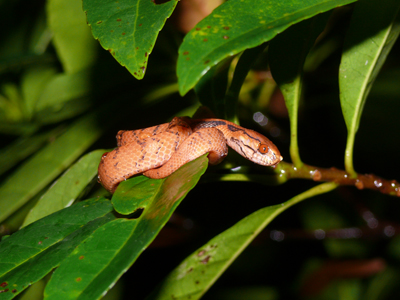
Hampton's Slug Snake Pareas hamptoni
The scientific name of the Hampton's Slug Snake is Pareas hamptoni. It is a species of reptile in the family Pareidae (slug snakes & wood snakes), order Squamata. The name dates from 1905.
- Scientific name
- Pareas hamptoni (Boulenger, 1905)
- Common name
- Hampton's Slug Snake
- Genus
- Pareas
- Family
- Pareidae (Slug Snakes & Wood Snakes)
- Order
- Squamata
- Class
- Reptilia
- Red List category
- LC Least Concern
- Recorded in
- 4 countries
- Name status
- accepted in the Catalogue of Life

Overview
Pareas hamptoni occurs in Cambodia, China, Laos, Myanmar, Thailand, and Vietnam. It is an arboreal snake that is active during both daytime and nighttime and preys on slugs.
Written 27 November 2026 from the sources listed below. Each statement was checked against the passage it cites; statements that could not be supported were removed.
Habitat
Hampton's Slug Snake inhabits forests at elevations of 600–1,500 m (2,000–4,900 ft).[1]
Diet
Hampton's Slug Snake preys on slugs.[2]
Behaviour
Hampton's Slug Snake is arboreal and active during both daytime and nighttime.[3]
Reproduction and life cycle
Hampton's Slug Snake is oviparous.[4]
Uses
The specific name hamptoni commemorates Herbert Hampton, who collected the holotype.[5]
Classification of the Hampton's Slug Snake
| Kingdom | Animalia |
|---|---|
| Phylum | Chordata |
| Subphylum | Vertebrata |
| Infraphylum | Gnathostomata |
| Parvphylum | Osteichthyes |
| Megaclass | Tetrapoda |
| Class | Reptilia (Reptile) |
| Order | Squamata (Snakes) |
| Suborder | Serpentes (Snakes) |
| Infraorder | Alethinophidia |
| Family | Pareidae (Slug Snakes & Wood Snakes) |
| Genus | Pareas (Oriental Slug-eating Snakes) |
| Species | Pareas hamptoni (Boulenger, 1905) |
Where the Hampton's Slug Snake is found
Checklists and occurrence records place Pareas hamptoni in 4 countries across Asia. GBIF holds 173 georeferenced records of it.
Countries
Regions and cities with the most records
- Vĩnh Yên, Vietnam 34
- Yunnan, China 27
- Thị Trấn Đại Từ, Vietnam 21
- Lao Cai, Vietnam 14
- Gia Lai, Vietnam 13
- Thị Trấn Đông Triều, Vietnam 8
- Kachin State, Myanmar 5
- Hà Giang, Vietnam 3
- Lai Châu Province, Vietnam 3
Range as the checklists state it
Burma, Vietnam (Lao Cai etc.), China ? (Yunnan)
A number beside a place is its count of GBIF occurrence records. A place without a number comes from a checklist alone. Records show where a species has been observed or collected, which can include escapes and vagrants.
Common names
English
- Hampton's Slug Snake
- Hampton's Slug-eating Snake
- Rắn Ăn Sên Hampton
Names in 6 other languages
- Chinese
- 緬甸鈍頭蛇, 缅甸钝头蛇
- Danish
- Burmesisk Sneglesnog
- German
- Hamptons Schneckennatter
- Portuguese
- Papa-lesmas-de-hampton
- Thai
- งูกินทากลายขวั้น
- Vietnamese
- Rắn hổ mây hampton
Synonyms
One other scientific name has been used for this species and is now treated as a synonym of Pareas hamptoni.
- Amblycephalus hamptoni Boulenger, 1905
Related species
-
 Iwasaki's Snail-eaterPareas iwasakii
-
 Keeled Slug SnakePareas carinatus
-
 Mountain Slug SnakePareas margaritophorus
- Common Slug SnakePareas monticola
-
 Formosa Slug SnakePareas formosensis
-
 Atayal Slug-eating SnakePareas atayal
-
 Mountain Slug SnakePareas macularius
- Anderson’s Slug SnakePareas andersonii
Compare
Questions and answers
What is the scientific name of the Hampton's Slug Snake?
The scientific name of the Hampton's Slug Snake is Pareas hamptoni. Written with its author, the full name is Pareas hamptoni (Boulenger, 1905).
Which family does the Hampton's Slug Snake belong to?
Pareas hamptoni belongs to the family Pareidae, in the order Squamata and the class Reptilia.
Where is the Hampton's Slug Snake found?
Checklists and occurrence records place Pareas hamptoni in 4 countries: Vietnam, China, Laos and Myanmar.
What is the conservation status of the Hampton's Slug Snake?
The IUCN Red List category recorded for Pareas hamptoni is Least Concern (LC).
What other names does the Hampton's Slug Snake have?
Pareas hamptoni is also known in English as Hampton's Slug-eating Snake and Rắn Ăn Sên Hampton.
What is a slug in snake terms?
A slug is prey of Hampton's Slug Snake.[2]
Sources
Passages the profile rests on
- The species inhabits forests at elevations of 600–1,500 m (2,000–4,900 ft). Source passage: “The preferred natural habitat of P. hamptoni is forest, at altitudes of 600–1,500 m (2,000–4,900 ft).” — English Wikipedia
- The species preys on slugs. Source passage: “P. hamptoni preys upon slugs.” — English Wikipedia
- The species is arboreal and active during both daytime and nighttime. Source passage: “P. hamptoni is arboreal, and it is both diurnal and nocturnal.” — English Wikipedia
- The species is oviparous. Source passage: “P. hamptoni is oviparous.” — English Wikipedia
- The specific name hamptoni commemorates Herbert Hampton, who collected the holotype. Source passage: “The specific name, hamptoni, is in honor of Herbert Hampton, collector of the holotype.” — English Wikipedia
Data
- Catalogue of Life, 2026-10-16 XR cc by
- Global Biodiversity Information Facility CC BY 4.0
- Wikidata CC0
- GeoNames CC BY 4.0
- Wikimedia Commons per image; credit shown with each image
- Within the Catalogue of Life, this name comes from The Reptile Database cc by
References
- Boulenger, G. A. (1905). Descriptions of Two New Snakes from Upper Burma. J. Bombay Nat. Hist. Soc. 16: 235-236.
- Smith, M. A. (1923). On a collection of reptiles and batrachians from the island of Hainan. J. Nat. Hist. Soc. Siam 6: 195—212.
- Parker, H. W. (1925). A collection of reptiles and batrachians from Tonkin. Ann. Mag. Nat. Hist. (9) 15: 300-306.
- Smith, M. A. (1943). The Fauna of British India, Ceylon and Burma, Including the Whole of the Indo-Chinese Sub-Region. Reptilia and Amphibia. 3 (Serpentes). Taylor and Francis, London. 583 Pp.
- Taylor, E. H. (1965). The serpents of Thailand and adjacent waters. Univ. Kansas Sci. Bull. 45 (9): 609-1096.
- Dowling, H.G., & Jenner, J.V. (1988). Snakes of Burma: checklist of reported species and bibliography. Smithsonian Herp. Inf. Serv. (76): 19 Pp.
- Li D. (1989). A survey of reptiles in Leigongshan area. In: Matsui, M., Hikida, T. & Goris, R.C. [Eds]. Current Herpetology in East Asia. Proceedings of the Second Japan-China Herpetological Symposium Kyoto, July 1988. Herpetological Society of Japan, Kyoto, Japan: I-Ix, 1-521 [269-275].
- Ota H. Lin J T. Hirata T. Chen S L. (1997). Systematic review of Colubrid snakes of the genus Pareas in the East Asian islands. Journal of Herpetology 31 (1): 79-87.
- Ziegler, T. (2002). Die Amphibien und Reptilien eines Tieflandfeuchtwald-Schutzgebietes in Vietnam. Natur Und Tier Verlag (Münster), 342 Pp.
- Zhao, E. M. (2006). The snakes of China [in Chinese]. Hefei, China, Anhui Sience & Technology Publ. House, Vol. I, 372 Pp., Vol. II (Color Plates), 280 Pp.
- ZIEGLER, THOMAS; RALF HENDRIX, VU NGOC THANH, MARTINA VOGT, BERNHARD FORSTER & DANG NGOC KIEN. (2007). The diversity of a snake community in a karst forest ecosystem in the central Truong Son, Vietnam, with an identification key. Zootaxa 1493: 1-40.
- Nguyen, S.V., Ho, C.T. and Nguyen, T.Q. (2009). Herpetofauna of Vietnam. Chimaira, Frankfurt, 768 Pp.
- Guo, Keji, Deng, & Xuejiang. (2009). A new species of Pareas (Serpentes: Colubridae: Pareatinae) from the Gaoligong Mountains, southwestern China. Zootaxa 2008: 53-60.
- Vogel, & Gernot. (2010). ON THE DISTRIBUTION OF Pareas hamptoni (BOULENGER, 1905) IN THAILAND (SERPENTES: PAREATINAE). Russ. J. Herpetol. 17 (3): 219 – 222.
- Beolens, B., & Michael Watkins, a. M. G. (2011). The Eponym Dictionary of Reptiles. Johns Hopkins University Press, Baltimore, USA.
- Das, I. (2012). A Naturalist’s Guide to the Snakes of South-East Asia: Malaysia, Singapore, Thailand, Myanmar, Borneo, Sumatra, Java and Bali. Oxford J, Ohn Beaufoy Publishing.
- Hecht, Vera L.; Cuong T. Pham, Tao T. Nguyen, Truong Q. Nguyen, Michael Bonkowski & Thomas Ziegler. (2013). First report on the herpetofauna of Tay Yen Tu Nature Reserve, northeastern Vietnam. Biodiversity Journal 4 (4): 507–552.
- Jestrzemski, Daniel; Stefan Schütz, Truong Quang Nguyen, Thomas Ziegler. (2013). A survey of amphibians and reptiles in Chu Mom Ray National Park, Vietnam, with implications for herpetofaunal conservation. Asian Journal of Conservation Biology, 2 (2): 88–110.
- Wallach, Van; Kenneth L. Williams, Jeff Boundy. (2014). Snakes of the World: A Catalogue of Living and Extinct Species. [type catalogue]. Taylor and Francis, CRC Press, 1237 Pp.
- Chan-ard, T., Parr, J. W. K., & Nabhitabhata, J. (2015). A field guide to the reptiles of Thailand. Oxford University Press, NY, 352 Pp. [See Book Reviews by Pauwels & Grismer 2015 and Hikida 2015 for Corrections].
- Nguyen, Truong Quang; Tan Van Nguyen, Cuong The Pham, An Vinh Ong & Thomas Ziegler. (2018). New records of snakes (Squamata: Serpentes) from Hoa Binh Province, northwestern Vietnam. Bonn Zoological Bulletin 67 (1): 15–24.
- Le, Dzung Trung; Anh Ngoc Dao, Dat Thang Pham, Thomas Ziegler, and Truong Quang Nguyen. (2018). New records and an updated list of snakes from Yen Bai Province, Vietnam. Herpetology Notes 11: 101-108.
- Harrington, Sean M; Jordyn M de Haan, Lindsey Shapiro, Sara Ruane. (2018). Habits and characteristics of arboreal snakes worldwide: arboreality constrains body size but does not affect lineage diversification. Biological Journal of the Linnean Society 125 (1): 61–71.
- Zaher H, Murphy RW, Arredondo JC, Graboski R, Machado-Filho PR, Mahlow K, et al. (2019). Large-scale molecular phylogeny, morphology, divergence-time estimation, and the fossil record of advanced caenophidian snakes (Squamata: Serpentes). PLoS ONE 14(5): E0216148.
- Nguyen, T. V., & Loi Duc Duong, T. T. A. D. (2019). NEW RECORDS AND UPDATED LIST OF SNAKES (SQUAMATA: SERPENTES) FROM BINH DINH PROVINCE, CENTRAL-SOUTHERN VIETNAM. Hue University Journal of Science: Natural Science 128 (1B): 35-41.
This species in other databases
Page built on 28 November 2026. See how the catalog is made and all sources and licences.
Cite this page
ScientificNames.org. (2026). Pareas hamptoni (Hampton's Slug Snake). Retrieved November 28, 2026, from https://scientificnames.org/species/pareas-hamptoni
“Pareas hamptoni (Hampton's Slug Snake).” ScientificNames.org, 2026, scientificnames.org/species/pareas-hamptoni. Accessed 28 Nov. 2026.
ScientificNames.org. “Pareas hamptoni (Hampton's Slug Snake).” Accessed November 28, 2026. https://scientificnames.org/species/pareas-hamptoni.
@misc{scientificnames_pareas_hamptoni_hamptons_slug_snake,
  author = {{ScientificNames.org}},
  title = {Pareas hamptoni (Hampton's Slug Snake)},
  year = {2026},
  url = {https://scientificnames.org/species/pareas-hamptoni},
  note = {Accessed 2026-11-28}
}