Species · Fishes
Sailfin Flying Fish Parexocoetus brachypterus
The scientific name of the Sailfin Flying Fish is Parexocoetus brachypterus. It is a species of fish in the family Exocoetidae (flying fish), order Beloniformes. The name dates from 1846.
- Scientific name
- Parexocoetus brachypterus (Richardson, 1846)
- Common name
- Sailfin Flying Fish
- Genus
- Parexocoetus
- Family
- Exocoetidae (Flying Fish)
- Order
- Beloniformes
- Class
- Teleostei
- Environment
- marine
- Recorded in
- 40 countries
- Name status
- accepted in the Catalogue of Life
Overview
Parexocoetus brachypterus inhabits coastal and sub-coastal waters and is recorded in the Atlantic, Pacific, and Indian Oceans. It is distinguished by comparatively small pectoral fins, a relatively long dorsal fin, and the ability to glide above the water.
Written 26 November 2026 from the sources listed below. Each statement was checked against the passage it cites; statements that could not be supported were removed.
Appearance
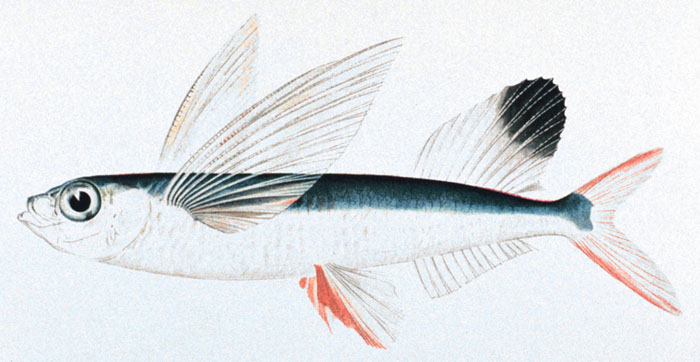
The Sailfin Flying Fish has an elongate, broadly cylindrical body, a short head, and a short, blunt snout. Its body is stocky compared with other flying fishes, and it displays countershading.[1][2][3][4]
It has a small mouth, a protrusible upper jaw, and small conical jaw teeth. Its dorsal fin has 12–14 rays, and its anal fin has 12–14 rays.[5][6]
The pectoral fin does not extend beyond the anal-fin base and has two unbranched rays followed by 11–12 branched rays. The pelvic fin is short and barely reaches the anal-fin origin.[7][8]
The tail is deeply forked, with a longer lower lobe. The lateral line lies low on the body and has a branch extending to the pectoral-fin origin.[9][10]
The species has large, smooth scales that are easily shed. Juveniles possess paired chin barbels that are easily lost.[11][12]
The upper surface is dark, iridescent green-blue, while the underside is silvery white. The dorsal fin is clear with a large black blotch at its outer tip.[13][14]
The pelvic fins are grey, while the other fins are clear except for the tail, which has a reddish cast. The species typically measures 110–130 mm in length, and females are generally slightly longer and heavier than males.[15][16][17]
Habitat
The Sailfin Flying Fish inhabits coastal and sub-coastal waters and is recorded as a pelagic fish. It occurs in the Atlantic, Pacific, and Indian Oceans.[18][19][20]
In the western Atlantic, its recorded range extends from northern Florida to Brazil and includes the Gulf of Mexico and Caribbean Sea. In the Indo-Pacific, it is recorded from Central Mexico to Ecuador and the oceanic islands.[21][22]
Diet
The Sailfin Flying Fish feeds primarily on zooplankton and is considered a generalist feeder. It has also been recorded eating fish scales and Sargassum.[23][24][25]
Behaviour
The Sailfin Flying Fish can jump out of the water and glide using its enlarged pectoral fins to evade predators. It is classified as a two-winged flying fish because it has enlarged pectoral fins but not enlarged pelvic fins.[26][27]
Spawning individuals aggregate in large groups that can contain up to one million fish. Individuals in these aggregations exhibit energetic jumping, gliding, and swimming.[28][29]
Males outnumber females in spawning aggregations by approximately three to one. Small groups of three to four fish have also been observed during spawning events.[30][31]
Reproduction and life cycle
The Sailfin Flying Fish has two spawning periods annually, from September to January and from March to August.[32]
It is uncertain whether fertilized eggs require attachment to floating debris. The eggs have been reported as potentially free-floating.[33][34]
Uses
The Sailfin Flying Fish is generally treated as commercial fishing bycatch. It can be prepared as salted fish by salting it and drying it in the sun.[35][36]
In Taiwan, the species is eaten locally and used as bait. It forms part of the traditional fishing stock of the Tao people in Taiwan.[37][38]
Classification of the Sailfin Flying Fish
| Kingdom | Animalia |
|---|---|
| Phylum | Chordata |
| Subphylum | Vertebrata |
| Infraphylum | Gnathostomata |
| Parvphylum | Osteichthyes |
| Gigaclass | Actinopterygii |
| Superclass | Actinopteri |
| Class | Teleostei (Teleost) |
| Order | Beloniformes |
| Family | Exocoetidae (Flying Fish) |
| Genus | Parexocoetus |
| Species | Parexocoetus brachypterus (Richardson, 1846) |
Where the Sailfin Flying Fish is found
Checklists and occurrence records place Parexocoetus brachypterus in 40 countries. GBIF holds 1,146 georeferenced records of it.
Countries
- Australia 51
- Bahamas 39
- Barbados 8
- Belize 16
- Bermuda 12
- Brazil 15
- Canada 5
- Colombia 33
- Costa Rica 6
- Cuba 6
- Ecuador 3
- French Guiana 14
- French Polynesia 5
- Grenada 5
- Guyana 4
- Honduras 4
- India 3
- Indonesia 28
- Jamaica 4
- Japan 114
- Lebanon 6
- Malaysia 3
- Marshall Islands 3
- Mexico 23
- New Caledonia 17
- Nicaragua 8
- Panama 53
- Papua New Guinea 52
- Philippines 69
- Puerto Rico 19
- Saint Lucia 3
- Saint Vincent and the Grenadines 4
- Solomon Islands 6
- Sri Lanka 3
- Suriname 8
- Taiwan 15
- Trinidad and Tobago 4
- U.S. Virgin Islands 6
- United States 448
- Venezuela 21
Regions and cities with the most records
- Veraguas Province, Panama 24
- Waipahu, United States 15
- ʻEwa Beach-Iroquois Point, United States 15
- ʻEwa Gentry-West Loch, United States 15
- ‘Ewa Beach, United States 15
- Aliamanu / Salt Lakes / Foster Village, United States 14
- Diamond Head / Kapahulu / Saint Louis Heights, United States 14
- East Honolulu, United States 14
- Honolulu, United States 14
- Joint Base Pearl Harbor Hickam, United States 14
- Kailua, United States 14
- Kalihi Valley, United States 14
- Kaneohe, United States 14
- Kuliouou - Kalani Iki, United States 14
- Makiki / Lower Punchbowl / Tantalus, United States 14
- Manoa, United States 14
- Niu Valley, United States 14
- Pearl City, United States 14
- Waikīkī, United States 14
- ‘Ewa Gentry, United States 14
- Minamisatsuma, Japan 11
- Kaseda-shirakame, Japan 10
- Taiwan, Taiwan 6
- Hawaii, United States 5
- Florida, United States 4
- Hamilton, Bermuda 4
- Kīhei, United States 4
- Bitung, Indonesia 3
- Bridgetown, Barbados 3
- Makakilo, United States 3
- Makakilo / Kapolei / Honokai Hale, United States 3
- Makakilo City, United States 3
- Makakilo-Makaīwa Hills-Kunia, United States 3
- Schofield Barracks, United States 3
9 more countries have a few records outside this range
These countries hold a few records of Parexocoetus brachypterus but lie outside the range the checklists give for it. Such records are often zoo or garden specimens, museum material or vagrants, so the species is not counted as occurring there.
A number beside a place is its count of GBIF occurrence records. A place without a number comes from a checklist alone. Records show where a species has been observed or collected, which can include escapes and vagrants.
Common names
English
- Sailfin Flying Fish
- Pacific Sailfin Flyingfish
- Two-winged Flying-fish
- Sailfin Flyingfish
Names in 12 other languages
- Chinese
- 小烏, 白短鰭擬飛魚, 短鰭擬飛魚, 草螟仔, 飛烏
- Czech
- letoun krátkoploutvý
- French
- exocet voilier
- Italian
- Pesce volante ali a vela, Pesce volante due ali
- Japanese
- ツマリトビウオ
- Malay
- Ikan terbang
- Mandarin Chinese
- 飞乌
- Polish
- krótkoskrzydlak oceaniczny
- Portuguese
- Peixe-voador-veleiro
- Russian
- Азиатско-американский короткокрыл
- Samoan
- Malolo
- Spanish
- volador aletón, volador aletón dle Pacifico, volador velero
Synonyms
7 other scientific names have been used for this species and are now treated as synonyms of Parexocoetus brachypterus.
- Exocaetus brachypterus Richardson, 1846
- Exocoetus atrodorsalis Günther, 1867
- Exocoetus brachypterus Richardson, 1846
- Paraexocoetus brachypterus (Richardson, 1846)
- Paraxocoetus brachypterus (Richardson, 1846)
- Parexocoetus brachypterus brachypterus (Richardson, 1846)
- Ptenonotus melanogeneion Pietschmann, 1928
Related species
-
 African Sailfin FlyingfishParexocoetus mento
-
 Atlantic Sailfin FlyingfishParexocoetus hillianus
-
 Cosmopolitan FlyingfishExocoetus volitans
-
 Atlantic FlyingfishCheilopogon melanurus
-
 Atlantic Flying-fishCheilopogon heterurus
-
 Black-wing Flying FishHirundichthys rondeletii
-
 Oceanic Two-wing FlyingfishExocoetus obtusirostris
- Oceanic FlyingfishExocoetus gibbosus
Compare
Questions and answers
What is the scientific name of the Sailfin Flying Fish?
The scientific name of the Sailfin Flying Fish is Parexocoetus brachypterus. Written with its author, the full name is Parexocoetus brachypterus (Richardson, 1846).
Which family does the Sailfin Flying Fish belong to?
Parexocoetus brachypterus belongs to the family Exocoetidae, in the order Beloniformes and the class Teleostei.
Where is the Sailfin Flying Fish found?
Checklists and occurrence records place Parexocoetus brachypterus in 40 countries, including United States, Japan, Philippines, Panama, Papua New Guinea and Australia.
What other names does the Sailfin Flying Fish have?
Parexocoetus brachypterus is also known in English as Pacific Sailfin Flyingfish, Two-winged Flying-fish and Sailfin Flyingfish.
Why is exocoetus called flying fish?
The Sailfin Flying Fish is classified as a two-winged flying fish because it has enlarged pectoral fins but not enlarged pelvic fins. It can jump out of the water and glide using its enlarged pectoral fins.[26][27]
Do flying fish actually fly or glide?
The Sailfin Flying Fish jumps out of the water and glides using its enlarged pectoral fins to evade predators.[26]
What is the diet of a flying fish?
The Sailfin Flying Fish feeds primarily on zooplankton. It also eats fish scales and Sargassum and is considered a generalist feeder.[23][24][25]
What is a flying fish habitat?
The Sailfin Flying Fish inhabits coastal and sub-coastal waters and is recorded as a pelagic fish.[18][19]
What animals eat flying fish?
The Sailfin Flying Fish serves as prey for larger fish, particularly dolphinfish, as well as large squids and seabirds.[39]
Sources
Passages the profile rests on
- The species has a stocky body compared with other flying fishes. Source passage: “The sailfin flying fish is stocky as far as flying fish are concerned.” — English Wikipedia
- The species has a blunt snout. Source passage: “One distinguishing feature is its blunt snout.” — English Wikipedia
- The species displays countershading. Source passage: “It displays countershading.” — English Wikipedia
- The species has an elongate, broadly cylindrical body, a short head, and a short, blunt snout. Source passage: “Elongate, broadly cylindrical body; head short, snout short and blunt;” — biogeodb.stri.si.edu
- The species has a small mouth, a protrusible upper jaw, and small conical jaw teeth. Source passage: “mouth small, upper jaw protrusible, jaw teeth small, conical;” — biogeodb.stri.si.edu
- The species has 12–14 dorsal fin rays and 12–14 anal fin rays. Source passage: “dorsal 12-14 rays, long fin rays; anal 12-14 rays;” — biogeodb.stri.si.edu
- The pectoral fin does not extend beyond the anal-fin base and has two unbranched rays followed by 11–12 branched rays. Source passage: “pectoral moderately long, not reaching past anal base, 1st 2 rays unbranched , 11-12 branched rays;” — biogeodb.stri.si.edu
- The pelvic fin is short and barely reaches the anal-fin origin. Source passage: “pelvic fin short, barely reaching anal origin;” — biogeodb.stri.si.edu
- The species has a deeply forked tail with a longer lower lobe. Source passage: “tail deeply forked with a longer lower lobe;” — biogeodb.stri.si.edu
- The lateral line lies low on the body and has a branch extending to the pectoral-fin origin. Source passage: “lateral line low on the body, with a branch to origin of pectoral;” — biogeodb.stri.si.edu
- The species has large, smooth scales that are easily shed. Source passage: “scales large, smooth, easily shed;” — biogeodb.stri.si.edu
- Juveniles possess paired chin barbels that are easily lost. Source passage: “juveniles with paired chin barbells (easily lost).” — biogeodb.stri.si.edu
- The species is dark, iridescent green-blue on its upper surface and silvery white underneath. Source passage: “Dark, iridescent green-blue above, silvery white below;” — biogeodb.stri.si.edu
- The dorsal fin is clear with a large black blotch at its outer tip. Source passage: “dorsal fin clear, with large black blotch at outer tip;” — biogeodb.stri.si.edu
- The pelvic fins are grey, while the other fins are clear except for the tail, which has a reddish cast. Source passage: “pelvics grey; other fins clear except tail with red cast.” — biogeodb.stri.si.edu
- The species typically measures 110–130 mm in length. Source passage: “One average, P. brachypterus measure 110-130 mm in length.” — English Wikipedia
- Females are generally slightly longer and heavier than males. Source passage: “Females of the species are usually slightly longer and heavier than the males.” — English Wikipedia
- The species inhabits coastal and sub-coastal waters. Source passage: “This species is dispersed globally in coastal and sub-coastal waters.” — English Wikipedia
- The species is recorded as a pelagic fish. Source passage: “No Data Pelagic fish eggs Pelagic fish larvae Zooplankton” — biogeodb.stri.si.edu
- The species occurs in the Atlantic, Pacific, and Indian Oceans. Source passage: “It is found in the Atlantic, Pacific, and Indian Oceans.” — English Wikipedia
- In the western Atlantic, its recorded range extends from northern Florida to Brazil and includes the Gulf of Mexico and Caribbean Sea. Source passage: “In the Western Atlantic Ocean, it can be found off the shores of northern Florida to Brazil, as well as in the Gulf of Mexico and the Caribbean Sea.” — English Wikipedia
- The species is recorded in the Indo-Pacific, from Central Mexico to Ecuador and the oceanic islands. Source passage: “Indo-Pacific; Central Mexico to Ecuador and the oceanic islands.” — biogeodb.stri.si.edu
- The species feeds primarily on zooplankton. Source passage: “the sailfin flying fish feeds primarily on zooplankton.” — English Wikipedia
- The species has also been recorded eating fish scales and Sargassum. Source passage: “It has also been found to eat fish scales and Sargassum” — English Wikipedia
- The species is considered a generalist feeder. Source passage: “and is thought to be a generalist.” — English Wikipedia
- The species can jump out of the water and glide using its enlarged pectoral fins to evade predators. Source passage: “this species has the ability to jump out of the water and glide on hypertrophied fins in order to evade predators.” — English Wikipedia
- The species is classified as a two-winged flying fish because it has enlarged pectoral fins but not enlarged pelvic fins. Source passage: “it only has enlarged pectoral fins, as opposed to “four-winged” flying fish, which have both enlarged pectoral and pelvic fins.” — English Wikipedia
- Spawning individuals aggregate in large groups that can contain up to one million fish. Source passage: “groups estimated to contain up to one million members in some cases.” — English Wikipedia
- Individuals in spawning aggregations exhibit energetic jumping, gliding, and swimming. Source passage: “The individuals in such aggregations display high-energy jumping, gliding and swimming.” — English Wikipedia
- Males outnumber females in spawning aggregations by approximately three to one. Source passage: “males being approximately three times more abundant than females.” — English Wikipedia
- Small groups of three to four fish have been observed during spawning events. Source passage: “Small groups usually containing 3-4 fish have been observed during spawning events.” — English Wikipedia
- The species has two spawning periods annually, from September to January and from March to August. Source passage: “There are two spawning periods during the year, one from September to January, and one from March to August.” — English Wikipedia
- It is uncertain whether fertilized eggs require attachment to floating debris. Source passage: “it is unsure whether or not fertilized eggs need to attach themselves to flotsam.” — English Wikipedia
- The eggs of this species have been reported as potentially free-floating. Source passage: “There are reports that this species’ eggs may be free-floating.” — English Wikipedia
- The species is generally treated as commercial fishing bycatch. Source passage: “P. brachypterus is generally considered bycatch by the commercial fishing industry.” — English Wikipedia
- The species can be prepared as salted fish by salting it and drying it in the sun. Source passage: “they can be prepared as salted fish by salting them and leaving them to dry out in the sun.” — English Wikipedia
- In Taiwan, the species is eaten locally and used as bait. Source passage: “the sailfin flying fish and other flying fish are eaten by locals and are also used as bait.” — English Wikipedia
- The species forms part of the traditional fishing stock of the Tao people in Taiwan. Source passage: “P. brachypterus is one of the species of flying fish that comprise the bulk of their traditional fishing stock.” — English Wikipedia
- The species serves as prey for larger fish, particularly dolphinfish, as well as large squids and seabirds. Source passage: “Some organisms known to predate on the sailfin flying fish are large fish, dolphinfish in particular, large squids, and seabirds.” — English Wikipedia
Data
- Catalogue of Life, 2026-10-16 XR cc by
- Global Biodiversity Information Facility CC BY 4.0
- Wikidata CC0
- GeoNames CC BY 4.0
- Wikimedia Commons per image; credit shown with each image
- Within the Catalogue of Life, this name comes from World Register of Marine Species cc by
References
- Richardson, John. 1846. [Original taxonomic description(s)]. . where the name was published
This species in other databases
- Catalogue of Life 4DLS4
- Wikidata Q13688923
- iNaturalist 317281
- WoRMS urn:lsid:marinespecies.org:taxname:217872
- ITIS 165522
Page built on 28 November 2026. See how the catalog is made and all sources and licences.
Cite this page
ScientificNames.org. (2026). Parexocoetus brachypterus (Sailfin Flying Fish). Retrieved November 28, 2026, from https://scientificnames.org/species/parexocoetus-brachypterus
“Parexocoetus brachypterus (Sailfin Flying Fish).” ScientificNames.org, 2026, scientificnames.org/species/parexocoetus-brachypterus. Accessed 28 Nov. 2026.
ScientificNames.org. “Parexocoetus brachypterus (Sailfin Flying Fish).” Accessed November 28, 2026. https://scientificnames.org/species/parexocoetus-brachypterus.
@misc{scientificnames_parexocoetus_brachypterus_sailfin_flying_fish,
  author = {{ScientificNames.org}},
  title = {Parexocoetus brachypterus (Sailfin Flying Fish)},
  year = {2026},
  url = {https://scientificnames.org/species/parexocoetus-brachypterus},
  note = {Accessed 2026-11-28}
}