Species · Fishes
Atlantic Sailfin Flyingfish Parexocoetus hillianus
The scientific name of the Atlantic Sailfin Flyingfish is Parexocoetus hillianus. It is a species of fish in the family Exocoetidae (flying fish), order Beloniformes. The name dates from 1851.
- Scientific name
- Parexocoetus hillianus (Gosse, 1851)
- Common name
- Atlantic Sailfin Flyingfish
- Genus
- Parexocoetus
- Family
- Exocoetidae (Flying Fish)
- Order
- Beloniformes
- Class
- Teleostei
- Red List category
- LC Least Concern
- Environment
- marine
- Recorded in
- 23 countries
- Name status
- accepted in the Catalogue of Life

Overview
The Atlantic Sailfin Flyingfish is a fish belonging to the flying-fish genus Parexocoetus. It occurs in the eastern and western Atlantic, including the Caribbean Sea, Gulf of Mexico, and waters from Guinea-Bissau to Angola. It is distinguished by a very high dorsal fin with a large black blotch at its outer tip and a deeply forked tail with a longer lower lobe.
Written 27 November 2026 from the sources listed below. Each statement was checked against the passage it cites; statements that could not be supported were removed.
Appearance
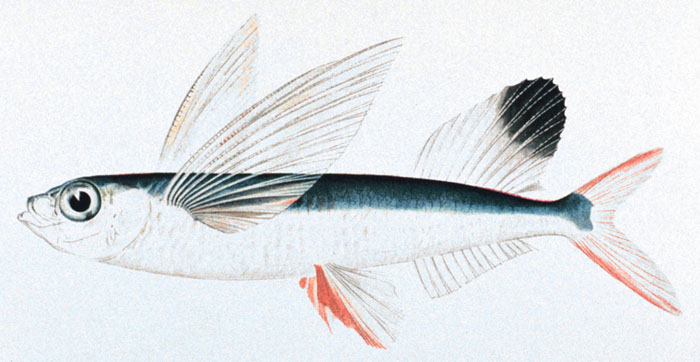
The Atlantic Sailfin Flyingfish has an elongate, broadly cylindrical body, a short head, and a short, blunt snout. Its mouth is small and short, with a protrusible upper jaw and small conical teeth.[1][2]
Its dorsal fin is very high and has 9–14 rays. The anal fin has 10–14 rays and originates before the second dorsal-fin ray.[3][4]
Its moderately long pectoral fin reaches the middle rays of the dorsal fin and has 11–13 rays, of which only the first is unbranched. Its short pelvic fins barely reach the anal-fin origin and are positioned nearer the operculum than the tail-fin base.[5][6]
Its tail is deeply forked, with a longer lower lobe. Its large, smooth scales are easily shed, and its lateral line lies low on the body with a branch extending to the pectoral-fin origin.[7][8][9]
Adults are dark iridescent green-blue above and silvery white below. Their dorsal fin is clear with a large black blotch at its outer tip, while all other fins are transparent.[10][11][12]
Juveniles possess paired chin barbels that are easily lost. They have black pigment on their dorsal, pelvic, and anal fins.[13][14]
The species is recorded with a standard length of 10.3.[15]
Habitat
The Atlantic Sailfin Flyingfish is classified as pelagic-neritic.[16]
In the western Atlantic, it occurs in Gulf Stream waters off the southeastern United States and Bermuda. Its range extends south through the Gulf of Mexico and Caribbean Sea to northern Brazil.[17][18]
A separate eastern Atlantic population occurs from Guinea-Bissau south to Angola. This population may represent a subspecies.[19][20]
The species is transatlantic, occurring in both the eastern and western Atlantic. It is non-endemic in the Greater Caribbean and is recorded in tropical, equatorial, and subtropical Greater Caribbean zones.[21][22][23]
The species is recorded as native in the Caribbean Sea.[24]
Classification of the Atlantic Sailfin Flyingfish
| Kingdom | Animalia |
|---|---|
| Phylum | Chordata |
| Subphylum | Vertebrata |
| Infraphylum | Gnathostomata |
| Parvphylum | Osteichthyes |
| Gigaclass | Actinopterygii |
| Superclass | Actinopteri |
| Class | Teleostei (Teleost) |
| Order | Beloniformes |
| Family | Exocoetidae (Flying Fish) |
| Genus | Parexocoetus |
| Species | Parexocoetus hillianus (Gosse, 1851) |
Where the Atlantic Sailfin Flyingfish is found
Checklists and occurrence records place Parexocoetus hillianus in 23 countries. GBIF holds 395 georeferenced records of it.
Countries
- Angola 12
- Bahamas 13
- Barbados 9
- Brazil 10
- Cayman Islands 3
- Colombia 14
- Cuba 6
- Dominica 5
- Dominican Republic 4
- Gabon 7
- Guadeloupe 8
- Honduras 4
- Jamaica 8
- Martinique 11
- Mexico 13
- Panama 7
- Puerto Rico 4
- Republic of the Congo 4
- Suriname 3
- Trinidad and Tobago 3
- U.S. Virgin Islands 9
- United States 224
- Venezuela 14
Regions and cities with the most records
- Ducos, Martinique 4
- Fort-de-France, Martinique 4
- La Trinité, Martinique 4
- Le François, Martinique 4
- Le Lamentin, Martinique 4
- Le Robert, Martinique 4
- Saint-Joseph, Martinique 4
- Sainte-Marie, Martinique 4
A number beside a place is its count of GBIF occurrence records. A place without a number comes from a checklist alone. Records show where a species has been observed or collected, which can include escapes and vagrants.
Common names
English
- Atlantic Sailfin Flyingfish
- Atlantc Sailfin Flyingfish
- Oddspot Midget
- Sailfin Flyingfish
Names in 3 other languages
- Czech
- letoun jamajský
- Portuguese
- Peixe-voador-roxo
- Spanish
- Pez volador hiliano, volador aletón del Atlántico
Synonyms
3 other scientific names have been used for this species and are now treated as synonyms of Parexocoetus hillianus.
- Exocoetus hillianus Gosse, 1851
- Parexocoetus brachypterus hillianus (Gosse, 1851)
- Parexocoetus brachypterus littoralis Breder, 1938
Related species
-
 Sailfin Flying FishParexocoetus brachypterus
-
 African Sailfin FlyingfishParexocoetus mento
-
 Cosmopolitan FlyingfishExocoetus volitans
-
 Atlantic FlyingfishCheilopogon melanurus
-
 Atlantic Flying-fishCheilopogon heterurus
-
 Black-wing Flying FishHirundichthys rondeletii
-
 Oceanic Two-wing FlyingfishExocoetus obtusirostris
- Oceanic FlyingfishExocoetus gibbosus
Compare
Questions and answers
What is the scientific name of the Atlantic Sailfin Flyingfish?
The scientific name of the Atlantic Sailfin Flyingfish is Parexocoetus hillianus. Written with its author, the full name is Parexocoetus hillianus (Gosse, 1851).
Which family does the Atlantic Sailfin Flyingfish belong to?
Parexocoetus hillianus belongs to the family Exocoetidae, in the order Beloniformes and the class Teleostei.
Where is the Atlantic Sailfin Flyingfish found?
Checklists and occurrence records place Parexocoetus hillianus in 23 countries, including United States, Colombia, Venezuela, Bahamas, Mexico and Angola.
What is the conservation status of the Atlantic Sailfin Flyingfish?
The IUCN Red List category recorded for Parexocoetus hillianus is Least Concern (LC).
What other names does the Atlantic Sailfin Flyingfish have?
Parexocoetus hillianus is also known in English as Atlantc Sailfin Flyingfish, Oddspot Midget and Sailfin Flyingfish.
What are some examples of flying fish species?
The Atlantic Sailfin Flyingfish is one recorded example. It belongs to the flying-fish genus Parexocoetus.[25]
How big are flying fish?
The Atlantic Sailfin Flyingfish is recorded with a standard length of 10.3.[15]
Sources
Passages the profile rests on
- The species has an elongate, broadly cylindrical body with a short head and a short, blunt snout. Source passage: “Elongate, broadly cylindrical body; head short, snout short and blunt;” — biogeodb.stri.si.edu
- Its mouth is small and short, with a protrusible upper jaw and small conical teeth. Source passage: “mouth small, short, blunt, upper jaw protrusible, small conical teeth;” — biogeodb.stri.si.edu
- Its dorsal fin is very high and has 9–14 rays. Source passage: “dorsal fin very high, 9-14 rays;” — biogeodb.stri.si.edu
- Its anal fin has 10–14 rays and originates before the second dorsal-fin ray. Source passage: “anal 10-14 rays, origin before 2nd dorsal ray;” — biogeodb.stri.si.edu
- Its pectoral fin is moderately long, reaches the middle rays of the dorsal fin, and has 11–13 rays, of which only the first is unbranched. Source passage: “pectoral fin moderate length, reaching to middle rays of dorsal fin, only 1st ray unbranched, 11-13 rays;” — biogeodb.stri.si.edu
- Its pelvic fins are short, barely reach the anal-fin origin, and are positioned nearer the operculum than the tail-fin base. Source passage: “pelvic fin short, barely reaching anal origin, inserted nearer operculum than tail fin base;” — biogeodb.stri.si.edu
- Its tail is deeply forked, with a longer lower lobe. Source passage: “tail deeply forked with a longer lower lobe;” — biogeodb.stri.si.edu
- Its scales are large, smooth, and easily shed. Source passage: “scales large, smooth, easily shed;” — biogeodb.stri.si.edu
- Its lateral line lies low on the body and has a branch extending to the pectoral-fin origin. Source passage: “lateral line low on the body, with a branch to origin of pectoral.” — biogeodb.stri.si.edu
- Adults are dark iridescent green-blue above and silvery white below. Source passage: “Dark, iridescent green-blue above, silvery white below;” — biogeodb.stri.si.edu
- The dorsal fin is clear and has a large black blotch at its outer tip. Source passage: “dorsal fin clear, with large black blotch at outer tip;” — biogeodb.stri.si.edu
- All fins other than the dorsal fin are transparent in adults. Source passage: “all other fins transparent.” — biogeodb.stri.si.edu
- Juveniles possess paired chin barbels that are easily lost. Source passage: “Juveniles with paired chin barbells (easily lost).” — biogeodb.stri.si.edu
- Juveniles have black pigment on their dorsal, pelvic, and anal fins. Source passage: “Juvenile: dorsal, pelvics and anal fins with black pigment.” — biogeodb.stri.si.edu
- The species is recorded with a standard length of 10.3. Source passage: “Parexocoetus hillianus, Flyingfish, Exocoetidae, pelagic-neritic, 10.3 SL” — fishbase.se
- The species is classified as pelagic-neritic. Source passage: “Parexocoetus hillianus, Flyingfish, Exocoetidae, pelagic-neritic” — fishbase.se
- The species occurs in the western Atlantic in the Gulf Stream waters off the southeastern United States and Bermuda. Source passage: “in the waters of the Gulf Stream off the southeastern United States and Bermuda” — English Wikipedia
- Its western Atlantic range extends south through the Gulf of Mexico and Caribbean Sea to northern Brazil. Source passage: “south through the Gulf of Mexico and the Caribbean Sea to northern Brazil.” — English Wikipedia
- A separate eastern Atlantic population occurs from Guinea-Bissau south to Angola. Source passage: “is found from Guinea-Bissau south to Angola.” — English Wikipedia
- The eastern Atlantic population may represent a subspecies. Source passage: “a separate population, which may be a subspecies” — English Wikipedia
- The species is classified as transatlantic, occurring in both the eastern and western Atlantic. Source passage: “All species Transatlantic (East+West Atlantic)” — biogeodb.stri.si.edu
- The species is classified as non-endemic in the Greater Caribbean. Source passage: “Greater Caribbean non-endemic” — biogeodb.stri.si.edu
- The species is recorded in tropical, equatorial, and subtropical Greater Caribbean zones. Source passage: “Tropical (10-23N, Nicaragua / Cuba) Equatorial (0-10N, Costa Rica / Venezuela) Subtropical (23-35N, Florida / Carolinas / Bermuda)” — biogeodb.stri.si.edu
- The species is recorded as native in the Caribbean Sea. Source passage: “Parexocoetus hillianus, Flyingfish, Exocoetidae, pelagic-neritic, 10.3 SL, 3.3, native.” — fishbase.se
- The species belongs to the flying-fish genus Parexocoetus. Source passage: “a species of flying fish from the genus Parexocoetus.” — English Wikipedia
Data
- Catalogue of Life, 2026-10-16 XR cc by
- Global Biodiversity Information Facility CC BY 4.0
- Wikidata CC0
- GeoNames CC BY 4.0
- Wikimedia Commons per image; credit shown with each image
- Within the Catalogue of Life, this name comes from World Register of Marine Species cc by
This species in other databases
- Catalogue of Life 4DLS5
- Wikidata Q5010498
- iNaturalist 614156
- WoRMS urn:lsid:marinespecies.org:taxname:272173
- ITIS 645260
Page built on 29 November 2026. See how the catalog is made and all sources and licences.
Cite this page
ScientificNames.org. (2026). Parexocoetus hillianus (Atlantic Sailfin Flyingfish). Retrieved November 29, 2026, from https://scientificnames.org/species/parexocoetus-hillianus
“Parexocoetus hillianus (Atlantic Sailfin Flyingfish).” ScientificNames.org, 2026, scientificnames.org/species/parexocoetus-hillianus. Accessed 29 Nov. 2026.
ScientificNames.org. “Parexocoetus hillianus (Atlantic Sailfin Flyingfish).” Accessed November 29, 2026. https://scientificnames.org/species/parexocoetus-hillianus.
@misc{scientificnames_parexocoetus_hillianus_atlantic_sailfin_flyingfish,
  author = {{ScientificNames.org}},
  title = {Parexocoetus hillianus (Atlantic Sailfin Flyingfish)},
  year = {2026},
  url = {https://scientificnames.org/species/parexocoetus-hillianus},
  note = {Accessed 2026-11-29}
}