Species · Fishes
English Sole Parophrys vetulus
The scientific name of the English Sole is Parophrys vetulus. It is a species of fish in the family Pleuronectidae (dabs), order Pleuronectiformes. The name dates from 1854.
- Scientific name
- Parophrys vetulus Girard, 1854
- Common name
- English Sole
- Genus
- Parophrys
- Family
- Pleuronectidae (Dabs)
- Order
- Pleuronectiformes
- Class
- Teleostei
- Red List category
- LC Least Concern
- Environment
- marine
- Recorded in
- 3 countries
- Name status
- accepted in the Catalogue of Life

Overview
Parophrys vetulus inhabits sandy and muddy bottoms in estuaries and nearshore areas, at depths of up to 550 metres.
Written 26 November 2026 from the sources listed below. Each statement was checked against the passage it cites; statements that could not be supported were removed.
Appearance
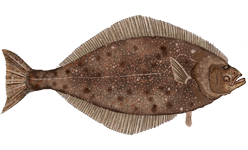
The English Sole is a right-eyed flatfish with a compressed, diamond-shaped body. It has a small head, a pointed snout and a small asymmetric mouth.[1][2][3]
Its upper surface has rough scales and is usually uniformly brown, although it can occasionally be speckled. The lower surface is smooth and white to pale yellow.[4][5]
The dorsal and ventral fin edges are dark. Its lateral line is mostly straight but curves slightly around the pectoral fin.[6][7]
Habitat
The English Sole inhabits sandy and muddy bottoms in estuaries and nearshore areas. It occurs at depths of up to 550 metres.[8][9]
Its native range extends across the eastern Pacific from Baja California to the Bering Sea.[10]
Diet
The English Sole feeds on zoobenthic organisms, including marine worms, molluscs, crustaceans and echinoderms.[11]
Behaviour
The English Sole feeds during daylight using both sight and smell. It often digs for food.[12][13]
Uses
The English Sole is an important commercial fish. Commercial fishing of the species in the eastern Pacific has been conducted almost exclusively by trawler since 1876.[14][15]
The commercial fishery operates along the United States West Coast off Washington, Oregon and California. A second commercial fishery operates in the Bering Sea off Alaska.[16][17]
The species is commonly harvested commercially off the Washington coast using otter trawls. Longline gear is also occasionally used.[18][19]
Conservation
The biomass of the English Sole has been increasing while catches have declined since the 1960s. Most recent commercial take occurs as bycatch in the West Coast fishery.[20][21]
Exploitation has been low in the Bering Sea and Aleutian Islands region since 1997. It has also remained low on the United States West Coast for approximately 30 years.[22][23]
Bottom trawls cause minimal habitat damage when used to target English Sole, according to NOAA.[24]
Similar species
The true lemon sole is a separate species identified as Microstomus kitt. The English Sole hybridizes with the starry flounder, Platichthys stellatus.[25][26]
The hybrid between English Sole and Platichthys stellatus is called Inopsetta ischyra. It has been reported from the Bering Sea south to San Francisco, California, USA.[27][28]
Classification of the English Sole
| Kingdom | Animalia |
|---|---|
| Phylum | Chordata |
| Subphylum | Vertebrata |
| Infraphylum | Gnathostomata |
| Parvphylum | Osteichthyes |
| Gigaclass | Actinopterygii |
| Superclass | Actinopteri |
| Class | Teleostei (Teleost) |
| Order | Pleuronectiformes |
| Suborder | Pleuronectoidei |
| Family | Pleuronectidae (Dabs) |
| Subfamily | Pleuronectinae |
| Genus | Parophrys |
| Species | Parophrys vetulus Girard, 1854 |
Where the English Sole is found
Checklists and occurrence records place Parophrys vetulus in 3 countries. GBIF holds 175,217 georeferenced records of it.
Countries
Regions and cities with the most records
- Richmond, Canada 534
- Vancouver, Canada 493
- West Vancouver, Canada 417
- Riley Park, Canada 400
- North Vancouver, Canada 390
- Courtenay, Canada 383
- Victoria-Fraserview, Canada 335
- Central Saanich, Canada 232
- Campbell River, Canada 208
- Saanich, Canada 200
- Burnaby, Canada 185
- Delta, Canada 175
- Nanaimo, Canada 163
- British Columbia, Canada 156
- Harewood, Canada 137
- California, United States 121
- New Westminster, Canada 119
- Oak Bay, Canada 119
- Victoria, Canada 113
- Port Moody, Canada 112
- Esquimalt, Canada 111
- Coquitlam, Canada 109
- El Cerrito, United States 109
- San Francisco, United States 108
- Albany, United States 105
- Bayview-Hunters Point, United States 105
- Port Coquitlam, Canada 105
- Hermosa Beach, United States 103
- Redondo Beach, United States 100
- Manhattan Beach, United States 96
- Duncan, Canada 95
- El Segundo, United States 95
- Washington, United States 95
- Torrance, United States 93
- Berkeley, United States 92
- Oakland, United States 91
A number beside a place is its count of GBIF occurrence records. A place without a number comes from a checklist alone. Records show where a species has been observed or collected, which can include escapes and vagrants.
Common names
English
- English Sole
- Sole (hybrid)
Names in 4 other languages
- Chinese
- 副眉鰈
- French
- carlottin anglais, sole anglaise
- Russian
- Английский морской язык, Парофрис
- Spanish
- platija limón
Synonyms
6 other scientific names have been used for this species and are now treated as synonyms of Parophrys vetulus.
- Inopsetta ischyra (Jordan & Gilbert, 1880)
- Parophrys hubbardii Gill, 1862
- Parophrys ischyrus Jordan & Gilbert, 1880
- Parophrys vetula Girard, 1854
- Pleuronectes digrammus Günther, 1862
- Pleuronectes vetulus (Girard, 1854)
Related species
-
 European PlaicePleuronectes platessa
-
 Atlantic HalibutHippoglossus hippoglossus
-
 Pacific HalibutHippoglossus stenolepis
-
 Greenland HalibutReinhardtius hippoglossoides
-
 Lemon SoleMicrostomus kitt
-
 European FlounderPlatichthys flesus
-
 Common DabLimanda limanda
-
 Petrale SoleEopsetta jordani
Compare
Questions and answers
What is the scientific name of the English Sole?
The scientific name of the English Sole is Parophrys vetulus. Written with its author, the full name is Parophrys vetulus Girard, 1854.
Which family does the English Sole belong to?
Parophrys vetulus belongs to the family Pleuronectidae, in the order Pleuronectiformes and the class Teleostei.
Where is the English Sole found?
Checklists and occurrence records place Parophrys vetulus in 3 countries: Canada, United States and Mexico.
What is the conservation status of the English Sole?
The IUCN Red List category recorded for Parophrys vetulus is Least Concern (LC).
What other names does the English Sole have?
Parophrys vetulus is also known in English as Sole (hybrid).
Sources
Passages the profile rests on
- The English sole is a right-eyed flatfish. Source passage: “The English sole is a right-eyed flatfish” — English Wikipedia
- Its body is compressed and diamond-shaped. Source passage: “with a compressed, diamond-shaped body” — English Wikipedia
- The species has a small head with a pointed snout and a small asymmetric mouth. Source passage: “a small head with a pointed snout and small, asymmetric mouth.” — English Wikipedia
- The upper surface of the English sole has rough scales and is usually uniformly brown, although it can occasionally be speckled. Source passage: “The upper surface is covered in rough scales and is usually uniformly brown, but occasionally speckled;” — English Wikipedia
- The lower surface is smooth and white to pale yellow. Source passage: “the lower surface is smooth, and white to pale yellow in colour.” — English Wikipedia
- The dorsal and ventral fin edges are dark. Source passage: “The dorsal and ventral fin edges are dark.” — English Wikipedia
- The lateral line is mostly straight but curves slightly around the pectoral fin. Source passage: “The lateral line is mostly straight, but curves slightly around the pectoral fin.” — English Wikipedia
- The English sole inhabits sandy and muddy bottoms in estuaries and nearshore areas. Source passage: “It is a demersal fish that lives on sandy and muddy bottoms in estuaries and near shore areas” — English Wikipedia
- The species occurs at depths of up to 550 metres. Source passage: “at depths of up to 550 metres (1,800 ft).” — English Wikipedia
- The native range of the English sole extends across the eastern Pacific from Baja California to the Bering Sea. Source passage: “Its native habitat is the eastern Pacific, stretching from the coast of Baja California in the south to the Bering Sea in the north.” — English Wikipedia
- The English sole feeds on zoobenthic organisms, including marine worms, molluscs, crustaceans and echinoderms. Source passage: “The diet of the English sole consists of zoobenthos organisms, primarily marine worms, molluscs, crustaceans and echinoderms.” — English Wikipedia
- The English sole feeds during daylight using both sight and smell. Source passage: “English sole feed by day, using both sight and smell” — English Wikipedia
- The species often digs for food. Source passage: “and often dig for food.” — English Wikipedia
- The English sole is an important commercial fish. Source passage: “The English sole is an important commercial fish” — English Wikipedia
- Commercial fishing of the English sole in the eastern Pacific has been conducted almost exclusively by trawler since 1876. Source passage: “has been fished in the Eastern Pacific, almost exclusively by trawler, since 1876.” — English Wikipedia
- The commercial fishery for English sole operates along the United States West Coast off Washington, Oregon and California. Source passage: “one on the West Coast of the United States, off Washington, Oregon and California” — English Wikipedia
- A second commercial fishery for the species operates in the Bering Sea off Alaska. Source passage: “and one in the Bering Sea off Alaska.” — English Wikipedia
- The English sole is commonly harvested commercially off the Washington coast using otter trawls. Source passage: “Commonly caught off the Washington coast by commercial harvesters using otter-trawls” — wdfw.wa.gov
- Longline gear is also occasionally used to harvest English sole off Washington. Source passage: “and occasionally by longline gear.” — wdfw.wa.gov
- The biomass of the English sole has been increasing while catches have declined since the 1960s. Source passage: “Although biomass is increasing, catches have been steadily decreasing since the 1960s” — English Wikipedia
- Most recent commercial take of English sole occurs as bycatch in the West Coast fishery. Source passage: “and most take occurs as bycatch.” — English Wikipedia
- Exploitation of the English sole has been low in the Bering Sea and Aleutian Islands region since 1997. Source passage: “the level of exploitation of this species has been low since 1997 within the Bering Sea and Aleutian Islands region” — English Wikipedia
- Exploitation of the English sole has remained low on the United States West Coast for approximately 30 years. Source passage: “while it has been low for approximately 30 years on the West Coast of the United States” — English Wikipedia
- Bottom trawls cause minimal habitat damage when used to target English sole, according to NOAA. Source passage: “Bottom trawls cause minimal damage to habitat when targeting English sole” — fisheries.noaa.gov
- The true lemon sole is a separate species identified as Microstomus kitt. Source passage: “the true lemon sole is a separate species, Microstomus kitt.” — English Wikipedia
- The English sole hybridizes with the starry flounder, Platichthys stellatus. Source passage: “Hybridizes with Platichthys stellatus” — fishbase.se
- The hybrid between English sole and Platichthys stellatus is called Inopsetta ischyra. Source passage: “the hybrid, called Inopsetta ischyra” — fishbase.se
- The hybrid Inopsetta ischyra has been reported from the Bering Sea south to San Francisco, California, USA. Source passage: “may be found from the Bering Sea to San Francisco, California, USA.” — fishbase.se
Data
- Catalogue of Life, 2026-10-16 XR cc by
- Global Biodiversity Information Facility CC BY 4.0
- Wikidata CC0
- GeoNames CC BY 4.0
- Wikimedia Commons per image; credit shown with each image
- Within the Catalogue of Life, this name comes from World Register of Marine Species cc by
References
- Girard, C. F. (1854). Descriptions of new fishes, collected by Dr. A. L. Heermann, naturalist attached to the survey of the Pacific railroad route, under Lieut. R. S. Williamson, U. S. A. Proceedings of the Academy of Natural Sciences of Philadelphia, v. 7: 129–140. where the name was published
This species in other databases
- Catalogue of Life 4DRYX
- Wikidata Q2845287
- iNaturalist 117545
- WoRMS urn:lsid:marinespecies.org:taxname:254393
- ITIS 172921
Page built on 26 November 2026. See how the catalog is made and all sources and licences.
Cite this page
ScientificNames.org. (2026). Parophrys vetulus (English Sole). Retrieved November 26, 2026, from https://scientificnames.org/species/parophrys-vetulus
“Parophrys vetulus (English Sole).” ScientificNames.org, 2026, scientificnames.org/species/parophrys-vetulus. Accessed 26 Nov. 2026.
ScientificNames.org. “Parophrys vetulus (English Sole).” Accessed November 26, 2026. https://scientificnames.org/species/parophrys-vetulus.
@misc{scientificnames_parophrys_vetulus_english_sole,
  author = {{ScientificNames.org}},
  title = {Parophrys vetulus (English Sole)},
  year = {2026},
  url = {https://scientificnames.org/species/parophrys-vetulus},
  note = {Accessed 2026-11-26}
}