Species · Fishes
Pyramidnose Armored Searobin Peristedion ecuadorense
The scientific name of the Pyramidnose Armored Searobin is Peristedion ecuadorense. It is a species of fish in the family Peristediidae (armored gurnards), order Perciformes. The name dates from 1961.
- Scientific name
- Peristedion ecuadorense Teague, 1961
- Common name
- Pyramidnose Armored Searobin
- Genus
- Peristedion
- Family
- Peristediidae (Armored Gurnards)
- Order
- Perciformes
- Class
- Teleostei
- Red List category
- LC Least Concern
- Environment
- marine
- Recorded in
- 10 countries
- Name status
- accepted in the Catalogue of Life
Overview
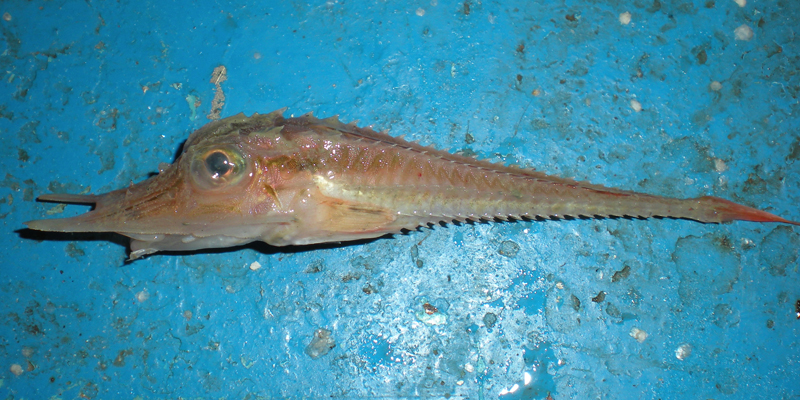
The recorded geographic range includes equatorial, tropical, and subtropical waters between 0° and 35° north latitude. It has a flattened, armored head and lower body, a broad triangular snout, and multiple lip and chin barbels.
Written 28 November 2026 from the sources listed below. Each statement was checked against the passage it cites; statements that could not be supported were removed.
Appearance
The species has a flattened head and lower body covered by four rows of bony, spiny scales. Its head is very wide and moderately depressed, with a long, very broad snout.[1][2]
The bony rim along the sides of its head is wide and undulating, ending in a broad triangle that may be rounded. Its rostral plates are very short, very broad, and triangular. It lacks a spine at the nostril but has a strong spine at the base of its snout plates.[3][4][5]
It has one long filamentous lip barbel and five additional lip barbels arranged in three clusters. Its 11–13 chin barbels are arranged in four to five clusters.[6][7]
Its gill rakers number 3–4 on one portion and 23–24 on the other. Its dorsal fin is divided into separate spiny and soft portions, with eight spines and 16–19 soft rays. Its anal fin has no spines and contains 18–21 rays.[8][9][10]
Its pelvic fins are widely separated, positioned below the pectoral-fin bases, and have one spine and five rays. The front edge of its first spiny plate beneath the belly lies behind the front edge of the bony pelvic girdle.[11][12]
Its head and body are reddish with yellow-brown blotches. The outer halves of both dorsal fins and the pectoral fin are black.[13][14]
Habitat
The species is associated with muddy soft-bottom habitats.[15]
Diet
Its recorded food includes mobile benthic worms and mobile benthic crustaceans such as shrimps and crabs.[16][17]
Classification of the Pyramidnose Armored Searobin
| Kingdom | Animalia |
|---|---|
| Phylum | Chordata |
| Subphylum | Vertebrata |
| Infraphylum | Gnathostomata |
| Parvphylum | Osteichthyes |
| Gigaclass | Actinopterygii |
| Superclass | Actinopteri |
| Class | Teleostei (Teleost) |
| Order | Perciformes |
| Suborder | Scorpaenoidei |
| Family | Peristediidae (Armored Gurnards) |
| Genus | Peristedion |
| Species | Peristedion ecuadorense Teague, 1961 |
Where the Pyramidnose Armored Searobin is found
Checklists and occurrence records place Peristedion ecuadorense in 10 countries. GBIF holds 175 georeferenced records of it.
Countries
- Brazil 7
- Colombia 10
- French Guiana 11
- Honduras 4
- Nicaragua 8
- Panama 6
- Suriname 14
- Trinidad and Tobago 3
- United States 109
- Venezuela 3
A number beside a place is its count of GBIF occurrence records. A place without a number comes from a checklist alone. Records show where a species has been observed or collected, which can include escapes and vagrants.
Common names
English
- Pyramidnose Armored Searobin
Names in 4 other languages
- Czech
- brňák ekvádorský
- Japanese
- エビキホウボウ
- Portuguese
- Falso-voador-de-chifre-caribenho
- Spanish
- Vaquita de Belice
Synonyms
One other scientific name has been used for this species and is now treated as a synonym of Peristedion ecuadorense.
- Peristedion ecuadorensis Teague, 1961
Related species
-
 Armed GurnardPeristedion cataphractum
-
 Alligator Armored SearobinPeristedion greyae
-
 Flathead Armored SearobinPeristedion brevirostre
-
 Slender SearobinPeristedion gracile
-
 Armoured SearobinPeristedion miniatum
-
 Armoured GurnardPeristedion liorhynchus
-
 Peristedion altipinne
- Peristedion barbiger
Compare
Questions and answers
What is the scientific name of the Pyramidnose Armored Searobin?
The scientific name of the Pyramidnose Armored Searobin is Peristedion ecuadorense. Written with its author, the full name is Peristedion ecuadorense Teague, 1961.
Which family does the Pyramidnose Armored Searobin belong to?
Peristedion ecuadorense belongs to the family Peristediidae, in the order Perciformes and the class Teleostei.
Where is the Pyramidnose Armored Searobin found?
Checklists and occurrence records place Peristedion ecuadorense in 10 countries, including United States, Suriname, French Guiana, Colombia, Nicaragua and Brazil.
What is the conservation status of the Pyramidnose Armored Searobin?
The IUCN Red List category recorded for Peristedion ecuadorense is Least Concern (LC).
Where is the Pyramidnose Armored Searobin recorded?
Its recorded geographic range includes tropical waters between 10° and 23° north latitude, equatorial waters between 0° and 10° north latitude, and subtropical waters between 23° and 35° north latitude. It is recorded in the Greater Caribbean, where it is classified as non-endemic.[18][19][20][21]
Sources
Passages the profile rests on
- The species has a flattened head and lower body covered by four rows of bony, spiny scales. Source passage: “Head and body flattened below, body completely covered in a heavy armor of 4 rows of bony spiny scales” — biogeodb.stri.si.edu
- Its head is very wide and moderately depressed, with a long, very broad snout. Source passage: “head very wide, moderately depressed, snout long and very broad” — biogeodb.stri.si.edu
- The bony rim along the sides of its head is wide and undulating, ending in a broad triangle that may be rounded. Source passage: “bony rim around sides of head edge wide, undulating edge, ending in a broad triangle that may be rounded” — biogeodb.stri.si.edu
- Its rostral plates are very short, very broad, and triangular. Source passage: “rostral plates very short, very broad, triangular” — biogeodb.stri.si.edu
- The species lacks a spine at the nostril but has a strong spine at the base of its snout plates. Source passage: “no spine at nostril, strong spine at base of snout plates” — biogeodb.stri.si.edu
- It has one long filamentous lip barbel and five additional lip barbels arranged in three clusters. Source passage: “lip barbells - 1 long filamentous barbell long + 5 in 3 clusters (2,1,2)” — biogeodb.stri.si.edu
- It has 11–13 chin barbels arranged in four to five clusters. Source passage: “11-13 chin barbels in 4-5 clusters” — biogeodb.stri.si.edu
- Its gill rakers number 3–4 on one portion and 23–24 on the other. Source passage: “gill rakers 3-4+23-24” — biogeodb.stri.si.edu
- Its dorsal fin is divided into separate spiny and soft portions, with eight spines and 16–19 soft rays. Source passage: “dorsal fin divided into separate spiny and soft parts, VIII + 16-19, both parts low” — biogeodb.stri.si.edu
- Its anal fin has no spines and contains 18–21 rays. Source passage: “anal fin without spines, 18-21, fin low” — biogeodb.stri.si.edu
- Its pelvic fins are widely separated, positioned below the pectoral-fin bases, and have one spine and five rays. Source passage: “pelvic fins wide apart, below base of pectorals, I,5 rays, extremely short” — biogeodb.stri.si.edu
- The front edge of its first spiny plate beneath the belly lies behind the front edge of the bony pelvic girdle. Source passage: “front edge of first spiny plate under belly behind front edge of bony pelvic girdle.” — biogeodb.stri.si.edu
- Its head and body are reddish with yellow-brown blotches. Source passage: “Head and body reddish with blotches of yellow-brown;” — biogeodb.stri.si.edu
- The outer halves of both dorsal fins and the pectoral fin are black. Source passage: “outer half of both dorsals and of pectoral black.” — biogeodb.stri.si.edu
- The species is associated with muddy soft-bottom habitats. Source passage: “Mud Soft bottom only” — biogeodb.stri.si.edu
- Its recorded food includes mobile benthic worms. Source passage: “Mobile benthic worms” — biogeodb.stri.si.edu
- Its recorded food includes mobile benthic crustaceans such as shrimps and crabs. Source passage: “Mobile benthic crustacea (shrimps/crabs)” — biogeodb.stri.si.edu
- The species is recorded in the Greater Caribbean but is classified as non-endemic there. Source passage: “Greater Caribbean non-endemic” — biogeodb.stri.si.edu
- Its recorded geographic range includes tropical waters between 10° and 23° north latitude. Source passage: “Tropical (10-23N, Nicaragua / Cuba)” — biogeodb.stri.si.edu
- Its recorded geographic range includes equatorial waters between 0° and 10° north latitude. Source passage: “Equatorial (0-10N, Costa Rica / Venezuela)” — biogeodb.stri.si.edu
- Its recorded geographic range includes subtropical waters between 23° and 35° north latitude. Source passage: “Subtropical (23-35N, Florida / Carolinas / Bermuda)” — biogeodb.stri.si.edu
Data
- Catalogue of Life, 2026-10-16 XR cc by
- Global Biodiversity Information Facility CC BY 4.0
- Wikidata CC0
- GeoNames CC BY 4.0
- Within the Catalogue of Life, this name comes from World Register of Marine Species cc by
References
- Teague, G. W. (1961). The armored sea-robins of America, a revision of the American species of the family Peristediidae. Anales Del Museo Nacional de Historia Natural de Montevideo (Serie 2), 7 (2): 1–27, 2 pls. + Pls. 1–3. where the name was published
This species in other databases
- Catalogue of Life 76TGS
- Wikidata Q2578352
- iNaturalist 619123
- WoRMS urn:lsid:marinespecies.org:taxname:274639
- ITIS 692108
Page built on 28 November 2026. See how the catalog is made and all sources and licences.
Cite this page
ScientificNames.org. (2026). Peristedion ecuadorense (Pyramidnose Armored Searobin). Retrieved November 28, 2026, from https://scientificnames.org/species/peristedion-ecuadorense
“Peristedion ecuadorense (Pyramidnose Armored Searobin).” ScientificNames.org, 2026, scientificnames.org/species/peristedion-ecuadorense. Accessed 28 Nov. 2026.
ScientificNames.org. “Peristedion ecuadorense (Pyramidnose Armored Searobin).” Accessed November 28, 2026. https://scientificnames.org/species/peristedion-ecuadorense.
@misc{scientificnames_peristedion_ecuadorense_pyramidnose_armored_searobin,
  author = {{ScientificNames.org}},
  title = {Peristedion ecuadorense (Pyramidnose Armored Searobin)},
  year = {2026},
  url = {https://scientificnames.org/species/peristedion-ecuadorense},
  note = {Accessed 2026-11-28}
}