Species · Birds
Striated Caracara Phalcoboenus australis
The scientific name of the Striated Caracara is Phalcoboenus australis. It is a species of bird in the family Falconidae (falcons), order Falconiformes. The name dates from 1788.
- Scientific name
- Phalcoboenus australis (J. F. Gmelin, 1788)
- Common name
- Striated Caracara
- Genus
- Phalcoboenus
- Family
- Falconidae (Falcons)
- Order
- Falconiformes
- Class
- Aves
- Red List category
- NT Near Threatened
- Recorded in
- 3 countries
- Name status
- accepted in the Catalogue of Life

Overview
The Striated Caracara is a relatively large, stocky bird of prey. The species occurs in the Falkland Islands. It exhibits both scavenging and predatory feeding behaviours.
Written 26 November 2026 from the sources listed below. Each statement was checked against the passage it cites; statements that could not be supported were removed.
Appearance
The Striated Caracara is a relatively large, stocky bird of prey.[1]
Behaviour
The Striated Caracara exhibits both scavenging and predatory feeding behaviours. Immature individuals often forage in groups described as gangs.[2][3]
Resightings of banded individuals were more frequent at marine-subsidized feeding sites during austral summer than during winter. Resightings at human-subsidized feeding sites were higher during austral winter than summer.[4][5]
At least 6.1% of observed individuals moved between human-subsidized and marine-subsidized sites at least once during the same winter, and at least 4.5% did so during spring. No recorded individuals moved between the two feeding sites during summer, while at least 5.4% moved between them at least once during autumn.[6][7][8][9]
Seasonal changes in food-resource availability drive short-distance seasonal movements in the studied farm-island population. The study monitored movements between two feeding areas separated by 16 km on Saunders Island.[10][11]
Reproduction and life cycle
The Striated Caracara is described as a relatively long-lived raptor. Individuals obtain adult plumage and begin breeding at approximately five years of age.[12][13][14]
Habitat
The species breeds close to seabird colonies and uses these colonies as feeding areas. It also uses anthropogenic farm sites as feeding areas.[15][16][17]
Two satellite-tagged individuals that spent summer at breeding colonies 80 km west-northwest of Saunders Island were subsequently observed at a human-subsidized site during winter.[18]
Diet
During breeding, adults feed themselves and their developing offspring on seabird eggs and nestlings. The species also consumes dead and dying adult seabirds.[19][20]
The diet includes marine and terrestrial invertebrates, as well as placentas and carrion from terrestrial livestock and marine mammals.[21][22]
Farm sites provide nutritional resources when naturally occurring marine food resources become less available.[23]
Conservation
The Striated Caracara is described as part of a globally Near-Threatened population. Improved winter survival could contribute to improving the conservation status of the studied population.[24][25]
Classification of the Striated Caracara
| Kingdom | Animalia |
|---|---|
| Phylum | Chordata |
| Subphylum | Vertebrata |
| Infraphylum | Gnathostomata |
| Parvphylum | Osteichthyes |
| Megaclass | Tetrapoda |
| Class | Aves (Bird) |
| Order | Falconiformes (Falcons) |
| Family | Falconidae (Falcons) |
| Subfamily | Polyborinae |
| Genus | Phalcoboenus |
| Species | Phalcoboenus australis (J. F. Gmelin, 1788) |
Where the Striated Caracara is found
Checklists and occurrence records place Phalcoboenus australis in 3 countries across South America. GBIF holds 5,372 georeferenced records of it.
Countries
Regions and cities with the most records
- Tierra del Fuego, Argentina 180
- Ushuaia, Argentina 101
- Stanley, Falkland Islands 86
- Punta Arenas, Chile 7
2 more countries have a few records outside this range
These countries hold a few records of Phalcoboenus australis but lie outside the range the checklists give for it. Such records are often zoo or garden specimens, museum material or vagrants, so the species is not counted as occurring there.
Range as the checklists state it
Tierra del Fuego, Staten Island, Navarino Island, and Falkland Islands
South America
A number beside a place is its count of GBIF occurrence records. A place without a number comes from a checklist alone. Records show where a species has been observed or collected, which can include escapes and vagrants.
Common names
English
- Striated Caracara
- Forster's Caracara
Names in 29 other languages
- Arabic
- كاراكارا مخطط
- Bulgarian
- Ивичеста каракара
- Catalan
- caracarà austral
- Chinese
- 條紋卡拉鷹, 红腿巨隼
- Croatian
- velika karakara
- Czech
- čimango falklandský
- Danish
- Falkland Caracara
- Dutch
- Falklandcaracara
- Esperanto
- aŭstrala karakaro
- Estonian
- randkarakaara
- Finnish
- rantakarakara
- French
- Caracara austral
- German
- Falklandkarakara, Falkland-Karakara
- Hungarian
- tűzföldi karakara
- Italian
- Caracara striato
- Japanese
- フォークランドカラカラ, ホークランドカラカラ
- Lithuanian
- Folklendinė karakara, folklandinė karakara
- Norwegian
- brungumpkarakara
- Norwegian Bokmål
- Brungumpkarakara
- Polish
- karakara falklandzka
- Portuguese
- carcará-austral, caracara-austral
- Russian
- Южная горная каракара, Южная каракара
- Serbian
- Prugasta karakara
- Slovak
- karakara červenobruchá
- Spanish
- Matamico grande, Tiuque Cordillerano Austral, Caracara austral, Carancho Austral, Carancho negro, Matamico Estriado
- Swedish
- strimkarakara
- Turkish
- Falkland Karakarası
- Ukrainian
- каракара фолклендська
- Welsh
- caracara Forster
Synonyms
2 other scientific names have been used for this species and are now treated as synonyms of Phalcoboenus australis.
- Daptrius australis (Gmelin, 1788)
- Falco australis J. F. Gmelin, 1788
Related species
-
 Mountain CaracaraPhalcoboenus megalopterus
-
 Carunculated CaracaraPhalcoboenus carunculatus
-
 White-throated CaracaraPhalcoboenus albogularis
-
 Peregrine FalconFalco peregrinus
-
 Common KestrelFalco tinnunculus
-
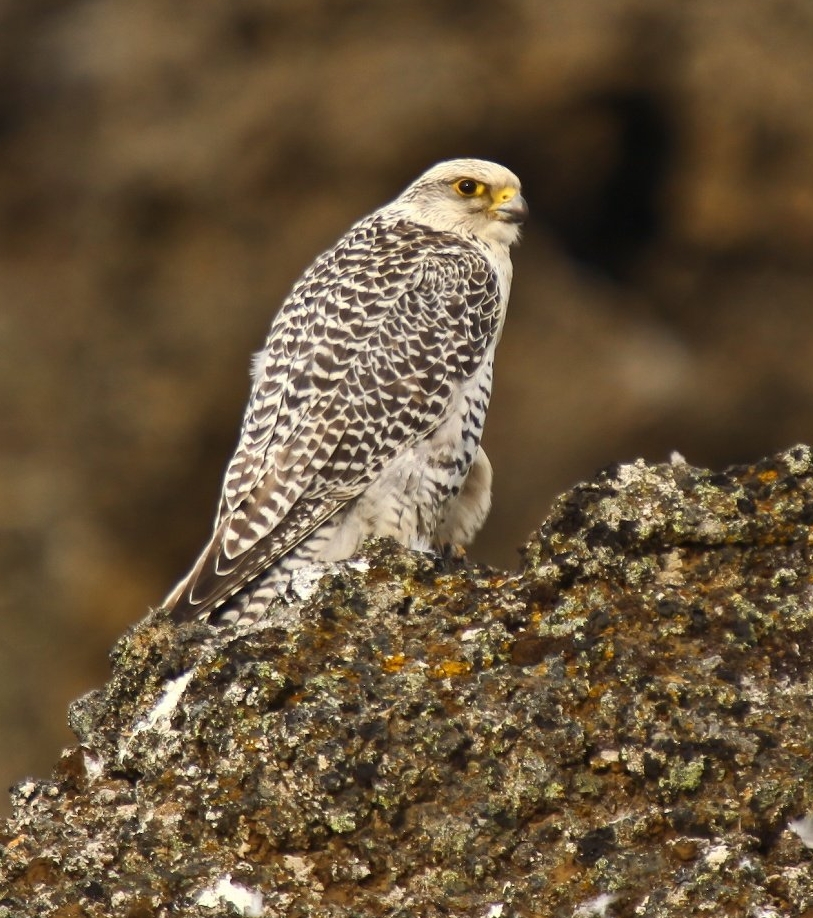 GyrfalconFalco rusticolus
-
 MerlinFalco columbarius
-
 American KestrelFalco sparverius
Compare
Questions and answers
What is the scientific name of the Striated Caracara?
The scientific name of the Striated Caracara is Phalcoboenus australis. Written with its author, the full name is Phalcoboenus australis (J. F. Gmelin, 1788).
Which family does the Striated Caracara belong to?
Phalcoboenus australis belongs to the family Falconidae, in the order Falconiformes and the class Aves.
Where is the Striated Caracara found?
Checklists and occurrence records place Phalcoboenus australis in 3 countries: Falkland Islands, Argentina and Chile.
What is the conservation status of the Striated Caracara?
The IUCN Red List category recorded for Phalcoboenus australis is Near Threatened (NT).
What other names does the Striated Caracara have?
Phalcoboenus australis is also known in English as Forster's Caracara.
How rare are caracaras?
The Striated Caracara is described as part of a globally Near-Threatened population.[24]
Sources
Passages the profile rests on
- The Striated Caracara is a relatively large, stocky bird of prey. Source passage: “Striated caracaras are relatively large, stocky, and inquisitive scavenging and predatory birds of prey (Falconiformes).” — pmc.ncbi.nlm.nih.gov
- The species exhibits both scavenging and predatory feeding behaviours. Source passage: “inquisitive scavenging and predatory birds of prey” — pmc.ncbi.nlm.nih.gov
- Immature individuals often forage in groups described as gangs. Source passage: “Before adulthood, individuals often feed in “gangs” on nutritional resources” — pmc.ncbi.nlm.nih.gov
- Resightings of banded individuals were more frequent at marine-subsidized feeding sites during austral summer than during winter. Source passage: “resightings of 312 banded caracaras were greater at the marine-subsidized site during austral summer than winter” — pmc.ncbi.nlm.nih.gov
- Resightings of individuals at human-subsidized feeding sites were higher during austral winter than summer. Source passage: “Resightings were higher at the human-subsidized site in austral winter than summer” — pmc.ncbi.nlm.nih.gov
- At least 6.1% of observed individuals moved between human-subsidized and marine-subsidized sites at least once during the same winter. Source passage: “at least 12 of 197 birds (6.1%) moved between the human- and marine-subsidized sites at least once during the same winter” — pmc.ncbi.nlm.nih.gov
- At least 4.5% of observed individuals moved between human-subsidized and marine-subsidized sites at least once during spring. Source passage: “15 of 335 birds (4.5%) did so in spring” — pmc.ncbi.nlm.nih.gov
- No recorded individuals moved between the two feeding sites during summer. Source passage: “none of 164 birds did so in summer” — pmc.ncbi.nlm.nih.gov
- At least 5.4% of observed individuals moved between the two feeding sites at least once during autumn. Source passage: “16 of 297 birds (5.4%) did so in autumn.” — pmc.ncbi.nlm.nih.gov
- Seasonal changes in food-resource availability drive short-distance seasonal movements in the studied farm-island population. Source passage: “seasonal shifts in food resource availability drive seasonal micro-migrations in a farm-island population of striated caracaras” — pmc.ncbi.nlm.nih.gov
- The study monitored movements between two feeding areas separated by 16 km on Saunders Island. Source passage: “a “marine-subsidized” site near seabird colonies and an anthropogenic “human-subsidized” farm site 16 km to the southeast.” — pmc.ncbi.nlm.nih.gov
- The Striated Caracara is described as a relatively long-lived raptor. Source passage: “Striated caracaras are relatively long-lived raptors” — pmc.ncbi.nlm.nih.gov
- Individuals obtain adult plumage at approximately five years of age. Source passage: “obtain adult plumage and begin breeding at approximately five years of age” — pmc.ncbi.nlm.nih.gov
- Individuals begin breeding at approximately five years of age. Source passage: “begin breeding at approximately five years of age” — pmc.ncbi.nlm.nih.gov
- The species breeds close to seabird colonies. Source passage: “The species breeds in close proximity to seabird colonies” — pmc.ncbi.nlm.nih.gov
- The species uses seabird colonies as feeding areas. Source passage: “a “marine-subsidized” site near seabird colonies” — pmc.ncbi.nlm.nih.gov
- The species also uses anthropogenic farm sites as feeding areas. Source passage: “an anthropogenic “human-subsidized” farm site 16 km to the southeast.” — pmc.ncbi.nlm.nih.gov
- Two satellite-tagged individuals that spent summer at breeding colonies 80 km west-northwest of Saunders Island were subsequently observed at a human-subsidized site during winter. Source passage: “Two of 6 satellite-tagged individuals that summered at known caracara breeding colonies 80 km WNW of Saunders Island were subsequently resighted in winter at the human-subsidized site.” — pmc.ncbi.nlm.nih.gov
- During breeding, adults feed themselves and their developing offspring on seabird eggs and nestlings. Source passage: “individuals feed themselves and their developing young on seabird eggs and nestlings” — pmc.ncbi.nlm.nih.gov
- The species consumes dead and dying adult seabirds. Source passage: “and on dead and dying adult seabirds” — pmc.ncbi.nlm.nih.gov
- The species consumes marine and terrestrial invertebrates. Source passage: “Striated caracaras take marine and terrestrial invertebrates” — pmc.ncbi.nlm.nih.gov
- The species feeds on placentas and carrion from terrestrial livestock and marine mammals. Source passage: “placentas and carrion of terrestrial livestock and marine mammals” — pmc.ncbi.nlm.nih.gov
- Farm sites provide nutritional resources when naturally occurring marine food resources become less available. Source passage: “farm sites can be critical in providing nutritional resources for caracaras when naturally occurring marine-subsidized resources become less available.” — pmc.ncbi.nlm.nih.gov
- The species is described as part of a globally Near-Threatened population. Source passage: “this globally Near-Threatened population” — pmc.ncbi.nlm.nih.gov
- Improved winter survival could contribute to improving the conservation status of the studied population. Source passage: “increased winter survival could improve the status of this globally Near-Threatened population.” — pmc.ncbi.nlm.nih.gov
- The species occurs in the Falkland Islands. Source passage: “in the Falkland Islands” — pmc.ncbi.nlm.nih.gov
Data
- Catalogue of Life, 2026-10-16 XR cc by
- Global Biodiversity Information Facility CC BY 4.0
- Wikidata CC0
- GeoNames CC BY 4.0
- Wikimedia Commons per image; credit shown with each image
- Within the Catalogue of Life, this name comes from The Integrated Taxonomic Information System cc0
References
- Dickinson, Edward C., ed. (2003). The Howard and Moore Complete Checklist of the Birds of the World, 3rd Edition.
- Gill, Frank, & and Minturn Wright. (2006). Birds of the World: Recommended English Names.
- Dickinson, E. C., and J. V. Remsen Jr., eds. (2013). The Howard and Moore Complete Checklist of the Birds of the World, 4th Edition, Vol. 1 Non-Passerines.
This species in other databases
Page built on 27 November 2026. See how the catalog is made and all sources and licences.
Cite this page
ScientificNames.org. (2026). Phalcoboenus australis (Striated Caracara). Retrieved November 27, 2026, from https://scientificnames.org/species/phalcoboenus-australis
“Phalcoboenus australis (Striated Caracara).” ScientificNames.org, 2026, scientificnames.org/species/phalcoboenus-australis. Accessed 27 Nov. 2026.
ScientificNames.org. “Phalcoboenus australis (Striated Caracara).” Accessed November 27, 2026. https://scientificnames.org/species/phalcoboenus-australis.
@misc{scientificnames_phalcoboenus_australis_striated_caracara,
  author = {{ScientificNames.org}},
  title = {Phalcoboenus australis (Striated Caracara)},
  year = {2026},
  url = {https://scientificnames.org/species/phalcoboenus-australis},
  note = {Accessed 2026-11-27}
}