Species · Reptiles
Gold Dust Day Gecko Phelsuma laticauda
The scientific name of the Gold Dust Day Gecko is Phelsuma laticauda. It is a species of reptile in the family Gekkonidae (geckos), order Squamata. The name dates from 1880.
- Scientific name
- Phelsuma laticauda (Boettger, 1880)
- Common name
- Gold Dust Day Gecko
- Genus
- Phelsuma
- Family
- Gekkonidae (Geckos)
- Order
- Squamata
- Class
- Reptilia
- Red List category
- LC Least Concern
- Recorded in
- 7 countries
- Name status
- accepted in the Catalogue of Life

Overview
The gold dust day gecko (Phelsuma laticauda) is a diurnal species of gecko. It lives in northern Madagascar, the Comoro Islands, and the Mascarene Islands; it has also been introduced to Hawaii and other Pacific islands. It is primarily an arboreal species which can be found in tropical forests and may also associate with human dwellings. The gold dust day gecko feeds on insects and nectar.
Classification of the Gold Dust Day Gecko
| Kingdom | Animalia |
|---|---|
| Phylum | Chordata |
| Subphylum | Vertebrata |
| Infraphylum | Gnathostomata |
| Parvphylum | Osteichthyes |
| Megaclass | Tetrapoda |
| Class | Reptilia (Reptile) |
| Order | Squamata (Snakes) |
| Suborder | Gekkota |
| Family | Gekkonidae (Geckos) |
| Genus | Phelsuma (Day Geckos) |
| Species | Phelsuma laticauda (Boettger, 1880) |
Where the Gold Dust Day Gecko is found
Checklists and occurrence records place Phelsuma laticauda in 7 countries across Africa. GBIF holds 11,001 georeferenced records of it.
Countries
Regions and cities with the most records
- Hawaii, United States 8,789
- Honolulu, United States 1,518
- Pearl City, United States 1,501
- East Honolulu, United States 1,391
- Le Tampon, Reunion 442
- Saint-Pierre, Reunion 432
- Saint-Paul, Reunion 321
- Makakilo / Kapolei / Honokai Hale, United States 289
- Saint-Louis, Reunion 264
- Saint-Denis, Reunion 259
- Mamoudzou, Mayotte 181
- Hell-Ville, Madagascar 147
- Saint-André, Reunion 112
- Chirongui, Mayotte 48
- Mamoudzou, Mayotte 38
- Anjouan, Comoros 30
- Dzaoudzi, Mayotte 20
- M'Tsangamouji, Mayotte 20
- Florida, United States 19
- Outer Islands, Seychelles 18
- Ouangani, Mayotte 17
- Sambava, Madagascar 17
- Toamasina, Madagascar 12
- Maroantsetra, Madagascar 11
- Tsingoni, Mayotte 11
- California, United States 10
- Dembeni, Mayotte 10
- Ambanja, Madagascar 9
- Bouéni, Mayotte 9
- Grande Comore, Comoros 9
- Moroni, Comoros 9
- Clearwater, United States 8
- Largo, United States 8
- Pinellas Park, United States 8
- St. Petersburg, United States 7
- Bagamoyo, Tanzania 6
2 more countries have a few records outside this range
These countries hold a few records of Phelsuma laticauda but lie outside the range the checklists give for it. Such records are often zoo or garden specimens, museum material or vagrants, so the species is not counted as occurring there.
Range as the checklists state it
Madagascar, Comores (Mayotte) = Comoro Island, Nossi Be = Nosy Bé, Seychelles, Nosy Mitsio, Nosy Komba
A number beside a place is its count of GBIF occurrence records. A place without a number comes from a checklist alone. Records show where a species has been observed or collected, which can include escapes and vagrants.
Common names
English
- Gold Dust Day Gecko
- Broad-tailed Day Gecko
- Gold-dust Day Gecko
Names in 12 other languages
- Chinese
- 馬達加斯加金粉守宮
- Czech
- felsuma zlatoocasá
- Danish
- Guldstøvdaggekko
- Dutch
- Goudstofdaggekko
- French
- Gecko diurne à poussière d'or, Gecko vert à trois tâches rouges
- German
- Goldstaub Taggecko, Goldstaub-Taggecko
- Hungarian
- aranyporos nappaligekkó
- Italian
- Felsuma dalla coda larga, Geco diurno dalla coda larga
- Japanese
- ヒロオヒルヤモリ
- Polish
- Felsuma gruboogonowa
- Russian
- Коморский дневной геккон, Плоскохвостая фельзума, Плоскохвостый мадагаскарский геккон
- Spanish
- Geco Diurno de Polvo Dorado
Synonyms
One other scientific name has been used for this species and is now treated as a synonym of Phelsuma laticauda.
- Pachydactylus laticauda Boettger, 1880
Subspecies and varieties
- Phelsuma laticauda angularis subspecies
- Phelsuma laticauda laticauda subspecies
Related species
-
 Madagascar Giant Day GeckoPhelsuma grandis
-
 Mauritius Ornate Day GeckoPhelsuma ornata
-
 Yellow-headed Day GeckoPhelsuma klemmeri
-
 Blue-tailed Day GeckoPhelsuma cepediana
-
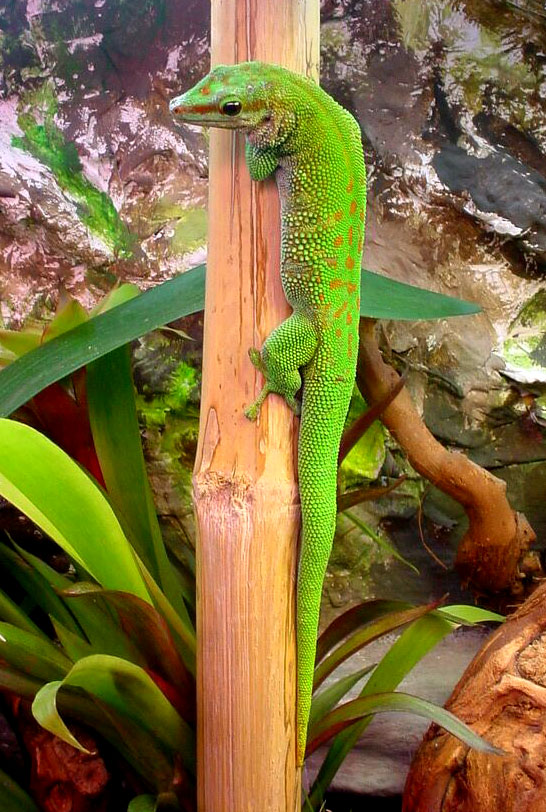 Madagascar Day GeckoPhelsuma madagascariensis
-
 Standing's Day GeckoPhelsuma standingi
-
 Rodrigues Giant Day GeckoPhelsuma gigas
- Mauritius Lowland Forest Day GeckoPhelsuma guimbeaui
Compare
Questions and answers
What is the scientific name of the Gold Dust Day Gecko?
The scientific name of the Gold Dust Day Gecko is Phelsuma laticauda. Written with its author, the full name is Phelsuma laticauda (Boettger, 1880).
Which family does the Gold Dust Day Gecko belong to?
Phelsuma laticauda belongs to the family Gekkonidae, in the order Squamata and the class Reptilia.
Where is the Gold Dust Day Gecko found?
Checklists and occurrence records place Phelsuma laticauda in 7 countries, including United States, Reunion, Madagascar, Mayotte, Comoros and Seychelles.
What is the conservation status of the Gold Dust Day Gecko?
The IUCN Red List category recorded for Phelsuma laticauda is Least Concern (LC).
What other names does the Gold Dust Day Gecko have?
Phelsuma laticauda is also known in English as Broad-tailed Day Gecko and Gold-dust Day Gecko.
Sources
Data
- Catalogue of Life, 2026-10-16 XR cc by
- Global Biodiversity Information Facility CC BY 4.0
- Wikidata CC0
- English Wikipedia CC BY-SA 4.0
- GeoNames CC BY 4.0
- Wikimedia Commons per image; credit shown with each image
- Within the Catalogue of Life, this name comes from The Reptile Database cc by
References
- Boettger, O. (1880). Diagnoses reptilium et batrachiorum novorum a Carolo Ebenau in insula Nossi-Bé Madagascariensi lectorum. Zool. Anz. 3: 279—283.
- Boulenger, G. A. (1885). Catalogue of the lizards in the British Museum (Nat. Hist.) I. Geckonidae, Eublepharidae, Uroplatidae, Pygopodidae, Agamidae. London: 450 Pp.
- Barbour, & Thomas. (1918). Vertebrata from Madagascar. 2. Amphibia and Reptilia. Bull. Mus. Comp. Zool. Harvard 61 (14): 479-489.
- Loveridge, A. (1920). Notes on East African lizards collected 1915-1919, with description of a new genus and species of skink and new subspecies of gecko. Proc. Zool. Soc. London 1920: 131-167.
- Mertens, R. (1962). Die Arten und Unterarten der Geckonengattung Phelsuma. Senckenbergiana Biologica 43: 81-127.
- Mertens, R. (1964). Fünf neue Rassen der Geckonengattung Phelsuma. Senckenbergiana Biologica 45: 99-112.
- Mertens, R. (1967). Die herpetologische Sektion des Natur-Museums und Forschungs-Institutes Senckenberg in Frankfurt am Main nebst einem Verzeichnis ihrer Typen. Senckenbergiana Biologica 48: 1-106.
- Meier H. (1980). Zur Taxonomie und Okologie der Gattung Phelsuma (Reptilia: Sauria: Gekkonidae) auf den Komoren, mit Beschreibung einer neuen Art. Bonner Zoologische Beiträge 31 (3-4): 323-332.
- Heselhaus, R. (1980). Phelsumen im Terrarium. Herpetofauna 2 (4): 9-10.
- Oostveen, H. (1980). Phelsuma’s: steeds kleine wonderen. Lacerta 38 (10-11): 98-101.
- Denzer, W. (1981). Phelsumen - Haltung und Nachzucht im Terrarium. Sauria 3 (1): 23-26.
- Meier, H. (1982). Ergebnisse zur Taxonomie und Ökologie einiger Arten und Unterarten der Gattung Phelsuma auf Madagaskar, gesammelt in den Jahren 1972 bis 1981, mit Beschreibung einer neuen Form (Reptilia: Sauria: Gekkonidae). Salamandra 18 (3-4): 168—190.
- Gardner, A. S. (1985). An identification key to the geckos of the Seychelles, with brief notes on their distributions and habits. The Herpetological Journal 1 (1): 17-19.
- Frank, & Ronald. (1988). De goudstofdaggekko (Phelsuma laticauda); verzorging en kweek in terraria. Lacerta 47 (1): 7-14.
- Glaw, F., & Vences, M. (1994). A Fieldguide to the Amphibians and Reptiles of Madagascar. Vences & Glaw Verlag, Köln (ISBN 3-929449-01-3).
- Mckeown, & Sean. (1996). A Field Guide to Reptiles and Amphibians in the Hawaiian Islands. Diamond Head Publishing, Inc., Los Osos, CA,.
- Budzinski, R.-M. (1997). Homosexuelles Verhalten bei Geckos der Gattung Phelsuma. Sauria 19 (3): 33-34.
- PROBST, J-M. (1997). Animaux de La Réunion - guide d’identification des oiseaux, mammifères, reptiles et amphibiens. Edit. Azalées, 168 Pp.
- TURPIN, A., & PROBST, J. M. (1997). Nouvelle répartition du gecko vert malgache Phelsuma laticauda dans l’ouest de l’île de la Réunion. Bulletin Phaethon. 5 : 3-4.
- Krüger, & Jens. (1999). Neue Erkenntnisse zur Faunistik einiger Reptilien Madagaskars. Salamandra 35 (2): 65-76.
- Meirte, D. (1999). In: Louette,M., La faune terrestre de Mayotte. Annales Sciences Zoologiques, Musée Royal de l’Afrique Centrale, Tervuren, Belgique 284: 247 Pp.
- Budzinski, R.-M. (1999). Induktion des männlichen Geschlechts bei Geckos der Gattung Phelsuma durch tägliche kurzzeitige Inkubation bei hoher Temperatur. Sauria 21 (3): 43-46.
- Rösler, H. (2000). Kommentierte Liste der rezent, subrezent und fossil bekannten Geckotaxa (Reptilia: Gekkonomorpha). Gekkota 2: 28-153.
- Rösler, & Herbert. (2001). Zur Rumpfbeschuppung der Gattung Phelsuma GRAY 1825: zoogeographische Aspekte (Sauria: Gekkonidae). Gekkota 3: 47-73.
- ANDREONE F., F. GLAW, R. A. NUSSBAUM, C. J. RAXWORTHY, M. VENCES, and J. E. RANDRIANIRINA. (2003). The amphibians and reptiles of Nosy Be (NW Madagascar) and nearby islands: a case study of diversity and conservation of an insular fauna. Journal of Natural History 37 (17): 2119–2149.
This species in other databases
Page built on 25 November 2026. See how the catalog is made and all sources and licences.
Cite this page
ScientificNames.org. (2026). Phelsuma laticauda (Gold Dust Day Gecko). Retrieved November 25, 2026, from https://scientificnames.org/species/phelsuma-laticauda
“Phelsuma laticauda (Gold Dust Day Gecko).” ScientificNames.org, 2026, scientificnames.org/species/phelsuma-laticauda. Accessed 25 Nov. 2026.
ScientificNames.org. “Phelsuma laticauda (Gold Dust Day Gecko).” Accessed November 25, 2026. https://scientificnames.org/species/phelsuma-laticauda.
@misc{scientificnames_phelsuma_laticauda_gold_dust_day_gecko,
  author = {{ScientificNames.org}},
  title = {Phelsuma laticauda (Gold Dust Day Gecko)},
  year = {2026},
  url = {https://scientificnames.org/species/phelsuma-laticauda},
  note = {Accessed 2026-11-25}
}