Species · Reptiles
Standing's Day Gecko Phelsuma standingi
The scientific name of the Standing's Day Gecko is Phelsuma standingi. It is a species of reptile in the family Gekkonidae (geckos), order Squamata. The name dates from 1913.
- Scientific name
- Phelsuma standingi Methuen & Hewitt, 1913
- Common name
- Standing's Day Gecko
- Genus
- Phelsuma
- Family
- Gekkonidae (Geckos)
- Order
- Squamata
- Class
- Reptilia
- Red List category
- VU Vulnerable
- Recorded in
- 1 country
- Name status
- accepted in the Catalogue of Life

Overview
Phelsuma standingi inhabits arid environments in southwest Madagascar, including deciduous dry forests and dense thorn forest vegetation. Adults have brownish-grey, bright-green, or turquoise coloration with grey-to-blue reticulated markings, and their coloration helps them blend into their surroundings.
Written 26 November 2026 from the sources listed below. Each statement was checked against the passage it cites; statements that could not be supported were removed.
Habitat
Standing's Day Gecko inhabits arid environments in southwest Madagascar, including deciduous dry forests and dense thorn forest vegetation. It is primarily adapted to living in baobab trees.[1][2]
Its distribution is restricted to southwest Madagascar, particularly the areas around Andranolaho, Sakaraha, and Zombitse-Vohibasia National Park.[3]
Appearance
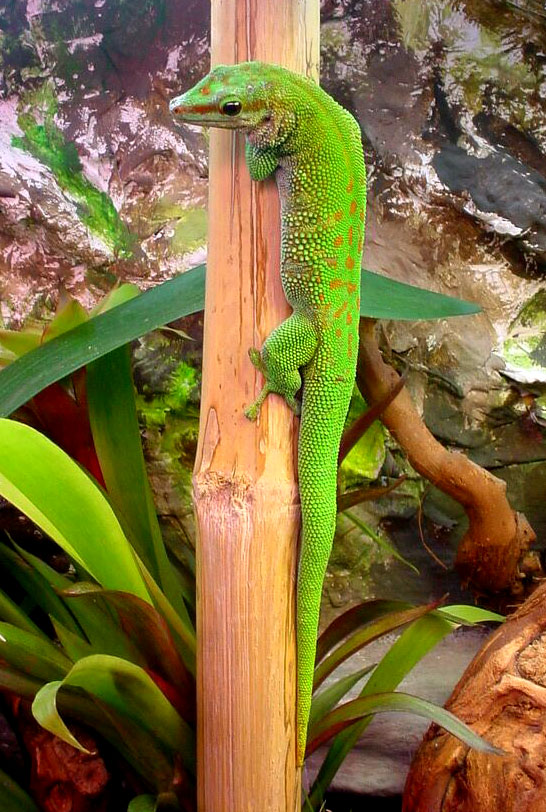
Adults can have brownish-grey, bright-green, or turquoise body coloration with grey-to-blue reticulated markings. The head and tail are often turquoise.[4][5]
Adults are also mottled pale blue or blue-green, resembling the coloration of bark in their habitat. Their coloration helps them blend into their surroundings and avoid predator attacks.[6][7]
Hatchlings have yellowish-green heads and light bands and bars on their backs.[8]
The species can reach a total length of 20–25.4 cm, including its tail, although larger individuals are possible. Adults weigh approximately 40–80 g.[9][10]
Diet
Standing's Day Gecko consumes insects, other invertebrates, and smaller lizards. Its diet also includes soft sweet fruit, pollen, and nectar.[11][12]
Behaviour
Standing's Day Gecko is arboreal and diurnal. Individuals live in pairs on trees and frequently bask on exposed upper branches.[13][14]
Males are highly territorial and fight when other males are present. Females also exhibit territorial behaviour toward other females.[15][16]
Individuals sometimes produce clicks, squeaks, and croaks.[17]
Reproduction and life cycle
Standing's Day Gecko is oviparous. The breeding season extends from November through March, and females lay one or two eggs every four to six weeks.[18][19][20]
At an incubation temperature of 28 °C, eggs hatch after approximately 60–70 days. Eggs also have a reported hatching period of approximately 70 days.[21][22]
Juveniles measure approximately 80 mm and reach sexual maturity after one year. Neither parent provides parental care.[23][24]
Females commonly have two well-developed endolymphatic chalk sacs on either side of the neck, whereas these structures are usually barely visible in males. The sacs store calcium required for eggshell formation.[25][26]
Conservation
Standing's Day Gecko is threatened by illegal collection for the international pet trade and habitat loss. Habitat loss, degradation, and fragmentation are major threats, and there are documented cases of illegal harvesting for the pet trade.[27][28][29]
Classification of the Standing's Day Gecko
| Kingdom | Animalia |
|---|---|
| Phylum | Chordata |
| Subphylum | Vertebrata |
| Infraphylum | Gnathostomata |
| Parvphylum | Osteichthyes |
| Megaclass | Tetrapoda |
| Class | Reptilia (Reptile) |
| Order | Squamata (Snakes) |
| Suborder | Gekkota |
| Family | Gekkonidae (Geckos) |
| Genus | Phelsuma (Day Geckos) |
| Species | Phelsuma standingi Methuen & Hewitt, 1913 |
Where the Standing's Day Gecko is found
Checklists and occurrence records place Phelsuma standingi in 1 country. GBIF holds 366 georeferenced records of it.
Countries
Regions and cities with the most records
Range as the checklists state it
SW Madagascar
A number beside a place is its count of GBIF occurrence records. A place without a number comes from a checklist alone. Records show where a species has been observed or collected, which can include escapes and vagrants.
Common names
English
- Standing's Day Gecko
- Banded Day Gecko
Names in 10 other languages
- Chinese
- 雲石日行守宮
- Czech
- felsuma Standingova
- Danish
- Grønhovedet Daggekko
- Dutch
- Standing daggekko
- French
- Gecko Diurne De Standing, Phelsume De Standing
- German
- Querstreifen-Taggecko
- Hungarian
- Standing-nappaligekkó
- Japanese
- スタンディングヒルヤモリ
- Russian
- Фельзума Стандинга
- Spanish
- Geco Diurno De Standing
Synonyms
One other scientific name has been used for this species and is now treated as a synonym of Phelsuma standingi.
- Phelsuma standini Methuen & Hewitt, 1913
Related species
-
 Gold Dust Day GeckoPhelsuma laticauda
-
 Madagascar Giant Day GeckoPhelsuma grandis
-
 Mauritius Ornate Day GeckoPhelsuma ornata
-
 Yellow-headed Day GeckoPhelsuma klemmeri
-
 Blue-tailed Day GeckoPhelsuma cepediana
-
 Madagascar Day GeckoPhelsuma madagascariensis
-
 Rodrigues Giant Day GeckoPhelsuma gigas
- Mauritius Lowland Forest Day GeckoPhelsuma guimbeaui
Compare
Questions and answers
What is the scientific name of the Standing's Day Gecko?
The scientific name of the Standing's Day Gecko is Phelsuma standingi. Written with its author, the full name is Phelsuma standingi Methuen & Hewitt, 1913.
Which family does the Standing's Day Gecko belong to?
Phelsuma standingi belongs to the family Gekkonidae, in the order Squamata and the class Reptilia.
Where is the Standing's Day Gecko found?
Checklists and occurrence records place Phelsuma standingi in 1 country: Madagascar.
What is the conservation status of the Standing's Day Gecko?
The IUCN Red List category recorded for Phelsuma standingi is Vulnerable (VU).
What other names does the Standing's Day Gecko have?
Phelsuma standingi is also known in English as Banded Day Gecko.
What is the average lifespan of a Standing's day gecko?
The reported lifespan is five years in the wild and twelve years in zoos. In captivity, appropriately cared-for individuals can live up to 15–20 years.[30][31]
What do standing day geckos eat?
They consume insects, other invertebrates, smaller lizards, soft sweet fruit, pollen, and nectar.[11][12]
Sources
Passages the profile rests on
- The species inhabits arid environments in southwest Madagascar, including deciduous dry forests and dense thorn forest vegetation. Source passage: “Standing’s day geckos are arboreal species and live in arid environments such as deciduous dry forests and dense scrub-like vegetation, known as thorn forest.” — henryvilaszoo.gov
- The species is primarily adapted to living in baobab trees. Source passage: “They are primarily adapted to live in baobab trees.” — henryvilaszoo.gov
- The species is restricted to southwest Madagascar, particularly the areas around Andranolaho, Sakaraha, and Zombitse-Vohibasia National Park. Source passage: “P. standingi is restricted to the arid southwest of Madagascar, specifically the region around Andranolaho, Sakaraha and in the Zombitse-Vohibasia National Park.” — English Wikipedia
- Adults can have brownish-grey, bright-green, or turquoise body coloration with grey-to-blue reticulated markings. Source passage: “It can be brownish grey or bright green or turquoise with grey to blue reticulated markings on its body and head.” — English Wikipedia
- The head and tail are often turquoise. Source passage: “The head and tail are often turquoise.” — English Wikipedia
- Adults are mottled pale blue or blue-green, resembling the coloration of bark in their habitat. Source passage: “Adults are mottled pale blue or blue-green, similar to the bark coloration in their habitat.” — henryvilaszoo.gov
- Their coloration helps them blend into their surroundings and avoid predator attacks. Source passage: “This helps them blend into their surroundings and prevent attacks from predators.” — henryvilaszoo.gov
- Hatchlings have yellowish-green heads and light bands and bars on their backs. Source passage: “Hatchlings have a yellowish green head and typical light bands and bars on their backs.” — English Wikipedia
- The species can reach a total length of 20–25.4 cm, including its tail, although larger individuals are possible. Source passage: “It can reach a maximum total length (including tail) of 8-10″ (20-25.4cm), although larger is possible.” — English Wikipedia
- Adults weigh approximately 40–80 g. Source passage: “Weight: 1.4 – 2.8 ounces (40 – 80 g)” — henryvilaszoo.gov
- The species consumes insects, other invertebrates, and smaller lizards. Source passage: “Standing's day gecko feeds on various insects, invertebrates, and even smaller lizards.” — English Wikipedia
- Its diet also includes soft sweet fruit, pollen, and nectar. Source passage: “It is omnivorous, however, supplementing its prey with soft, sweet fruit, pollen and nectar.” — English Wikipedia
- The species is arboreal and diurnal. Source passage: “Strictly an arboreal and diurnal species” — English Wikipedia
- Individuals live in pairs on trees and frequently bask on exposed upper branches. Source passage: “P. standingi lives in pairs on trees, spending a lot of time basking in the sun on the highest and well exposed branches.” — English Wikipedia
- Males are highly territorial and fight when other males are present. Source passage: “The males are very territorial and will fight when in the presence of other males” — English Wikipedia
- Females also exhibit territorial behaviour toward other females. Source passage: “females have this character towards other females, a behavior which is rather rare in geckos.” — English Wikipedia
- Individuals sometimes produce clicks, squeaks, and croaks. Source passage: “The Standing’s day gecko will sometimes make various noises such as clicks, squeaks, and croaks.” — henryvilaszoo.gov
- The species is oviparous. Source passage: “P. standingi is oviparous.” — English Wikipedia
- The breeding season extends from November through March. Source passage: “Their breeding season lasts from November through March.” — henryvilaszoo.gov
- Females lay one or two eggs every four to six weeks. Source passage: “Females lay one or two eggs every four to six weeks” — henryvilaszoo.gov
- At an incubation temperature of 28 °C, eggs hatch after approximately 60–70 days. Source passage: “At a temperature of 28 °C (82 °F), the young will hatch after approximately 60–70 days.” — English Wikipedia
- Eggs hatch after approximately 70 days. Source passage: “and they hatch after 70 days.” — henryvilaszoo.gov
- Juveniles measure approximately 80 mm and reach sexual maturity after one year. Source passage: “The juveniles measure 80 mm and reach sexual maturity after one year.” — English Wikipedia
- Neither parent provides parental care. Source passage: “Neither the female nor the male provides parental care.” — henryvilaszoo.gov
- Females commonly have two well-developed endolymphatic chalk sacs on either side of the neck, whereas these structures are usually barely visible in males. Source passage: “In many females two endolymphatic chalk sacs, located on each side of the neck, are well-developed, while in males usually they are just barely visible.” — English Wikipedia
- The endolymphatic chalk sacs store calcium required for eggshell formation. Source passage: “These sacs store calcium, which is needed for the formation of egg shells.” — English Wikipedia
- The species is threatened by illegal collection for the international pet trade and habitat loss. Source passage: “it is threatened by illegal collection for the international pet trade and habitat loss.” — English Wikipedia
- Habitat loss, degradation, and fragmentation are major threats to the species. Source passage: “The Standing’s day gecko’s major threats include habitat loss, degradation, and fragmentation.” — henryvilaszoo.gov
- There are documented cases of the species being illegally harvested for the pet trade. Source passage: “There are also known cases of this species being illegally harvested for the pet trade.” — henryvilaszoo.gov
- In captivity, appropriately cared-for individuals can live up to 15–20 years. Source passage: “In captivity, Standing's day geckos can be expected to live up to 15-20 years when appropriately cared-for.” — English Wikipedia
- The reported lifespan is five years in the wild and twelve years in zoos. Source passage: “Life Span: 5 years (wild) / 12 years (zoo)” — henryvilaszoo.gov
Data
- Catalogue of Life, 2026-10-16 XR cc by
- Global Biodiversity Information Facility CC BY 4.0
- Wikidata CC0
- GeoNames CC BY 4.0
- Wikimedia Commons per image; credit shown with each image
- Within the Catalogue of Life, this name comes from The Reptile Database cc by
References
- Methuen, P. A. & J. Hewitt. (1913). On a collection of reptiles from Madagascar made during the year 1911. Annals Transvaal Mus. 3 (4): 183-193.
- Loveridge, A. R. (1942). Revision of the Afro-Oriental geckos of the genus Phelsuma. Bull. Mus. Comp. Zool. Harvard 89: 439-482.
- Mertens, R. (1962). Die Arten und Unterarten der Geckonengattung Phelsuma. Senckenbergiana Biologica 43: 81-127.
- Meier, H. (1977). Beobachtungen an Phelsuma standingi. Salamandra 13 (1): 1-12.
- Thomsen, J. (1983). Der große madagassische Taggecko, Phelsuma standingi. Herpetofauna 5 (25): 16-20.
- Meier, H. (1984). Zwei neue Formen der Gattung Phelsuma von den Komoren (Sauria: Gekkonidae). Salamandra 20 (1): 32-38.
- Glaw, F., & Vences, M. (1994). A Fieldguide to the Amphibians and Reptiles of Madagascar. Vences & Glaw Verlag, Köln (ISBN 3-929449-01-3).
- Berghof, H.P. & Krause. (1999). Kurzmitteilung: Bemerkungen zum Verbreitungsgebiet von Phelsuma standingi Methuen & Hewitt, 1913. Herpetofauna 21 (123): 19-20.
- Rösler, & Herbert. (2001). Zur Rumpfbeschuppung der Gattung Phelsuma GRAY 1825: zoogeographische Aspekte (Sauria: Gekkonidae). Gekkota 3: 47-73.
- Bonetti, & Mathilde. (2002). 100 Sauri. Mondadori (Milano), 192 Pp.
- Austin, J.J.; E. N. Arnold and C. G. Jones. (2004). Reconstructing an island radiation using ancient and recent DNA: the extinct and living day geckos (Phelsuma) of the Mascarene islands. Molecular Phylogenetics and Evolution 31 (1): 109-122.
- Bruse, F., & Werning, H. (2004). Futtertiere selber züchten - ein Problem? Reptilia (Münster) 9 (49): 20-26.
- Van Beest, & Piet. (2004). Herpetologische waarnemingen op Madagascar - deel 3: Ifaty. Lacerta 62 (4): 136-143.
- Bruse, F., & WErning, H. (2005). Invertebrate Prey for Terrarium Animals. Reptilia (GB) (38):10-16.
- Berghof, H.-P. (2005). Taggeckos. Natur Und Tier Verlag, Münster, 144 Pp.
- Hallmann, G.; Krüger, J. & Trautmann, G. (2008). Faszinierende Taggeckos. Die Gattung Phelsuma. 2. Aufl. Natur Und Tier Verlag, Münster, 253 Pp.
- Zeeb, S. (2008). Guter Anfang: Querstreifen-Taggecko, Phelsuma standingi Methuen & Hewitt, 1913. Terraria (9) 3 (1): 85-87.
- D’Cruze, Neil; Annette Olsonn, David Henson, Sunil Kumar, and David Emmett. (2009). The Amphibians and Reptiles of the Lower Onilahy River Valley, a Temporary Protected Area in Southwest Madagascar. Herp. Cons. Biol. 4: 62-79.
- Cornu, C., & Raxworthy, C. J. (2010). Discovery of a novel association between baobab trees (Adansonia) and the poorly known Standing’s day gecko Phelsuma standingi in Madagascar. The Herpetological Journal 20: 281-284.
- Akeret, B. (2010). Sukkulenten und andere Pflanzen für das Trockenterrarium. Draco 11 (41): 44-53.
- Schönecker, P., & Schönecker, S. (2010). Biologie, Haltung und Nachzucht des Querstreifen-Taggeckos - Phelsuma standingi METHUEN & HEWITT 1913. Draco 11 (43): 22-28.
- ROCHA, SARA; HERBERT RÖSLER, PHILIP-SEBASTIAN GEHRING, FRANK GLAW, DAVID POSADA, D. JAMES HARRIS & MIGUEL VENCES. (2010). Phylogenetic systematics of day geckos, genus Phelsuma, based on molecular and morphological data (Squamata: Gekkonidae). Zootaxa 2429: 1–28.
- TREU, B. (2011). On the Wall, on the Lookout. erfahrungen mit der Zimmerhaltung verschiedener Geckos II. Sauria, Berlin 33 (2): 25-28.
- Beolens, B., & Michael Watkins, a. M. G. (2011). The Eponym Dictionary of Reptiles. Johns Hopkins University Press, Baltimore, USA.
- Wohler, Josua. (2013). Unterschiede in der Pupillenform bei einigen Arten der Gattung Phelsuma. Sauria 35 (4): 15-22.
This species in other databases
Page built on 27 November 2026. See how the catalog is made and all sources and licences.
Cite this page
ScientificNames.org. (2026). Phelsuma standingi (Standing's Day Gecko). Retrieved November 27, 2026, from https://scientificnames.org/species/phelsuma-standingi
“Phelsuma standingi (Standing's Day Gecko).” ScientificNames.org, 2026, scientificnames.org/species/phelsuma-standingi. Accessed 27 Nov. 2026.
ScientificNames.org. “Phelsuma standingi (Standing's Day Gecko).” Accessed November 27, 2026. https://scientificnames.org/species/phelsuma-standingi.
@misc{scientificnames_phelsuma_standingi_standings_day_gecko,
  author = {{ScientificNames.org}},
  title = {Phelsuma standingi (Standing's Day Gecko)},
  year = {2026},
  url = {https://scientificnames.org/species/phelsuma-standingi},
  note = {Accessed 2026-11-27}
}