Species · Mammals
Maxwell's Duiker Philantomba maxwellii
The scientific name of the Maxwell's Duiker is Philantomba maxwellii. It is a species of mammal in the family Bovidae (goats), order Artiodactyla. The name dates from 1827.
- Scientific name
- Philantomba maxwellii (C. H. Smith, 1827)
- Common name
- Maxwell's Duiker
- Genus
- Philantomba
- Family
- Bovidae (Goats)
- Order
- Artiodactyla
- Class
- Mammalia
- Red List category
- LC Least Concern
- Recorded in
- 11 countries
- Name status
- accepted in the Catalogue of Life
Overview
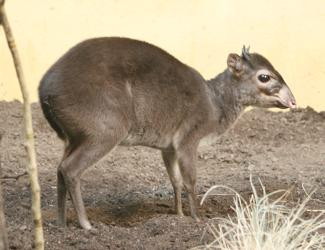
Philantomba maxwellii inhabits warm, moist lowland forests in western Africa. It has a grayish brown coat, a bushy white-lined tail, and short, spiky horns in males and occasionally females.
Written 26 November 2026 from the sources listed below. Each statement was checked against the passage it cites; statements that could not be supported were removed.
Appearance
Maxwell's Duiker has a slightly elevated back, short legs, a small head, and short, rounded ears. Its coat is grayish brown, sometimes with a bluish tinge that varies among individuals, and its underbelly is generally white.[1][2][3]
Its tail is bushy, white-lined, and 8–10 centimetres long. A short tuft of hair surrounds the bases of its horns and covers the area between them.[4][5]
Males and occasionally females have straight, short, spiky horns. The horns are thick at the base, heavily ringed, and measure 3.5–6 centimetres long.[6][7]
The species has four teats.[8]
Habitat
Maxwell's Duiker prefers habitats with fresh, dense growth of shrubs and other plants. It inhabits warm, moist lowland forests in western Africa.[9][10]
Its habitats also include forest fringes, secondary forests, scrub forests, gallery forests, and farmlands.[11]
Diet
Its diet consists mainly of fruits, seeds, secondary vegetation, and shrubs. At the beginning of winter, its diet shifts toward vegetation and flower parts.[12][13]
It tends to select food items no larger than 3 centimetres in diameter.[14]
Behaviour
Maxwell's Duiker uses its preorbital gland to mark objects and other individuals of the same species, particularly through dominant males. Males and females sometimes press their preorbital glands together on opposite sides of each other's faces.[15][16]
Its scent-marking behaviour is associated with individual recognition and social appeasement.[17]
Reproduction and life cycle
Females give birth to one calf per year. The gestation period lasts approximately 120 days.[18][19]
Calves are born mainly during the two dry seasons in Africa. Newborn calves typically weigh approximately one-tenth of their mothers' weight and have coloration similar to calves of other duiker species.[20][21][22]
Conservation
Maxwell's Duiker is classified as Least Concern by the IUCN, although its population trend is decreasing. Excessive hunting and habitat destruction are identified as causes of declining duiker populations.[23][24]
Similar species
The blue duiker closely resembles Maxwell's Duiker. Maxwell's Duiker is nearly twice the size and weight of the blue duiker and has more uniform coloration.[25][26][27]
Classification of the Maxwell's Duiker
| Kingdom | Animalia |
|---|---|
| Phylum | Chordata |
| Subphylum | Vertebrata |
| Infraphylum | Gnathostomata |
| Parvphylum | Osteichthyes |
| Megaclass | Tetrapoda |
| Class | Mammalia (Mammal) |
| Subclass | Theria |
| Infraclass | Eutheria |
| Order | Artiodactyla (Artiodactyls) |
| Family | Bovidae (Goats) |
| Subfamily | Antilopinae |
| Tribe | Cephalophini |
| Genus | Philantomba (Blue Duikers) |
| Species | Philantomba maxwellii (C. H. Smith, 1827) |
Where the Maxwell's Duiker is found
Checklists and occurrence records place Philantomba maxwellii in 11 countries across Africa. GBIF holds 869 georeferenced records of it.
Countries
- Angola 3
- Benin 7
- Cameroon 55
- Gambia 25
- Ghana 85
- Guinea 62
- Guinea-Bissau 59
- Ivory Coast 74
- Liberia 464
- Nigeria 15
- Sierra Leone 20
Regions and cities with the most records
- Sinoe County, Liberia 220
- Eastern, Ghana 36
- River Gee County, Liberia 36
- Kindia, Guinea 32
- Abuko, Gambia 25
- Bakau, Gambia 25
- Bakoti, Gambia 25
- Banjul, Gambia 25
- Brikama, Gambia 25
- Brufut, Gambia 25
- Busumbala, Gambia 25
- Dippa Kunda, Gambia 25
- Faji Kunda, Gambia 25
- Kanifing, Gambia 25
- Kotu, Gambia 25
- Kunkujang, Gambia 25
- Latri Sabiji, Gambia 25
- Manjai Kunda, Gambia 25
- New Jeshwang, Gambia 25
- Sanchaba, Gambia 25
- Sanyang, Gambia 25
- Serekunda, Gambia 25
- Sinchu Alagi, Gambia 25
- Sukuta, Gambia 25
- Talinding, Gambia 25
- Tanji, Gambia 25
- Welingara, Gambia 25
- Western, Gambia 25
- Coyah, Guinea 24
- Manéah, Guinea 24
- Montagnes, Ivory Coast 18
- Dubréka, Guinea 17
- Nimba, Liberia 17
- Bas-Sassandra District, Ivory Coast 16
- Boké Region, Guinea 16
- Akim Oda, Ghana 12
1 more country has a few records outside this range
These countries hold a few records of Philantomba maxwellii but lie outside the range the checklists give for it. Such records are often zoo or garden specimens, museum material or vagrants, so the species is not counted as occurring there.
Range as the checklists state it
Africa
A number beside a place is its count of GBIF occurrence records. A place without a number comes from a checklist alone. Records show where a species has been observed or collected, which can include escapes and vagrants.
Common names
English
- Maxwell's Duiker
- Maxwell’s Duiker
Names in 15 other languages
- Arabic
- ديكر ماكسويل
- Chinese
- 褐麂羚
- Czech
- chocholatka Maxwellova
- Dutch
- Maxwells Duiker
- Finnish
- pikkupuikkija
- French
- Céphalophe de Maxwell
- German
- Maxwell-Ducker, Maxwellducker
- Hungarian
- Maxwell-bóbitásantilop
- Japanese
- マックスウェルダイカー
- Korean
- 맥스웰다이커
- Norwegian Bokmål
- Maxwellduiker
- Polish
- dujkerczyk karłowaty
- Portuguese
- Duiker-de-Maxwell
- Russian
- Дукер Максвелла
- Spanish
- Duiker de Maxwell
Synonyms
2 other scientific names have been used for this species and are now treated as synonyms of Philantomba maxwellii.
- Antilope maxwellii C. H. Smith, 1827
- Cephalophus maxwellii (C. H. Smith, 1827)
Subspecies and varieties
- Philantomba maxwellii danei subspecies
- Philantomba maxwellii maxwellii subspecies
Related species
-
 Blue DuikerPhilantomba monticola
- Walter's DuikerPhilantomba walteri
- Zimbabwe Blue DuikerPhilantomba bicolor
- Angolan Blue DuikerPhilantomba anchietae
- Western Blue DuikerPhilantomba congica
- Zambian Blue DuikerPhilantomba defriesi
- Malawi Blue DuikerPhilantomba hecki
- Mountain Blue DuikerPhilantomba lugens
Compare
Questions and answers
What is the scientific name of the Maxwell's Duiker?
The scientific name of the Maxwell's Duiker is Philantomba maxwellii. Written with its author, the full name is Philantomba maxwellii (C. H. Smith, 1827).
Which family does the Maxwell's Duiker belong to?
Philantomba maxwellii belongs to the family Bovidae, in the order Artiodactyla and the class Mammalia.
Where is the Maxwell's Duiker found?
Checklists and occurrence records place Philantomba maxwellii in 11 countries, including Liberia, Ghana, Ivory Coast, Guinea, Guinea-Bissau and Cameroon.
What is the conservation status of the Maxwell's Duiker?
The IUCN Red List category recorded for Philantomba maxwellii is Least Concern (LC).
What other names does the Maxwell's Duiker have?
Philantomba maxwellii is also known in English as Maxwell’s Duiker.
Sources
Passages the profile rests on
- Maxwell's duiker has a slightly elevated back, short legs, a small head, and short, rounded ears. Source passage: “It is characterised by a slightly elevated back, short legs, a small head and short, round ears.” — English Wikipedia
- Its coat is grayish brown and may have a bluish tinge that varies among individuals. Source passage: “The coat is grayish brown, sometimes with a bluish tinge; the colour varies with individuals.” — English Wikipedia
- Its underbelly is generally white, contrasting with its dorsal coloration. Source passage: “The underbelly, in contrast with the dorsal parts, is generally white.” — English Wikipedia
- Its tail is bushy, white-lined, and 8–10 centimetres long. Source passage: “The tail, 8–10 centimetres (3.1–3.9 in) long, is bushy and lined with white.” — English Wikipedia
- A short tuft of hair surrounds the bases of its horns and covers the area between them. Source passage: “A short tuft of hair circles the base of the horns and covers the area between them.” — English Wikipedia
- Males and occasionally females have straight, short, spiky horns. Source passage: “Males, and sometimes females, possess straight, short, spiky horns.” — English Wikipedia
- Its horns are thick at the base, heavily ringed, and measure 3.5–6 centimetres long. Source passage: “Heavily ringed and thick at the base, these measure 3.5–6 centimetres (1.4–2.4 in) in length.” — English Wikipedia
- The species has four teats. Source passage: “Four teats are present.” — English Wikipedia
- The species prefers habitats with fresh, dense growth of shrubs and other plants. Source passage: “The Maxwell duiker prefers areas with fresh and dense growth of shrubs and other plants.” — English Wikipedia
- It inhabits warm, moist lowland forests in western Africa. Source passage: “It inhabits the warm, moist lowland forests prevalent in western African countries” — English Wikipedia
- Its habitats also include forest fringes, secondary forests, scrub forests, gallery forests, and farmlands. Source passage: “The habitat also includes forest fringes, secondary, scrub and gallery forests and farmlands.” — English Wikipedia
- Its diet consists mainly of fruits, seeds, secondary vegetation, and shrubs. Source passage: “The Maxwell duiker's diet mostly consists of fruits, seeds, secondary vegetation and shrubs.” — English Wikipedia
- Its diet shifts toward vegetation and flower parts at the beginning of winter. Source passage: “Diets are subject to seasonal changes, with a shift towards vegetation and parts of flowers at the beginning of winter.” — English Wikipedia
- It tends to select food items no larger than 3 centimetres in diameter. Source passage: “it tends to concentrate on food items up to 3 cm in diameter, while larger species eat items up to 6 cm in diameter.” — English Wikipedia
- The species uses its preorbital gland to mark objects and other individuals of the same species, particularly through dominant males. Source passage: “Maxwell's duiker has a preorbital gland known to be used for marking objects and members of the same species, especially by dominant males.” — English Wikipedia
- Males and females sometimes press their preorbital glands together on opposite sides of each other's faces. Source passage: “male and females will often press these glands together on both sides of each other's faces.” — English Wikipedia
- Its scent-marking behaviour is associated with individual recognition and social appeasement. Source passage: “It was shown that scent marking is also associated with individual recognition or social appeasement” — English Wikipedia
- Females give birth to one calf per year. Source passage: “Females birth a single calf once per year” — English Wikipedia
- The gestation period lasts approximately 120 days. Source passage: “after a gestation period of 120 days.” — English Wikipedia
- Calves are born mainly during the two dry seasons in Africa. Source passage: “Calves are born mainly during the two dry seasons in Africa.” — English Wikipedia
- Newborn calves typically weigh approximately one-tenth of their mothers' weight. Source passage: “Offspring usually weigh around 1/10 the weight of their mother” — English Wikipedia
- Newborn calves have coloration similar to calves of other duiker species. Source passage: “and are similar in color to calves from other duiker species.” — English Wikipedia
- The species is classified as Least Concern by the IUCN, although its population trend is decreasing. Source passage: “Maxwell's duiker is listed as Least Concern, though with the population trend decreasing, by the International Union for Conservation of Nature and Natural Resources (IUCN).” — English Wikipedia
- Excessive hunting and habitat destruction are identified as causes of declining duiker populations. Source passage: “Duiker populations have decreased from excessive hunting and habitat destruction.” — animaldiversity.org
- The blue duiker is described as closely resembling Maxwell's duiker. Source passage: “The blue duiker bears a striking resemblance to Maxwell's duiker.” — English Wikipedia
- Maxwell's duiker is nearly twice the size and weight of the blue duiker. Source passage: “However, the latter is nearly twice as large and heavier as the former, with a larger skull.” — English Wikipedia
- Maxwell's duiker has more uniform coloration than the blue duiker. Source passage: “While colouration is more uniform in Maxwell's duiker, the blue duiker shows two different colourations” — English Wikipedia
Data
- Catalogue of Life, 2026-10-16 XR cc by
- Global Biodiversity Information Facility CC BY 4.0
- Wikidata CC0
- GeoNames CC BY 4.0
- Wikimedia Commons per image; credit shown with each image
- Within the Catalogue of Life, this name comes from The Integrated Taxonomic Information System cc0
References
- In Griffith et al., Animal Kingdom vol.4 p.267 where the name was published
- Wilson, Don E., and DeeAnn M. Reeder, eds. (2005). Mammal Species of the World: A Taxonomic and Geographic Reference, 3rd Ed., Vols. 1 & 2.
- Wilson, D. E., and R. A. Mittermeier, eds. (2011). Handbook of the Mammals of the World, Vol. 2: Hoofed Mammals.
- Burgin, Connor J., Don E. Wilson, Russell A. Mittermeier, Anthony B. Rylands, et al. (2020). Illustrated Checklist of the Mammals of the World. Vol. 2. Eulipotyphla to Carnivora.
This species in other databases
Page built on 27 November 2026. See how the catalog is made and all sources and licences.
Cite this page
ScientificNames.org. (2026). Philantomba maxwellii (Maxwell's Duiker). Retrieved November 27, 2026, from https://scientificnames.org/species/philantomba-maxwellii
“Philantomba maxwellii (Maxwell's Duiker).” ScientificNames.org, 2026, scientificnames.org/species/philantomba-maxwellii. Accessed 27 Nov. 2026.
ScientificNames.org. “Philantomba maxwellii (Maxwell's Duiker).” Accessed November 27, 2026. https://scientificnames.org/species/philantomba-maxwellii.
@misc{scientificnames_philantomba_maxwellii_maxwells_duiker,
  author = {{ScientificNames.org}},
  title = {Philantomba maxwellii (Maxwell's Duiker)},
  year = {2026},
  url = {https://scientificnames.org/species/philantomba-maxwellii},
  note = {Accessed 2026-11-27}
}