Species · Mammals
Walter's Duiker Philantomba walteri
The scientific name of the Walter's Duiker is Philantomba walteri. It is a species of mammal in the family Bovidae (goats), order Artiodactyla. The name dates from 2010.
- Scientific name
- Philantomba walteri Colyn et al., 2010
- Common name
- Walter's Duiker
- Genus
- Philantomba
- Family
- Bovidae (Goats)
- Order
- Artiodactyla
- Class
- Mammalia
- Red List category
- DD Data Deficient
- Recorded in
- 2 countries
- Name status
- accepted in the Catalogue of Life
Overview
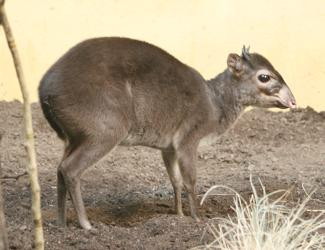
Walter's Duiker is a species described in 2010. It occurs in Togo, Benin and Nigeria and is endemic to the Dahomey Gap in West Africa. It has a slightly raised back, short legs, a small head, short rounded ears, a long tail and a distinctive stripe above the eye.
Written 26 November 2026 from the sources listed below. Each statement was checked against the passage it cites; statements that could not be supported were removed.
Appearance
Walter's Duiker measures less than 40 cm at the shoulder. Adults weigh between 4 and 6 kg.[1][2]
It has a slightly raised back, short legs, a small head and short, rounded ears. It also has a long tail, pedal glands and a distinctive stripe above the eye.[3][4]
Similar species
Walter's Duiker is intermediate in size between Maxwell's duiker and the blue duiker. It differs from both in morphology, cranial structure and DNA characteristics.[5][6]
Walter's Duiker was historically classified together with Maxwell's duiker, and the two have similar morphology. DNA analyses helped confirm Walter's Duiker as a distinct species.[7][8][9]
Habitat
Walter's Duiker is believed to originate from the Dahomey Gap, a savannah area within the Guinean forest-savanna mosaic. The Dahomey Gap has a relatively dry climate.[10][11]
The Dahomey Gap is a forest-savanna mosaic corridor approximately 200 km wide, lying between 0° and 3° East. It receives approximately 1,000–1,200 mm of annual rainfall.[12][13]
The Dahomey Gap contains savannas, cultivated areas and isolated fragments of gallery forests, swamp forests and semi-deciduous forests. Herbaceous or cultivated land is interspersed with fragmented forest patches.[14][15]
The Dahomey Gap extends to the coast of Benin, Togo and Ghana.[16]
Conservation
The species is extensively hunted and may already be threatened with extinction. It is hunted in protected reserves across a substantial part of its distribution range.[17][18]
Habitat loss and climate change are identified as threats to the species. Agricultural development, charcoal production and timber exploitation have contributed to shaping forest patches in its region.[19][20]
Only 11 research articles mentioning Walter's Duiker were retained in a literature review. Existing research has primarily addressed feeding, parasitology and hunting pressure.[21][22]
The species' population size, diet, behaviour, reproduction, habitat range and life cycle remain insufficiently documented. Research into its abundance and ecological characteristics is considered important for assessing its conservation status.[23][24]
Research priorities include the species' diet, seed dispersal role, home range, activity rate and abundance.[25]
Classification of the Walter's Duiker
| Kingdom | Animalia |
|---|---|
| Phylum | Chordata |
| Subphylum | Vertebrata |
| Infraphylum | Gnathostomata |
| Parvphylum | Osteichthyes |
| Megaclass | Tetrapoda |
| Class | Mammalia (Mammal) |
| Subclass | Theria |
| Infraclass | Eutheria |
| Order | Artiodactyla (Artiodactyls) |
| Family | Bovidae (Goats) |
| Subfamily | Antilopinae |
| Tribe | Cephalophini |
| Genus | Philantomba (Blue Duikers) |
| Species | Philantomba walteri Colyn et al., 2010 |
Origin of the name. Etymology: The species is named Walter's Duiker in honor of the late Walter N. Verheyen (1932 - 2005), in recognition of his work on African mammals. Moreover, he collected the first specimen at Badou (Togo) in 1968.
Where the Walter's Duiker is found
Checklists and occurrence records place Philantomba walteri in 2 countries across Africa. GBIF holds 63 georeferenced records of it.
Countries
Regions and cities with the most records
- Ekiti State, Nigeria 10
- Ado-Ekiti, Nigeria 9
- Ikere-Ekiti, Nigeria 8
- Atlantique, Benin 5
- Donga, Benin 5
- Edo State, Nigeria 5
- Igbara-Odo, Nigeria 5
- Ise-Ekiti, Nigeria 5
- Borgou, Benin 3
- Comé, Benin 3
- Igede-Ekiti, Nigeria 3
- Kouandé, Benin 3
- Ouidah, Benin 3
Range as the checklists state it
Africa
A number beside a place is its count of GBIF occurrence records. A place without a number comes from a checklist alone. Records show where a species has been observed or collected, which can include escapes and vagrants.
Common names
English
- Walter's Duiker
- Verheyen's Duiker
- Verheyen’s Duiker
Names in 11 other languages
- Arabic
- ديكر والتر
- Czech
- chocholatka Verheyenova
- Dutch
- Walters Duiker
- French
- Céphalophe de Verheyen, Céphalophe de Walter
- German
- Verheyen-Ducker
- Hungarian
- Walter-bóbitásantilop
- Korean
- 월터다이커
- Norwegian Bokmål
- Walterduiker
- Polish
- Dujkerczyk skryty
- Russian
- Дукер Уолтера
- Spanish
- Duiker de Walter
Related species
-
 Blue DuikerPhilantomba monticola
-
 Maxwell's DuikerPhilantomba maxwellii
- Zimbabwe Blue DuikerPhilantomba bicolor
- Angolan Blue DuikerPhilantomba anchietae
- Western Blue DuikerPhilantomba congica
- Zambian Blue DuikerPhilantomba defriesi
- Malawi Blue DuikerPhilantomba hecki
- Mountain Blue DuikerPhilantomba lugens
Compare
Questions and answers
What is the scientific name of the Walter's Duiker?
The scientific name of the Walter's Duiker is Philantomba walteri. Written with its author, the full name is Philantomba walteri Colyn et al., 2010.
Which family does the Walter's Duiker belong to?
Philantomba walteri belongs to the family Bovidae, in the order Artiodactyla and the class Mammalia.
Where is the Walter's Duiker found?
Checklists and occurrence records place Philantomba walteri in 2 countries: Benin and Nigeria.
What is the conservation status of the Walter's Duiker?
The IUCN Red List category recorded for Philantomba walteri is Data Deficient (DD).
What other names does the Walter's Duiker have?
Philantomba walteri is also known in English as Verheyen's Duiker and Verheyen’s Duiker.
Sources
Passages the profile rests on
- The species measures less than 40 cm at the shoulder. Source passage: “It measures under 40 cm (16 in) tall at the shoulder” — English Wikipedia
- Adults weigh between 4 and 6 kg. Source passage: “weighs between 4 and 6 kg (8.8 and 13.2 lb).” — English Wikipedia
- The species has a slightly raised back, short legs, a small head and short, rounded ears. Source passage: “It is a small antelope and is characterised by a slightly raised back, short legs, a small head and short, rounded ears.” — English Wikipedia
- The species has a long tail, pedal glands and a distinctive stripe above the eye. Source passage: “It has a long tail, pedal glands and a distinctive stripe above the eye.” — English Wikipedia
- The species is intermediate in size between Maxwell's duiker and the blue duiker. Source passage: “It is intermediate in size between the larger Maxwell's duiker (Philantomba maxwellii) and the smaller blue duiker (Philantomba monticola)” — English Wikipedia
- The species differs from Maxwell's duiker and the blue duiker in morphology, cranial structure and DNA characteristics. Source passage: “but is clearly different in morphology, cranial structure and DNA analysis.” — English Wikipedia
- Walter's duiker was historically classified together with Maxwell's duiker. Source passage: “The latter, recognized as a species in 2010, had long been assimilated to its forest cousin, the Maxwell's duiker” — pmc.ncbi.nlm.nih.gov
- Walter's duiker and Maxwell's duiker have similar morphology. Source passage: “these two species have been confounded and are morphologically similar.” — pmc.ncbi.nlm.nih.gov
- DNA analyses helped confirm Walter's duiker as a distinct species. Source passage: “modern taxonomic classification methods, including DNA analyses, led to confirm the specificity of the Walter's duiker.” — pmc.ncbi.nlm.nih.gov
- The species is believed to originate from the Dahomey Gap, a savannah area within the Guinean forest-savanna mosaic. Source passage: “are believed to come from the Dahomey Gap, an area of savannah which is a portion of the Guinean forest-savanna mosaic” — English Wikipedia
- The Dahomey Gap has a relatively dry climate. Source passage: “with a relatively dry climate” — English Wikipedia
- The Dahomey Gap is a forest-savanna mosaic corridor approximately 200 km wide. Source passage: “a corridor of forest‐savanna mosaics of approximately 200 km width” — pmc.ncbi.nlm.nih.gov
- The Dahomey Gap lies between 0° and 3° East and receives approximately 1,000–1,200 mm of annual rainfall. Source passage: “between 0° and 3° East) with only 1000–1200 mm of cumulative rainfall per year.” — pmc.ncbi.nlm.nih.gov
- The Dahomey Gap contains savannas, cultivated areas and isolated fragments of gallery forests, swamp forests and semi-deciduous forests. Source passage: “it hosts savannas, crops, and isolated fragments of gallery forests, swamp forests, and semi‐deciduous forests.” — pmc.ncbi.nlm.nih.gov
- The Dahomey Gap contains herbaceous or cultivated land interspersed with fragmented forest patches. Source passage: “It comprises vast tracts of herbaceous or cultivated land mixed with a network of fragmented forest patches of varying size” — pmc.ncbi.nlm.nih.gov
- The Dahomey Gap extends to the coast of Benin, Togo and Ghana. Source passage: “that extends all the way to the coast in Benin, Togo and Ghana” — English Wikipedia
- The species is extensively hunted and may already be threatened with extinction. Source passage: “This species is largely hunted and may already be threatened by extinction.” — pmc.ncbi.nlm.nih.gov
- The species is hunted in protected reserves across a substantial part of its distribution range. Source passage: “The species is hunted in a large part of its range, including in the reserves that are supposed to protect it.” — pmc.ncbi.nlm.nih.gov
- Agricultural development, charcoal production and timber exploitation have contributed to shaping forest patches in the species' region. Source passage: “notably agricultural development, charcoal production, and timber exploitation” — pmc.ncbi.nlm.nih.gov
- Habitat loss and climate change are identified as threats to the species. Source passage: “hunting pressure, habitat loss, and climate change threaten its existence in this region.” — pmc.ncbi.nlm.nih.gov
- Only 11 research articles mentioning Walter's duiker were retained in the literature review. Source passage: “to finally retain a total of only 11 research articles mentioning Walter's duiker.” — pmc.ncbi.nlm.nih.gov
- Existing research on the species has primarily addressed feeding, parasitology and hunting pressure. Source passage: “Existing studies focus on feeding, parasitology, and hunting pressure.” — pmc.ncbi.nlm.nih.gov
- The species' population size, diet, behaviour, reproduction, habitat range and life cycle remain insufficiently documented. Source passage: “crucial scientific data remains incomplete, such as population size, diet, behavior, reproduction, habitat range, and life cycle.” — pmc.ncbi.nlm.nih.gov
- Research into the species' abundance and ecological characteristics is considered important for assessing its conservation status. Source passage: “All these information together would allow to thoroughly assess the species status and contribute to its conservation.” — pmc.ncbi.nlm.nih.gov
- Research on the species' diet, seed dispersal role, home range, activity rate and abundance has been identified as a priority. Source passage: “Priority should be given to studying the diet composition of Walter's duiker by analyzing rumens and feces, its role in seed dispersal and forest regeneration, its home range and activity rate, and the estimation of its abundance.” — pmc.ncbi.nlm.nih.gov
Data
- Catalogue of Life, 2026-10-16 XR cc by
- Global Biodiversity Information Facility CC BY 4.0
- Wikidata CC0
- GeoNames CC BY 4.0
- Within the Catalogue of Life, this name comes from The Integrated Taxonomic Information System cc0
References
- Discovery of a new duiker species (Bovidae: Cephalophinae) from the Dahomey Gap, West Africa. (2010). Zootaxa, 2637, 1–30. https://doi.org/10.11646/zootaxa.2637.1.1 Link where the name was published
- Wilson, D. E., and R. A. Mittermeier, eds. (2011). Handbook of the Mammals of the World, Vol. 2: Hoofed Mammals.
- Burgin, Connor J., Don E. Wilson, Russell A. Mittermeier, Anthony B. Rylands, et al. (2020). Illustrated Checklist of the Mammals of the World. Vol. 2. Eulipotyphla to Carnivora.
This species in other databases
Page built on 28 November 2026. See how the catalog is made and all sources and licences.
Cite this page
ScientificNames.org. (2026). Philantomba walteri (Walter's Duiker). Retrieved November 28, 2026, from https://scientificnames.org/species/philantomba-walteri
“Philantomba walteri (Walter's Duiker).” ScientificNames.org, 2026, scientificnames.org/species/philantomba-walteri. Accessed 28 Nov. 2026.
ScientificNames.org. “Philantomba walteri (Walter's Duiker).” Accessed November 28, 2026. https://scientificnames.org/species/philantomba-walteri.
@misc{scientificnames_philantomba_walteri_walters_duiker,
  author = {{ScientificNames.org}},
  title = {Philantomba walteri (Walter's Duiker)},
  year = {2026},
  url = {https://scientificnames.org/species/philantomba-walteri},
  note = {Accessed 2026-11-28}
}