Species · Flowering plants
Blushing Philodendron Philodendron erubescens
The scientific name of the Blushing Philodendron is Philodendron erubescens. It is a species of flowering plant in the family Araceae (arum family), order Alismatales.
- Scientific name
- Philodendron erubescens K.Koch & Augustin
- Common name
- Blushing Philodendron
- Genus
- Philodendron
- Family
- Araceae (Arum Family)
- Order
- Alismatales
- Class
- Liliopsida
- Recorded in
- 5 countries
- Name status
- accepted in the Catalogue of Life

Overview
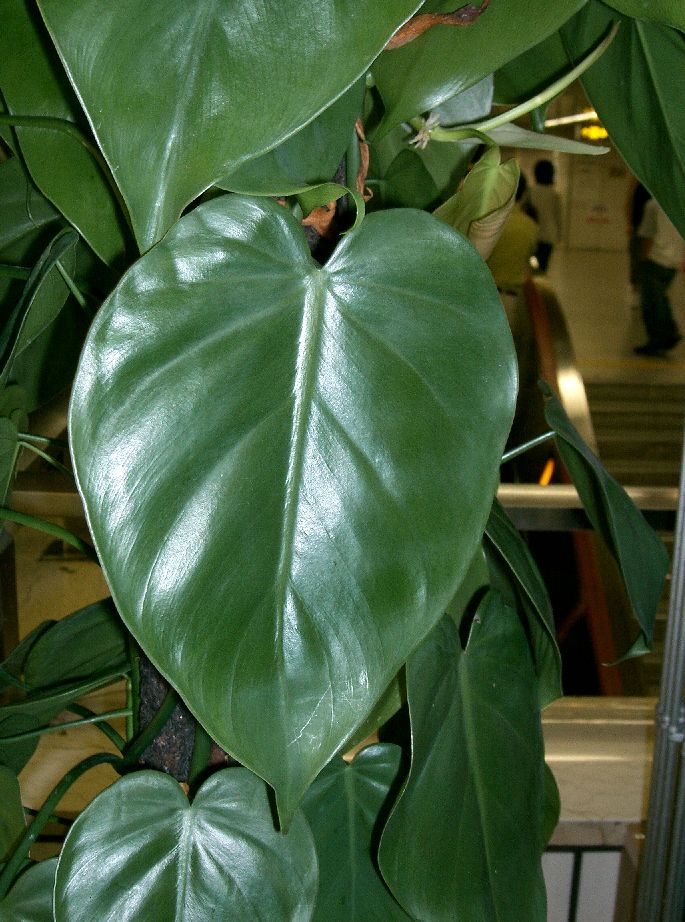
The blushing philodendron (Philodendron erubescens K.Koch & Augustin) is a herbaceous perennial flowering plant in the family Araceae, order Alismatales and class Liliopsida. The species naturally grows in tropical rainforests. The blushing philodendron is distinguished by its red stems and glossy, heart-shaped leaves with reddish or copper coloring underneath.
Written 26 November 2026 from the sources listed below. Each statement was checked against the passage it cites; statements that could not be supported were removed.
Appearance
The blushing philodendron has simple, glossy, heart-shaped leaves with entire margins. Their upper surfaces are deep green, while their undersides are reddish or copper-colored.[1][2]
The plant has red stems and purplish-red petioles approximately as long as its leaf blades. Its flowers have a white spadix surrounded by a reddish-burgundy spathe.[3][4][5]
The flowers have fragrant, deep-red spathes measuring up to 15 centimetres long. The leaves measure between 9 and 18 inches long.[6][7]
Habitat
The blushing philodendron naturally grows in tropical rainforests. It prefers warm temperatures, high humidity, moist, well-drained soil rich in organic matter, and partial shade.[8][9]
The preferred indoor temperature range is 65 to 85 degrees Fahrenheit.[10]
Behaviour
When grown indoors, the blushing philodendron can climb a moss pole or trellis or spread outward.[11]
Reproduction and life cycle
The blushing philodendron flowers during spring and summer, and its recorded flowering period also includes autumn.[12][13]
Indoor specimens rarely produce flowers. Stem cuttings are a recommended propagation method.[14][15]
Conservation
All parts of the blushing philodendron are toxic because they contain calcium oxalate crystals. Ingestion can cause mouth and stomach irritation, while contact with the sap may cause skin irritation.[16][17][18][19]
The plant is listed as a potential problem for cats, dogs, and children.[20]
Uses
The blushing philodendron is commonly cultivated as a houseplant in temperate regions for its attractive foliage and distinctive coloring. It has received the Royal Horticultural Society's Award of Garden Merit.[21][22][23]
The plant can remove certain airborne toxins, including xylene and trichloroethylene.[24]
Classification of the Blushing Philodendron
| Kingdom | Plantae |
|---|---|
| Subkingdom | Pteridobiotina |
| Phylum | Tracheophyta |
| Class | Liliopsida |
| Order | Alismatales |
| Family | Araceae (Arum Family) |
| Genus | Philodendron (Philodendrons) |
| Species | Philodendron erubescens K.Koch & Augustin |
Where the Blushing Philodendron is found
Checklists and occurrence records place Philodendron erubescens in 5 countries across South America. GBIF holds 177 georeferenced records of it.
Countries
Regions and cities with the most records
- Rio de Janeiro, Brazil 25
- São Paulo, Brazil 22
- Antioquia, Colombia 20
- Medellín, Colombia 20
- Bello, Colombia 19
- Copacabana, Colombia 19
- Envigado, Colombia 18
- Itagüí, Colombia 18
- La Estrella, Colombia 17
- Caldas, Colombia 14
- Retiro, Colombia 12
- Botafogo, Brazil 9
- Catete, Brazil 9
- Niterói, Brazil 9
- Rio de Janeiro, Brazil 9
- Santa Teresa, Brazil 9
- Barra da Tijuca, Brazil 8
- Estácio, Brazil 8
- Ipanema, Brazil 8
- Leblon, Brazil 8
- Teresópolis, Brazil 8
- Cordovil, Brazil 7
- Diadema, Brazil 7
- Minas Gerais, Brazil 7
- Osasco, Brazil 7
- Petrópolis, Brazil 7
- Rocinha, Brazil 7
- São Caetano do Sul, Brazil 7
- São Paulo, Brazil 7
- Taboão da Serra, Brazil 7
- Vidigal, Brazil 7
- Vila Galvão, Brazil 7
- Carapicuíba, Brazil 6
- Cundinamarca, Colombia 6
- Acari, Brazil 5
- Barueri, Brazil 5
21 more countries have a few records outside this range
These countries hold a few records of Philodendron erubescens but lie outside the range the checklists give for it. Such records are often zoo or garden specimens, museum material or vagrants, so the species is not counted as occurring there.
A number beside a place is its count of GBIF occurrence records. A place without a number comes from a checklist alone. Records show where a species has been observed or collected, which can include escapes and vagrants.
Common names
English
- Blushing Philodendron
- Red-leaf Philodendron
Names in 10 other languages
- Chinese
- 红苞喜林芋, 芋葉蔓綠絨
- Finnish
- purppuraköynnösvehka
- German
- rotblättriger Philodendron
- Polish
- filodendron czerwieniejący
- Portuguese
- Filodendro, Filodendro Sanguíneo, Filodendro-roxo
- Russian
- Филодендрон красноватый
- Slovak
- filodendron červenejúci
- Swedish
- kopparranka
- Thai
- ฟิโลทอง
- Turkish
- Kızaran Filodendron
Related species
-
 Heart-leaf PhilodendronPhilodendron hederaceum
-
 Black-gold PhilodendronPhilodendron melanochrysum
-
 Heart-leaf PhilodendronPhilodendron cordatum
-
 Elephant EarPhilodendron giganteum
-
 Ecuador PhilodendronPhilodendron verrucosum
-
 Silver Leaf PhilodendronPhilodendron brandtianum
-
 Horsehead PhilodendronPhilodendron bipennifolium
-
 Split Leaf ClimberPhilodendron radiatum
Compare
Questions and answers
What is the scientific name of the Blushing Philodendron?
The scientific name of the Blushing Philodendron is Philodendron erubescens. Written with its author, the full name is Philodendron erubescens K.Koch & Augustin.
Which family does the Blushing Philodendron belong to?
Philodendron erubescens belongs to the family Araceae, in the order Alismatales and the class Liliopsida.
Where is the Blushing Philodendron found?
Checklists and occurrence records place Philodendron erubescens in 5 countries: Brazil, Colombia, Peru, Venezuela and Ecuador.
What other names does the Blushing Philodendron have?
Philodendron erubescens is also known in English as Red-leaf Philodendron.
How do you take care of a blushing philodendron?
Provide warm temperatures, high humidity, moist, well-drained soil rich in organic matter, and partial shade. The preferred indoor temperature range is 65 to 85 degrees Fahrenheit.[9][10]
Is blushing philodendron a climber?
Yes. When grown indoors, it can climb a moss pole or trellis or spread outward.[11]
Sources
Passages the profile rests on
- The leaves are glossy and deep green on their upper surfaces, with reddish or copper coloring underneath. Source passage: “The leaves are glossy, deep green on the upper surface, and have a reddish or copper coloring on the underside.” — plants.ces.ncsu.edu
- The species has simple, glossy, heart-shaped leaves with entire margins. Source passage: “Leaf Feel: Glossy Leaf Value To Gardener: Showy Leaf Type: Simple Leaf Shape: Cordate Leaf Margin: Entire” — plants.ces.ncsu.edu
- The plant has red stems and heart-shaped leaves. Source passage: “with red stems and heart-shaped leaves up to 40 cm (16 in) in length.” — English Wikipedia
- The plant has purplish-red petioles approximately as long as its leaf blades. Source passage: “The petioles are purplish-red and are equally as long as the leaf.” — plants.ces.ncsu.edu
- The species produces a white spadix surrounded by a reddish-burgundy spathe. Source passage: “The flower is a white spadix that is surrounded by reddish-burgundy spathe.” — plants.ces.ncsu.edu
- Its flowers have fragrant, deep-red spathes measuring up to 15 centimetres long. Source passage: “The flowers are deep red, fragrant spathes up to 15 cm (6 in) long” — English Wikipedia
- The leaves measure between 9 and 18 inches long. Source passage: “The leaves can measure 9 to 18 inches long.” — plants.ces.ncsu.edu
- The species naturally grows in tropical rainforests. Source passage: “native to Colombia and will grow up to 60 feet tall in its native rainforests.” — plants.ces.ncsu.edu
- The species prefers warm temperatures, high humidity, moist well-drained soil rich in organic matter, and partial shade. Source passage: “This species prefers warm temperatures, high humidity, moist, well-drained soil rich in organic matter, and partial shade.” — plants.ces.ncsu.edu
- The preferred indoor temperature range is 65 to 85 degrees Fahrenheit. Source passage: “It prefers temperatures between 65 to 85 degrees Fahrenheit” — plants.ces.ncsu.edu
- When grown indoors, the plant can climb a moss pole or trellis or spread outward. Source passage: “When grown indoors, it can be a climber on a moss pole or trellis, or it can grow spreading outwards” — plants.ces.ncsu.edu
- The plant flowers during summer and autumn. Source passage: “in summer and autumn.” — English Wikipedia
- The recorded flowering period includes spring and summer. Source passage: “Flower Bloom Time: Spring Summer” — plants.ces.ncsu.edu
- Indoor specimens rarely produce flowers. Source passage: “Indoor plants rarely flower.” — plants.ces.ncsu.edu
- Stem cuttings are a recommended propagation method for this species. Source passage: “Recommended Propagation Strategy: Stem Cutting” — plants.ces.ncsu.edu
- All parts of the plant are toxic because they contain calcium oxalate. Source passage: “All parts of P. erubescens are toxic due to calcium oxalate” — English Wikipedia
- Ingestion of the plant can cause mouth and stomach irritation. Source passage: “If ingested, mouth and stomach irritation.” — plants.ces.ncsu.edu
- Contact with the plant's sap may cause skin irritation. Source passage: “Sap may cause skin irritation” — plants.ces.ncsu.edu
- Calcium oxalate crystals are identified as the plant's toxic principle. Source passage: “Poison Toxic Principle: Calcium oxalate crystals” — plants.ces.ncsu.edu
- The plant is listed as a potential problem for cats, dogs, and children. Source passage: “Problems: Contact Dermatitis Poisonous to Humans Problem for Cats Problem for Children Problem for Dogs” — plants.ces.ncsu.edu
- The species is cultivated as a houseplant in temperate regions. Source passage: “in temperate regions it must be grown under glass or as a houseplant.” — English Wikipedia
- The species has received the Royal Horticultural Society's Award of Garden Merit. Source passage: “The species, as well as some cultivars, have gained the Royal Horticultural Society's Award of Garden Merit.” — English Wikipedia
- The species is commonly cultivated as a houseplant for its attractive foliage and distinctive coloring. Source passage: “It is commonly known as the Blushing Philodendron and is very popular as a houseplant for its attractive foliage and unique coloring.” — plants.ces.ncsu.edu
- The plant can remove certain airborne toxins, including xylene and trichloroethylene. Source passage: “can remove certain toxins from the air such as xylene and trichloroethylene.” — plants.ces.ncsu.edu
Data
- Catalogue of Life, 2026-10-16 XR cc by
- Global Biodiversity Information Facility CC BY 4.0
- Wikidata CC0
- GeoNames CC BY 4.0
- Wikimedia Commons per image; credit shown with each image
- Within the Catalogue of Life, this name comes from The World Checklist of Vascular Plants (WCVP) cc by
References
- Index Seminum (B, Berolinensis) 1854(App.): 6 (1855) where the name was published
This species in other databases
- Catalogue of Life 4G82S
- Wikidata Q4484253
- iNaturalist 327366
- World Flora Online wfo-0000268620
- GRIN 27727
Page built on 29 November 2026. See how the catalog is made and all sources and licences.
Cite this page
ScientificNames.org. (2026). Philodendron erubescens (Blushing Philodendron). Retrieved November 29, 2026, from https://scientificnames.org/species/philodendron-erubescens
“Philodendron erubescens (Blushing Philodendron).” ScientificNames.org, 2026, scientificnames.org/species/philodendron-erubescens. Accessed 29 Nov. 2026.
ScientificNames.org. “Philodendron erubescens (Blushing Philodendron).” Accessed November 29, 2026. https://scientificnames.org/species/philodendron-erubescens.
@misc{scientificnames_philodendron_erubescens_blushing_philodendron,
  author = {{ScientificNames.org}},
  title = {Philodendron erubescens (Blushing Philodendron)},
  year = {2026},
  url = {https://scientificnames.org/species/philodendron-erubescens},
  note = {Accessed 2026-11-29}
}