Species · Flowering plants
Heart-leaf Philodendron Philodendron hederaceum
The scientific name of the Heart-leaf Philodendron is Philodendron hederaceum. It is a species of flowering plant in the family Araceae (arum family), order Alismatales.
- Scientific name
- Philodendron hederaceum (Jacq.) Schott
- Common name
- Heart-leaf Philodendron
- Genus
- Philodendron
- Family
- Araceae (Arum Family)
- Order
- Alismatales
- Class
- Liliopsida
- Recorded in
- 39 countries
- Name status
- accepted in the Catalogue of Life
Overview
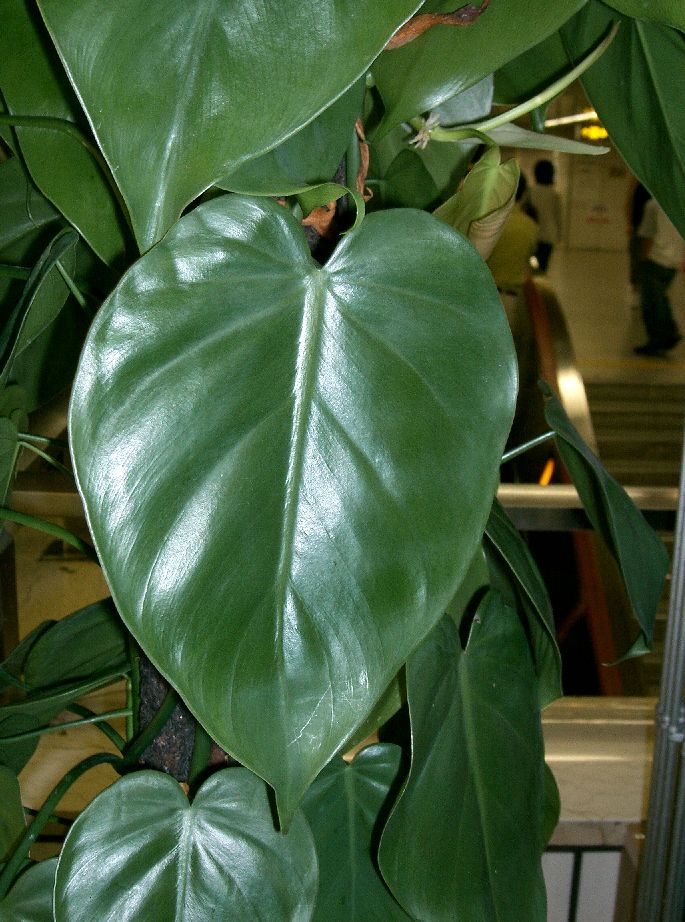
The heart-leaf philodendron is a flowering plant in the family Araceae, order Alismatales and class Liliopsida. The species is native to Central America and the Caribbean. It is an evergreen climbing plant with heart-shaped, glossy leaves arranged alternately along its stems.
Written 26 November 2026 from the sources listed below. Each statement was checked against the passage it cites; statements that could not be supported were removed.
Appearance
The heart-leaf philodendron is an evergreen climbing plant with heart-shaped, glossy leaves. Its leaves are arranged alternately along the stems.[1][2][3]
The plant can grow to a height or climbing length of 3–6 metres. Its leaves can reach 30 centimetres in length.[4][5]
Mature plants occasionally produce white flowers.[6]
Habitat
The heart-leaf philodendron is native to Central America and the Caribbean.[7]
It commonly grows upwards along tree trunks. Its roots can grow both inside and outside the soil.[8][9]
Uses
The heart-leaf philodendron is commonly cultivated as a houseplant and used for ornamental household decoration.[10][11]
Similar species
Philodendron scandens is listed as a synonym of the heart-leaf philodendron.[12]
Reproduction and life cycle
The heart-leaf philodendron can be propagated through layering and cuttings. Spring and summer are recommended seasons for propagation.[13][14]
The species can produce white flowers approximately 15 years after planting. It can also produce fruits, and spike inflorescences are the most common type when inflorescences appear.[15][16][17]
Classification of the Heart-leaf Philodendron
| Kingdom | Plantae |
|---|---|
| Subkingdom | Pteridobiotina |
| Phylum | Tracheophyta |
| Class | Liliopsida |
| Order | Alismatales |
| Family | Araceae (Arum Family) |
| Genus | Philodendron (Philodendrons) |
| Species | Philodendron hederaceum (Jacq.) Schott |
Where the Heart-leaf Philodendron is found
Checklists and occurrence records place Philodendron hederaceum in 39 countries across Africa, Asia, North America and South America. GBIF holds 4,606 georeferenced records of it.
Countries where it is native or its origin is not stated
- Argentina 5
- Belize 104
- Bolivia 26
- Bonaire, Saint Eustatius and Saba 9
- Brazil 620
- British Virgin Islands 4
- Cayman Islands 3
- Colombia 768
- Costa Rica 508
- Cuba 49
- Dominica 17
- Dominican Republic 22
- Ecuador 76
- El Salvador 42
- French Guiana 132
- Grenada 8
- Guadeloupe 38
- Guatemala 84
- Guyana 41
- Haiti 3
- Honduras 56
- Jamaica 45
- Martinique 13
- Mexico 620
- Montserrat 5
- Nicaragua 136
- Panama 475
- Paraguay 6
- Peru 111
- Puerto Rico 78
- Saint Kitts and Nevis 3
- Saint Vincent and the Grenadines 7
- Suriname 84
- Trinidad and Tobago 47
- U.S. Virgin Islands 8
- United States 262
- Venezuela 78
Countries where it has been introduced
Regions and cities with the most records
- Antioquia, Colombia 298
- Chiapas, Mexico 163
- Hawaii, United States 137
- Ituango, Colombia 135
- Limón Province, Costa Rica 132
- Alcalde Díaz, Panama 127
- Bahia, Brazil 120
- Panamá, Panama 120
- Alajuela Province, Costa Rica 113
- Oaxaca, Mexico 104
- Meta Department, Colombia 101
- Veracruz, Mexico 100
- São Paulo, Brazil 94
- San Miguelito, Panama 91
- Ancón, Panama 90
- Chilibre, Panama 90
- Curundú, Panama 90
- Panama City, Panama 90
- Puntarenas Province, Costa Rica 80
- Arraiján, Panama 77
- Colón, Panama 75
- Veraguas Province, Panama 74
- Heredia Province, Costa Rica 71
- Juan Díaz, Panama 70
- Veracruz, Panama 70
- Villavicencio, Colombia 56
- Cayo District, Belize 53
- Diadema, Brazil 53
- Espírito Santo, Brazil 53
- Panamá Oeste Province, Panama 53
- Florida, United States 51
- Dabeiba, Colombia 50
- Aliamanu / Salt Lakes / Foster Village, United States 48
- Diamond Head / Kapahulu / Saint Louis Heights, United States 48
- Kailua, United States 48
- Kaneohe, United States 48
19 more countries have a few records outside this range
These countries hold a few records of Philodendron hederaceum but lie outside the range the checklists give for it. Such records are often zoo or garden specimens, museum material or vagrants, so the species is not counted as occurring there.
A number beside a place is its count of GBIF occurrence records. A place without a number comes from a checklist alone. Records show where a species has been observed or collected, which can include escapes and vagrants.
Common names
English
- Heart-leaf Philodendron
- Vilevine
- Heartleaf Philodendron
Names in 9 other languages
- Chinese
- 大心葉綠蘿, 心葉蔓綠絨
- Danish
- hjertefilodendron
- German
- Kletter-Baumfreund, kletternder Philodendron
- Hebrew
- פילודנדרון מטפס
- Russian
- Филодендрон плющевидный
- Slovak
- filodendron šplhavý
- Spanish
- Bejuco de Calabazón, Paisaje, camote de sargotín
- Swedish
- klätterkalla
- yua
- ak'al-k'umché
Synonyms
7 other scientific names have been used for this species and are now treated as synonyms of Philodendron hederaceum.
- Arum hederaceum Jacq.
- Philodendron cordatum hort.
- Philodendron scandens f. scandens
- Philodendron scandens subsp. scandens
- Solenosterigma bicolor Klotzsch ex K.Krause
- Solenosterigma micans Klotzsch ex K.Krause
- Pothos hederaceus (Jacq.) Aubl. ambiguous synonym
Subspecies and varieties
- Philodendron hederaceum var. hederaceum (Vilevine) variety
- Philodendron hederaceum var. kirkbridei variety
- Philodendron hederaceum var. oxycardium variety
Related species
-
 Blushing PhilodendronPhilodendron erubescens
-
 Black-gold PhilodendronPhilodendron melanochrysum
-
 Heart-leaf PhilodendronPhilodendron cordatum
-
 Arum LilyPhilodendron giganteum
-
 Ecuador PhilodendronPhilodendron verrucosum
-
 Silver Leaf PhilodendronPhilodendron brandtianum
-
 Horsehead PhilodendronPhilodendron bipennifolium
-
 Split Leaf ClimberPhilodendron radiatum
Compare
Questions and answers
What is the scientific name of the Heart-leaf Philodendron?
The scientific name of the Heart-leaf Philodendron is Philodendron hederaceum. Written with its author, the full name is Philodendron hederaceum (Jacq.) Schott.
Which family does the Heart-leaf Philodendron belong to?
Philodendron hederaceum belongs to the family Araceae, in the order Alismatales and the class Liliopsida.
Where is the Heart-leaf Philodendron found?
Checklists and occurrence records place Philodendron hederaceum in 39 countries, including Colombia, Brazil, Mexico, Costa Rica, Panama and United States.
What other names does the Heart-leaf Philodendron have?
Philodendron hederaceum is also known in English as Vilevine and Heartleaf Philodendron.
Where do philodendrons grow naturally?
The heart-leaf philodendron is native to Central America and the Caribbean.[7]
Sources
Passages the profile rests on
- The species has heart-shaped, glossy leaves. Source passage: “with heart-shaped glossy leaves to 30 cm (12 in) long” — English Wikipedia
- The species is an evergreen climbing plant. Source passage: “It is an evergreen climber” — English Wikipedia
- Its leaves are arranged alternately along the stems. Source passage: “P. hederaceum have simple leaves that are arranged in an alternate fashion” — English Wikipedia
- The species can grow to a height or climbing length of 3–6 metres. Source passage: “growing to 3–6 m (10–20 ft)” — English Wikipedia
- Its leaves can reach 30 centimetres in length. Source passage: “leaves to 30 cm (12 in) long” — English Wikipedia
- Mature plants occasionally produce white flowers. Source passage: “occasionally spathes of white flowers in mature plants.” — English Wikipedia
- The species is native to Central America and the Caribbean. Source passage: “native to Central America and the Caribbean” — English Wikipedia
- The species can grow with its roots both inside and outside the soil. Source passage: “P. hederaceum can grow with its roots both in and out of the soil” — English Wikipedia
- The species commonly grows upwards along tree trunks. Source passage: “P. hederaceum are most comfortable growing in an upwards fashion, usually up the trunk of a tree” — English Wikipedia
- The species is commonly cultivated as a houseplant. Source passage: “which is common in the houseplant trade.” — English Wikipedia
- The species is used for ornamental household decoration. Source passage: “Its uses include ornamental household decoration.” — English Wikipedia
- Philodendron scandens is listed as a synonym of this species. Source passage: “Philodendron hederaceum, the heartleaf philodendron (syn. Philodendron scandens)” — English Wikipedia
- The species can be propagated through layering and cuttings. Source passage: “Layering and cutting are two of the favored techniques when it comes to propagating P. hederaceum.” — English Wikipedia
- Spring and summer are recommended seasons for propagating the species. Source passage: “It is best to propagate during the spring and summer.” — English Wikipedia
- The species can produce white flowers approximately 15 years after planting. Source passage: “Philodendron hederaceum will eventually grow white flowers (approximately 15 years after planting).” — English Wikipedia
- The species can produce fruits. Source passage: “They have the capacity to bear fruits as well.” — English Wikipedia
- The species most commonly produces spike inflorescences when inflorescences appear. Source passage: “Inflorescences are rare; spike inflorescences are the most common when one does appear.” — English Wikipedia
- The species can be toxic because parts of it contain calcium oxalate crystals. Source passage: “Parts of the plant are known to contain calcium oxalate crystals in varying concentrations.” — English Wikipedia
- The species can cause oral irritation, swelling of the mouth, lips and tongue, drooling, vomiting and difficulty swallowing in animals. Source passage: “can cause oral irritation, a painful and swollen mouth, lips, and tongue, drooling, vomiting (except in horses), and difficulty swallowing in animals.” — English Wikipedia
Data
- Catalogue of Life, 2026-10-16 XR cc by
- Global Biodiversity Information Facility CC BY 4.0
- Wikidata CC0
- GeoNames CC BY 4.0
- Wikimedia Commons per image; credit shown with each image
- Within the Catalogue of Life, this name comes from The World Checklist of Vascular Plants (WCVP) cc by
References
- Wiener Z. Kunst 3: 780 (1829) where the name was published
This species in other databases
- Catalogue of Life 4G84S
- Wikidata Q4484257
- iNaturalist 120490
- World Flora Online wfo-0000268684
- GRIN 102625
Page built on 26 November 2026. See how the catalog is made and all sources and licences.
Cite this page
ScientificNames.org. (2026). Philodendron hederaceum (Heart-leaf Philodendron). Retrieved November 26, 2026, from https://scientificnames.org/species/philodendron-hederaceum
“Philodendron hederaceum (Heart-leaf Philodendron).” ScientificNames.org, 2026, scientificnames.org/species/philodendron-hederaceum. Accessed 26 Nov. 2026.
ScientificNames.org. “Philodendron hederaceum (Heart-leaf Philodendron).” Accessed November 26, 2026. https://scientificnames.org/species/philodendron-hederaceum.
@misc{scientificnames_philodendron_hederaceum_heart_leaf_philodendron,
  author = {{ScientificNames.org}},
  title = {Philodendron hederaceum (Heart-leaf Philodendron)},
  year = {2026},
  url = {https://scientificnames.org/species/philodendron-hederaceum},
  note = {Accessed 2026-11-26}
}