Species · Flowering plants
Carolina Phlox Phlox carolina
The scientific name of the Carolina Phlox is Phlox carolina. It is a species of flowering plant in the family Polemoniaceae (phlox family), order Ericales.
- Scientific name
- Phlox carolina L.
- Common name
- Carolina Phlox
- Genus
- Phlox
- Family
- Polemoniaceae (Phlox Family)
- Order
- Ericales
- Class
- Magnoliopsida
- Recorded in
- 2 countries
- Name status
- accepted in the Catalogue of Life

Overview
Phlox carolina is native to the southeastern United States, with a reported range extending from Florida to Indiana and from North Carolina to Texas. Its inflorescences are panicle-shaped and fragrant.
Written 27 November 2026 from the sources listed below. Each statement was checked against the passage it cites; statements that could not be supported were removed.
Appearance
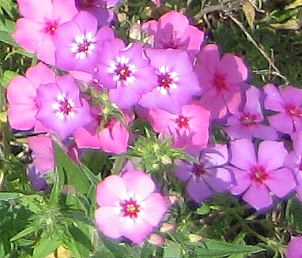
Carolina phlox has pink, purple, or white flowers that grow in clusters or dome-shaped arrangements at the top of the plant. Its inflorescences are panicle-shaped and fragrant.[1][2][3]
Its leaves are simple, oppositely arranged, entire-margined, and lanceolate to ovate. They measure between 1 and 4 inches long.[4][5]
Its stems are red and covered with hairs, and its fruit is capsule-shaped.[6][7]
Carolina phlox typically grows 2 to 3 feet tall. Mature plants generally reach 1 to 2 feet in width.[8][9]
Habitat
Carolina phlox grows along woodland edges, in woodland openings, and in open forested areas. It also occurs along roadsides and in clearings.[10][11]
The species grows in moist habitats and can grow in loam, clay, sand, and nutrient-rich soils. It grows best in soils with a pH below 6.8.[12][13][14]
Carolina phlox tolerates heat and grows in full sun or partial shade.[15]
Conservation
Carolina phlox is considered critically imperiled in West Virginia.[16]
Uses
The species is used in genetic studies to compare chromosome numbers among species. It is also used in studies examining how plant height relates to hybridization success.[17][18]
Carolina phlox is a parent of numerous garden cultivars.[19]
The cultivar 'Miss Lingard' has pure white flowers and is also known as wedding phlox. It is used in floral arrangements for weddings.[20][21][22]
The cultivar 'Minnie Pearl' has white flowers, while 'Kim' has pink flowers.[23][24]
The cultivar 'Gypsy Love' is shorter than other listed cultivars and has pink flowers. 'Magnificence' is taller than the other listed cultivars and has purple-pink flowers.[25][26]
Diet
Carolina phlox provides a food source for small mammals, including cottontail rabbits.[27]
Similar species
Carolina phlox is listed among North American native species similar in appearance and habit to dame's rocket.[28]
Reproduction and life cycle
Carolina phlox flowers from May through late June. Flowering continues indeterminately throughout the flowering season.[29][30]
Its fruit reaches full maturity during summer.[31]
Classification of the Carolina Phlox
| Kingdom | Plantae |
|---|---|
| Subkingdom | Pteridobiotina |
| Phylum | Tracheophyta |
| Class | Magnoliopsida |
| Order | Ericales |
| Family | Polemoniaceae (Phlox Family) |
| Subfamily | Polemonioideae |
| Tribe | Phlocideae |
| Genus | Phlox (Phloxes) |
| Species | Phlox carolina L. |
Where the Carolina Phlox is found
Checklists and occurrence records place Phlox carolina in 2 countries across North America. GBIF holds 1,979 georeferenced records of it.
Countries
Regions and cities with the most records
- Georgia, United States 232
- Alabama, United States 227
- Mississippi, United States 209
- South Carolina, United States 145
- North Carolina, United States 123
- Ocean Springs, United States 76
- Gautier, United States 72
- Pascagoula, United States 70
- Florida, United States 41
- Tennessee, United States 33
- Biloxi, United States 28
- Brookhaven, United States 18
- Smyrna, United States 18
- Chamblee, United States 17
- North Druid Hills, United States 17
- Starkville, United States 17
- Sandy Springs, United States 16
- Mableton, United States 14
- Marietta, United States 14
- Dunwoody, United States 13
- Helena, United States 13
- North Decatur, United States 13
- Pelham, United States 13
- Alabaster, United States 12
- Homewood, United States 12
- Virginia, United States 12
- Woodstock, United States 12
- Arkansas, United States 11
- Bessemer, United States 11
- Hoover, United States 11
- Mountain Brook, United States 11
- Roswell, United States 11
- Vestavia Hills, United States 11
- Atlanta, United States 10
- West Gulfport, United States 10
- Auburn, United States 9
A number beside a place is its count of GBIF occurrence records. A place without a number comes from a checklist alone. Records show where a species has been observed or collected, which can include escapes and vagrants.
Common names
English
- Carolina Phlox
- Thick-leaf Phlox
- Thickleaf Phlox
Names in 3 other languages
- Finnish
- kiiltoleimu
- Russian
- Флокс каролинский
- Swedish
- knutflox
Synonyms
One other scientific name has been used for this species and is now treated as a synonym of Phlox carolina.
- Phlox carolina subsp. typica Wherry
Subspecies and varieties
- Phlox carolina subsp. alta subspecies
- Phlox carolina subsp. angusta subspecies
- Phlox carolina subsp. carolina subspecies
- Phlox carolina subsp. turritella subspecies
Related species
-
 Creeping PhloxPhlox subulata
-
 Garden PhloxPhlox paniculata
- Cherokee PhloxPhlox stolonifera
-
 Woodland PhloxPhlox divaricata
-
 Annual PhloxPhlox drummondii
-
 Spreading PhloxPhlox diffusa
-
 Meadow PhloxPhlox maculata
-
 Downy PhloxPhlox pilosa
Compare
Questions and answers
What is the scientific name of the Carolina Phlox?
The scientific name of the Carolina Phlox is Phlox carolina. Written with its author, the full name is Phlox carolina L..
Which family does the Carolina Phlox belong to?
Phlox carolina belongs to the family Polemoniaceae, in the order Ericales and the class Magnoliopsida.
Where is the Carolina Phlox found?
Checklists and occurrence records place Phlox carolina in 2 countries: United States and Canada.
What other names does the Carolina Phlox have?
Phlox carolina is also known in English as Thick-leaf Phlox and Thickleaf Phlox.
Do phlox do better in sun or shade?
Carolina phlox grows in full sun or partial shade and tolerates heat.[15]
How far will phlox spread?
Mature Carolina phlox plants generally reach 1 to 2 feet in width.[9]
Sources
Passages the profile rests on
- Phlox carolina is a herbaceous perennial with pink, purple, or white flowers. Source passage: “The flowers are less than one inch in length and are pink, purple, or white.” — English Wikipedia
- The flowers grow in clusters or dome-shaped arrangements at the top of the plant. Source passage: “They are located in bunches or a dome shape at the top of the plant.” — English Wikipedia
- Its inflorescences are panicle-shaped and fragrant. Source passage: “The inflorescence of Phlox carolina is panicle-shaped with a fragrant scent.” — English Wikipedia
- Its leaves are simple, oppositely arranged, entire-margined, and lanceolate to ovate. Source passage: “The leaf type of Phlox carolina is simple with an opposite arrangement, an entire margin, and a lanceolate to ovate shape.” — English Wikipedia
- Its leaves measure between 1 and 4 inches long. Source passage: “They are 1 to 4 inches long.” — English Wikipedia
- Its stems are red and covered with hairs. Source passage: “The stem is red and is pubescently haired.” — English Wikipedia
- Its fruit is capsule-shaped. Source passage: “The fruit is capsule-shaped and fully matured in summer.” — English Wikipedia
- Phlox carolina typically grows 2 to 3 feet tall. Source passage: “Phlox carolina grows from 1 to 5 feet tall, typically 2 to 3 feet tall” — English Wikipedia
- Mature plants generally reach 1 to 2 feet in width. Source passage: “and 1 to 2 feet wide at maturity.” — English Wikipedia
- The species grows along woodland edges and in woodland openings. Source passage: “It grows in woodland edges and openings.” — English Wikipedia
- Phlox carolina occurs in open forested areas, forest edges, roadsides, and clearings. Source passage: “It tends to grow in open forested areas, forest edges, roadsides, and clearings.” — English Wikipedia
- The species grows in moist habitats. Source passage: “Phlox carolina grow in moist habitats” — English Wikipedia
- It can grow in loam, clay, sand, and nutrient-rich soils. Source passage: “can grow in loam, clay, sand, or high-nutrient soil.” — English Wikipedia
- It grows best in soils with a pH below 6.8. Source passage: “It thrives in soil pH below 6.8.” — English Wikipedia
- The species tolerates heat and grows in full sun or partial shade. Source passage: “It is heat tolerant and grows in full sun or partial shade.” — English Wikipedia
- Phlox carolina is considered critically imperiled in West Virginia. Source passage: “Phlox carolina is considered to be critically imperiled in West Virginia.” — English Wikipedia
- The species is used in genetic studies to compare chromosome numbers among species. Source passage: “Phlox carolina is often used as a reference in gene studies to count the differing number of chromosome that differing species contain.” — English Wikipedia
- The species is used in studies examining how plant height relates to hybridization success. Source passage: “Phlox carolina is also used as a Tall Phlox for studies on mechanical aspects of hybridization success in relation to height” — English Wikipedia
- Phlox carolina is a parent of numerous garden cultivars. Source passage: “It is the parent of numerous garden cultivars” — English Wikipedia
- The cultivar 'Miss Lingard' has pure white flowers. Source passage: “'Miss Lingard' (pure white)” — English Wikipedia
- The cultivar 'Miss Lingard' is also known as wedding phlox. Source passage: “The most common cultivar is known as the "Miss Lingard," as known as wedding phlox” — English Wikipedia
- The cultivar 'Miss Lingard' is used in floral arrangements for weddings. Source passage: “with white flowers and is a popular floral arrangement used for weddings.” — English Wikipedia
- The cultivar 'Minnie Pearl' has white flowers. Source passage: “"Minnie Pearl" with white flowers” — English Wikipedia
- The cultivar 'Kim' has pink flowers. Source passage: “"Kim" with pink flowers” — English Wikipedia
- The cultivar 'Gypsy Love' is shorter than other listed cultivars and has pink flowers. Source passage: “"Gypsy Love," which is shorter than the others with pink flowers” — English Wikipedia
- The cultivar 'Magnificence' is taller than the other listed cultivars and has purple-pink flowers. Source passage: “"Magnificence," which is taller than the others with purple-pink flowers.” — English Wikipedia
- The plant provides a food source for small mammals, including cottontail rabbits. Source passage: “It serves as a food source for small mammals such as Cottontail Rabbits.” — English Wikipedia
- Carolina phlox is listed among North American native species similar in appearance and habit to dame's rocket. Source passage: “Carolina phlox (Phlox carolina), meadow phlox (P. maculata), summer phlox (P. paniculata), and prairie phlox (P. pilosa) are four North American native species that are similar in appearance and habit to dame's rocket” — extension.psu.edu
- Phlox carolina flowers from May through late June. Source passage: “Phlox carolina flowers from May to late June” — English Wikipedia
- Its flowering continues indeterminately throughout the flowering season. Source passage: “flowering indeterminately throughout the season.” — English Wikipedia
- Its fruit reaches full maturity during summer. Source passage: “The fruit is capsule-shaped and fully matured in summer.” — English Wikipedia
Data
- Catalogue of Life, 2026-10-16 XR cc by
- Global Biodiversity Information Facility CC BY 4.0
- Wikidata CC0
- GeoNames CC BY 4.0
- Wikimedia Commons per image; credit shown with each image
- Within the Catalogue of Life, this name comes from Synonymic Checklists of the Vascular Plants of the World cc by
References
- L. where the name was published
This species in other databases
- Catalogue of Life 4GJ7D
- Wikidata Q7186537
- iNaturalist 166690
- World Flora Online wfo-0001099737
- GRIN 432180
Page built on 28 November 2026. See how the catalog is made and all sources and licences.
Cite this page
ScientificNames.org. (2026). Phlox carolina (Carolina Phlox). Retrieved November 28, 2026, from https://scientificnames.org/species/phlox-carolina
“Phlox carolina (Carolina Phlox).” ScientificNames.org, 2026, scientificnames.org/species/phlox-carolina. Accessed 28 Nov. 2026.
ScientificNames.org. “Phlox carolina (Carolina Phlox).” Accessed November 28, 2026. https://scientificnames.org/species/phlox-carolina.
@misc{scientificnames_phlox_carolina_carolina_phlox,
  author = {{ScientificNames.org}},
  title = {Phlox carolina (Carolina Phlox)},
  year = {2026},
  url = {https://scientificnames.org/species/phlox-carolina},
  note = {Accessed 2026-11-28}
}