Species · Flowering plants
Downy Phlox Phlox pilosa
The scientific name of the Downy Phlox is Phlox pilosa. It is a species of flowering plant in the family Polemoniaceae (phlox family), order Ericales.
- Scientific name
- Phlox pilosa L.
- Common name
- Downy Phlox
- Genus
- Phlox
- Family
- Polemoniaceae (Phlox Family)
- Order
- Ericales
- Class
- Magnoliopsida
- Recorded in
- 3 countries
- Name status
- accepted in the Catalogue of Life

Overview
Phlox pilosa is native to eastern North America and grows in open habitats including prairies and woodlands.
Written 26 November 2026 from the sources listed below. Each statement was checked against the passage it cites; statements that could not be supported were removed.
Appearance
Downy phlox is a herbaceous perennial with upright stems that may branch near their tops. The stems, leaves, and sepals are covered with hairs that give the plant a sticky feel.[1][2][3]
Its leaves are deep green, pointed, stalkless, and arranged oppositely along the stems. The lower leaves are linear, while the upper leaves are lanceolate.[4][5][6]
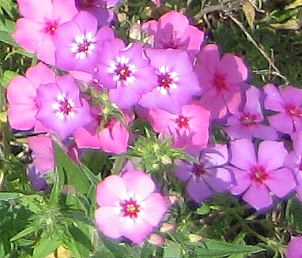
Its fragrant, tubular flowers have five spreading, flat, rounded lobes widened at their outer ends. They range from light pink to bright pink, lavender, or light purple, with white flowers occurring rarely.[7][8][9]
The flowers grow in loosely arranged, rounded clusters at the ends of stems.[10][11]
Downy phlox typically grows between 15 and 61 cm tall. Its leaves can reach 8 cm in length and range from 3 to 13 mm in width, while its flower clusters can reach 8 cm across.[12][13][14]
Habitat
Downy phlox occurs in open habitats including prairies and woodlands in eastern North America. In Missouri, it grows in glades, savannas, upland prairies, bottomland forests, and upland forests.[15][16][17]
Its Missouri habitats also include bluff areas, sinkhole pond margins, streambanks, riverbanks, and fens. It also grows in pastures, old fields, ditches, railroad corridors, and roadsides.[18][19]
The species grows in full sun to partial shade and tolerates most soil types, including dry soils. It grows in well-drained soils in sunny to partially shaded conditions.[20][21][22]
Reproduction and life cycle
The species can be propagated using stem cuttings, root cuttings, or seeds. Its rhizomes form clumps that enable the plant to spread.[23][24]
Behaviour
Only insects with sufficiently long tongues can reach the nectar inside the flowers. Shorter-tongued bees and flower flies visit the flowers to consume or collect pollen.[25][26][27]
The flowers attract bees, butterflies, and Cloudwing skippers.[28]
Diet
Rabbits, deer, and groundhogs eat the foliage of downy phlox. White-tailed deer, eastern cottontails, and woodchucks also browse on the species.[29][30]
The caterpillars of the phlox moth feed on its flowers.[31]
Uses
Downy phlox is occasionally cultivated as an ornamental garden plant. It is used in wildflower gardens and rock gardens and is suitable for sunny meadows and woodland plantings.[32][33][34]
The Meskwaki used an infusion of its leaves for blood purification and as a wash for eczema. They also used a compound containing its root as a love medicine.[35][36]
Similar species
Blue phlox (Phlox divaricata) can be confused with downy phlox in Missouri.[37]
Classification of the Downy Phlox
| Kingdom | Plantae |
|---|---|
| Subkingdom | Pteridobiotina |
| Phylum | Tracheophyta |
| Class | Magnoliopsida |
| Order | Ericales |
| Family | Polemoniaceae (Phlox Family) |
| Subfamily | Polemonioideae |
| Tribe | Phlocideae |
| Genus | Phlox (Phloxes) |
| Species | Phlox pilosa L. |
Where the Downy Phlox is found
Checklists and occurrence records place Phlox pilosa in 3 countries across North America. GBIF holds 15,316 georeferenced records of it.
Countries
Regions and cities with the most records
- Texas, United States 1,777
- Minnesota, United States 1,285
- Wisconsin, United States 1,264
- Arkansas, United States 1,038
- Illinois, United States 968
- Missouri, United States 600
- Mississippi, United States 376
- Oklahoma, United States 330
- Kansas, United States 288
- Florida, United States 279
- Alabama, United States 265
- Indiana, United States 242
- Iowa, United States 222
- Middleton, United States 214
- Tennessee, United States 208
- Madison, United States 203
- Libertyville, United States 200
- Michigan, United States 199
- Lake Forest, United States 197
- Gurnee, United States 192
- Glendale Heights, United States 182
- Waukegan, United States 182
- North Chicago, United States 179
- Zion, United States 179
- Pleasant Prairie, United States 177
- Kenosha, United States 176
- Lisle, United States 175
- Louisiana, United States 175
- Lombard, United States 172
- La Grange, United States 170
- Westchester, United States 169
- Downers Grove, United States 168
- Darien, United States 167
- Glen Ellyn, United States 167
- Wheaton, United States 167
- Fitchburg, United States 166
A number beside a place is its count of GBIF occurrence records. A place without a number comes from a checklist alone. Records show where a species has been observed or collected, which can include escapes and vagrants.
Common names
English
- Downy Phlox
- Prairie Phlox
Names in 4 other languages
- Arabic
- قبس شعري
- French
- phlox pubescent
- Russian
- Флокс волосистый
- Swedish
- nejlikflox
Synonyms
3 other scientific names have been used for this species and are now treated as synonyms of Phlox pilosa.
- Penstemon pauciflorus Buckley
- Phlox pilosa var. pilosa
- Phlox pilosa var. typica Lundell
Subspecies and varieties
- Phlox pilosa subsp. deamii (Deam's Downy Phlox) subspecies
- Phlox pilosa subsp. detonsa subspecies
- Phlox pilosa subsp. fulgida (Prairie Phlox) subspecies
- Phlox pilosa subsp. longipilosa (Long-hair Phlox) subspecies
- Phlox pilosa subsp. ozarkana (Ozark Downy Phlox) subspecies
- Phlox pilosa subsp. pilosa (Common Prairie Phlox) subspecies
- Phlox pilosa subsp. pulcherrima (Big Thicket Phlox) subspecies
- Phlox pilosa subsp. riparia (Texas Phlox) subspecies
- Phlox pilosa subsp. sangamonensis (Sangamon Phlox) subspecies
Related species
-
 Creeping PhloxPhlox subulata
-
 Garden PhloxPhlox paniculata
- Cherokee PhloxPhlox stolonifera
-
 Woodland PhloxPhlox divaricata
-
 Annual PhloxPhlox drummondii
-
 Spreading PhloxPhlox diffusa
-
 Meadow PhloxPhlox maculata
-
 Carolina PhloxPhlox carolina
Compare
Questions and answers
What is the scientific name of the Downy Phlox?
The scientific name of the Downy Phlox is Phlox pilosa. Written with its author, the full name is Phlox pilosa L..
Which family does the Downy Phlox belong to?
Phlox pilosa belongs to the family Polemoniaceae, in the order Ericales and the class Magnoliopsida.
Where is the Downy Phlox found?
Checklists and occurrence records place Phlox pilosa in 3 countries: United States, Canada and Mexico.
What other names does the Downy Phlox have?
Phlox pilosa is also known in English as Prairie Phlox.
What is the problem with phlox?
Downy phlox has no serious insect or disease problems, although hot, dry conditions can encourage spider mite infestations. It is resistant to powdery mildew.[38][39]
Do phlox like full sun or shade?
Downy phlox grows in full sun to partial shade and tolerates most soil types. It also tolerates dry soil conditions.[20][21][22]
Will rabbits eat phlox plants?
Yes. Rabbits eat the foliage of downy phlox. Eastern cottontails also browse on the species.[29][30]
What are the downsides of growing phlox?
Hot, dry conditions can encourage spider mite infestations on downy phlox.[38]
Sources
Passages the profile rests on
- Phlox pilosa is a herbaceous perennial wildflower with upright stems that may branch near their tops. Source passage: “The stems are upright and sometimes branched near the top.” — English Wikipedia
- The stems, leaves, and sepals of Phlox pilosa are covered with hairs, giving the plant a sticky feel. Source passage: “Leaves, stems, and sepals are covered with hairs and the plant is sticky to the touch.” — English Wikipedia
- Phlox pilosa is a perennial plant. Source passage: “Downy phlox, also called prairie phlox, is a perennial wildflower” — mdc.mo.gov
- Its leaves are narrow, elongated, pointed, and arranged oppositely along the stems. Source passage: “Leaves are long and narrow and have pointed tips” — English Wikipedia
- The leaves are deep green, pointed, stalkless, and have prominent central veins. Source passage: “Leaves are opposite, widely-spaced, sharp-pointed, stalkless, deep green, with prominent central veins and often finely pubescent.” — plants.ces.ncsu.edu
- The lower leaves are linear, whereas the upper leaves are lanceolate. Source passage: “The lower leaves are linear, while the upper leaves are lanceolate.” — plants.ces.ncsu.edu
- Its tubular flowers have five spreading lobes that are rounded and widened at their outer ends. Source passage: “The flowers are tubular with 5 lobes, the lobes spreading, widened and rounded at the outer portion” — mdc.mo.gov
- The flowers can range from light pink to bright pink, lavender, or light purple, with white flowers occurring rarely. Source passage: “the color varies from light pink to bright pink, lavender, or light purple, rarely white.” — mdc.mo.gov
- Its flowers are fragrant and tubular, with five flat petal-like lobes. Source passage: “Each fragrant, tubular, pink to pale purple flowers (to 3/4” diameter) has a long corolla tube and five flat petal-like lobes.” — plants.ces.ncsu.edu
- Its flowers grow in rounded clusters at the ends of stems. Source passage: “The flowers grow in rounded clusters up to 3 in (8 cm) at the top of stems.” — English Wikipedia
- Its flowers are loosely arranged in rounded clusters at the ends of stems. Source passage: “Florets are loosely packed in rounded terminal clusters (cymes).” — plants.ces.ncsu.edu
- Phlox pilosa typically grows between 15 and 61 cm tall. Source passage: “Downy phlox is a perennial that grows 6–24 in (15–61 cm) high.” — English Wikipedia
- Its leaves can reach 8 cm in length and range from 3 to 13 mm in width. Source passage: “they can be up to 3 in (8 cm) long and 1⁄8–1⁄2 in (3–13 mm) wide.” — English Wikipedia
- Its flower clusters can reach 8 cm across. Source passage: “The flowers grow in rounded clusters up to 3 in (8 cm) at the top of stems.” — English Wikipedia
- The species occurs in open habitats including prairies and woodlands in eastern North America. Source passage: “where it is found in open areas such as prairies and woodlands.” — English Wikipedia
- In Missouri, it occurs in glades, savannas, upland prairies, bottomland forests, and upland forests. Source passage: “Occurs in glades, savannas, upland prairies, bottomland forests, moist to dry upland forests” — mdc.mo.gov
- Phlox pilosa is native to eastern North America. Source passage: “It is native to eastern North America” — English Wikipedia
- Its Missouri habitats also include bluff areas, sinkhole pond margins, streambanks, riverbanks, and fens. Source passage: “bases, ledges and tops of bluffs, margins of sinkhole ponds, banks of streams and rivers, and fens” — mdc.mo.gov
- It also grows in pastures, old fields, ditches, railroad corridors, and roadsides. Source passage: “also in pastures, old fields, ditches, railroads, and roadsides.” — mdc.mo.gov
- The species grows in full sun to partial shade and tolerates most soil types. Source passage: “Downy phlox grows in full sun to partial shade and in most soil types.” — plants.ces.ncsu.edu
- It tolerates dry soil conditions. Source passage: “It is tolerant of dry soil” — plants.ces.ncsu.edu
- It grows in well-drained soils in sunny to partially shaded conditions. Source passage: “Growing conditions: Sun to part shade, well-drained soils” — extension.sdstate.edu
- The species can be propagated using stem cuttings, root cuttings, or seeds. Source passage: “Propagate through stem or root cuttings or by seed.” — plants.ces.ncsu.edu
- Its rhizomes form clumps that enable the plant to spread. Source passage: “Its rhizomes form clumps that allow it to spread easily” — plants.ces.ncsu.edu
- The flowers produce nectar at the bottom of their corolla tubes. Source passage: “and nectar at the bottom of the corolla.” — English Wikipedia
- Only insects with sufficiently long tongues can reach the nectar inside the flowers. Source passage: “Only butterflies, moths, skippers, and very long-tongued bees (the largest bumblebees) have long enough tongues to reach the nectar.” — English Wikipedia
- Shorter-tongued bees and flower flies visit the flowers to consume or collect pollen. Source passage: “Shorter-tongued bees and flower flies visit to feed on or gather pollen.” — English Wikipedia
- The flowers attract bees, butterflies, and Cloudwing skippers. Source passage: “Its flowers attract bees, butterflies, and Cloudwing skippers.” — plants.ces.ncsu.edu
- The foliage of Phlox pilosa is eaten by rabbits, deer, and groundhogs. Source passage: “Rabbits, deer, and groundhogs will eat the foliage.” — plants.ces.ncsu.edu
- White-tailed deer, eastern cottontails, and woodchucks browse on this species. Source passage: “including white-tailed deer, eastern cottontail, and woodchuck.” — mdc.mo.gov
- The caterpillars of the phlox moth feed on the flowers of this plant. Source passage: “The caterpillars feed on the flowers.” — mdc.mo.gov
- The species is occasionally cultivated as an ornamental garden plant. Source passage: “Occasionally cultivated as an ornamental in gardens.” — mdc.mo.gov
- Downy phlox is used in wildflower gardens and rock gardens. Source passage: “Downy phlox is sometimes cultivated in wildflower gardens and rock gardens.” — mdc.mo.gov
- The species is suitable for sunny meadows and woodland plantings. Source passage: “Downy phlox is excellent for sunny meadows or woodland areas.” — plants.ces.ncsu.edu
- The Meskwaki used an infusion of its leaves for blood purification and as a wash for eczema. Source passage: “Meskwaki Indians used an infusion of leaves to cure and purify the blood, and as a wash for eczema.” — plants.ces.ncsu.edu
- The Meskwaki also used a compound containing its root as a love medicine. Source passage: “They also used a compound containing the root used as a 'love medicine'.” — plants.ces.ncsu.edu
- Blue phlox (Phlox divaricata) is a species that can be confused with downy phlox in Missouri. Source passage: “In our state, blue phlox, or wild sweet William (P. divaricata), is the species most likely to be confused with downy phlox.” — mdc.mo.gov
- The species has no serious insect or disease problems, although hot, dry conditions can encourage spider mite infestations. Source passage: “Downy phlox has no serious insect or disease problems although hot, dry conditions can promote spider mite infestations.” — plants.ces.ncsu.edu
- Phlox pilosa is resistant to powdery mildew. Source passage: “It has resistance to powdery mildew.” — plants.ces.ncsu.edu
Data
- Catalogue of Life, 2026-10-16 XR cc by
- Global Biodiversity Information Facility CC BY 4.0
- Wikidata CC0
- GeoNames CC BY 4.0
- Wikimedia Commons per image; credit shown with each image
- Within the Catalogue of Life, this name comes from Synonymic Checklists of the Vascular Plants of the World cc by
References
- L. where the name was published
This species in other databases
- Catalogue of Life 6VBXW
- Wikidata Q7186544
- iNaturalist 127020
- World Flora Online wfo-0001099777
- GRIN 408324
Page built on 27 November 2026. See how the catalog is made and all sources and licences.
Cite this page
ScientificNames.org. (2026). Phlox pilosa (Downy Phlox). Retrieved November 27, 2026, from https://scientificnames.org/species/phlox-pilosa
“Phlox pilosa (Downy Phlox).” ScientificNames.org, 2026, scientificnames.org/species/phlox-pilosa. Accessed 27 Nov. 2026.
ScientificNames.org. “Phlox pilosa (Downy Phlox).” Accessed November 27, 2026. https://scientificnames.org/species/phlox-pilosa.
@misc{scientificnames_phlox_pilosa_downy_phlox,
  author = {{ScientificNames.org}},
  title = {Phlox pilosa (Downy Phlox)},
  year = {2026},
  url = {https://scientificnames.org/species/phlox-pilosa},
  note = {Accessed 2026-11-27}
}