Species · Flowering plants
Hood's Phlox Phlox hoodii
The scientific name of the Hood's Phlox is Phlox hoodii. It is a species of flowering plant in the family Polemoniaceae (phlox family), order Ericales.
- Scientific name
- Phlox hoodii Richardson
- Common name
- Hood's Phlox
- Genus
- Phlox
- Family
- Polemoniaceae (Phlox Family)
- Order
- Ericales
- Class
- Magnoliopsida
- Recorded in
- 2 countries
- Name status
- accepted in the Catalogue of Life

Overview
Phlox hoodii occurs from Alaska to Arizona and commonly grows in sagebrush country in western North America. It is a low-growing plant with sharp-pointed, needle-like leaves, hairy foliage, and solitary flowers that may be white, pink, or blue.
Written 27 November 2026 from the sources listed below. Each statement was checked against the passage it cites; statements that could not be supported were removed.
Appearance
Hood's phlox typically grows as a compact mat or loosely clustered clump. Individual plants generally measure 5–30 centimetres across and less than 13 centimetres tall, with a maximum height of 13 centimetres.[1][2][3]
Its abundant leaves grow in opposite pairs and are narrow, firm, pungent, needle-like, and sharply pointed. They are typically 3–13 millimetres long and less than one millimetre wide, with short to long hairs that may be woolly or cobweb-like.[4][5][6][7][8]
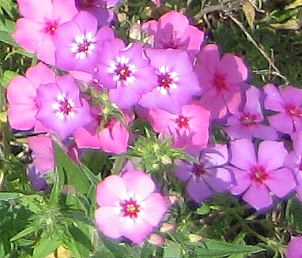
The foliage has a moss-like appearance before flowering. Flowers are solitary, with colours ranging from white and pale blue to purple and pink.[9][10][11]
Each flower has a tubular throat approximately 6–12 millimetres long that spreads into a flat corolla with five lobes. The petal lobes typically measure 4–7 millimetres long.[12][13][14]
The plant produces coarse, woody taproots.[15]
Habitat
It occurs in a prairie Junegrass–spiny phlox association on glacial till in Glacier County, Montana. It has also been recorded in a pristine big sagebrush and mixed-grass community in southern Idaho.[16][17]
The species' distribution extends from Alaska to Arizona. Its six accepted subspecies have different recorded native ranges: canescens from British Columbia to New Mexico; glabrata in Idaho, Montana, Nebraska, North Dakota, South Dakota, and Wyoming; hoodii in Alaska, the Yukon, and areas extending from southern Canada to Arizona; lanata from Washington to Arizona; muscoides from California to North Dakota; and viscidula in Alberta, British Columbia, Idaho, Montana, Oregon, Washington, and Wyoming.[18][19][20][21][22][23][24]
Behaviour
Hood's phlox is stress-tolerant and has slow leaf turnover. Old leaves remain attached to the plant.[25][26]
Its early spring growth is rapid, and it generally matures before surrounding vegetation reaches appreciable height.[27]
Reproduction and life cycle
Hood's phlox typically produces solitary flowers at the ends of its branches. The presence of insect pollinators suggests that cross-pollination may be the predominant breeding process.[28][29]
Mature, average-sized plants growing under low competition in North Dakota have been reported to produce approximately 50 seeds each. The seeds typically measure 2–3 millimetres long and may be transported by wind.[30][31][32]
The muscoides subspecies is pollinated by long-tongued bees. Most species in the Phlox genus are pollinated by Lepidoptera.[33][34]
Conservation
Hood's phlox has no special federal legal status in the United States.[35]
Classification of the Hood's Phlox
| Kingdom | Plantae |
|---|---|
| Subkingdom | Pteridobiotina |
| Phylum | Tracheophyta |
| Class | Magnoliopsida |
| Order | Ericales |
| Family | Polemoniaceae (Phlox Family) |
| Subfamily | Polemonioideae |
| Tribe | Phlocideae |
| Genus | Phlox (Phloxes) |
| Species | Phlox hoodii Richardson |
Where the Hood's Phlox is found
Checklists and occurrence records place Phlox hoodii in 2 countries across North America. GBIF holds 12,025 georeferenced records of it.
Countries
Regions and cities with the most records
- Alberta, Canada 4,378
- Calgary, Canada 1,931
- Chestermere, Canada 1,376
- Wyoming, United States 932
- Idaho, United States 787
- Montana, United States 777
- Saskatchewan, Canada 610
- Colorado, United States 579
- Nevada, United States 510
- Utah, United States 428
- Oregon, United States 383
- Lethbridge, Canada 255
- Pocatello, United States 236
- Washington, United States 223
- Okotoks, Canada 219
- Airdrie, Canada 213
- Nebraska, United States 195
- South Dakota, United States 139
- California, United States 135
- North Dakota, United States 112
- Cochrane, Canada 104
- Saskatoon, Canada 84
- Regina, Canada 73
- Laramie, United States 61
- Bozeman, United States 53
- Medicine Hat, Canada 50
- Yukon, Canada 50
- Yakima, United States 42
- Billings, United States 37
- Helena, United States 32
- Eagle Mountain, United States 29
- Alaska, United States 26
- Manitoba, Canada 24
- New Mexico, United States 24
- Reno, United States 24
- Grand Junction, United States 23
A number beside a place is its count of GBIF occurrence records. A place without a number comes from a checklist alone. Records show where a species has been observed or collected, which can include escapes and vagrants.
Common names
English
- Hood's Phlox
- Carpet Phlox
- Moss Phlox
- Moss-pink
- Spiny Phlox
Names in 2 other languages
- French
- phlox de Hood
- Russian
- Флокс Гуда
Synonyms
One other scientific name has been used for this species and is now treated as a synonym of Phlox hoodii.
- Phlox hoodii subsp. genuina Wherry
Subspecies and varieties
- Phlox hoodii subsp. canescens subspecies
- Phlox hoodii subsp. glabrata subspecies
- Phlox hoodii subsp. hoodii (Hood's Phlox) subspecies
- Phlox hoodii subsp. lanata subspecies
- Phlox hoodii subsp. muscoides subspecies
- Phlox hoodii subsp. viscidula (Hood's Phlox) subspecies
- Phlox hoodii var. madsenii variety
Related species
-
 Creeping PhloxPhlox subulata
-
 Garden PhloxPhlox paniculata
- Cherokee PhloxPhlox stolonifera
-
 Woodland PhloxPhlox divaricata
-
 Annual PhloxPhlox drummondii
-
 Spreading PhloxPhlox diffusa
-
 Meadow PhloxPhlox maculata
-
 Downy PhloxPhlox pilosa
Compare
Questions and answers
What is the scientific name of the Hood's Phlox?
The scientific name of the Hood's Phlox is Phlox hoodii. Written with its author, the full name is Phlox hoodii Richardson.
Which family does the Hood's Phlox belong to?
Phlox hoodii belongs to the family Polemoniaceae, in the order Ericales and the class Magnoliopsida.
Where is the Hood's Phlox found?
Checklists and occurrence records place Phlox hoodii in 2 countries: United States and Canada.
What other names does the Hood's Phlox have?
Phlox hoodii is also known in English as Carpet Phlox, Moss Phlox, Moss-pink and Spiny Phlox.
Sources
Passages the profile rests on
- The plant typically grows as a compact mat or a loosely clustered clump. Source passage: “usually forms a tight mat or loose clump on the ground.” — English Wikipedia
- The plant grows to a maximum height of 13 centimetres. Source passage: “the plant form is no more than 13 centimetres (5 in) tall.” — English Wikipedia
- Individual plants typically measure 5–30 centimetres across and less than 13 centimetres tall. Source passage: “Plants are typically hairy and measure between 2 and 12 inches (5-30 cm) across and less than 5 inches (13 cm) tall” — fs.usda.gov
- The plant has abundant, small, sharp-pointed leaves arranged in opposite pairs. Source passage: “The abundant tiny, sharp-pointed leaves are oppositely arranged” — English Wikipedia
- The plant's foliage is hairy, with hairs ranging from short to long and woolly to cobweb-like. Source passage: “The herbage is hairy in texture, the hairs short to long, woolly to cobwebby.” — English Wikipedia
- The leaves are narrow, firm, pungent, needle-like, and sharply pointed. Source passage: “Leaves are narrow, firm, pungent, and needle-like with sharp points;” — fs.usda.gov
- Its leaves are generally no longer than one centimetre. Source passage: “barely exceed one centimetre (1⁄3 in) long.” — English Wikipedia
- Leaves typically measure 3–13 millimetres long and less than one millimetre wide. Source passage: “Leaves normally range from 0.1 to 0.5 inch (3-13 mm) long and less than 1 mm wide at the midpoint” — fs.usda.gov
- The plant has a moss-like appearance before flowering. Source passage: “The appearance of the plant is almost mosslike until blooming.” — English Wikipedia
- Its flowers are solitary and may be white, pink, or blue. Source passage: “The inflorescence is a solitary flower in shades of white, pink, or blue.” — English Wikipedia
- The flower petals range in color from white to pale blue, purple, or pink. Source passage: “Petals are 5 lobed and range from white to pale blue, purple, or pink” — fs.usda.gov
- Each flower has a tubular throat that spreads into a flat corolla with five lobes. Source passage: “It has a tubular throat about one centimetre (1⁄3 in) long spreading into a flat five-lobed corolla.” — English Wikipedia
- The flower tube measures approximately 6–12 millimetres long. Source passage: “the flower tube measures 0.24 to 0.47 inch (6-12 mm) long.” — fs.usda.gov
- The flower's petal lobes typically measure 4–7 millimetres long. Source passage: “Petal lobes are typically 0.16 to 0.28 inch (4-7 mm) long” — fs.usda.gov
- The plant produces coarse, woody taproots. Source passage: “Spiny phlox produces coarse woody taproots” — fs.usda.gov
- The species occurs in a prairie Junegrass–spiny phlox association on glacial till in Glacier County, Montana. Source passage: “prairie Junegrass (Koeleria macrantha)-spiny phlox association, also known as the Koelerietum Phloxetosum association on glacial till in Glacier County” — fs.usda.gov
- The species has been recorded in a pristine big sagebrush and mixed-grass community in southern Idaho. Source passage: “in a pristine big sagebrush/mixed grass community in southern Idaho” — fs.usda.gov
- The species' distribution extends from Alaska to Arizona. Source passage: “Its distribution extends from Alaska to Arizona.” — English Wikipedia
- The canescens subspecies is native from British Columbia to New Mexico. Source passage: “Native from British Columbia to New Mexico” — English Wikipedia
- The glabrata subspecies is native to Idaho, Montana, Nebraska, North Dakota, South Dakota, and Wyoming. Source passage: “Native to Idaho, Montana, Nebraska, North Dakota, South Dakota, and Wyoming” — English Wikipedia
- The hoodii subspecies is native to Alaska, the Yukon, and areas extending from southern Canada to Arizona. Source passage: “Native to Alaska and the Yukon and from southern Canada to Arizona” — English Wikipedia
- The lanata subspecies is native from Washington to Arizona. Source passage: “Native from Washington to Arizona” — English Wikipedia
- The muscoides subspecies is native from California to North Dakota. Source passage: “Native from California to North Dakota” — English Wikipedia
- The viscidula subspecies is native to Alberta, British Columbia, Idaho, Montana, Oregon, Washington, and Wyoming. Source passage: “Native to Alberta, British Columbia, Idaho, Montana, Oregon, Washington, and Wyoming” — English Wikipedia
- The species is a stress-tolerant plant with slow leaf turnover. Source passage: “Spiny phlox is a stress-tolerant species with slow leaf turnover” — fs.usda.gov
- Old leaves remain attached to the plant. Source passage: “Old leaves are persistent” — fs.usda.gov
- Its early spring growth is rapid, and it generally matures before surrounding vegetation reaches appreciable height. Source passage: “Early spring growth is rapid, and plants normally mature before associated vegetation grows to an "appreciable height"” — fs.usda.gov
- The species typically produces solitary flowers at the ends of its branches. Source passage: “Flowers are most often solitary and appear at the ends of branches” — fs.usda.gov
- The presence of insect pollinators suggests that cross-pollination may be the predominant breeding process. Source passage: “The presence of insect pollinators suggests that cross pollination may predominate.” — fs.usda.gov
- The seeds typically measure 2–3 millimetres long. Source passage: “Seeds are normally 0.08 to 0.1 inch (2-3 mm) long” — fs.usda.gov
- Mature, average-sized plants growing under low competition in North Dakota have been reported to produce approximately 50 seeds each. Source passage: “50 seeds/plant were produced by mature, average-sized plants growing in a "low competition" area in North Dakota.” — fs.usda.gov
- The species' small seeds may be transported by wind. Source passage: “Spiny phlox seed is small [18] and could easily be transported by wind.” — fs.usda.gov
- The muscoides subspecies is pollinated by long-tongued bees. Source passage: “Phlox hoodii ssp. muscoides is pollinated by long-tongued bees [37].” — fs.usda.gov
- Most species in the Phlox genus are pollinated by Lepidoptera. Source passage: “Most phlox (Phlox spp.) are pollinated by Lepidoptera species.” — fs.usda.gov
- The species has no special federal legal status in the United States. Source passage: “FEDERAL LEGAL STATUS: No special status” — fs.usda.gov
Data
- Catalogue of Life, 2026-10-16 XR cc by
- Global Biodiversity Information Facility CC BY 4.0
- Wikidata CC0
- GeoNames CC BY 4.0
- Wikimedia Commons per image; credit shown with each image
- Within the Catalogue of Life, this name comes from Synonymic Checklists of the Vascular Plants of the World cc by
References
- Richardson. where the name was published
This species in other databases
- Catalogue of Life 4GJ8R
- Wikidata Q7186543
- iNaturalist 78548
- World Flora Online wfo-0001099605
- GRIN 432049
Page built on 29 November 2026. See how the catalog is made and all sources and licences.
Cite this page
ScientificNames.org. (2026). Phlox hoodii (Hood's Phlox). Retrieved November 29, 2026, from https://scientificnames.org/species/phlox-hoodii
“Phlox hoodii (Hood's Phlox).” ScientificNames.org, 2026, scientificnames.org/species/phlox-hoodii. Accessed 29 Nov. 2026.
ScientificNames.org. “Phlox hoodii (Hood's Phlox).” Accessed November 29, 2026. https://scientificnames.org/species/phlox-hoodii.
@misc{scientificnames_phlox_hoodii_hoods_phlox,
  author = {{ScientificNames.org}},
  title = {Phlox hoodii (Hood's Phlox)},
  year = {2026},
  url = {https://scientificnames.org/species/phlox-hoodii},
  note = {Accessed 2026-11-29}
}