Species · Flowering plants
Showy Phlox Phlox speciosa
The scientific name of the Showy Phlox is Phlox speciosa. It is a species of flowering plant in the family Polemoniaceae (phlox family), order Ericales.
- Scientific name
- Phlox speciosa Pursh
- Common name
- Showy Phlox
- Genus
- Phlox
- Family
- Polemoniaceae (Phlox Family)
- Order
- Ericales
- Class
- Magnoliopsida
- Recorded in
- 2 countries
- Name status
- accepted in the Catalogue of Life

Overview
Showy phlox is an erect perennial herb with a shrubby base. It occurs in sagebrush habitats, pine woodlands, mountain forests, and on rocky, wooded slopes. It is distinguished by flowers ranging from bright pink to white, with elongated tubular throats and five-lobed corollas.
Written 27 November 2026 from the sources listed below. Each statement was checked against the passage it cites; statements that could not be supported were removed.
Appearance
Showy phlox is an erect perennial herb with a shrubby base and upright stems. It can grow to approximately 40 centimeters tall.[1][2][3]
Its leaves are linear or lance-shaped, arranged oppositely, and generally glandular. They measure between 1 and 5 centimeters long.[4][5][6]
Its inflorescence bears one or more flowers ranging from white to pink. The flowers have elongated tubular throats reaching approximately 1.5 centimeters in length.[7][8]
Its corolla ranges in color from bright pink to white and has five lobes that are double-lobed, notched, or heart-shaped. The lobes are obcordate or deeply divided into two lobes.[9][10][11]
The terminal inflorescence has leaf-like bracts beneath it. Its slender flower stalks measure between 3 and 20 millimeters long, and its calyx measures between 7 and 10 millimeters long.[12][13][14]
Its stamens are short, with their anthers positioned inside the corolla tube.[15]
Habitat
Showy phlox occurs in sagebrush habitats, pine woodlands, and mountain forests. It grows on rocky, wooded slopes and occurs in sagebrush scrub.[16][17][18][19][20]
Similar species
Several subspecies of showy phlox have been identified. Most recognized subspecies are restricted to particular portions of the species' overall distribution, and further study is needed.[21][22][23]
Classification of the Showy Phlox
| Kingdom | Plantae |
|---|---|
| Subkingdom | Pteridobiotina |
| Phylum | Tracheophyta |
| Class | Magnoliopsida |
| Order | Ericales |
| Family | Polemoniaceae (Phlox Family) |
| Subfamily | Polemonioideae |
| Tribe | Phlocideae |
| Genus | Phlox (Phloxes) |
| Species | Phlox speciosa Pursh |
Where the Showy Phlox is found
Checklists and occurrence records place Phlox speciosa in 2 countries across North America. GBIF holds 3,387 georeferenced records of it.
Countries
Regions and cities with the most records
- California, United States 847
- Washington, United States 834
- Oregon, United States 272
- Idaho, United States 151
- Spokane Valley, United States 91
- Spokane, United States 82
- British Columbia, Canada 73
- Ellensburg, United States 71
- Pullman, United States 63
- The Dalles, United States 59
- Moscow, United States 56
- Redding, United States 52
- Wenatchee, United States 40
- Coeur d'Alene, United States 39
- Post Falls, United States 37
- Yakima, United States 35
- Penticton, Canada 30
- Montana, United States 22
- Susanville, United States 15
- Paradise, United States 12
- Lewiston Orchards, United States 11
- Windsor, United States 11
- Lewiston, United States 8
- Ashland, United States 7
- Grants Pass, United States 7
- Nevada, United States 7
- Arizona, United States 6
- Sunnyside, United States 6
- Helena, United States 5
- Bozeman, United States 4
- Flagstaff, United States 4
- Oroville, United States 4
- Medford, United States 3
A number beside a place is its count of GBIF occurrence records. A place without a number comes from a checklist alone. Records show where a species has been observed or collected, which can include escapes and vagrants.
Common names
English
- Showy Phlox
- Bush Phlox
- Showy Phloxا
Names in 3 other languages
- Arabic
- قبس بهي
- French
- phlox voyant
- Russian
- Флокс особенный
Synonyms
2 other scientific names have been used for this species and are now treated as synonyms of Phlox speciosa.
- Phlox speciosa subsp. eu-speciosa Brand
- Phlox speciosa var. speciosa
Subspecies and varieties
- Phlox speciosa subsp. lanceolata subspecies
- Phlox speciosa subsp. lignosa subspecies
- Phlox speciosa subsp. nitida (Klamath Showy Phlox) subspecies
- Phlox speciosa subsp. occidentalis (Sierra Showy Phlox) subspecies
- Phlox speciosa subsp. speciosa subspecies
Related species
-
 Creeping PhloxPhlox subulata
-
 Garden PhloxPhlox paniculata
- Cherokee PhloxPhlox stolonifera
-
 Woodland PhloxPhlox divaricata
-
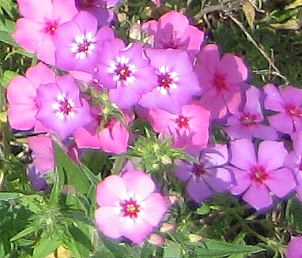 Annual PhloxPhlox drummondii
-
 Spreading PhloxPhlox diffusa
-
 Meadow PhloxPhlox maculata
-
 Downy PhloxPhlox pilosa
Compare
Questions and answers
What is the scientific name of the Showy Phlox?
The scientific name of the Showy Phlox is Phlox speciosa. Written with its author, the full name is Phlox speciosa Pursh.
Which family does the Showy Phlox belong to?
Phlox speciosa belongs to the family Polemoniaceae, in the order Ericales and the class Magnoliopsida.
Where is the Showy Phlox found?
Checklists and occurrence records place Phlox speciosa in 2 countries: United States and Canada.
What other names does the Showy Phlox have?
Phlox speciosa is also known in English as Bush Phlox and Showy Phloxا.
Sources
Passages the profile rests on
- Phlox speciosa is an erect perennial herb with a shrubby base. Source passage: “It is an erect perennial herb with a shrubby base growing up to about 40 centimeters tall.” — English Wikipedia
- The stems of Phlox speciosa grow erect. Source passage: “Phlox speciosa has an erect stem.” — English Wikipedia
- Phlox speciosa can grow to approximately 40 centimeters tall. Source passage: “growing up to about 40 centimeters tall.” — English Wikipedia
- Its leaves are linear or lance-shaped and arranged oppositely. Source passage: “The leaves are linear or lance-shaped, oppositely arranged, and generally glandular.” — English Wikipedia
- Its leaves are generally glandular. Source passage: “The leaves are linear or lance-shaped, oppositely arranged, and generally glandular.” — English Wikipedia
- Its leaves measure between 1 and 5 centimeters long. Source passage: “Leaves are between 1–5 cm and lance-linear.” — English Wikipedia
- Its inflorescence bears one or more flowers ranging from white to pink. Source passage: “The inflorescence bears one or more white to pink flowers” — English Wikipedia
- Its flowers have elongated tubular throats reaching approximately 1.5 centimeters in length. Source passage: “with elongated tubular throats each up to about 1.5 centimeters long.” — English Wikipedia
- Its corolla has five lobes that are double-lobed, notched, or heart-shaped. Source passage: “The corolla has five double-lobed, notched, or heart-shaped lobes.” — English Wikipedia
- Its corolla ranges in color from bright pink to white. Source passage: “corolla bright pink to white,” — English Wikipedia
- Its corolla lobes are obcordate or deeply divided into two lobes. Source passage: “lobes obcordate to deeply 2-lobed;” — English Wikipedia
- Its terminal inflorescence has leaf-like bracts beneath it. Source passage: “Terminal inflorescence with leaf-like bracts below;” — English Wikipedia
- Its slender flower stalks measure between 3 and 20 millimeters long. Source passage: “pedicel 3–20 mm and slender.” — English Wikipedia
- Its calyx measures between 7 and 10 millimeters long. Source passage: “The calyx is 7–10 mm,” — English Wikipedia
- Its stamens are short, with their anthers positioned inside the corolla tube. Source passage: “stamens short, anthers in corolla tube;” — English Wikipedia
- Phlox speciosa occurs in sagebrush habitats. Source passage: “where it occurs in sagebrush, pine woodlands, and mountain forests.” — English Wikipedia
- Phlox speciosa occurs in pine woodlands. Source passage: “where it occurs in sagebrush, pine woodlands, and mountain forests.” — English Wikipedia
- Phlox speciosa occurs in mountain forests. Source passage: “where it occurs in sagebrush, pine woodlands, and mountain forests.” — English Wikipedia
- The species grows on rocky, wooded slopes. Source passage: “Rocky, wooded slopes, sagebrush scrub; 500–2400 m.” — English Wikipedia
- The species occurs in sagebrush scrub. Source passage: “Rocky, wooded slopes, sagebrush scrub; 500–2400 m.” — English Wikipedia
- Several subspecies of Phlox speciosa have been identified. Source passage: “There are several subspecies,” — English Wikipedia
- Most of the recognized subspecies are restricted to particular portions of the species' overall distribution. Source passage: “most being limited to certain sections of the plant's overall distribution.” — English Wikipedia
- Further study of the recognized subspecies is needed. Source passage: “Several subspecies named, study needed.” — English Wikipedia
Data
- Catalogue of Life, 2026-10-16 XR cc by
- Global Biodiversity Information Facility CC BY 4.0
- Wikidata CC0
- GeoNames CC BY 4.0
- Wikimedia Commons per image; credit shown with each image
- Within the Catalogue of Life, this name comes from Synonymic Checklists of the Vascular Plants of the World cc by
References
- Pursh. where the name was published
This species in other databases
- Catalogue of Life 4GJB3
- Wikidata Q7186546
- iNaturalist 78551
- World Flora Online wfo-0001099782
- GRIN 432060
Page built on 29 November 2026. See how the catalog is made and all sources and licences.
Cite this page
ScientificNames.org. (2026). Phlox speciosa (Showy Phlox). Retrieved November 29, 2026, from https://scientificnames.org/species/phlox-speciosa
“Phlox speciosa (Showy Phlox).” ScientificNames.org, 2026, scientificnames.org/species/phlox-speciosa. Accessed 29 Nov. 2026.
ScientificNames.org. “Phlox speciosa (Showy Phlox).” Accessed November 29, 2026. https://scientificnames.org/species/phlox-speciosa.
@misc{scientificnames_phlox_speciosa_showy_phlox,
  author = {{ScientificNames.org}},
  title = {Phlox speciosa (Showy Phlox)},
  year = {2026},
  url = {https://scientificnames.org/species/phlox-speciosa},
  note = {Accessed 2026-11-29}
}