Species · Reptiles
Terror Skink Phoboscincus bocourti
The scientific name of the Terror Skink is Phoboscincus bocourti. It is a species of reptile in the family Scincidae (skink), order Squamata. The name dates from 1876.
- Scientific name
- Phoboscincus bocourti (Brocchi, 1876)
- Common name
- Terror Skink
- Genus
- Phoboscincus
- Family
- Scincidae (Skink)
- Order
- Squamata
- Class
- Reptilia
- Red List category
- CR Critically Endangered
- Recorded in
- 1 country
- Name status
- accepted in the Catalogue of Life

Overview
Phoboscincus bocourti is endemic to two small islets offshore of Île des Pins in New Caledonia. It is distinguished by its long, curved and sharp teeth and its specialised diet of land crabs.
Written 26 November 2026 from the sources listed below. Each statement was checked against the passage it cites; statements that could not be supported were removed.
Appearance
The Terror Skink reaches approximately 50 centimetres in total length, including its tail. Its snout-to-vent length is approximately 28 centimetres.[1][2]
It has long, curved and sharp teeth.[3]
Habitat
The Terror Skink is endemic to two small islets offshore of Île des Pins in New Caledonia. The combined surface area of its currently known range is approximately 0.9 square kilometres.[4][5]
It may also occur on other islands in the vicinity of Île des Pins.[6]
Diet
The Terror Skink is largely a dietary specialist on land crabs, particularly Geograpsus grayi. It uses its large teeth and strong bite force to penetrate their tough exoskeletons.[7][8]
It is the only known skink species whose diet consists of land crabs.[9]
Behaviour
The Terror Skink is presumed to be active during daylight hours. It is considered mainly terrestrial, although it may also spend some time in trees.[10][11]
Conservation
The Terror Skink is classified as critically endangered by the International Union for Conservation of Nature.[12]
Potential threats include habitat loss caused by typhoons and wildfires, as well as the introduction of predatory animals to its island habitat.[13][14]
Classification of the Terror Skink
| Kingdom | Animalia |
|---|---|
| Phylum | Chordata |
| Subphylum | Vertebrata |
| Infraphylum | Gnathostomata |
| Parvphylum | Osteichthyes |
| Megaclass | Tetrapoda |
| Class | Reptilia (Reptile) |
| Order | Squamata (Snakes) |
| Suborder | Autarchoglossa |
| Family | Scincidae (Skink) |
| Subfamily | Eugongylinae |
| Genus | Phoboscincus |
| Species | Phoboscincus bocourti (Brocchi, 1876) |
Where the Terror Skink is found
Checklists and occurrence records place Phoboscincus bocourti in 1 country across Oceania. GBIF holds 5 georeferenced records of it.
Countries
Range as the checklists state it
New Caledonia (small islet south of Grande Terre, off Isle of Pines)
A number beside a place is its count of GBIF occurrence records. A place without a number comes from a checklist alone. Records show where a species has been observed or collected, which can include escapes and vagrants.
Common names
English
- Terror Skink
- Bocourt's Eyelid Skink
- Bocourt's Giant Skink
- Bocourt's Terrific Skink
- Bocourt’s Terrific Skink
Names in 1 other language
- French
- Le scinque géant de Bocourt, Scinque géant de Bocourt, Scinque terrifiant de Bocourt
Synonyms
2 other scientific names have been used for this species and are now treated as synonyms of Phoboscincus bocourti.
- Eumeces bocourti Brocchi, 1876
- Lygosoma bocourti (Brocchi, 1876)
Related species
- Garnier's Giant SkinkPhoboscincus garnieri
-
 ShinglebackTiliqua rugosa
-
 Five-lined SkinkPlestiodon fasciatus
- Common Garden SkinkLampropholis guichenoti
-
 Blue-tailed SkinkCryptoblepharus egeriae
-
 Red-eyed Crocodile SkinkTribolonotus gracilis
-
 Common Blue-tongued SkinkTiliqua scincoides
-
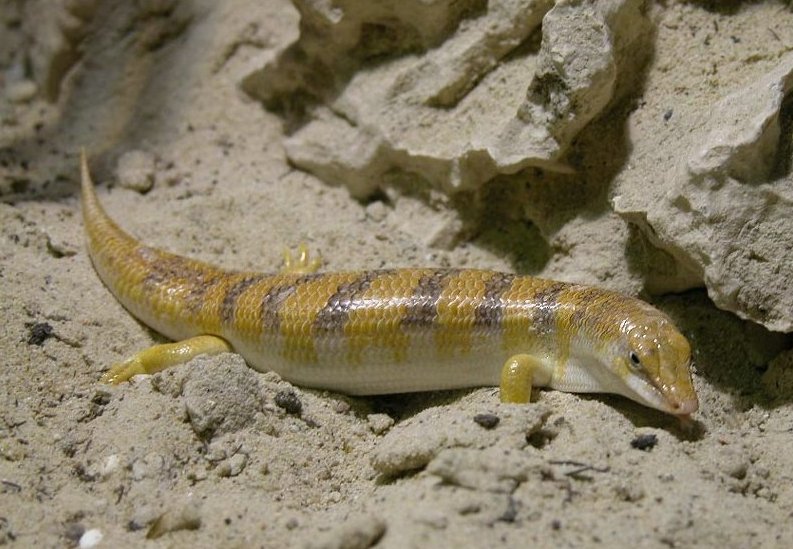 Sandfish SkinkScincus scincus
Compare
Questions and answers
What is the scientific name of the Terror Skink?
The scientific name of the Terror Skink is Phoboscincus bocourti. Written with its author, the full name is Phoboscincus bocourti (Brocchi, 1876).
Which family does the Terror Skink belong to?
Phoboscincus bocourti belongs to the family Scincidae, in the order Squamata and the class Reptilia.
Where is the Terror Skink found?
Checklists and occurrence records place Phoboscincus bocourti in 1 country: New Caledonia.
What is the conservation status of the Terror Skink?
The IUCN Red List category recorded for Phoboscincus bocourti is Critically Endangered (CR).
What other names does the Terror Skink have?
Phoboscincus bocourti is also known in English as Bocourt's Eyelid Skink, Bocourt's Giant Skink, Bocourt's Terrific Skink and Bocourt’s Terrific Skink.
Sources
Passages the profile rests on
- The species reaches approximately 50 centimetres in total length, including its tail. Source passage: “P. bocourti is about 50 centimetres (20 in) in total length (including tail)” — English Wikipedia
- Its snout-to-vent length is approximately 28 centimetres. Source passage: “28 cm (11 in) in snout-to-vent length (SVL).” — English Wikipedia
- The species has long, curved and sharp teeth. Source passage: “The teeth of P. bocourti are long, curved and sharp” — English Wikipedia
- Phoboscincus bocourti is endemic to two small islets offshore of Île des Pins in New Caledonia. Source passage: “Phoboscincus bocourti is endemic to two islets offshore of the Île des Pins (Isle of Pines), an island off the coast of New Caledonia.” — English Wikipedia
- The combined surface area of the species' currently known range is approximately 0.9 square kilometres. Source passage: “Its extant range is severely limited as the islets' surfaces combine to about 0.9 square kilometres (0.35 sq mi).” — English Wikipedia
- The species may also occur on other islands in the vicinity of Île des Pins. Source passage: “However, it may be present on other islands in the locality.” — English Wikipedia
- The species is largely a dietary specialist on land crabs, particularly Geograpsus grayi. Source passage: “A 2022 study found P. bocourti to largely be a dietary specialist on Geograpsus land crabs, namely the species Geograpsus grayi” — English Wikipedia
- The species uses its large teeth and strong bite force to penetrate the tough exoskeletons of land crabs. Source passage: “with it using its large teeth and incredibly high bite force to penetrate the crabs' tough exoskeleton.” — English Wikipedia
- Phoboscincus bocourti is the only known skink species whose diet consists of land crabs. Source passage: “This makes it the only known species of skink with a diet consisting of land crabs.” — English Wikipedia
- The species is presumed to be active during daylight hours. Source passage: “P. bocourti is presumed to be diurnal” — English Wikipedia
- The species is considered mainly terrestrial, although it may also spend some time in trees. Source passage: “mainly terrestrial, but may be partially arboreal.” — English Wikipedia
- The species is classified as critically endangered by the International Union for Conservation of Nature. Source passage: “The International Union for Conservation of Nature has assessed its conservation status as being "critically endangered".” — English Wikipedia
- The species faces potential habitat loss caused by typhoons and wildfires. Source passage: “P. bocourti is subject to threats such as habitat loss through a typhoon or wildfire” — English Wikipedia
- The introduction of predatory animals to its island habitat is a potential threat to the species. Source passage: “and the possibility of predatory animals being introduced to the island.” — English Wikipedia
Data
- Catalogue of Life, 2026-10-16 XR cc by
- Global Biodiversity Information Facility CC BY 4.0
- Wikidata CC0
- GeoNames CC BY 4.0
- Wikimedia Commons per image; credit shown with each image
- Within the Catalogue of Life, this name comes from The Reptile Database cc by
References
- Brocchi, P. [given as M. Brocchi for “Monsieur”]. (1876). Sur un Scincoiden nouveau appartenant au genre Eumeces. Bull. Soc. Philomatique de Paris (6) 12: 95-97.
- Boulenger, G. A. (1883). Descriptions of new species of lizards and frogs collected by Herr A. Forrer in Mexico. Ann. Mag. Nat. Hist. (5) 11: 342-344.
- Greer, A. E. (1974). The generic relationships of the scincid lizard genus Leiolopisma and its relatives. Australian Journal of Zoology 31: 1-67.
- Bauer, Aaron M.;Vindum, Jens V. (1990). A checklist and key to the herpetofauna of New Caledonia, with remarks on biogeography. Proc. Cal. Acad. Sci. 47 (2): 17-45.
- Bauer, A. M., & Sadlier, R. A. (1993). Systematics, biogeography and conservation of the lizards of New Caledonia. Biodiv. Lett. 1: 107-122.
- Adler,G.H.; Austin,C.C. & Dudley,R. (1995). Dispersal and speciation of skinks among archipelagos in the tropical Pacific Ocean. Evolutionary Ecology 9: 529-541.
- Shea G, M. (1995). A taxonomic revision of the Cyclodomorphus casuarinae complex (Squamata: Scincidae). Rec. Austral. Mus. 47 (1): 83-115.
- Bauer, A. M., & SADLIER, R. A. (2000). The herpetofauna of New Caledonia. Contributions to Herpetology, 17; Society for Study Amphibians and Reptiles, Ithaca, New York.
- Ineich I. (2009). Bocourt’s Terrific Skink, Phoboscincus bocourti Brocchi, 1876 (Squamata, Scincidae, Lygosominae), in GraNdCoLaS P. (ed.), Zoologia Neocaledonica 7. Biodiversity studies in New Caledonia. Mémoires Du Muséum National d’Histoire Naturelle 198: 149-174. Paris, ISBN: 978-2-85653-618-6.
- Beolens, B., & Michael Watkins, a. M. G. (2011). The Eponym Dictionary of Reptiles. Johns Hopkins University Press, Baltimore, USA.
- Caut S, Holden M, Jowers MJ, Boistel R, & Ineich I. (2013). Is Bocourt’s Terrific Skink Really So Terrific? Trophic Myth and Reality. PLoS One 8 (10): E78638.
- LiVigni, F. (ed.). (2013). A Life for Reptiles and Amphibians, Volume 1. Chimaira, Frankfurt, 495 Pp.
- INEICH, Ivan; Ross A. SADLIER, Aaron M. BAUER, Todd R. JACKMAN & Sarah A. SMITH. (2014). Bocourt’s terrific Skink, Phoboscincus bocourti (Brocchi, 1876), and the Monophyly of the Genus Phoboscincus Greer, 1974 (Reptilia: Scincidae). Memoires Du Museum National d’Histoire Naturelle, 206: 69-78.
- Chapple, D., Chapple, S., Smith, S., Shea, G., Brennan, I., & Sadlier, R. (2023). Phylogenetic relationships in the Eugongylini (Squamata: Scincidae): generic limits and biogeography. Australian Journal of Zoology 70(6): 165–203.
- Lindken T.; Anderson, C. V., Ariano-Sánchez, D., Barki, G., Biggs, C., Bowles, P., Chaitanya, R., Cronin, D. T., Jähnig, S. C., Jeschke, J. M., Kennerley, R. J., Lacher, T. E. Jr., Luedtke, J. A., Liu, C., Long, B., Mallon, D., Martin, G. M., Meiri, S., Pasachnik, S. A. ... Evans, T. (2024). What factors influence the rediscovery of lost tetrapod species? Global Change Biology, 30: 1-18.
- Uetz, P. H., Patel, M., Gbadamosi, Z., Nguyen, A., & Shoope, S. (2024). A Reference Database of Reptile Images. Taxonomy 4: 723–732.
This species in other databases
Page built on 28 November 2026. See how the catalog is made and all sources and licences.
Cite this page
ScientificNames.org. (2026). Phoboscincus bocourti (Terror Skink). Retrieved November 28, 2026, from https://scientificnames.org/species/phoboscincus-bocourti
“Phoboscincus bocourti (Terror Skink).” ScientificNames.org, 2026, scientificnames.org/species/phoboscincus-bocourti. Accessed 28 Nov. 2026.
ScientificNames.org. “Phoboscincus bocourti (Terror Skink).” Accessed November 28, 2026. https://scientificnames.org/species/phoboscincus-bocourti.
@misc{scientificnames_phoboscincus_bocourti_terror_skink,
  author = {{ScientificNames.org}},
  title = {Phoboscincus bocourti (Terror Skink)},
  year = {2026},
  url = {https://scientificnames.org/species/phoboscincus-bocourti},
  note = {Accessed 2026-11-28}
}