Species · Birds
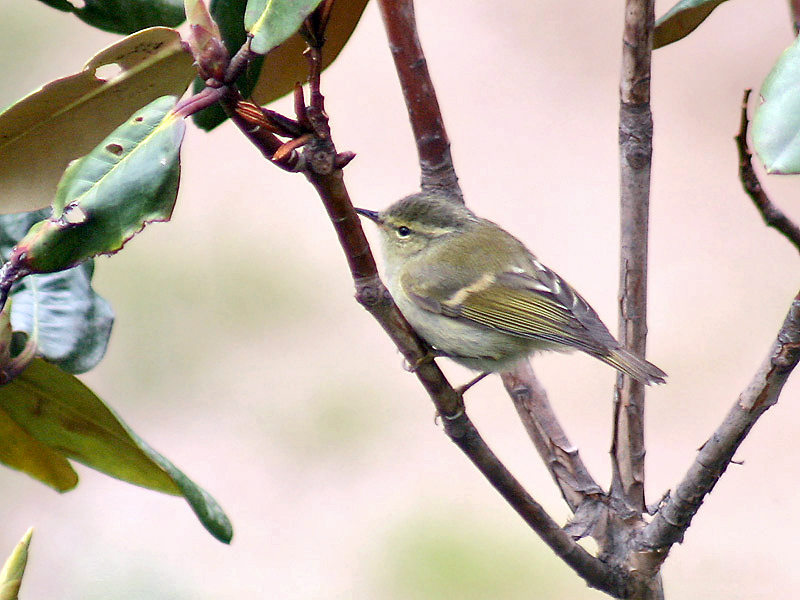
Kamchatka Leaf Warbler Phylloscopus examinandus
The scientific name of the Kamchatka Leaf Warbler is Phylloscopus examinandus. It is a species of bird in the family Phylloscopidae (leaf warbler), order Passeriformes. The name dates from 1913.
- Scientific name
- Phylloscopus examinandus Stresemann, 1913
- Common name
- Kamchatka Leaf Warbler
- Genus
- Phylloscopus
- Family
- Phylloscopidae (Leaf Warbler)
- Order
- Passeriformes
- Class
- Aves
- Red List category
- LC Least Concern
- Recorded in
- 9 countries
- Name status
- accepted in the Catalogue of Life

Overview
The species breeds in Kamchatka, Sakhalin, Hokkaido and the Kurile Islands and migrates to Indonesia and the Philippines. It is closely related to the Arctic warbler and the Japanese leaf warbler, with which it was formerly considered conspecific.
Written 26 November 2026 from the sources listed below. Each statement was checked against the passage it cites; statements that could not be supported were removed.
Habitat
The Kamchatka Leaf Warbler breeds in Kamchatka, Sakhalin, Hokkaido and the Kurile Islands. It migrates to Indonesia and the Philippines.[1][2]
Similar species
The Kamchatka Leaf Warbler is closely related to the Arctic warbler and the Japanese leaf warbler. It was formerly considered conspecific with both species.[3][4]
Conservation
The species was most recently assessed for the IUCN Red List of Threatened Species in 2024.[5]
Classification of the Kamchatka Leaf Warbler
| Kingdom | Animalia |
|---|---|
| Phylum | Chordata |
| Subphylum | Vertebrata |
| Infraphylum | Gnathostomata |
| Parvphylum | Osteichthyes |
| Megaclass | Tetrapoda |
| Class | Aves (Bird) |
| Order | Passeriformes (Passerine) |
| Family | Phylloscopidae (Leaf Warbler) |
| Genus | Phylloscopus (Leaf Warbler) |
| Species | Phylloscopus examinandus Stresemann, 1913 |
Where the Kamchatka Leaf Warbler is found
Checklists and occurrence records place Phylloscopus examinandus in 9 countries. GBIF holds 3,501 georeferenced records of it.
Countries
- China 432
- Finland 6
- Indonesia 270
- Japan 835
- Philippines 799
- Russia 369
- South Korea 606
- Taiwan 111
- Thailand 73
Regions and cities with the most records
- Kamchatka, Russia 233
- Seoul, South Korea 226
- Taytay, Philippines 225
- Seoul, South Korea 223
- Cainta, Philippines 220
- Bel Air, Philippines 202
- Makati City, Philippines 202
- Mandaluyong, Philippines 202
- Mandaluyong City, Philippines 202
- Pasig City, Philippines 202
- San Juan, Philippines 202
- Calumpang, Philippines 201
- Quezon City, Philippines 201
- Pateros, Philippines 200
- Zhejiang, China 200
- Goyang-si, South Korea 193
- Bagong Pagasa, Philippines 191
- Manila, Philippines 189
- Caloocan, Philippines 187
- Bagong Barrio, Philippines 185
- Angono, Philippines 183
- Navotas, Philippines 180
- Ishikawa, Japan 168
- Antipolo, Philippines 160
- Pasay, Philippines 160
- Upper Bicutan, Philippines 158
- Taguig, Philippines 157
- Gwangmyeong, South Korea 152
- Baclaran, Philippines 149
- Guri-si, South Korea 144
- Paranaque City, Philippines 143
- Marikina City, Philippines 140
- Hanam, South Korea 136
- Anyang-si, South Korea 132
- San Mateo, Philippines 131
- Commonwealth, Philippines 129
2 more countries have a few records outside this range
These countries hold a few records of Phylloscopus examinandus but lie outside the range the checklists give for it. Such records are often zoo or garden specimens, museum material or vagrants, so the species is not counted as occurring there.
A number beside a place is its count of GBIF occurrence records. A place without a number comes from a checklist alone. Records show where a species has been observed or collected, which can include escapes and vagrants.
Common names
English
- Kamchatka Leaf Warbler
- Kamchatka Leaf-warbler
Names in 24 other languages
- Chinese
- 勘察加柳鶯, 堪察加柳莺, 堪察加柳鶯
- Croatian
- kamčatski zviždak
- Czech
- budníček kamčatský
- Danish
- Kamchatka Løvsanger
- Dutch
- Kamtsjatkaboszanger
- Esperanto
- kamĉatka filoskopo
- Estonian
- Ainu lehelind
- Finnish
- Kamtshatkanuunilintu, kamtšatkanuunilintu
- French
- Pouillot du Kamtchatka
- German
- Kamtschatkalaubsänger
- Irish
- Ceolaire Caimseatca
- Japanese
- オオムシクイ
- Korean
- 솔새, 큰솔새
- Norwegian
- kamtsjatkasanger
- Polish
- świstunka kamczacka
- Portuguese
- Felosa-de-Camecháteca, felosa-de-kamchatka, felosa-do-camecháteca
- Russian
- Камчатская пеночка, Камчатская таловка
- Serbian
- Zviždak sa Kamčatke
- Slovak
- kolibiarik kamčatský
- Spanish
- Mosquitero de Kamchatka
- Swedish
- kamtjatkanordsångare, kamtjatkasångare
- Thai
- นกกระจิ๊ดคัมชัตกา
- Turkish
- Kamçatka Çıvgını
- Ukrainian
- вівчарик камчатський
Synonyms
One other scientific name has been used for this species and is now treated as a synonym of Phylloscopus examinandus.
- Phylloscopus borealis examinandus Stresemann, EFT, 1913
Related species
-
 Common ChiffchaffPhylloscopus collybita
-
 Willow WarblerPhylloscopus trochilus
-
 Yellow-browed WarblerPhylloscopus inornatus
-
 Arctic WarblerPhylloscopus borealis
-
 Hume's Leaf WarblerPhylloscopus humei
-
 Pallas's Leaf WarblerPhylloscopus proregulus
-
 Greenish WarblerPhylloscopus trochiloides
-
 Dusky WarblerPhylloscopus fuscatus
Compare
Questions and answers
What is the scientific name of the Kamchatka Leaf Warbler?
The scientific name of the Kamchatka Leaf Warbler is Phylloscopus examinandus. Written with its author, the full name is Phylloscopus examinandus Stresemann, 1913.
Which family does the Kamchatka Leaf Warbler belong to?
Phylloscopus examinandus belongs to the family Phylloscopidae, in the order Passeriformes and the class Aves.
Where is the Kamchatka Leaf Warbler found?
Checklists and occurrence records place Phylloscopus examinandus in 9 countries, including Japan, Philippines, South Korea, China, Russia and Indonesia.
What is the conservation status of the Kamchatka Leaf Warbler?
The IUCN Red List category recorded for Phylloscopus examinandus is Least Concern (LC).
What other names does the Kamchatka Leaf Warbler have?
Phylloscopus examinandus is also known in English as Kamchatka Leaf-warbler.
Sources
Passages the profile rests on
- The species breeds in Kamchatka, Sakhalin, Hokkaido and the Kurile Islands. Source passage: “It breeds in Kamchatka, Sakhalin, Hokkaido and the Kurile Islands;” — English Wikipedia
- The species migrates to Indonesia and the Philippines. Source passage: “it migrates to Indonesia and the Philippines.” — English Wikipedia
- The species is closely related to the Arctic warbler and the Japanese leaf warbler. Source passage: “It is closely related to the Arctic warbler and the Japanese leaf warbler,” — English Wikipedia
- The species was formerly considered conspecific with the Arctic warbler and the Japanese leaf warbler. Source passage: “to which it was formerly considered conspecific.” — English Wikipedia
- The species was most recently assessed for the IUCN Red List of Threatened Species in 2024. Source passage: “Kamchatka Leaf-warbler Phylloscopus examinandus has most recently been assessed for The IUCN Red List of Threatened Species in 2024.” — iucnredlist.org
Data
- Catalogue of Life, 2026-10-16 XR cc by
- Global Biodiversity Information Facility CC BY 4.0
- Wikidata CC0
- GeoNames CC BY 4.0
- Wikimedia Commons per image; credit shown with each image
- Within the Catalogue of Life, this name comes from The Integrated Taxonomic Information System cc0
References
- Alström, Per, Takema Saitoh, Dawn Williams, Isao Nishiumi, Yoshimitsu Shigeta, Keisuke Ueda, et al. (2011). The Arctic Warbler Phylloscopus borealis - three anciently separated cryptic species revealed. Ibis, Vol. 153, No. 2.
This species in other databases
Page built on 28 November 2026. See how the catalog is made and all sources and licences.
Cite this page
ScientificNames.org. (2026). Phylloscopus examinandus (Kamchatka Leaf Warbler). Retrieved November 28, 2026, from https://scientificnames.org/species/phylloscopus-examinandus
“Phylloscopus examinandus (Kamchatka Leaf Warbler).” ScientificNames.org, 2026, scientificnames.org/species/phylloscopus-examinandus. Accessed 28 Nov. 2026.
ScientificNames.org. “Phylloscopus examinandus (Kamchatka Leaf Warbler).” Accessed November 28, 2026. https://scientificnames.org/species/phylloscopus-examinandus.
@misc{scientificnames_phylloscopus_examinandus_kamchatka_leaf_warbler,
  author = {{ScientificNames.org}},
  title = {Phylloscopus examinandus (Kamchatka Leaf Warbler)},
  year = {2026},
  url = {https://scientificnames.org/species/phylloscopus-examinandus},
  note = {Accessed 2026-11-28}
}