Species · Birds
Tokara Leaf Warbler Phylloscopus tokaraensis
The scientific name of the Tokara Leaf Warbler is Phylloscopus tokaraensis. It is a species of bird in the family Phylloscopidae (leaf warbler), order Passeriformes. The name dates from 2026.
- Scientific name
- Phylloscopus tokaraensis Saitoh, Shipilina, Xia, Zhang, Seki, Olsson & Alström, 2026
- Common name
- Tokara Leaf Warbler
- Genus
- Phylloscopus
- Family
- Phylloscopidae (Leaf Warbler)
- Order
- Passeriformes
- Class
- Aves
- Name status
- provisionally accepted in the Catalogue of Life
Overview
The species occurs on the Tokara Islands of Japan and has two populations on the islands of Izu and Tokara. It is visually indistinguishable from Ijima's leaf warbler but has a noticeably different song and genetic differences.
Written 26 November 2026 from the sources listed below. Each statement was checked against the passage it cites; statements that could not be supported were removed.
Similar species
Tokara Leaf Warbler is closely related to Ijima's leaf warbler (Phylloscopus ijimae). The two species diverged from a common ancestor approximately 3.2 million years ago.[1][2]
The species is visually indistinguishable from Ijima's leaf warbler but has a noticeably different song and genetic differences. It was formerly considered a population of Ijima's leaf warbler.[3][4][5]
Appearance
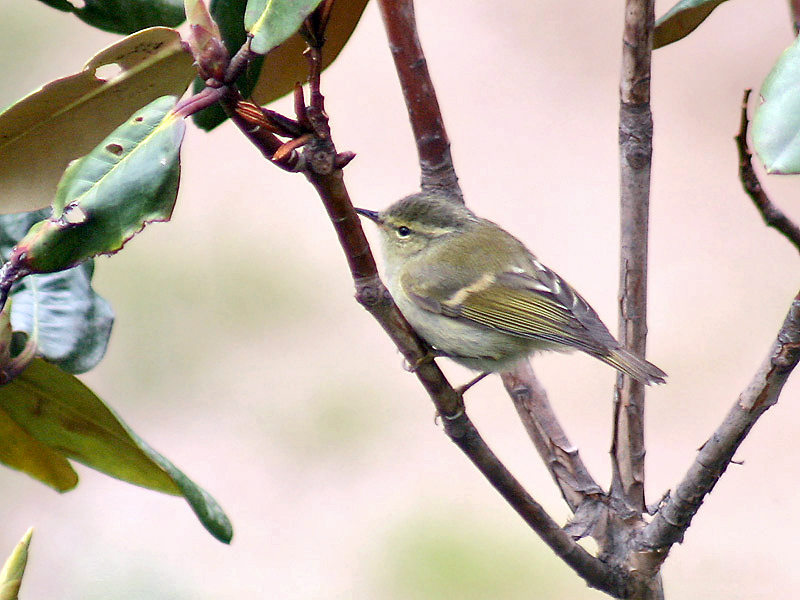
The crown is uniformly grey, without dark or pale stripes. The underside is whitish, with a pale yellow vent.[6][7]
Habitat
The species occurs in broadleaf subtropical forest with bamboo undergrowth on Nakanoshima, Kuchinoshima, Swanosejima and Akusekijima. It primarily breeds in forested habitats with bamboo undergrowth.[8][9]
Behaviour
Ijima's leaf warbler also migrates to the islands occupied by Tokara Leaf Warbler during summer. The Izu population responds to recorded Tokara leaf warbler songs.[10][11]
Reproduction and life cycle
Breeding has been recorded from the last week of April through the last week of May. The species builds globular nests on bamboo of the species Pleioblastus linearis.[12][13][14]
The nests are constructed from bamboo leaves and leaves of other trees, and are lined with feathers, roots and pine needles.[15][16]
The recorded clutch size is three to four eggs. The eggs are pale blue.[17][18]
Classification of the Tokara Leaf Warbler
| Kingdom | Animalia |
|---|---|
| Phylum | Chordata |
| Subphylum | Vertebrata |
| Infraphylum | Gnathostomata |
| Parvphylum | Osteichthyes |
| Megaclass | Tetrapoda |
| Class | Aves (Bird) |
| Order | Passeriformes (Passerine) |
| Family | Phylloscopidae (Leaf Warbler) |
| Genus | Phylloscopus (Leaf Warbler) |
| Species | Phylloscopus tokaraensis Saitoh, Shipilina, Xia, Zhang, Seki, Olsson & Alström, 2026 |
This name was added to the Catalogue of Life from a contributing dataset by automated merging and has not yet been reviewed by its editors.
Common names
English
- Tokara Leaf Warbler
Names in 1 other language
- Japanese
- トカラムシクイ
Related species
-
 Common ChiffchaffPhylloscopus collybita
-
 Willow WarblerPhylloscopus trochilus
-
 Yellow-browed WarblerPhylloscopus inornatus
-
 Arctic WarblerPhylloscopus borealis
-
 Hume's Leaf WarblerPhylloscopus humei
-
 Pallas's Leaf WarblerPhylloscopus proregulus
-
 Greenish WarblerPhylloscopus trochiloides
-
 Dusky WarblerPhylloscopus fuscatus
Compare
Questions and answers
What is the scientific name of the Tokara Leaf Warbler?
The scientific name of the Tokara Leaf Warbler is Phylloscopus tokaraensis. Written with its author, the full name is Phylloscopus tokaraensis Saitoh, Shipilina, Xia, Zhang, Seki, Olsson & Alström, 2026.
Which family does the Tokara Leaf Warbler belong to?
Phylloscopus tokaraensis belongs to the family Phylloscopidae, in the order Passeriformes and the class Aves.
Sources
Passages the profile rests on
- The species is closely related to Ijima's leaf warbler (Phylloscopus ijimae). Source passage: “The species is closely related to the Ijima's leaf warbler (Phylloscopus ijimae)” — English Wikipedia
- The species diverged from a common ancestor with Ijima's leaf warbler approximately 3.2 million years ago. Source passage: “they diverged from a common ancestor 3.2 million years ago.” — English Wikipedia
- The species is visually very similar to Ijima's leaf warbler but has a noticeably different song and genetic differences. Source passage: “They are visually very similar but have noticeably different songs, as well as genetic differences.” — English Wikipedia
- The species was formerly considered a population of Ijima's leaf warbler. Source passage: “In the past, the birds used to be considered as a population of Ijima's leaf warbler.” — English Wikipedia
- The species is visually indistinguishable from Ijima's leaf warbler. Source passage: “The two species are visually indistinguishable.” — English Wikipedia
- The species has a uniformly grey crown without dark or pale stripes. Source passage: “The Tokara and Ijima's leaf warblers both have a uniformly grey crown without dark or pale stripes.” — English Wikipedia
- The underside is whitish, with a pale yellow vent. Source passage: “The underside is whitish with the vent being pale yellow.” — English Wikipedia
- The species occurs in broadleaf subtropical forest with bamboo undergrowth on Nakanoshima, Kuchinoshima, Swanosejima and Akusekijima. Source passage: “On the Nakanoshima, Kuchinoshima, Swanosejim and Akusekijima islands, the species occurs in broadleaf subtropical forest with bamboo undergrowth.” — English Wikipedia
- The species primarily breeds in forested habitats with bamboo undergrowth. Source passage: “mainly in forested habitats with bamboo undergrowth.” — English Wikipedia
- Ijima's leaf warbler also migrates to the islands occupied by the Tokara leaf warbler during summer. Source passage: “Ijima's leaf warbler also migrates to these islands in summer.” — English Wikipedia
- The Izu population responds to recorded Tokara leaf warbler songs. Source passage: “The population found on Izu responds to the song recorded of Tokara” — English Wikipedia
- The species nests on bamboo of the species Pleioblastus linearis. Source passage: “It nests on bamboo (Pleioblastus linearis)” — English Wikipedia
- Breeding has been recorded from the last week of April through the last week of May. Source passage: “Breeding has been recorded from the last week of April to the last week of May.” — English Wikipedia
- The species builds globular nests. Source passage: “The nests are globular” — English Wikipedia
- The nests are constructed from bamboo leaves and leaves of other trees. Source passage: “made from leaves of bamboo and other trees” — English Wikipedia
- The nests are lined with feathers, roots and pine needles. Source passage: “with linings of feathers, roots and pine needles.” — English Wikipedia
- The recorded clutch size is three to four eggs. Source passage: “The clutch consisted of three to four pale blue eggs.” — English Wikipedia
- The species' eggs are pale blue. Source passage: “three to four pale blue eggs.” — English Wikipedia
Data
- Catalogue of Life, 2026-10-16 XR cc by
- Wikidata CC0
- Within the Catalogue of Life, this name comes from ZooBank DarwinCore Checklist Data cc0
References
- Saitoh, Takema, Daria Shipilina, Canwei Xia, Lijun Zhang, Shin-Ichi Seki, Urban Olsson & Per Alström. 2026. SI Appendix: Discovering and protecting cryptic biodiversity: a case study of a previously undescribed, vulnerable bird species in Japan. PNAS Nexus: 1-58. where the name was published
This species in other databases
Page built on 28 November 2026. See how the catalog is made and all sources and licences.
Cite this page
ScientificNames.org. (2026). Phylloscopus tokaraensis (Tokara Leaf Warbler). Retrieved November 28, 2026, from https://scientificnames.org/species/phylloscopus-tokaraensis
“Phylloscopus tokaraensis (Tokara Leaf Warbler).” ScientificNames.org, 2026, scientificnames.org/species/phylloscopus-tokaraensis. Accessed 28 Nov. 2026.
ScientificNames.org. “Phylloscopus tokaraensis (Tokara Leaf Warbler).” Accessed November 28, 2026. https://scientificnames.org/species/phylloscopus-tokaraensis.
@misc{scientificnames_phylloscopus_tokaraensis_tokara_leaf_warbler,
  author = {{ScientificNames.org}},
  title = {Phylloscopus tokaraensis (Tokara Leaf Warbler)},
  year = {2026},
  url = {https://scientificnames.org/species/phylloscopus-tokaraensis},
  note = {Accessed 2026-11-28}
}