Species · Birds
Chinese Leaf Warbler Phylloscopus yunnanensis
The scientific name of the Chinese Leaf Warbler is Phylloscopus yunnanensis. It is a species of bird in the family Phylloscopidae (leaf warbler), order Passeriformes. The name dates from 1922.
- Scientific name
- Phylloscopus yunnanensis La Touche, 1922
- Common name
- Chinese Leaf Warbler
- Genus
- Phylloscopus
- Family
- Phylloscopidae (Leaf Warbler)
- Order
- Passeriformes
- Class
- Aves
- Red List category
- LC Least Concern
- Recorded in
- 7 countries
- Name status
- accepted in the Catalogue of Life

Overview
The Chinese Leaf Warbler is an Old World warbler in the family Phylloscopidae. It inhabits mountainous forests and high-altitude shrubland in confined regions of central and northeastern China. It is distinguished by pale green to olive-green upperparts, a yellowish-white rump, and prominent pale eyebrow stripes.
Written 26 November 2026 from the sources listed below. Each statement was checked against the passage it cites; statements that could not be supported were removed.
Appearance
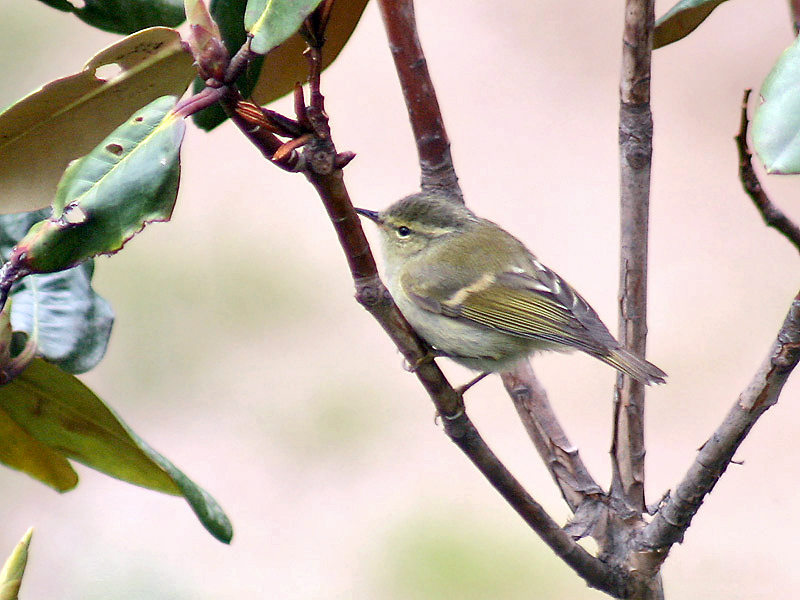
The Chinese Leaf Warbler has a brightly colored, compact body with a slightly elongated shape. Its total body length is approximately 10 cm, and its wings measure approximately 5–6 cm.[1][2][3]
Its upperparts are pale green to olive-green, with a yellowish-white rump and a faint gray wash on the nape. It has a well-defined pale eyebrow stripe, a faint yellow median crown stripe, and dusky-olive lateral crown stripes.[4][5][6]
The species has a slightly forked or notched, almost square-shaped tail and very short, rounded wings. Its short, pointed bill is approximately 1 cm long and dark brown, with a brownish-yellow underside.[7][8][9]
Its tertial feathers are sepia-colored with whitish tips, and its eye has a broken eyering and a dark brown iris. Its legs are slender and very dark, while its claws and toes are dark brownish-grey with dusky buff undersides.[9][10][11][12]
Male and female Chinese Leaf Warblers have similar appearances.[13]
Habitat
The Chinese Leaf Warbler inhabits subtropical or tropical dry forests, mountainous forests, and high-altitude shrubland. It prefers spruce and fir forests and favors low secondary growth.[14][15][16]
The species occurs at elevations between 200 and 2,800 m, usually between 1,000 and 2,600 m.[17]
The Chinese Leaf Warbler is found only in China, in confined regions of central and northeastern China. It is common in Xin Shui, Sichuan Province, China.[18][19][20]
Diet
The Chinese Leaf Warbler feeds on insects while remaining mainly in tree canopies.[21]
Behaviour
The Chinese Leaf Warbler is migratory, although its wintering grounds are unknown. During the breeding season, individuals occur singly or in pairs.[22][23]
The species is generally somewhat bold. Males sing from the tops of trees.[24][25]
Its distinctive song often lasts longer than one minute and consists of a dry, monotonous phrase repeated five times. Its call note consists of loud, varied, irregular sequences of clear scolding whistles.[26][27]
The close-range call is a soft trr-trr sound.[28]
Conservation
The Chinese Leaf Warbler was most recently assessed for the IUCN Red List in 2024.[29]
Classification of the Chinese Leaf Warbler
| Kingdom | Animalia |
|---|---|
| Phylum | Chordata |
| Subphylum | Vertebrata |
| Infraphylum | Gnathostomata |
| Parvphylum | Osteichthyes |
| Megaclass | Tetrapoda |
| Class | Aves (Bird) |
| Order | Passeriformes (Passerine) |
| Family | Phylloscopidae (Leaf Warbler) |
| Genus | Phylloscopus (Leaf Warbler) |
| Species | Phylloscopus yunnanensis La Touche, 1922 |
Where the Chinese Leaf Warbler is found
Checklists and occurrence records place Phylloscopus yunnanensis in 7 countries. GBIF holds 4,018 georeferenced records of it.
Countries
Regions and cities with the most records
- Sichuan, China 689
- Chiang Mai, Thailand 627
- Beijing, China 610
- Hebei, China 459
- Yunnan, China 281
- Gansu, China 235
- Qinghai, China 176
- Zhejiang, China 152
- Shaanxi, China 132
- Beijing, China 129
- Shanxi, China 128
- Tak, Thailand 127
- Hubei, China 97
- Mentougou, China 90
- Qiaotou, China 71
- Kunming, China 68
- Majie, China 68
- Shan State, Myanmar 42
- Pingliang, China 34
- Loei, Thailand 33
- Nan, Thailand 25
- Dali, China 21
- Dali Old Town, China 21
- Haidong Zhen, China 21
- Yinqiao Zhen, China 21
- Wanqiao Zhen, China 20
- Choi Hung Estate, Hong Kong 19
- Choi Wan, Hong Kong 19
- Choi Wan Estate (I & II), Hong Kong 19
- Chuk Yuen, Hong Kong 19
- Chuk Yuen North Estate, Hong Kong 19
- City One, Hong Kong 19
- Fo Tan, Hong Kong 19
- Incheon, South Korea 19
- Kai Tak, Hong Kong 19
- Kam Ying, Hong Kong 19
A number beside a place is its count of GBIF occurrence records. A place without a number comes from a checklist alone. Records show where a species has been observed or collected, which can include escapes and vagrants.
Common names
English
- Chinese Leaf Warbler
- Chinese Leaf-Warbler
Names in 26 other languages
- Catalan
- mosquiter de Sichuan
- Chinese
- 云南柳莺, 雲南柳鶯
- Croatian
- kineski zviždak
- Czech
- budníček s-čchuanský, budníček čínský
- Danish
- Yunnan Løvsanger
- Dutch
- Szechwanboszanger
- Esperanto
- ĉinia filoskopo
- Estonian
- huanghe lehelind
- Finnish
- sichuaninuunilintu, sichuaninuunilintu (setsuaninuunilintu)
- French
- Pouillot du Sichuan
- German
- Sichuanlaubsänger, Yunnanlaubsänger
- Italian
- Luì della Cina
- Japanese
- ウンナンムシクイ, シセンムシクイ
- Korean
- 연노랑허리솔새
- Latvian
- Juņnaņas ķauķītis
- Lithuanian
- sičuaninė pečialinda
- Norwegian
- mandarinsanger
- Polish
- świstunka syczuańska
- Portuguese
- Felosa-de-Iunã, Felosa-de-Iunão, felosa-chinesa, felosa-do-iunão
- Russian
- Амурская пеночка, Китайская зарничка
- Slovak
- kolibiarik ciridavý
- Spanish
- Mosquitero de Sichuán, Mosquitero de Yunnan
- Swedish
- kinesisk sångare
- Thai
- นกกระจิ๊ดพันธุ์จีน
- Turkish
- Yünnan Çıvgını
- Ukrainian
- вівчарик юнанський
Synonyms
5 other scientific names have been used for this species and are now treated as synonyms of Phylloscopus yunnanensis.
- Abrornis yunnanensis yunnanensis La Touche, JDD, 1922
- Phylloscopus proregulus sichuanensis Alström, P; Colston, PR; Olsson, U, 1992
- Phylloscopus proregulus yunnanensis La Touche, JDD, 1922
- Phylloscopus sichuanensis BirdLife International, 2005
- Phylloscopus yunmanensis La Touche, JDD, 1922
Related species
-
 Common ChiffchaffPhylloscopus collybita
-
 Willow WarblerPhylloscopus trochilus
-
 Yellow-browed WarblerPhylloscopus inornatus
-
 Arctic WarblerPhylloscopus borealis
-
 Hume's Leaf WarblerPhylloscopus humei
-
 Pallas's Leaf WarblerPhylloscopus proregulus
-
 Greenish WarblerPhylloscopus trochiloides
-
 Dusky WarblerPhylloscopus fuscatus
Compare
Questions and answers
What is the scientific name of the Chinese Leaf Warbler?
The scientific name of the Chinese Leaf Warbler is Phylloscopus yunnanensis. Written with its author, the full name is Phylloscopus yunnanensis La Touche, 1922.
Which family does the Chinese Leaf Warbler belong to?
Phylloscopus yunnanensis belongs to the family Phylloscopidae, in the order Passeriformes and the class Aves.
Where is the Chinese Leaf Warbler found?
Checklists and occurrence records place Phylloscopus yunnanensis in 7 countries, including China, Thailand, Hong Kong, South Korea, Laos and Myanmar.
What is the conservation status of the Chinese Leaf Warbler?
The IUCN Red List category recorded for Phylloscopus yunnanensis is Least Concern (LC).
What other names does the Chinese Leaf Warbler have?
Phylloscopus yunnanensis is also known in English as Chinese Leaf-Warbler.
Sources
Passages the profile rests on
- The Chinese leaf warbler has a brightly colored, compact body with a slightly elongated shape. Source passage: “The Chinese leaf warbler is a brightly colored, small leaf-warbler, with a total length of around 10 cm and a wing length of 5–6 cm. Its body is slightly elongated and compact.” — English Wikipedia
- The Chinese leaf warbler has a total body length of approximately 10 cm. Source passage: “with a total length of around 10 cm” — English Wikipedia
- Its wings measure approximately 5–6 cm in length. Source passage: “and a wing length of 5–6 cm.” — English Wikipedia
- The upperparts are pale green to olive-green, with a yellowish-white rump. Source passage: “The Chinese leaf warbler is pale green to olive-green above and has a yellowish-white rump.” — English Wikipedia
- The species has a well-defined pale eyebrow stripe, a faint yellow median crown stripe, and dusky-olive lateral crown stripes. Source passage: “The head pattern is noticeable and striking in appearance, with a well-defined pale eyebrow stripe, a faint yellow median crown stripe and dusky-olive lateral crown stripes.” — English Wikipedia
- The species has olive-yellow upperparts with a faint gray wash on the nape. Source passage: “Olive-yellow above with a faint gray wash on the nape.” — ebird.org
- The species has a slightly forked or notched tail that is almost square-shaped. Source passage: “The warbler has a slightly forked or notched tail that is almost square in shape.” — English Wikipedia
- Its short, pointed bill is approximately 1 cm long and dark brown, with a brownish-yellow underside. Source passage: “Its bill is pointed and short (around 1 cm long) and dark brown in color, brownish-yellow on the underside.” — English Wikipedia
- The Chinese leaf warbler has very short, rounded wings and slender, very dark legs. Source passage: “The wings are very short and rounded, the legs slender and very dark.” — English Wikipedia
- Its claws and toes are dark brownish-grey with dusky buff undersides. Source passage: “Claws and toes are dark brownish-grey with dusky buff undersides.” — English Wikipedia
- Its tertial feathers are sepia-colored with whitish tips. Source passage: “The tertial feathers are sepia-colored and have whitish tips.” — English Wikipedia
- The eye has a broken eyering and a dark brown iris. Source passage: “The eye is surrounded by a broken eyering; the iris of the eye is dark brown.” — English Wikipedia
- Male and female Chinese leaf warblers have similar appearances. Source passage: “The sexes are similar in appearance.” — English Wikipedia
- The species inhabits subtropical or tropical dry forests and high-altitude shrubland. Source passage: “Its natural habitats are subtropical or tropical dry forests and subtropical or tropical high-altitude shrubland.” — English Wikipedia
- The Chinese leaf warbler inhabits mountainous forests and prefers spruce and fir forests. Source passage: “It inhabits mountainous forests, preferring spruce and fir.” — English Wikipedia
- The Chinese leaf warbler favors low secondary growth. Source passage: “This species favors low secondary growth.” — English Wikipedia
- The species occurs at elevations between 200 and 2,800 m, usually between 1,000 and 2,600 m. Source passage: “It can be found at elevations of 200–2800 m, but usually between 1000 m and 2600 m.” — English Wikipedia
- The Chinese leaf warbler is found only in China. Source passage: “It is found only in China.” — English Wikipedia
- The species occurs in confined regions of central and northeastern China. Source passage: “The Chinese leaf warbler can be found in confined regions or locations in central and north-eastern China.” — English Wikipedia
- The species is common in Xin Shui, Sichuan Province, China. Source passage: “It is common in Xin Shui, Sichuan Province.” — English Wikipedia
- The Chinese leaf warbler feeds on insects while remaining mainly in tree canopies. Source passage: “They almost always keep to tree canopies, where they feed on insects.” — English Wikipedia
- The species is migratory, although its wintering grounds are unknown. Source passage: “The species is migratory, but its wintering grounds are currently unknown.” — English Wikipedia
- During the breeding season, Chinese leaf warblers occur singly or in pairs. Source passage: “Chinese leaf warblers can be found singly or in pairs during the breeding season.” — English Wikipedia
- The species is generally somewhat bold in personality. Source passage: “These birds are generally somewhat bold in personality.” — English Wikipedia
- Males sing from the tops of trees. Source passage: “Males also sing from the tops of trees.” — English Wikipedia
- The species has a distinctive song that often lasts longer than one minute and consists of a dry, monotonous phrase repeated five times. Source passage: “The song often lasts over a minute and is dry and monotonous tsiridi repeated five times.” — English Wikipedia
- Its call note consists of loud, varied, irregular sequences of clear scolding whistles. Source passage: “The call note is loud and varied, an irregular series of clear scolding whistles of tueet repeated five times” — English Wikipedia
- The close-range call is a soft trr-trr sound. Source passage: “The close-range call is a soft trr-trr.” — English Wikipedia
- The Chinese leaf warbler was most recently assessed for the IUCN Red List in 2024. Source passage: “Chinese Leaf-warbler Phylloscopus yunnanensis has most recently been assessed for The IUCN Red List of Threatened Species in 2024.” — iucnredlist.org
Data
- Catalogue of Life, 2026-10-16 XR cc by
- Global Biodiversity Information Facility CC BY 4.0
- Wikidata CC0
- GeoNames CC BY 4.0
- Wikimedia Commons per image; credit shown with each image
- Within the Catalogue of Life, this name comes from The Integrated Taxonomic Information System cc0
This species in other databases
Page built on 29 November 2026. See how the catalog is made and all sources and licences.
Cite this page
ScientificNames.org. (2026). Phylloscopus yunnanensis (Chinese Leaf Warbler). Retrieved November 29, 2026, from https://scientificnames.org/species/phylloscopus-yunnanensis
“Phylloscopus yunnanensis (Chinese Leaf Warbler).” ScientificNames.org, 2026, scientificnames.org/species/phylloscopus-yunnanensis. Accessed 29 Nov. 2026.
ScientificNames.org. “Phylloscopus yunnanensis (Chinese Leaf Warbler).” Accessed November 29, 2026. https://scientificnames.org/species/phylloscopus-yunnanensis.
@misc{scientificnames_phylloscopus_yunnanensis_chinese_leaf_warbler,
  author = {{ScientificNames.org}},
  title = {Phylloscopus yunnanensis (Chinese Leaf Warbler)},
  year = {2026},
  url = {https://scientificnames.org/species/phylloscopus-yunnanensis},
  note = {Accessed 2026-11-29}
}