Species · Flowering plants
Pariparoba Piper umbellatum
The scientific name of the Pariparoba is Piper umbellatum. It is a species of flowering plant in the family Piperaceae (peppers), order Piperales.
- Scientific name
- Piper umbellatum L.
- Common name
- Pariparoba
- Genus
- Piper
- Family
- Piperaceae (Peppers)
- Order
- Piperales
- Class
- Magnoliopsida
- Recorded in
- 34 countries
- Name status
- accepted in the Catalogue of Life

Overview
Pariparoba (Piper umbellatum L.) is an herbaceous or woody shrub in the family Piperaceae, order Piperales and class Magnoliopsida. It grows in the undergrowth of evergreen forests and along riverbanks. It has large, heart-shaped leaves, white to yellow flower spikes and brownish fruits shaped like inverted pyramids.
Written 26 November 2026 from the sources listed below. Each statement was checked against the passage it cites; statements that could not be supported were removed.
Appearance
Pariparoba has large, heart-shaped leaves. Its flower spikes are white to yellow, and its fruits are brownish and shaped like inverted pyramids.[1][2][3]
The plant grows to a height of 0.9–4 metres.[4]
Habitat
Pariparoba grows in the undergrowth of evergreen forests and along riverbanks.[5][6]
Diet
The young leaves and flowers are eaten steamed as vegetables. The ripe fruits are edible.[7][8][9]
Uses
The species has traditionally been used in folk remedies for digestive and liver-related ailments.[10][11]
The plant has demonstrated antibacterial properties against Helicobacter pylori. Molecules found in the plant demonstrated UVB-protective properties in laboratory testing.[12][13]
Indigenous Kenyah tribesmen in Belaga, Sarawak, Malaysia traditionally consume the species as a leafy vegetable.[14]
Classification of the Pariparoba
| Kingdom | Plantae |
|---|---|
| Subkingdom | Pteridobiotina |
| Phylum | Tracheophyta |
| Class | Magnoliopsida |
| Order | Piperales |
| Family | Piperaceae (Peppers) |
| Subfamily | Piperoideae |
| Genus | Piper (Pepper) |
| Species | Piper umbellatum L. |
Where the Pariparoba is found
Checklists and occurrence records place Piper umbellatum in 34 countries across Africa, Asia, North America and South America. GBIF holds 8,276 georeferenced records of it.
Countries where it is native or its origin is not stated
- Belize 11
- Bolivia 71
- Brazil 2,355
- Cameroon 337
- Colombia 487
- Costa Rica 493
- Cuba 117
- Dominican Republic 102
- Ecuador 235
- El Salvador 153
- Guatemala 125
- Guyana 3
- Haiti 50
- Honduras 99
- Jamaica 100
- Martinique 4
- Mexico 1,151
- Nicaragua 248
- Panama 121
- Paraguay 6
- Peru 229
- Puerto Rico 229
- Suriname 3
- Taiwan 301
- Trinidad and Tobago 11
- United States 16
- Venezuela 71
Countries where it has been introduced
- Cambodia 1
- Democratic Republic of the Congo 342
- Equatorial Guinea 126
- Guinea 36
- India 134
- Madagascar 443
- Thailand 66
Regions and cities with the most records
- São Paulo, Brazil 409
- Veracruz, Mexico 304
- Minas Gerais, Brazil 214
- Taiwan, Taiwan 170
- Curridabat, Costa Rica 166
- San Pedro, Costa Rica 165
- Guadalupe, Costa Rica 164
- San Vicente, Costa Rica 164
- San Vicente de Moravia, Costa Rica 164
- Purral, Costa Rica 163
- Heredia, Costa Rica 157
- San José, Costa Rica 156
- San Diego, Costa Rica 154
- San Juan, Costa Rica 154
- San Pablo, Costa Rica 154
- Bahia, Brazil 148
- Patarrá, Costa Rica 137
- San Miguel, Costa Rica 135
- San José, Costa Rica 129
- São Paulo, Brazil 117
- Chiapas, Mexico 116
- Oaxaca, Mexico 113
- San Felipe, Costa Rica 112
- San Rafael, Costa Rica 112
- San Juan de Dios, Costa Rica 105
- San Rafael Arriba, Costa Rica 104
- Diadema, Brazil 101
- São Caetano do Sul, Brazil 101
- Cartago, Costa Rica 100
- Rio de Janeiro, Brazil 99
- South-West, Cameroon 98
- Aserrí, Costa Rica 96
- Osasco, Brazil 96
- Taboão da Serra, Brazil 96
- Vila Galvão, Brazil 92
- Carapicuíba, Brazil 86
38 more countries have a few records outside this range
These countries hold a few records of Piper umbellatum but lie outside the range the checklists give for it. Such records are often zoo or garden specimens, museum material or vagrants, so the species is not counted as occurring there.
- Afghanistan 5
- Angola 52
- Australia 227
- Burundi 37
- Central African Republic 12
- China 6
- Comoros 30
- Ethiopia 41
- Gabon 227
- Germany 4
- Ghana 77
- Indonesia 198
- Ivory Coast 166
- Japan 6
- Kenya 57
- Liberia 85
- Malawi 8
- Malaysia 106
- Mauritius 26
- Mayotte 49
- Mozambique 16
- Nigeria 51
- Papua New Guinea 103
- Philippines 171
- Republic of the Congo 23
- Reunion 22
- Rwanda 4
- Sao Tome and Principe 39
- Seychelles 18
- Sierra Leone 20
- Solomon Islands 3
- South Africa 6
- Sri Lanka 30
- Sudan 8
- Tanzania 161
- Togo 28
- Uganda 75
- Zimbabwe 11
Range as the checklists state it
Guinea [I]; Bioko Isl. [Fernando Poo] [I]; Annobon Isl. [I]; Equatorial Guinea [I]; D. R. Congo [Zaire] [I]; Madagascar [I]; India [I] (Karnataka [I], Kerala [I], Maharashtra [I], Tamil Nadu [I]); Thailand [I]; Cambodia [I]; Borneo [I]; Sulawesi [I]; Jawa [I]; Lesser Sunda Isl. [I] (Bali [I]); Moluccas [I]; Solomon Isl. [I]; Mexico (Chiapas, Colima, Guerrero, Hidalgo, Jalisco, Mexico State, Michoacán, Morelos, Nayarit, Oaxaca, Puebla, Queretaro, San Luis Potosí, Tabasco, Tamaulipas, Veracruz); Guatemala; Belize; El Salvador; Honduras; Nicaragua; Costa Rica; Panama; Cuba; Jamaica; Hispaniola; Puerto Rico; Trinidad; Colombia (Amazonas, Antioquia, Atlántico, Caldas, Caquetá, Cauca, Chocó, Cundinamarca, Guainía, Magdalena, Norte de Santander, Putumayo, Santander, Valle); Venezuela (Anzoátegui, Aragua, Bolívar, Carabobo, Cojedes, Venezuela Distrito Federal, Falcón, Guárico, Lara, Miranda, Monagas, Portuguesa, Sucre, Táchira, Yaracuy, Zulia); Bolivia (Beni, Cochabamba, La Paz); N-Brazil (Roraima, Amazonas, Acre); NE-Brazil (Ceará, Pernambuco, Bahia, Alagoas); WC-Brazil (Mato Grosso, Goiás); SE-Brazil (Minas Gerais, Espírito Santo, São Paulo, Rio de Janeiro); S-Brazil (Paraná, Rio Grande do Sul, Santa Catarina)
A number beside a place is its count of GBIF occurrence records. A place without a number comes from a checklist alone. Records show where a species has been observed or collected, which can include escapes and vagrants.
Common names
English
- Pariparoba
- Txu Xan Pei Nimeraua
Names in 5 other languages
- Chinese
- da hu jiao, 台灣胡椒, 大胡椒, 臺灣胡椒
- Japanese
- アオイゴショウ
- Portuguese
- caapeba, capeba
- Spanish
- Acuya, acoyo cimarrón, cordoncillo
- cjp
- Kótomo̱
Synonyms
41 other scientific names have been used for this species and are now treated as synonyms of Piper umbellatum.
- Heckeria sidifolia (Link & Otto) Kunth
- Heckeria sidifolia var. subglabrata Kunth
- Heckeria subpeltata (Willd.) Kunth
- Heckeria umbellata (L.) Kunth
- Lepianthes umbellata (L.) Raf.
- Lepianthes umbellata (L.) Raf. ex Ramamoorthy
- Peperidia afzeliana (Roem. & Schult.) Kostel.
- Peperidia sidifolia (Link & Otto) Kostel.
- Peperidia subpeltata (Willd.) Kostel.
- Peperidia umbellata (L.) Kostel.
- Peperomia grandifolia A.Dietr.
- Peperomia sidifolia (Link & Otto) A.Dietr.
- Piper afzelianum Roem. & Schult.
- Piper cuernavacanum C.DC.
- Piper dombeyanum (Miq.) C.DC.
- Piper latifolium Lam.
- Piper sidifolium Link & Otto
- Piper subpeltatum Willd.
- Piper subpeltatum var. parvifolium C.DC.
- Piper subpeltatum var. sidifolium (Link & Otto) C.DC.
- Piper umbellatum var. geminatum C.DC.
- Piper umbellatum var. glabrum C.DC.
- Piper umbellatum var. majus C.DC.
- Piper umbellatum var. subpeltatum (Willd.) C.DC.
- Piper umbellatum var. tomentellum C.DC.
- Piper umbellatum var. vestitum C.DC.
- Pothomorphe allenii Trel.
- Pothomorphe dombeyana Miq.
- Pothomorphe sidifolia (Link & Otto) Miq.
- Pothomorphe subpeltata (Willd.) Miq.
- Pothomorphe umbellata (L.) Miq.
- Pothomorphe umbellata f. glabra (C.DC.) Steyerm.
- Pothomorphe umbellata var. cuernavacana (C.DC.) Trel. & Yunck.
- Pothomorphe umbellata var. glabra (C.DC.) Trel. & Yunck.
- Pothomorphe umbellata var. glabrior Miq.
- Pothomorphe umbellata var. vestita (C.DC.) Yunck.
- Peperomia reniformis (Poir.) A.Dietr. ambiguous synonym
- Peperomia subpeltata (Willd.) A.Dietr. ambiguous synonym
- Peperomia umbellata (L.) Kunth ambiguous synonym
- Piper grandifolium Afzel. ambiguous synonym
Showing 40 of 41.
Related species
-
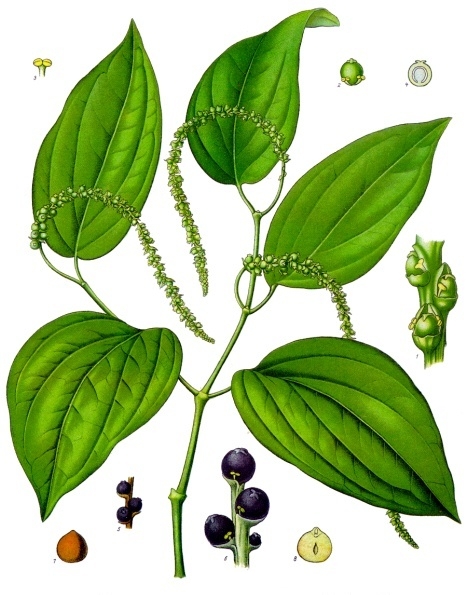 Black PepperPiper nigrum
-
 BetelPiper betle
-
 Long PepperPiper longum
-
 CubebPiper cubeba
-
 Mexican PepperleafPiper auritum
-
 Piper sarmentosum
-
Javanese Long PepperPiper retrofractum
-
 Spiked PepperPiper aduncum
Compare
Questions and answers
What is the scientific name of the Pariparoba?
The scientific name of the Pariparoba is Piper umbellatum. Written with its author, the full name is Piper umbellatum L..
Which family does the Pariparoba belong to?
Piper umbellatum belongs to the family Piperaceae, in the order Piperales and the class Magnoliopsida.
Where is the Pariparoba found?
Checklists and occurrence records place Piper umbellatum in 34 countries, including Brazil, Mexico, Costa Rica, Colombia, Cameroon and Taiwan.
What other names does the Pariparoba have?
Piper umbellatum is also known in English as Txu Xan Pei Nimeraua.
What is piper used for?
Pariparoba is used as a condiment, as a wrapping for pinais in the Philippines, and as a vegetable. It has also been traditionally used in folk remedies for digestive and liver-related ailments.[7][8][15][16][10][11][14]
What are the medicinal uses of Piper Umbellatum?
Pariparoba has traditionally been used in folk remedies for digestive and liver-related ailments. The plant has demonstrated antibacterial properties against Helicobacter pylori, and molecules found in it demonstrated UVB-protective properties in laboratory testing.[10][11][12][13]
Sources
Passages the profile rests on
- Piper umbellatum has large, heart-shaped leaves. Source passage: “It has large heart-shaped leaves.” — English Wikipedia
- Its flower spikes are white to yellow. Source passage: “The flower spikes are white to yellow in color.” — English Wikipedia
- Its fruits are brownish and shaped like inverted pyramids. Source passage: “The fruits are brownish and shaped like an inverted pyramid.” — English Wikipedia
- Piper umbellatum grows to a height of 0.9–4 metres. Source passage: “reaching a height of 0.9 to 4 m (3.0 to 13.1 ft) tall.” — English Wikipedia
- The species grows in the undergrowth of evergreen forests. Source passage: “They grow in the undergrowth of evergreen forests,” — English Wikipedia
- The species grows along riverbanks. Source passage: “and along riverbanks.” — English Wikipedia
- The young leaves are eaten steamed as a vegetable. Source passage: “commonly the young leaves and flowers are eaten steamed as a vegetable.” — English Wikipedia
- The flowers are eaten steamed as a vegetable. Source passage: “commonly the young leaves and flowers are eaten steamed as a vegetable.” — English Wikipedia
- The ripe fruits are edible. Source passage: “The fruit can be eaten when ripe,” — English Wikipedia
- The species has traditionally been used in folk remedies for digestive ailments. Source passage: “The plant has been traditionally used in folk remedies for digestive and liver-related maladies.” — English Wikipedia
- The species has traditionally been used in folk remedies for liver-related ailments. Source passage: “The plant has been traditionally used in folk remedies for digestive and liver-related maladies.” — English Wikipedia
- The plant has demonstrated antibacterial properties against Helicobacter pylori. Source passage: “discovered antibacterial properties of the plant specific to Helicobacter pylori.” — English Wikipedia
- Molecules found in the plant demonstrated UVB-protective properties in laboratory testing. Source passage: “molecules found within the plant were demonstrated to have UVB-protective properties.” — English Wikipedia
- The species is traditionally consumed as a leafy vegetable by indigenous Kenyah tribesmen in Belaga, Sarawak, Malaysia. Source passage: “Wild pepper, Piper umbellatum L. is traditionally consumed as a leafy vegetable by the indigenous Kenyah tribesmen of Belaga, Sarawak, Malaysia.” — academia.edu
- The bark is used as a condiment. Source passage: “and the bark can be used as a condiment.” — English Wikipedia
- In the Philippines, the leaves are used to wrap a steamed shrimp and grated coconut dish called pinais. Source passage: “it is used to wrap a steamed shrimp and grated coconut dish known as pinais.” — English Wikipedia
Data
- Catalogue of Life, 2026-10-16 XR cc by
- Global Biodiversity Information Facility CC BY 4.0
- Wikidata CC0
- GeoNames CC BY 4.0
- Wikimedia Commons per image; credit shown with each image
- Within the Catalogue of Life, this name comes from Synonymic Checklists of the Vascular Plants of the World cc by
References
- L. (1753). Sp. Pl. [Linnaeus] 1: 30 (1753). where the name was published
This species in other databases
- Catalogue of Life 4J6BD
- Wikidata Q3015026
- iNaturalist 285894
- World Flora Online wfo-0000487600
- GRIN 400110
Page built on 27 November 2026. See how the catalog is made and all sources and licences.
Cite this page
ScientificNames.org. (2026). Piper umbellatum (Pariparoba). Retrieved November 27, 2026, from https://scientificnames.org/species/piper-umbellatum
“Piper umbellatum (Pariparoba).” ScientificNames.org, 2026, scientificnames.org/species/piper-umbellatum. Accessed 27 Nov. 2026.
ScientificNames.org. “Piper umbellatum (Pariparoba).” Accessed November 27, 2026. https://scientificnames.org/species/piper-umbellatum.
@misc{scientificnames_piper_umbellatum_pariparoba,
  author = {{ScientificNames.org}},
  title = {Piper umbellatum (Pariparoba)},
  year = {2026},
  url = {https://scientificnames.org/species/piper-umbellatum},
  note = {Accessed 2026-11-27}
}