Species · Flowering plants
Erect Plectorrhiza Plectorrhiza erecta
The scientific name of the Erect Plectorrhiza is Plectorrhiza erecta. It is a species of flowering plant in the family Orchidaceae (orchid), order Asparagales.
- Scientific name
- Plectorrhiza erecta (Fitzg.) Dockrill
- Common name
- Erect Plectorrhiza
- Genus
- Plectorrhiza
- Family
- Orchidaceae (Orchid)
- Order
- Asparagales
- Class
- Liliopsida
- Recorded in
- 1 country
- Name status
- accepted in the Catalogue of Life
Overview
Plectorrhiza erecta has bright green, leathery leaves and yellowish orange flowers with purplish brown blotches and a white to cream-coloured labellum.
Written 27 November 2026 from the sources listed below. Each statement was checked against the passage it cites; statements that could not be supported were removed.
Appearance
The leaves are bright green, leathery and narrowly egg-shaped to oblong. The flowers are yellowish orange with purplish brown blotches.[1][2]
The flowers have a white to cream-coloured labellum with hairy side lobes and a blunt middle lobe. The flower column is purple.[3][4]
The stems measure 100–600 millimetres in length. The leaves measure 30–45 millimetres long and 12–18 millimetres wide.[5][6]
The flowers measure 8–10 millimetres long and 6–8 millimetres wide. The flowering stem measures 30–40 millimetres long.[7][8]
The sepals and petals measure 3–4 millimetres long and approximately 1 millimetre wide. The labellum measures approximately 6 millimetres long and 4 millimetres wide, and the spur measures approximately 2 millimetres long.[9][10][11]
Plants have one unbranched shoot or as many as five branching shoots. The leaves measure 2–4.5 centimetres long and 6–12 millimetres wide.[12][13]
The inflorescence measures 1.5–4.5 centimetres long and bears six to nine flowers.[14]
Habitat
The species grows near the ground on the fibrous bark of trees and shrubs. Its roots spread over bark, leaf litter and nearby rocks.[15][16]
The species occurs near the coast and at elevations up to 530 metres. It mainly grows terrestrially in sandy soil, usually among low shrubs.[17][18]
Its roots grow in surface litter and on shrub bark. The species occurs in closed forest and open clearings.[19][20]
Reproduction and life cycle
Flowering occurs between October and December.[21]
Flowering occurs between November and January.[22]
Flowers of the genus Plectorrhiza are pollinated by native bees. Reproduction in the genus occurs exclusively through seeds.[23][24]
Seed dispersal in the genus takes place 10–12 months after pollination. The genus produces numerous light-coloured, winged seeds.[25][26]
Behaviour
Plants of the genus Plectorrhiza grow mainly during spring and summer and remain relatively quiescent during the rest of the year.[27]
Classification of the Erect Plectorrhiza
| Kingdom | Plantae |
|---|---|
| Subkingdom | Pteridobiotina |
| Phylum | Tracheophyta |
| Class | Liliopsida |
| Order | Asparagales |
| Family | Orchidaceae (Orchid) |
| Genus | Plectorrhiza (Tangle Orchids) |
| Species | Plectorrhiza erecta (Fitzg.) Dockrill |
Where the Erect Plectorrhiza is found
Checklists and occurrence records place Plectorrhiza erecta in 1 country. GBIF holds 30 georeferenced records of it.
Countries
Regions and cities with the most records
A number beside a place is its count of GBIF occurrence records. A place without a number comes from a checklist alone. Records show where a species has been observed or collected, which can include escapes and vagrants.
Common names
English
- Erect Plectorrhiza
Synonyms
4 other scientific names have been used for this species and are now treated as synonyms of Plectorrhiza erecta.
- Cleisostoma erectum Fitzg.
- Sarcanthus erectus (Fitzg.) Rupp
- Sarcochilus erectus (Fitzg.) F.Muell.
- Sarcochilus tridentatus var. erectus (Fitzg.) F.M.Bailey
Related species
-
 Common Tangle OrchidPlectorrhiza tridentata
- Plectorrhiza beckleri
- Plectorrhiza brevilabris
- Plectorrhiza purpurata
-
 VanillaVanilla planifolia
-
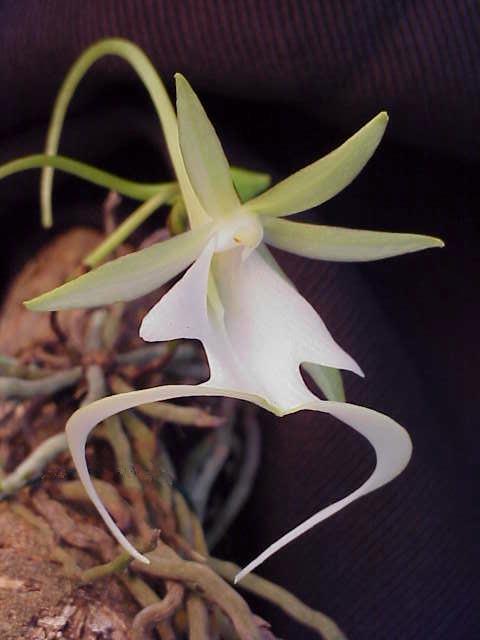 Ghost OrchidDendrophylax lindenii
-
 Noble DendrobiumDendrobium nobile
-
 Bee OrchidOphrys apifera
Compare
Questions and answers
What is the scientific name of the Erect Plectorrhiza?
The scientific name of the Erect Plectorrhiza is Plectorrhiza erecta. Written with its author, the full name is Plectorrhiza erecta (Fitzg.) Dockrill.
Which family does the Erect Plectorrhiza belong to?
Plectorrhiza erecta belongs to the family Orchidaceae, in the order Asparagales and the class Liliopsida.
Where is the Erect Plectorrhiza found?
Checklists and occurrence records place Plectorrhiza erecta in 1 country: Australia.
Sources
Passages the profile rests on
- Its leaves are bright green, leathery and narrowly egg-shaped to oblong. Source passage: “There are many bright green, more or less fleshy, leathery, narrow egg-shaped to oblong leaves” — English Wikipedia
- Its flowers are yellowish orange with purplish brown blotches. Source passage: “Between two and five yellowish orange flowers with purplish brown blotches” — English Wikipedia
- The flowers have a white to cream-coloured labellum with hairy side lobes and a blunt middle lobe. Source passage: “The labellum is white to cream-coloured, about 6 millimetres (0.24 in) long, 4 millimetres (0.16 in) wide with hairy side lobes and a blunt middle lobe.” — English Wikipedia
- The column of the flower is purple. Source passage: “and the column is purple.” — English Wikipedia
- The stems measure 100–600 millimetres in length. Source passage: “stem 100–600 millimetres (3.9–24 in) long.” — English Wikipedia
- The leaves measure 30–45 millimetres long and 12–18 millimetres wide. Source passage: “leaves 30–45 millimetres (1.2–1.8 in) long and 12–18 millimetres (0.47–0.71 in) wide.” — English Wikipedia
- The flowers measure 8–10 millimetres long and 6–8 millimetres wide. Source passage: “8–10 millimetres (0.31–0.39 in) long and 6–8 millimetres (0.24–0.31 in) wide” — English Wikipedia
- The flowering stem measures 30–40 millimetres long. Source passage: “borne on a flowering stem 30–40 millimetres (1.2–1.6 in) long.” — English Wikipedia
- The sepals and petals measure 3–4 millimetres long and approximately 1 millimetre wide. Source passage: “The sepals and petals are fleshy, 3–4 millimetres (0.12–0.16 in) long, about 1 millimetre (0.039 in) wide” — English Wikipedia
- The labellum measures approximately 6 millimetres long and 4 millimetres wide. Source passage: “about 6 millimetres (0.24 in) long, 4 millimetres (0.16 in) wide” — English Wikipedia
- The spur measures approximately 2 millimetres long. Source passage: “a straight spur about 2 millimetres (0.079 in) long” — English Wikipedia
- Plants have one unbranched shoot or as many as five branching shoots. Source passage: “with 1 unbranched shoot or up to 5 branching shoots” — plantnet.rbgsyd.nsw.gov.au
- The leaves measure 2–4.5 centimetres long and 6–12 millimetres wide. Source passage: “Leaves narrowly ovate to oblong, 2–4.5 cm long, 6–12 mm wide” — plantnet.rbgsyd.nsw.gov.au
- The inflorescence measures 1.5–4.5 centimetres long and bears six to nine flowers. Source passage: “Inflorescence 1.5–4.5 cm long, 6–9-flowered” — plantnet.rbgsyd.nsw.gov.au
- The species grows near the ground on the fibrous bark of trees and shrubs. Source passage: “Plectorrhiza erecta grows near the ground on the fibrous bark of trees and shrubs” — English Wikipedia
- Its roots spread over bark, leaf litter and nearby rocks. Source passage: “with its roots spreading over the bark, leaf litter and nearby rocks.” — English Wikipedia
- The species occurs near the coast and at elevations up to 530 metres. Source passage: “It is found near the coast and at altitudes of up to 530 metres (1,700 ft) on Lord Howe Island.” — English Wikipedia
- The species mainly grows terrestrially in sandy soil, usually among low shrubs. Source passage: “P. erecta mainly grows as a terrestrial in sandy soil, usually among low shrubs” — anbg.gov.au
- Its roots grow in surface litter and on shrub bark. Source passage: “with the roots growing in the surface litter and on the bark of the shrubs.” — anbg.gov.au
- The species occurs in closed forest and open clearings. Source passage: “in a variety of sites from closed forest to open clearings” — plantnet.rbgsyd.nsw.gov.au
- Flowering occurs between October and December. Source passage: “Flowering occurs from October to December.” — English Wikipedia
- Flowering occurs between November and January. Source passage: “Flowering: November–January” — plantnet.rbgsyd.nsw.gov.au
- Flowers of the genus Plectorrhiza are pollinated by native bees. Source passage: “The flowers of Plectorrhiza species last many days and are pollinated by native bees.” — anbg.gov.au
- Reproduction in the genus Plectorrhiza occurs exclusively through seeds. Source passage: “Reproduction in Plectorrhiza is solely from seed.” — anbg.gov.au
- Seed dispersal in the genus takes place 10–12 months after pollination. Source passage: “Seed dispersal takes 10-12 months after pollination” — anbg.gov.au
- The genus produces numerous light-coloured, winged seeds. Source passage: “Seeds numerous, light coloured, winged.” — anbg.gov.au
- Plants of the genus Plectorrhiza grow mainly during spring and summer and remain relatively quiescent during the rest of the year. Source passage: “Plants of Plectorrhiza species grow mainly during the spring and summer months and are relatively quiescent for the remainder of the year.” — anbg.gov.au
Data
- Catalogue of Life, 2026-10-16 XR cc by
- Global Biodiversity Information Facility CC BY 4.0
- Wikidata CC0
- GeoNames CC BY 4.0
- Within the Catalogue of Life, this name comes from The World Checklist of Vascular Plants (WCVP) cc by
References
- Australas. Sarcanthinae: 28 (1967) where the name was published
This species in other databases
Page built on 28 November 2026. See how the catalog is made and all sources and licences.
Cite this page
ScientificNames.org. (2026). Plectorrhiza erecta (Erect Plectorrhiza). Retrieved November 28, 2026, from https://scientificnames.org/species/plectorrhiza-erecta
“Plectorrhiza erecta (Erect Plectorrhiza).” ScientificNames.org, 2026, scientificnames.org/species/plectorrhiza-erecta. Accessed 28 Nov. 2026.
ScientificNames.org. “Plectorrhiza erecta (Erect Plectorrhiza).” Accessed November 28, 2026. https://scientificnames.org/species/plectorrhiza-erecta.
@misc{scientificnames_plectorrhiza_erecta_erect_plectorrhiza,
  author = {{ScientificNames.org}},
  title = {Plectorrhiza erecta (Erect Plectorrhiza)},
  year = {2026},
  url = {https://scientificnames.org/species/plectorrhiza-erecta},
  note = {Accessed 2026-11-28}
}