Species · Flowering plants
Common Tangle Orchid Plectorrhiza tridentata
The scientific name of the Common Tangle Orchid is Plectorrhiza tridentata. It is a species of flowering plant in the family Orchidaceae (orchid), order Asparagales.
- Scientific name
- Plectorrhiza tridentata (Lindl.) Dockrill
- Common name
- Common Tangle Orchid
- Genus
- Plectorrhiza
- Family
- Orchidaceae (Orchid)
- Order
- Asparagales
- Class
- Liliopsida
- Recorded in
- 1 country
- Name status
- accepted in the Catalogue of Life

Overview
Plectorrhiza tridentata usually grows on rainforest trees in humid environments, including deep gullies and swamps. Its green or brown flowers are borne on pendulous flowering stems.
Written 27 November 2026 from the sources listed below. Each statement was checked against the passage it cites; statements that could not be supported were removed.
Appearance
The Common tangle orchid has a flattened main stem measuring 100–300 mm in length, suspended by one to a few aerial roots. It has between three and twenty green to purplish, leathery leaves that are narrowly elliptic, egg-shaped or oblong.[1][2][3][4]
Its leaves measure 50–100 mm long and 10–15 mm wide. Its flowering stems are pendulous and measure 50–120 mm long.[5][6][7]
Its flowers are green or brown and number between three and fifteen per flowering stem. They measure 5–6 mm long and 6–8 mm wide.[8][9]
The sepals and petals are separate and spread widely apart. The dorsal sepal measures 4–5 mm long and approximately 2 mm wide, while the lateral sepals are slightly longer. The petals measure 4–5 mm long and approximately 1.5 mm wide.[10][11][12][13]
Its white labellum has a green patch and three lobes, and measures 6–7 mm long and approximately 4 mm wide. The approximately triangular side lobes curve outwards, while the blunt middle lobe bears a curved spur measuring approximately 2 mm long.[14][15][16][17][18]
Habitat
The Common tangle orchid usually grows on trees in humid environments. Its recorded habitats include deep gullies and swamps, and it grows on rainforest trees.[19][20][21]
Reproduction and life cycle
Flowering occurs between September and January.[22]
Classification of the Common Tangle Orchid
| Kingdom | Plantae |
|---|---|
| Subkingdom | Pteridobiotina |
| Phylum | Tracheophyta |
| Class | Liliopsida |
| Order | Asparagales |
| Family | Orchidaceae (Orchid) |
| Genus | Plectorrhiza (Tangle Orchids) |
| Species | Plectorrhiza tridentata (Lindl.) Dockrill |
Where the Common Tangle Orchid is found
Checklists and occurrence records place Plectorrhiza tridentata in 1 country across Oceania. GBIF holds 1,471 georeferenced records of it.
Countries
Regions and cities with the most records
- New South Wales, Australia 1,109
- Victoria, Australia 166
- Queensland, Australia 152
- Hornsby, Australia 55
- Central Coast, Australia 33
- Port Macquarie, Australia 26
- Taree, Australia 24
- Cessnock, Australia 23
- Parramatta, Australia 23
- Wollongong, Australia 22
- Coffs Harbour, Australia 17
- Liverpool, Australia 14
- Gold Coast, Australia 9
- Maitland, Australia 8
- Batemans Bay, Australia 7
- Newcastle, Australia 5
- Toowoomba, Australia 3
A number beside a place is its count of GBIF occurrence records. A place without a number comes from a checklist alone. Records show where a species has been observed or collected, which can include escapes and vagrants.
Common names
English
- Common Tangle Orchid
Synonyms
8 other scientific names have been used for this species and are now treated as synonyms of Plectorrhiza tridentata.
- Cleisostoma cornutum Rupp
- Cleisostoma tridentatum Lindl.
- Saccolabium calcaratum F.Muell.
- Sarcanthus tridentatus (Lindl.) Rupp
- Sarcochilus calcaratus (F.Muell.) F.Muell.
- Sarcochilus tridentatus (Lindl.) Rchb.f.
- Thrixspermum tridentatum (Lindl.) Rchb.f.
- Thrixspermum tridentatum (Lindl.) P.F.Hunt
Related species
- Erect PlectorrhizaPlectorrhiza erecta
- Plectorrhiza beckleri
- Plectorrhiza brevilabris
- Plectorrhiza purpurata
-
 VanillaVanilla planifolia
-
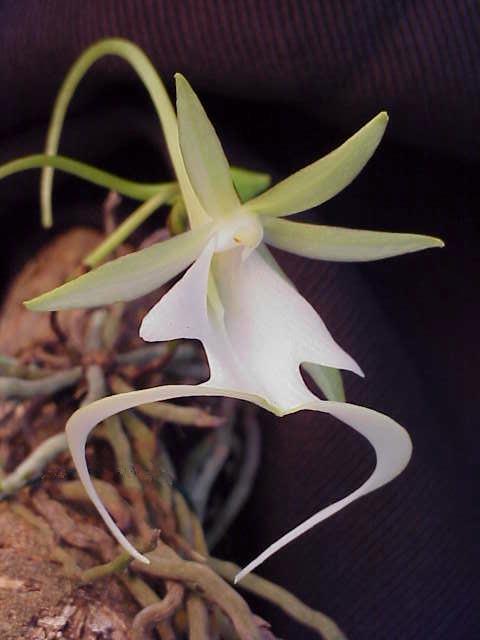 Ghost OrchidDendrophylax lindenii
-
 Noble DendrobiumDendrobium nobile
-
 Bee OrchidOphrys apifera
Compare
Questions and answers
What is the scientific name of the Common Tangle Orchid?
The scientific name of the Common Tangle Orchid is Plectorrhiza tridentata. Written with its author, the full name is Plectorrhiza tridentata (Lindl.) Dockrill.
Which family does the Common Tangle Orchid belong to?
Plectorrhiza tridentata belongs to the family Orchidaceae, in the order Asparagales and the class Liliopsida.
Where is the Common Tangle Orchid found?
Checklists and occurrence records place Plectorrhiza tridentata in 1 country: Australia.
Sources
Passages the profile rests on
- Its main stem is flattened and suspended by one to a few aerial roots. Source passage: “a single main flattened stem, 100–300 millimetres (3.9–12 in) long suspended by one to a few of its many tangled aerial roots.” — English Wikipedia
- Its main stem measures 100–300 mm in length. Source passage: “100–300 millimetres (3.9–12 in) long” — English Wikipedia
- The species has between three and twenty green to purplish, leathery leaves. Source passage: “There are between three and twenty green to purplish, leathery” — English Wikipedia
- Its leaves are narrowly elliptic, egg-shaped or oblong. Source passage: “narrowly elliptic to egg-shaped leaves, sometimes with the narrower end towards the base, or oblong” — English Wikipedia
- Its leaves measure 50–100 mm long and 10–15 mm wide. Source passage: “50–100 millimetres (2.0–3.9 in) long and 10–15 millimetres (0.39–0.59 in) wide.” — English Wikipedia
- Its flowers are borne on pendulous flowering stems. Source passage: “are borne on a pendulous flowering stem” — English Wikipedia
- Its flowering stems measure 50–120 mm long. Source passage: “50–120 millimetres (2.0–4.7 in) long.” — English Wikipedia
- Its flowers are green or brown and number between three and fifteen per flowering stem. Source passage: “Between three and fifteen green or brown flowers” — English Wikipedia
- Its flowers measure 5–6 mm long and 6–8 mm wide. Source passage: “5–6 millimetres (0.20–0.24 in) long and 6–8 millimetres (0.24–0.31 in) wide” — English Wikipedia
- Its sepals and petals are separate from one another and spread widely apart. Source passage: “The sepals and petals are free from each other and spread widely apart.” — English Wikipedia
- Its dorsal sepal is 4–5 mm long and approximately 2 mm wide. Source passage: “The dorsal sepal is 4–5 millimetres (0.16–0.20 in) long, about 2 millimetres (0.079 in) wide” — English Wikipedia
- Its lateral sepals are slightly longer than its dorsal sepal. Source passage: “and the lateral sepals are slightly longer.” — English Wikipedia
- Its petals measure 4–5 mm long and approximately 1.5 mm wide. Source passage: “The petals are 4–5 millimetres (0.16–0.20 in) long, about 1.5 millimetres (0.059 in) wide.” — English Wikipedia
- Its labellum is white with a green patch and has three lobes. Source passage: “The labellum is white with a green patch, 6–7 millimetres (0.24–0.28 in) long, about 4 millimetres (0.16 in) wide with three lobes.” — English Wikipedia
- Its labellum measures 6–7 mm long and approximately 4 mm wide. Source passage: “6–7 millimetres (0.24–0.28 in) long, about 4 millimetres (0.16 in) wide” — English Wikipedia
- Its labellum has approximately triangular side lobes that curve outwards. Source passage: “The side lobes are more or less triangular and curve outwards” — English Wikipedia
- Its middle labellum lobe is blunt and bears a curved spur. Source passage: “the middle lobe is blunt with a curved spur” — English Wikipedia
- Its labellum spur measures approximately 2 mm long. Source passage: “about 2 millimetres (0.079 in) long.” — English Wikipedia
- The species usually grows on trees in humid environments. Source passage: “Plectorrhiza tridentata usually grows on trees in humid places” — English Wikipedia
- Its recorded habitats include deep gullies and swamps. Source passage: “such as deep gullies and swamps.” — English Wikipedia
- The species grows on rainforest trees. Source passage: “It grows on rainforest trees” — English Wikipedia
- Flowering occurs between September and January. Source passage: “Flowering occurs from September to January.” — English Wikipedia
Data
- Catalogue of Life, 2026-10-16 XR cc by
- Global Biodiversity Information Facility CC BY 4.0
- Wikidata CC0
- GeoNames CC BY 4.0
- Wikimedia Commons per image; credit shown with each image
- Within the Catalogue of Life, this name comes from The World Checklist of Vascular Plants (WCVP) cc by
References
- Australas. Sarcanthinae: 27 (1967) where the name was published
This species in other databases
Page built on 27 November 2026. See how the catalog is made and all sources and licences.
Cite this page
ScientificNames.org. (2026). Plectorrhiza tridentata (Common Tangle Orchid). Retrieved November 27, 2026, from https://scientificnames.org/species/plectorrhiza-tridentata
“Plectorrhiza tridentata (Common Tangle Orchid).” ScientificNames.org, 2026, scientificnames.org/species/plectorrhiza-tridentata. Accessed 27 Nov. 2026.
ScientificNames.org. “Plectorrhiza tridentata (Common Tangle Orchid).” Accessed November 27, 2026. https://scientificnames.org/species/plectorrhiza-tridentata.
@misc{scientificnames_plectorrhiza_tridentata_common_tangle_orchid,
  author = {{ScientificNames.org}},
  title = {Plectorrhiza tridentata (Common Tangle Orchid)},
  year = {2026},
  url = {https://scientificnames.org/species/plectorrhiza-tridentata},
  note = {Accessed 2026-11-27}
}