Species · Birds
Asian Golden Weaver Ploceus hypoxanthus
The scientific name of the Asian Golden Weaver is Ploceus hypoxanthus. It is a species of bird in the family Ploceidae (bishops), order Passeriformes. The name dates from 1788.
- Scientific name
- Ploceus hypoxanthus (Sparrman, 1788)
- Common name
- Asian Golden Weaver
- Genus
- Ploceus
- Family
- Ploceidae (Bishops)
- Order
- Passeriformes
- Class
- Aves
- Red List category
- NT Near Threatened
- Recorded in
- 8 countries
- Name status
- accepted in the Catalogue of Life

Overview
The Asian Golden Weaver is a bird with two recognized subspecies. It inhabits lowland areas close to water in Cambodia, Indonesia, Laos, Myanmar, Thailand and Vietnam. The breeding male is generally bright yellow with a black facial mask.
Written 26 November 2026 from the sources listed below. Each statement was checked against the passage it cites; statements that could not be supported were removed.
Similar species
Females, non-breeding males and juveniles can be difficult to distinguish from Baya Weavers. Females, non-breeding males and young birds have thicker bills than the Baya Weaver.[1][2]
Appearance
The breeding male is generally bright yellow with a black facial mask. It has a dark bill and scaly speckling on its back.[3][4]
The species has yellow and black upperparts, yellow underparts, a black face, a yellow crown and a strong black bill. It is also described as a bright yellow finch with a thick, powerful bill.[5][6][7]
Females, non-breeding males and young birds have duller plumage than breeding males. They also have thicker bills than the Baya Weaver.[8][1]
The species has an average body length of 22 centimetres.[9]
Habitat
The Asian Golden Weaver inhabits subtropical or tropical seasonally wet or flooded lowland grasslands. It generally occupies lowland habitats close to water.[10][11]
It occurs in swamps and agricultural land. Common habitats include marshes, rice paddies, flooded grasslands and swamps.[12][13]
The species occurs in Cambodia, Indonesia, Laos, Myanmar, Thailand and Vietnam.[14]
Diet
The species feeds mainly on seeds. During breeding, insects account for approximately 7% of its diet.[15][16]
Behaviour
The Asian Golden Weaver is primarily resident rather than migratory.[17]
Reproduction and life cycle
The species is generally considered monogamous, although occasional polygamy has been reported. It breeds in small colonies.[18][19]
The male initially constructs the nest, which the female subsequently helps complete. The nest is rounded, has a side entrance and is woven from thin strips of grass or palm leaves.[20][21][22]
Nests are attached to vegetation over water or very swampy ground. They are often positioned in reeds or bulrushes less than one metre above the surface, although some are built in trees or shrubs at heights exceeding two metres.[23][24][25]
Some nests have been recorded near hornet nests or biting ants.[26]
The average clutch contains two to three eggs, which are often greyish-white. The female alone incubates the eggs.[27][28][29]
The female provides most of the food to the chicks, with occasional help from the male.[30]
Conservation
The Asian Golden Weaver is classified as Near Threatened. Habitat loss threatens the species.[31][32]
Wetland conversion to agriculture is associated with continuing population decline across the species' range. The species has experienced local declines and is now rare in Java and Sumatra.[33][34]
The species is subject to direct persecution and capture for the bird trade. Breeding colonies are sometimes robbed and destroyed by people.[35][36]
Classification of the Asian Golden Weaver
| Kingdom | Animalia |
|---|---|
| Phylum | Chordata |
| Subphylum | Vertebrata |
| Infraphylum | Gnathostomata |
| Parvphylum | Osteichthyes |
| Megaclass | Tetrapoda |
| Class | Aves (Bird) |
| Order | Passeriformes (Passerine) |
| Family | Ploceidae (Bishops) |
| Genus | Ploceus (Typical Weavers) |
| Species | Ploceus hypoxanthus (Sparrman, 1788) |
Where the Asian Golden Weaver is found
Checklists and occurrence records place Ploceus hypoxanthus in 8 countries across Asia. GBIF holds 17,991 georeferenced records of it.
Countries
Regions and cities with the most records
- Khlong Sam Wa, Thailand 2,992
- Tak, Thailand 2,372
- Bangkok, Thailand 2,223
- Ban Khlong Prawet, Thailand 2,143
- Lat Krabang, Thailand 2,048
- Suan Luang, Thailand 1,993
- Bang Kapi, Thailand 1,962
- Bueng Kum, Thailand 1,961
- Nong Chok, Thailand 1,959
- Saphan Sung, Thailand 1,957
- Khan Na Yao, Thailand 1,945
- Sai Mai, Thailand 1,882
- Ban Khlong Bang Sao Thong, Thailand 1,820
- Bang Bo District, Thailand 1,803
- Ban Lam Luk Ka, Thailand 1,725
- Ban Bang Kadi, Thailand 1,718
- Pathum Thani, Thailand 1,628
- Khlong Luang, Thailand 1,617
- Phetchaburi, Thailand 1,281
- Phetchaburi, Thailand 1,099
- Khao Yoi, Thailand 997
- Sukhothai, Thailand 991
- Khon Kaen, Thailand 930
- Wang Noi, Thailand 837
- Nakhon Pathom, Thailand 803
- Bang Na, Thailand 748
- Phra Khanong, Thailand 732
- Bang Kruai, Thailand 731
- Khlong Toei, Thailand 728
- Thon Buri, Thailand 726
- Wang Thonglang, Thailand 700
- Phra Nakhon, Thailand 695
- Taling Chan, Thailand 695
- Ban Khlong Bang Ramat, Thailand 693
- Ban Bang Bamru, Thailand 690
- Pathum Wan, Thailand 689
A number beside a place is its count of GBIF occurrence records. A place without a number comes from a checklist alone. Records show where a species has been observed or collected, which can include escapes and vagrants.
Common names
English
- Asian Golden Weaver
Names in 29 other languages
- Arabic
- حباك ذهبي آسيوي
- Catalan
- teixidor daurat asiàtic
- Chinese
- 亚洲金织雀, 亞洲金織布鳥, 金色織布鳥
- Croatian
- zlatna pletilja
- Czech
- snovač dlaskozobý
- Danish
- Gulbrystet Bayavæver
- Dutch
- Geelbuikbayawever
- Esperanto
- orventra teksbirdo
- Finnish
- aasiankultakutoja
- French
- Tisserin doré
- German
- Kernbeißerweber
- Indonesian
- Manyar emas
- Italian
- Tessitore dorato asiatico
- Japanese
- キンイロコウヨウジャク
- Khmer
- ចាកពួកទ្រូងលឿង
- Lithuanian
- azijinis audėjas
- Norwegian
- risvever
- Persian
- جولای طلایی آسیایی
- Polish
- wikłacz złotobrzuchy
- Portuguese
- tecelão-dourado, tecelão-dourado-asiático, tecelão-dourado-oriental
- Russian
- Азиатский золотой ткач, Желтобрюхий ткач
- Serbian
- Jakokljuna tkalja
- Slovak
- pletiarka zlatá
- Spanish
- Tejedor dorado asiático
- Swedish
- risvävare
- Thai
- นกกระจาบทอง, นกจาบทอง
- Turkish
- Asya Altın Dokumacısı
- Ukrainian
- ткачик золоточеревий
- Welsh
- gwehydd euraid Asia
Synonyms
2 other scientific names have been used for this species and are now treated as synonyms of Ploceus hypoxanthus.
- Loxia hypoxantha Sparrman, A, 1788
- Loxia sumatrana Forster, JR, 1795
Subspecies and varieties
- Ploceus hypoxanthus chryseus subspecies
- Ploceus hypoxanthus hymenaicus subspecies
- Ploceus hypoxanthus hypoxanthus subspecies
Related species
-
 Southern Masked WeaverPloceus velatus
-
 Village WeaverPloceus cucullatus
-
 Cape WeaverPloceus capensis
-
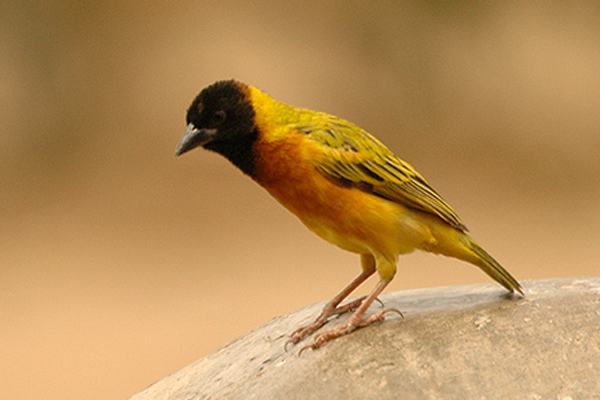 Black-headed WeaverPloceus melanocephalus
-
 Eastern Golden WeaverPloceus subaureus
-
 Baglafecht WeaverPloceus baglafecht
-
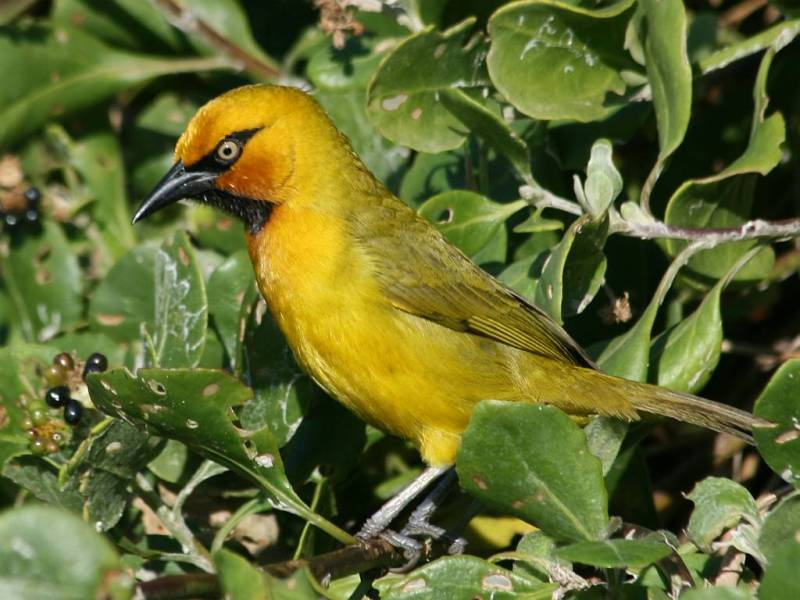 Spectacled WeaverPloceus ocularis
-
 Streaked WeaverPloceus manyar
Compare
Questions and answers
What is the scientific name of the Asian Golden Weaver?
The scientific name of the Asian Golden Weaver is Ploceus hypoxanthus. Written with its author, the full name is Ploceus hypoxanthus (Sparrman, 1788).
Which family does the Asian Golden Weaver belong to?
Ploceus hypoxanthus belongs to the family Ploceidae, in the order Passeriformes and the class Aves.
Where is the Asian Golden Weaver found?
Checklists and occurrence records place Ploceus hypoxanthus in 8 countries, including Thailand, Cambodia, Myanmar, Singapore, Indonesia and Laos.
What is the conservation status of the Asian Golden Weaver?
The IUCN Red List category recorded for Ploceus hypoxanthus is Near Threatened (NT).
What is special about the weaver bird?
The Asian Golden Weaver builds rounded nests with side entrances, woven from thin strips of grass or palm leaves. The male initially constructs the nest, and the female subsequently helps complete it.[20][21][22]
How long do weaver birds live?
The oldest recorded Asian Golden Weaver was 11 years old.[37]
Do weaver birds mate for life?
The Asian Golden Weaver is generally considered monogamous, although occasional polygamy has been reported.[18]
Sources
Passages the profile rests on
- Females, non-breeding males and young birds have thicker bills than the Baya Weaver. Source passage: “with their thicker bills being the only thing that sets them apart.” — English Wikipedia
- Females, non-breeding males and juveniles can be difficult to distinguish from Baya Weavers. Source passage: “Females, non-breeding males and young birds are dull coloured and difficult to distinguish from the Baya Weaver” — English Wikipedia
- The breeding male is generally bright yellow with a black facial mask. Source passage: “The breeding male is generally bright yellow with a black mask (diagnostic in Asia).” — English Wikipedia
- The breeding male has a dark bill and scaly speckling on its back. Source passage: “Male is daffodil-yellow with a black mask, dark bill, and scaly speckling on the back.” — ebird.org
- The species has yellow and black upperparts and yellow underparts. Source passage: “In general, Asian golden weavers are considered medium-sized birds with yellow and black upperparts, along with yellow underparts.” — English Wikipedia
- The species has a black face, yellow crown and strong black bill. Source passage: “They possess a black face, yellow crown, a strong black bill” — English Wikipedia
- The species is described as a bright yellow finch with a thick, powerful bill. Source passage: “Bright yellow finch with a thick, powerful bill.” — ebird.org
- Females, non-breeding males and young birds have duller plumage than breeding males. Source passage: “Females, non-breeding males and young birds are dull coloured and difficult to distinguish from the Baya Weaver” — English Wikipedia
- The species has an average body length of 22 centimetres. Source passage: “and have an average length of 22 centimeters.” — English Wikipedia
- The species inhabits subtropical or tropical seasonally wet or flooded lowland grasslands. Source passage: “Its natural habitats are subtropical or tropical seasonally wet or flooded lowland grassland, swamps, and arable land.” — English Wikipedia
- The species generally occupies lowland habitats close to water. Source passage: “The most common habitats of the Asian golden weaver would include the lowlands, usually those with a close proximity to water” — English Wikipedia
- The species occurs in swamps and agricultural land. Source passage: “Its natural habitats are subtropical or tropical seasonally wet or flooded lowland grassland, swamps, and arable land.” — English Wikipedia
- The species commonly inhabits marshes, rice paddies, flooded grasslands and swamps. Source passage: “some of these areas would involve marshes, rice paddies, flooded grasslands, and swamps.” — English Wikipedia
- The species occurs in Cambodia, Indonesia, Laos, Myanmar, Thailand and Vietnam. Source passage: “It is found in Cambodia, Indonesia, Laos, Myanmar, Thailand, and Vietnam.” — English Wikipedia
- The species feeds mainly on seeds. Source passage: “In addition, this weaver feeds mainly on seeds” — English Wikipedia
- Insects account for approximately 7% of the species' diet during breeding. Source passage: “during breeding, insects usually account for only 7% of their diet.” — English Wikipedia
- The species is primarily resident rather than migratory. Source passage: “Asian golden weavers are primarily presumed residents” — English Wikipedia
- The species is generally considered monogamous, although occasional polygamy has been reported. Source passage: “It is widely believed that the Asian Golden Weaver is monogamous, with some rare cases of polygamy.” — English Wikipedia
- The species breeds in small colonies. Source passage: “It breeds in small colonies” — English Wikipedia
- The male initially constructs the nest, which the female subsequently helps complete. Source passage: “the nest is initially created by the male, and completed with assistance of the female.” — English Wikipedia
- The nest is rounded and has a side entrance. Source passage: “The nest is a rounded structure with a side entrance” — English Wikipedia
- The nest is woven from thin strips of grass or palm leaves. Source passage: “woven from thin strips of grass or palm leaves.” — English Wikipedia
- Nests are attached to vegetation over water or very swampy ground. Source passage: “Nests are firmly attached to vegetation over water or very swampy ground” — English Wikipedia
- Nests are often positioned in reeds or bulrushes less than one metre above the surface. Source passage: “often less than 1m above the surface, usually in reeds or bulrushes.” — English Wikipedia
- Some nests are built in trees or shrubs at heights exceeding two metres. Source passage: “Sometimes nests are placed in trees or shrubs, and then higher than 2 m above the ground.” — English Wikipedia
- Some nests have been recorded near hornet nests or biting ants. Source passage: “There are several records of nests built close to hornet nests or near biting ants.” — English Wikipedia
- The average clutch contains two to three eggs. Source passage: “The average clutch size ranges from two to three eggs” — English Wikipedia
- The eggs are often greyish-white. Source passage: “these eggs often have a greyish-white color.” — English Wikipedia
- The female alone incubates the eggs. Source passage: “Incubation is done by the female only” — English Wikipedia
- The female provides most of the food to the chicks, with occasional help from the male. Source passage: “the chicks are fed mainly by the female, with occasional assistance by the male.” — English Wikipedia
- The species is classified as Near Threatened. Source passage: “it still possesses a conservation status of Near Threatened” — English Wikipedia
- Habitat loss threatens the species. Source passage: “It is threatened by habitat loss and capture, notably for the merit release trade.” — English Wikipedia
- Wetland conversion to agriculture is associated with continuing population decline across the species' range. Source passage: “Its population is showing a continued decline throughout its range as wetlands are converted to agriculture.” — English Wikipedia
- The species has experienced local declines and is now rare in Java and Sumatra. Source passage: “The Asian Golden Weaver was formerly more ordinary in the areas of Java and Sumatra, but it is now localized and considered rare in today's age.” — English Wikipedia
- The species is subject to direct persecution and capture for the bird trade. Source passage: “There is also direct persecution and capture of these weavers for the bird trade” — English Wikipedia
- Breeding colonies are sometimes robbed and destroyed by people. Source passage: “colonies are often robbed and destroyed by people.” — English Wikipedia
- The oldest recorded individual was 11 years old. Source passage: “The oldest bird is 11 years of age.” — English Wikipedia
Data
- Catalogue of Life, 2026-10-16 XR cc by
- Global Biodiversity Information Facility CC BY 4.0
- Wikidata CC0
- GeoNames CC BY 4.0
- Wikimedia Commons per image; credit shown with each image
- Within the Catalogue of Life, this name comes from The Integrated Taxonomic Information System cc0
References
- Gill, Frank, & and Minturn Wright. (2006). Birds of the World: Recommended English Names.
This species in other databases
Page built on 27 November 2026. See how the catalog is made and all sources and licences.
Cite this page
ScientificNames.org. (2026). Ploceus hypoxanthus (Asian Golden Weaver). Retrieved November 27, 2026, from https://scientificnames.org/species/ploceus-hypoxanthus
“Ploceus hypoxanthus (Asian Golden Weaver).” ScientificNames.org, 2026, scientificnames.org/species/ploceus-hypoxanthus. Accessed 27 Nov. 2026.
ScientificNames.org. “Ploceus hypoxanthus (Asian Golden Weaver).” Accessed November 27, 2026. https://scientificnames.org/species/ploceus-hypoxanthus.
@misc{scientificnames_ploceus_hypoxanthus_asian_golden_weaver,
  author = {{ScientificNames.org}},
  title = {Ploceus hypoxanthus (Asian Golden Weaver)},
  year = {2026},
  url = {https://scientificnames.org/species/ploceus-hypoxanthus},
  note = {Accessed 2026-11-27}
}