Species · Flowering plants
Myrtle-leaf Milkwort Polygala myrtifolia
The scientific name of the Myrtle-leaf Milkwort is Polygala myrtifolia. It is a species of flowering plant in the family Polygalaceae (milkwort family), order Fabales.
- Scientific name
- Polygala myrtifolia L.
- Common name
- Myrtle-leaf Milkwort
- Genus
- Polygala
- Family
- Polygalaceae (Milkwort Family)
- Order
- Fabales
- Class
- Magnoliopsida
- Recorded in
- 14 countries
- Name status
- accepted in the Catalogue of Life

Overview
Polygala myrtifolia is native to South Africa's southern and south-eastern coastal regions, where it occurs on coastal dunes, along forest margins and in open grassland. It is distinguished by sweet pea-like flowers with a brush-like tuft extending from the keel and an intricate piston pollination mechanism.
Written 26 November 2026 from the sources listed below. Each statement was checked against the passage it cites; statements that could not be supported were removed.
Appearance
Myrtle-leaf milkwort is an evergreen shrub or small tree. Its leaves are thin, oval and mucronate, with entire margins, measuring 25–50 mm in length and up to 13 mm in width. Some forms have thin, needle-like leaves.[1][2][3][4]
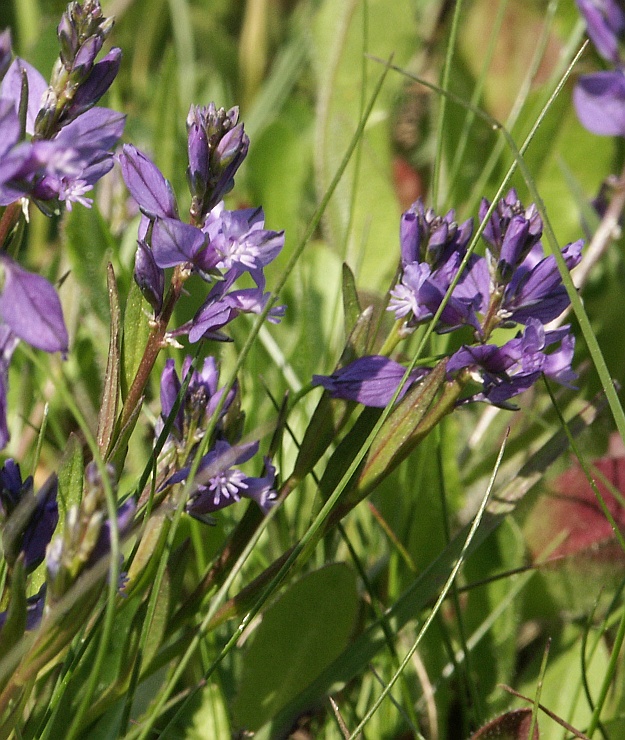
Its flowers resemble sweet peas and are commonly mauve, although pink, crimson and white forms also occur. They possess a characteristic brush-like tuft extending from the keel.[5][6]
The fruit is an oval, brown capsule with narrow wings that opens at maturity.[7]
Habitat
Myrtle-leaf milkwort occurs on coastal dunes, along forest margins and in open grassland. It is a typical component of fynbos vegetation.[8][9][10][11]
Behaviour
Myrtle-leaf milkwort is a fast-growing pioneer plant. Its flowers close during the night.[12][13]
Reproduction and life cycle
Pollination involves an intricate piston mechanism.[14]
Conservation
Myrtle-leaf milkwort has become naturalised in coastal areas of California, New Zealand and Norfolk Island.[15]
It is classified as a significant environmental weed in coastal districts of Victoria and South Australia. It is considered a moderately important environmental weed in New South Wales, Tasmania and Western Australia.[16][17]
During the 2010s, it was listed as a priority environmental weed in parts of Queensland.[18]
Uses
Myrtle-leaf milkwort is cultivated in South African gardens. It has documented antibacterial and antifungal properties.[19][20][21]
Aqueous extracts of the species have demonstrated effectiveness against Candida albicans.[22]
Classification of the Myrtle-leaf Milkwort
| Kingdom | Plantae |
|---|---|
| Subkingdom | Pteridobiotina |
| Phylum | Tracheophyta |
| Class | Magnoliopsida |
| Order | Fabales |
| Family | Polygalaceae (Milkwort Family) |
| Tribe | Polygaleae |
| Genus | Polygala (Milkwort) |
| Species | Polygala myrtifolia L. |
Where the Myrtle-leaf Milkwort is found
Checklists and occurrence records place Polygala myrtifolia in 14 countries across Africa, Europe, North America and Oceania. GBIF holds 16,607 georeferenced records of it.
Countries where it is native or its origin is not stated
Countries where it has been introduced
- Algeria 12
- Australia 2,945
- France 7,489
- Italy 339
- Malta 30
- New Zealand 570
- Portugal 76
- United States 40
Regions and cities with the most records
- Western Cape, South Africa 3,403
- Provence-Alpes-Côte d'Azur, France 3,049
- Victoria, Australia 1,533
- Occitanie, France 1,103
- Retreat, South Africa 800
- Muizenberg, South Africa 789
- Rondebosch, South Africa 739
- Sanary-sur-Mer, France 709
- La Valette-du-Var, France 688
- Toulon, France 683
- Cape Town, South Africa 664
- La Ciotat, France 664
- La Garde, France 661
- Six-Fours-les-Plages, France 648
- Aubagne, France 642
- Marseille 11, France 617
- Marseille 09, France 612
- Marseille 10, France 611
- Hyères, France 605
- Eastern Cape, South Africa 582
- La Crau, France 534
- La Seyne-sur-Mer, France 527
- Marseille 12, France 509
- New South Wales, Australia 487
- Corsica, France 462
- Allauch, France 428
- Marseille 03, France 425
- Marseille 14, France 425
- Marseille 02, France 423
- Marseille, France 419
- Marseille 01, France 419
- Marseille 06, France 418
- Mandelieu-la-Napoule, France 413
- Marseille 07, France 413
- Marseille 08, France 413
- Marseille 15, France 413
18 more countries have a few records outside this range
These countries hold a few records of Polygala myrtifolia but lie outside the range the checklists give for it. Such records are often zoo or garden specimens, museum material or vagrants, so the species is not counted as occurring there.
Range as the checklists state it
France [I]; Corsica [I]; Italy [I]; Sicily [I]; Malta [I]; Algeria [I]; Madeira [I] (Madeira Isl. [I]); South Africa (Gauteng, KwaZulu-Natal, N-Cape Prov., W-Cape Prov., E-Cape Prov.); Lesotho; St. Helena [I]; Australia [I] (Western Australia [I], South Australia [I], New South Wales [I], Victoria [I], Tasmania [I]); Norfolk Isl. [I]; New Zealand [I]; USA [I] (California [I])
A number beside a place is its count of GBIF occurrence records. A place without a number comes from a checklist alone. Records show where a species has been observed or collected, which can include escapes and vagrants.
Common names
English
- Myrtle-leaf Milkwort
- Butterfly-bush
- Parrotbush
Names in 1 other language
- Swedish
- myrtenjungfrulin
Synonyms
25 other scientific names have been used for this species and are now treated as synonyms of Polygala myrtifolia.
- Polygala amoena Thunb.
- Polygala clutioides Burch. ex DC.
- Polygala cluytioides Burch. ex DC.
- Polygala linkiana Sweet
- Polygala myrtifolia f. salicifolia Chodat
- Polygala myrtifolia var. amoena (Thunb.) Harv.
- Polygala myrtifolia var. angustifolia DC.
- Polygala myrtifolia var. cluytioides (Burch. ex DC.) Harv.
- Polygala myrtifolia var. coriacea Chodat
- Polygala myrtifolia var. cyanella Wimm. & Grab.
- Polygala myrtifolia var. grandiflora (Spach) Chodat
- Polygala myrtifolia var. lancifolia Chodat
- Polygala myrtifolia var. leucantha Wimm. & Grab.
- Polygala myrtifolia var. ligularis (Ker Gawl.) Harv.
- Polygala myrtifolia var. natalensis Sond.
- Polygala myrtifolia var. obtusifolia Chodat
- Polygala myrtifolia var. rosmarinifolia DC.
- Polygala myrtifolia var. salicifolia (Chodat) T.Durand & Schinz
- Polygala myrtifolia var. vera DC.
- Psychanthus grandiflorus Spach
- Psychanthus myrtifolius (L.) Raf.
- Psychanthus myrtifolius (L.) Spach
- Polygala formosa F.Dietr. ambiguous synonym
- Polygala grandiflora G.Lodd. ambiguous synonym
- Polygala ligularis Ker Gawl. ambiguous synonym
Subspecies and varieties
- Polygala myrtifolia var. pinifolia (Pineleaf Septemberbush) variety
Related species
-
 Common MilkwortPolygala vulgaris
-
 Chinese Senega-rootPolygala tenuifolia
-
 Sweet Pea BushPolygala fruticosa
-
 Tufted MilkwortPolygala comosa
-
 Broom MilkwortPolygala virgata
-
 Heath MilkwortPolygala serpyllifolia
-
 Dwarf MilkwortPolygala amarella
- Chalk MilkwortPolygala calcarea
Compare
Questions and answers
What is the scientific name of the Myrtle-leaf Milkwort?
The scientific name of the Myrtle-leaf Milkwort is Polygala myrtifolia. Written with its author, the full name is Polygala myrtifolia L..
Which family does the Myrtle-leaf Milkwort belong to?
Polygala myrtifolia belongs to the family Polygalaceae, in the order Fabales and the class Magnoliopsida.
Where is the Myrtle-leaf Milkwort found?
Checklists and occurrence records place Polygala myrtifolia in 14 countries, including South Africa, Morocco, Saint Helena, Eswatini, Ethiopia and Lesotho.
What other names does the Myrtle-leaf Milkwort have?
Polygala myrtifolia is also known in English as Butterfly-bush and Parrotbush.
Is polygala myrtifolia invasive?
Myrtle-leaf milkwort has become naturalised in coastal areas of California, New Zealand and Norfolk Island. It is classified as a significant environmental weed in coastal districts of Victoria and South Australia, and as a moderately important environmental weed in New South Wales, Tasmania and Western Australia. During the 2010s, it was listed as a priority environmental weed in parts of Queensland.[15][16][17][18]
Sources
Passages the profile rests on
- Polygala myrtifolia is an evergreen shrub or small tree. Source passage: “is an evergreen 2–4 m tall South African shrub or small tree” — English Wikipedia
- Its leaves are thin, oval and mucronate, with entire margins. Source passage: “The thin, oval, mucronate leaves, 25–50 mm long and up to 13 mm wide, are arranged alternately and have entire margins” — English Wikipedia
- Its leaves measure 25–50 mm in length and up to 13 mm in width. Source passage: “25–50 mm long and up to 13 mm wide” — English Wikipedia
- Some forms of the species have thin, needle-like leaves. Source passage: “some forms of P. myrtifolia have thin, needle-like leaves.” — English Wikipedia
- Its flowers resemble sweet peas and are commonly mauve, although pink, crimson and white forms also occur. Source passage: “The attractive mauve sweetpea-like flowers, which close at night, may also be pink, crimson or white” — English Wikipedia
- The flowers possess a characteristic brush-like tuft that extends from the keel. Source passage: “have a characteristic brush-like tuft protruding from the keel.” — English Wikipedia
- Its fruit is an oval, brown capsule that opens at maturity and has narrow wings. Source passage: “The fruit is an oval, brown, dehiscent capsule which is narrowly winged.” — English Wikipedia
- The species occurs on coastal dunes. Source passage: “may be found on dunes” — English Wikipedia
- The species occurs along forest margins. Source passage: “along forest margins” — English Wikipedia
- The species also occurs in open grassland. Source passage: “and in open grassland.” — English Wikipedia
- The species is a typical component of fynbos vegetation. Source passage: “a typical fynbos component” — English Wikipedia
- The flowers close during the night. Source passage: “flowers, which close at night” — English Wikipedia
- Polygala myrtifolia is a fast-growing pioneer plant. Source passage: “It is a fast-growing pioneer plant” — English Wikipedia
- Pollination in this species involves an intricate piston mechanism. Source passage: “For pollination an intricate piston mechanism is used.” — English Wikipedia
- The species has become naturalised in coastal areas of California, New Zealand and Norfolk Island. Source passage: “P. myrtifolia has become naturalised in coastal areas of California, New Zealand and Norfolk Island.” — English Wikipedia
- The species is classified as a significant environmental weed in coastal districts of Victoria and South Australia. Source passage: “it is a significant environmental weed in coastal districts of Victoria and South Australia” — English Wikipedia
- The species is considered a moderately important environmental weed in New South Wales, Tasmania and Western Australia. Source passage: “a moderately important environmental weed in New South Wales, Tasmania and Western Australia.” — English Wikipedia
- During the 2010s, the species was listed as a priority environmental weed in parts of Queensland. Source passage: “In the 2010s, it was recently listed as a priority environmental weed in parts of Queensland.” — English Wikipedia
- The species is cultivated in South African gardens. Source passage: “The species is often cultivated in South African gardens.” — English Wikipedia
- The species has documented antibacterial properties. Source passage: “The species is noted for its antibacterial and antifungal properties.” — English Wikipedia
- The species has documented antifungal properties. Source passage: “The species is noted for its antibacterial and antifungal properties.” — English Wikipedia
- Aqueous extracts of the species have demonstrated effectiveness against Candida albicans. Source passage: “aqueous extracts of P. myrtifolia proved effective against Candida albicans.” — English Wikipedia
Data
- Catalogue of Life, 2026-10-16 XR cc by
- Global Biodiversity Information Facility CC BY 4.0
- Wikidata CC0
- GeoNames CC BY 4.0
- Wikimedia Commons per image; credit shown with each image
- Within the Catalogue of Life, this name comes from Synonymic Checklists of the Vascular Plants of the World cc by
References
- L. (1753). Sp. Pl. [Linnaeus] 2: 703 (1753). where the name was published
This species in other databases
Page built on 27 November 2026. See how the catalog is made and all sources and licences.
Cite this page
ScientificNames.org. (2026). Polygala myrtifolia (Myrtle-leaf Milkwort). Retrieved November 27, 2026, from https://scientificnames.org/species/polygala-myrtifolia
“Polygala myrtifolia (Myrtle-leaf Milkwort).” ScientificNames.org, 2026, scientificnames.org/species/polygala-myrtifolia. Accessed 27 Nov. 2026.
ScientificNames.org. “Polygala myrtifolia (Myrtle-leaf Milkwort).” Accessed November 27, 2026. https://scientificnames.org/species/polygala-myrtifolia.
@misc{scientificnames_polygala_myrtifolia_myrtle_leaf_milkwort,
  author = {{ScientificNames.org}},
  title = {Polygala myrtifolia (Myrtle-leaf Milkwort)},
  year = {2026},
  url = {https://scientificnames.org/species/polygala-myrtifolia},
  note = {Accessed 2026-11-27}
}