Species · Flowering plants
Chinese Senega-root Polygala tenuifolia
The scientific name of the Chinese Senega-root is Polygala tenuifolia. It is a species of flowering plant in the family Polygalaceae (milkwort family), order Fabales.
- Scientific name
- Polygala tenuifolia Willd.
- Common name
- Chinese Senega-root
- Genus
- Polygala
- Family
- Polygalaceae (Milkwort Family)
- Order
- Fabales
- Class
- Magnoliopsida
- Recorded in
- 5 countries
- Name status
- accepted in the Catalogue of Life

Overview
Chinese senega-root is hardy to USDA Zone 6. Chinese senega-root contains tenuifolin, senegenin and polygalacic acid.
Written 26 November 2026 from the sources listed below. Each statement was checked against the passage it cites; statements that could not be supported were removed.
Appearance
Chinese senega-root is an herb.[1]
Habitat
Chinese senega-root is hardy to USDA Zone 6.[2]
Uses
Chinese senega-root has been studied as a potential source of drugs for depression and Alzheimer's disease.[3]
Classification of the Chinese Senega-root
| Kingdom | Plantae |
|---|---|
| Subkingdom | Pteridobiotina |
| Phylum | Tracheophyta |
| Class | Magnoliopsida |
| Order | Fabales |
| Family | Polygalaceae (Milkwort Family) |
| Tribe | Polygaleae |
| Genus | Polygala (Milkwort) |
| Species | Polygala tenuifolia Willd. |
Where the Chinese Senega-root is found
Checklists and occurrence records place Polygala tenuifolia in 5 countries across Asia. GBIF holds 2,063 georeferenced records of it.
Countries
Regions and cities with the most records
- Shaanxi, China 141
- Shanxi, China 138
- Irkutsk Oblast, Russia 130
- Hebei, China 117
- Beijing, China 102
- Buryatiya Republic, Russia 89
- Gansu, China 75
- Henan, China 63
- Liaoning, China 58
- Shandong, China 47
- Heilongjiang, China 46
- Mentougou, China 33
- Primorye, Russia 32
- Sichuan, China 30
- Krasnoyarsk Krai, Russia 29
- Jilin, China 26
- Changping, China 24
- Amur Oblast, Russia 23
- Jiangxi, China 23
- Fangshan, China 20
- Xilin Hot, China 18
- Xilinhot, China 18
- Ulanhot, China 16
- Anhua, China 13
- Anhui, China 13
- Belovo, Russia 13
- Chengjiao, China 13
- Dongjiang, China 13
- Gur’yevsk, Russia 13
- Hanwang, China 13
- Hubei, China 13
- Liangshui, China 13
- Longnan, China 13
- Majie, China 13
- Puchi, China 13
- Qinghai, China 13
1 more country has a few records outside this range
These countries hold a few records of Polygala tenuifolia but lie outside the range the checklists give for it. Such records are often zoo or garden specimens, museum material or vagrants, so the species is not counted as occurring there.
Range as the checklists state it
Siberia (Altay, Buryatia, Chita, Irkutsk, Krasnoyarsk, Tuva, SW-Siberia); Russian Far East (Upper Amur, Khabarovsk, Primorye); China (Gansu, Hebei, Heilongjiang, Henan, Jiangsu, Jiangxi, Liaoning, Nei Mongol, Ningxia, Qinghai, Shaanxi, Shanxi, Sichuan); Mongolia; North Korea; South Korea
A number beside a place is its count of GBIF occurrence records. A place without a number comes from a checklist alone. Records show where a species has been observed or collected, which can include escapes and vagrants.
Common names
English
- Chinese Senega-root
Names in 4 other languages
- Chinese
- yuan zhi
- Korean
- wonji
- Russian
- istod tonkolistnyj
- Swedish
- kinesisk senegarot
Synonyms
4 other scientific names have been used for this species and are now treated as synonyms of Polygala tenuifolia.
- Polygala sibirica f. tenuifolia (Willd.) Regel
- Polygala sibirica var. angustifolia Ledeb.
- Polygala sibirica var. tenuifolia (Willd.) Backer & Moore
- Polygala sibirica var. tenuifolia (Willd.) Chodat
Related species
-
 Myrtle-leaf MilkwortPolygala myrtifolia
-
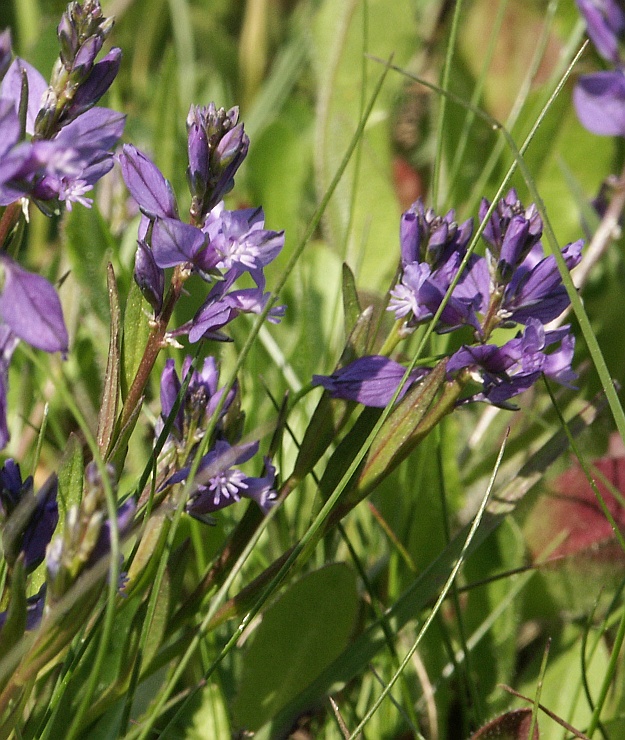 Common MilkwortPolygala vulgaris
-
 Sweet Pea BushPolygala fruticosa
-
 Tufted MilkwortPolygala comosa
-
 Broom MilkwortPolygala virgata
-
 Heath MilkwortPolygala serpyllifolia
-
 Dwarf MilkwortPolygala amarella
- Chalk MilkwortPolygala calcarea
Compare
Questions and answers
What is the scientific name of the Chinese Senega-root?
The scientific name of the Chinese Senega-root is Polygala tenuifolia. Written with its author, the full name is Polygala tenuifolia Willd..
Which family does the Chinese Senega-root belong to?
Polygala tenuifolia belongs to the family Polygalaceae, in the order Fabales and the class Magnoliopsida.
Where is the Chinese Senega-root found?
Checklists and occurrence records place Polygala tenuifolia in 5 countries: China, Russia, Mongolia, South Korea and North Korea.
What is Yuan Zhi herb?
Yuan Zhi, called yuǎn zhì in traditional Chinese medicine, is Chinese senega-root.[4]
Sources
Passages the profile rests on
- Polygala tenuifolia is an herb. Source passage: “Polygala tenuifolia (yuǎn zhì; Chinese: 远志) is an herb in the family Polygalaceae” — English Wikipedia
- Polygala tenuifolia is hardy to USDA Zone 6. Source passage: “which is hardy to USDA Zone 6.” — English Wikipedia
- Polygala tenuifolia has been studied as a potential source of drugs for depression and Alzheimer's disease. Source passage: “It has been studied as a potential drug source in depression and Alzheimer's.” — English Wikipedia
- Polygala tenuifolia is called yuǎn zhì in traditional Chinese medicine. Source passage: “where it is called yuǎn zhì (Chinese: 遠志)” — English Wikipedia
Data
- Catalogue of Life, 2026-10-16 XR cc by
- Global Biodiversity Information Facility CC BY 4.0
- Wikidata CC0
- GeoNames CC BY 4.0
- Wikimedia Commons per image; credit shown with each image
- Within the Catalogue of Life, this name comes from Synonymic Checklists of the Vascular Plants of the World cc by
References
- Willd. (1802). Sp. Pl., ed. 4 [Willdenow] 3(2): 879 (1802). where the name was published
This species in other databases
Page built on 28 November 2026. See how the catalog is made and all sources and licences.
Cite this page
ScientificNames.org. (2026). Polygala tenuifolia (Chinese Senega-root). Retrieved November 28, 2026, from https://scientificnames.org/species/polygala-tenuifolia
“Polygala tenuifolia (Chinese Senega-root).” ScientificNames.org, 2026, scientificnames.org/species/polygala-tenuifolia. Accessed 28 Nov. 2026.
ScientificNames.org. “Polygala tenuifolia (Chinese Senega-root).” Accessed November 28, 2026. https://scientificnames.org/species/polygala-tenuifolia.
@misc{scientificnames_polygala_tenuifolia_chinese_senega_root,
  author = {{ScientificNames.org}},
  title = {Polygala tenuifolia (Chinese Senega-root)},
  year = {2026},
  url = {https://scientificnames.org/species/polygala-tenuifolia},
  note = {Accessed 2026-11-28}
}