Species · Insects
Lofty Bath White Pontia callidice
The scientific name of the Lofty Bath White is Pontia callidice. It is a species of insect in the family Pieridae (whites), order Lepidoptera. The name dates from 1800.
- Scientific name
- Pontia callidice (Hübner, [1800] )
- Common name
- Lofty Bath White
- Genus
- Pontia
- Family
- Pieridae (Whites)
- Order
- Lepidoptera
- Class
- Insecta
- Recorded in
- 11 countries
- Name status
- accepted in the Catalogue of Life
Overview
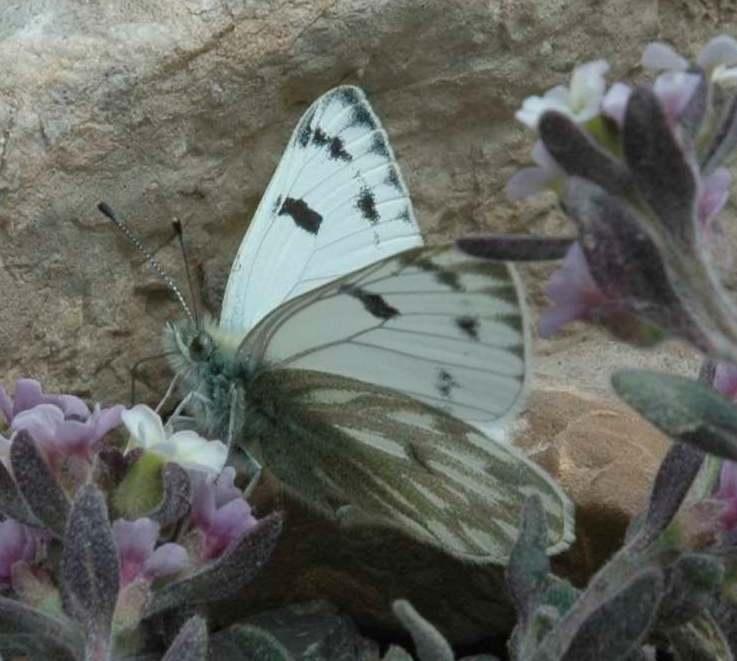
The Lofty Bath White is an insect in the Pieridae butterfly family. It inhabits alpine meadows at high elevations above the tree line. Both sexes have antennae with an unusually abrupt, shorter and broader club.
Written 27 November 2026 from the sources listed below. Each statement was checked against the passage it cites; statements that could not be supported were removed.
Appearance
Male butterflies have white upperwing surfaces with black markings at the bases of the forewing cells and a quadrate black spot on the discocellulars. Their forewings have a curved series of inwardly toothed black discal spots, with the spots in interspaces 1 and 2 often reduced or absent.[1][2]
Male hindwings have a uniform upper-surface pattern, through which the underside pattern is visible. Their bases are densely covered with black scales.[3][4]
The male forewing underside is white, with a dull-black basal costal margin and quadrate discocellular spot. It has four black discal spots in interspaces 1, 3, 5 and 6, and green streaks along veins 3 to 7 extending to the wing margin.[5][6][7]
The male hindwing underside is green, with an elongated oval yellowish-white spot in the cell. Curved series of yellowish-white discal and terminal spots are also present.[8][9]
Male antennae are black with white spots. The head is fuscous grey, the thorax is blackish grey, and the abdomen is black with sparse white scaling; the underside of the head, thorax and abdomen is white.[10][11][12]
Females have more extensive black scaling at the wing bases than males, particularly across the dorsal half of the hindwings. Their forewings have a dusky-black apex and terminal third above vein 2, containing elongated white spots, and a paired transverse black spot in the outer half of interspace 1.[13][14][15]
Female hindwings have a terminal series of large black spots with inwardly pointed oval white centres. A large black spot is also present near the costal margin before the apex.[16][17]
Female forewing undersides have more extensive green colouring at the apex and termen than those of males. They lack the black discal spots in interspaces 5 and 6.[18][19]
Female hindwing undersides have narrower and smaller yellowish-white lanceolate spots than males. Both sexes have antennae with an unusually abrupt, shorter and broader club.[20][21]
Habitat
The Lofty Bath White inhabits alpine meadows at high elevations above the tree line.[22]
In India, it occurs in the north-western Himalayas above 12,000 feet (3,700 m), from Chitral to Mussoorie. Its Asian distribution extends from the Altai to the Himalayas.[23][24]
The species also occurs in the higher mountains of Europe and in the Palearctic realm.[25][26]
Classification of the Lofty Bath White
| Kingdom | Animalia |
|---|---|
| Phylum | Arthropoda |
| Subphylum | Hexapoda |
| Class | Insecta (Insect) |
| Order | Lepidoptera |
| Superfamily | Papilionoidea |
| Family | Pieridae (Whites) |
| Genus | Pontia (Whites) |
| Species | Pontia callidice (Hübner, [1800] ) |
Where the Lofty Bath White is found
Checklists and occurrence records place Pontia callidice in 11 countries. GBIF holds 8,934 georeferenced records of it.
Countries
- Andorra 73
- Austria 649
- Finland 3
- France 1,744
- Germany 37
- Italy 408
- Liechtenstein 13
- Russia 207
- Spain 332
- Switzerland 5,434
- Ukraine 34
Regions and cities with the most records
- Valais, Switzerland 2,303
- Sierre, Switzerland 911
- Provence-Alpes-Côte d'Azur, France 781
- Auvergne-Rhône-Alpes, France 669
- Sitten, Switzerland 454
- Tyrol, Austria 394
- Bern, Switzerland 332
- Occitanie, France 286
- Ticino, Switzerland 191
- Martigny-Ville, Switzerland 184
- Catalonia, Spain 178
- Lombardy, Italy 163
- Chur, Switzerland 146
- Monthey, Switzerland 145
- Domodossola, Italy 126
- Aragon, Spain 121
- Uri, Switzerland 120
- Aosta Valley, Italy 96
- les Escaldes, Andorra 95
- Andorra la Vella, Andorra 93
- Vorarlberg, Austria 91
- Salzburg, Austria 88
- Vaud, Switzerland 86
- Trentino-Alto Adige, Italy 82
- Innsbruck, Austria 74
- Aosta, Italy 59
- Bellinzona, Switzerland 58
- Carinthia, Austria 50
- Glarus, Switzerland 49
- Magadan Oblast, Russia 49
- Sallanches, France 46
- Vaduz, Liechtenstein 42
- Saint-Martin-d'Hères, France 41
- Chukotka, Russia 35
- Telfs, Austria 33
- Garmisch-Partenkirchen, Germany 29
12 more countries have a few records outside this range
These countries hold a few records of Pontia callidice but lie outside the range the checklists give for it. Such records are often zoo or garden specimens, museum material or vagrants, so the species is not counted as occurring there.
A number beside a place is its count of GBIF occurrence records. A place without a number comes from a checklist alone. Records show where a species has been observed or collected, which can include escapes and vagrants.
Common names
English
- Lofty Bath White
- Peak White
Names in 11 other languages
- Catalan
- Pòntia dels cims
- Czech
- bělásek alpský
- Dutch
- Bergresedawitje
- Finnish
- alppisinappiperhonen, vuorisinappiperhonen
- French
- Marbré des alpages, Piéride du vélar, Veiné de vert
- German
- Alpen-Weißling, Alpenweißling
- Norwegian Bokmål
- alpehvitvinge
- Russian
- Белянка альпийская
- Spanish
- Blanquiverdosa alpina
- Swedish
- alpvitfjäril
- Turkish
- Dorukların Beneklimeleği
Synonyms
9 other scientific names have been used for this species and are now treated as synonyms of Pontia callidice.
- Papilio callidice Esper, [1804]
- Papilio callidice Hübner, 1800
- Pieris callidice (Hübner, 1800)
- Pieris kalora Moore, 1865
- Pontia callidice callidice (Hübner, 1800)
- Pontia callidice kalora (Moore), 1865
- Synchloe callidice (Hübner, 1800)
- Synchloe callidice duplati Bernardi, 1965
- Synchloe callidice hazara Wyatt, 1961
Related species
-
 Checkered WhitePontia protodice
-
 Bath WhitePontia daplidice
-
 Eastern Bath WhitePontia edusa
-
 Desert WhitePontia glauconome
-
 Western WhitePontia occidentalis
-
 Lesser Bath WhitePontia chloridice
-
 Becker's WhitePontia beckerii
-
 Meadow WhitePontia helice
Compare
Questions and answers
What is the scientific name of the Lofty Bath White?
The scientific name of the Lofty Bath White is Pontia callidice. Written with its author, the full name is Pontia callidice (Hübner, [1800] ).
Which family does the Lofty Bath White belong to?
Pontia callidice belongs to the family Pieridae, in the order Lepidoptera and the class Insecta.
Where is the Lofty Bath White found?
Checklists and occurrence records place Pontia callidice in 11 countries, including Switzerland, France, Austria, Italy, Spain and Russia.
What other names does the Lofty Bath White have?
Pontia callidice is also known in English as Peak White.
Sources
Passages the profile rests on
- Male butterflies have white upperwing surfaces with black markings at the bases of the forewing cells and a quadrate black spot on the discocellulars. Source passage: “Upperside: white Forewing: black at extreme bases of interspaces 1a and 1 and of cell; discocellulars marked with a quadrate black spot” — English Wikipedia
- Male forewings have a curved series of inwardly toothed black discal spots, with the spots in interspaces 1 and 2 often reduced or absent. Source passage: “a discal curved series of inwardly dentate spots, the spots in interspaces 1 and 2 generally reduced to a mere trace, often absent” — English Wikipedia
- Male hindwings are uniformly patterned on the upper surface, with the underside pattern visible through their transparency. Source passage: “Hindwing: uniform, the pattern of the underside visible through transparency” — English Wikipedia
- Male hindwing bases are densely covered with black scales. Source passage: “base densely irrorated (sprinkled) with black scales.” — English Wikipedia
- The male forewing underside is white, with a dull-black basal costal margin and quadrate discocellular spot. Source passage: “Forewing: white; basal half of costal margin and quadrate spot on discocellulars dull black” — English Wikipedia
- The male forewing underside has four black discal spots in interspaces 1, 3, 5 and 6. Source passage: “a discal curved series of four black spots in interspaces 1, 3, 5 and 6” — English Wikipedia
- The male forewing underside has green streaks along veins 3 to 7 extending to the wing margin. Source passage: “followed by elongate streaks of green along veins 3 to 7 that extend to the termen.” — English Wikipedia
- The male hindwing underside is green and has an elongated oval yellowish-white spot in the cell. Source passage: “Hindwing: green, an elongate oval yellowish-white spot in cell” — English Wikipedia
- The male hindwing underside has curved series of yellowish-white discal and terminal spots. Source passage: “followed beyond by complete curved series of discal and terminal yellowish-white, inwardly lanceolate spots.” — English Wikipedia
- The male antennae are black with white spots. Source passage: “Antennae black, spotted with white” — English Wikipedia
- The male head is fuscous grey, its thorax is blackish grey, and its abdomen is black with sparse white scaling. Source passage: “head fuscous grey, thorax blackish grey, abdomen black with more or less sparse white scaling” — English Wikipedia
- The underside of the male head, thorax and abdomen is white. Source passage: “beneath: head, thorax and abdomen white.” — English Wikipedia
- Females have more extensive black scaling at the wing bases than males, particularly across the dorsal half of the hindwings. Source passage: “the black scaling at the base of the wings more extended, especially on the hindwing where it stretches broadly down the dorsal half of the wing” — English Wikipedia
- Female forewings have a dusky-black apex and terminal third above vein 2, containing elongated white spots. Source passage: “the apex and terminal third of the wing above vein 2 dusky black, with a series of elongate white spots in the interspaces” — English Wikipedia
- Female forewings have a paired transverse black spot in the outer half of interspace 1. Source passage: “lastly, a geminate (paired) transverse black spot in the outer half of interspace 1.” — English Wikipedia
- Female hindwings have a terminal series of large black spots with inwardly pointed oval white centres. Source passage: “a terminal series of large, inwardly acute pointed, black spots with oval white centres” — English Wikipedia
- Female hindwings have a large black spot near the costal margin before the apex. Source passage: “and a large costal black spot before the apex.” — English Wikipedia
- Female forewing undersides have more extensive green colouring at the apex and termen than those of males. Source passage: “the green on the apex and termen are more extended” — English Wikipedia
- Female forewing undersides lack the black discal spots in interspaces 5 and 6. Source passage: “the black discal spots in interspaces 5 and 6 are absent.” — English Wikipedia
- Female hindwing undersides have narrower and smaller yellowish-white lanceolate spots than males. Source passage: “the yellowish-white lanceolate spots narrower and smaller.” — English Wikipedia
- Both sexes have antennae with an unusually abrupt, shorter and broader club. Source passage: “In both sexes the antennae are not generally typical, the club abrupt, shorter, and broader.” — English Wikipedia
- Pontia callidice inhabits alpine meadows at high elevations above the tree line. Source passage: “It lives at high altitude in alpine meadows, above the tree line.” — English Wikipedia
- In India, Pontia callidice occurs in the north-western Himalayas above 12,000 feet (3,700 m), from Chitral to Mussoorie. Source passage: “Within India, it occurs in the north-western Himalayas above 12,000 feet (3,700 m) from Chitral to Mussoorie.” — English Wikipedia
- The Asian distribution of Pontia callidice extends from the Altai to the Himalayas. Source passage: “in Asia from the Altai to the Himalayas” — English Wikipedia
- Pontia callidice also occurs in the higher mountains of Europe. Source passage: “It also occurs in the higher mountains of Europe” — English Wikipedia
- Pontia callidice occurs in the Palearctic realm. Source passage: “which occurs in the Palearctic realm.” — English Wikipedia
Data
- Catalogue of Life, 2026-10-16 XR cc by
- Global Biodiversity Information Facility CC BY 4.0
- Wikidata CC0
- GeoNames CC BY 4.0
- Wikimedia Commons per image; credit shown with each image
- Within the Catalogue of Life, this name comes from Global Butterfly Information System cc by
This species in other databases
Page built on 28 November 2026. See how the catalog is made and all sources and licences.
Cite this page
ScientificNames.org. (2026). Pontia callidice (Lofty Bath White). Retrieved November 28, 2026, from https://scientificnames.org/species/pontia-callidice
“Pontia callidice (Lofty Bath White).” ScientificNames.org, 2026, scientificnames.org/species/pontia-callidice. Accessed 28 Nov. 2026.
ScientificNames.org. “Pontia callidice (Lofty Bath White).” Accessed November 28, 2026. https://scientificnames.org/species/pontia-callidice.
@misc{scientificnames_pontia_callidice_lofty_bath_white,
  author = {{ScientificNames.org}},
  title = {Pontia callidice (Lofty Bath White)},
  year = {2026},
  url = {https://scientificnames.org/species/pontia-callidice},
  note = {Accessed 2026-11-28}
}