Species · Insects
Eastern Bath White Pontia edusa
The scientific name of the Eastern Bath White is Pontia edusa. It is a species of insect in the family Pieridae (whites), order Lepidoptera. The name dates from 1777.
- Scientific name
- Pontia edusa (Fabricius, 1777)
- Common name
- Eastern Bath White
- Genus
- Pontia
- Family
- Pieridae (Whites)
- Order
- Lepidoptera
- Class
- Insecta
- Recorded in
- 58 countries
- Name status
- accepted in the Catalogue of Life

Overview
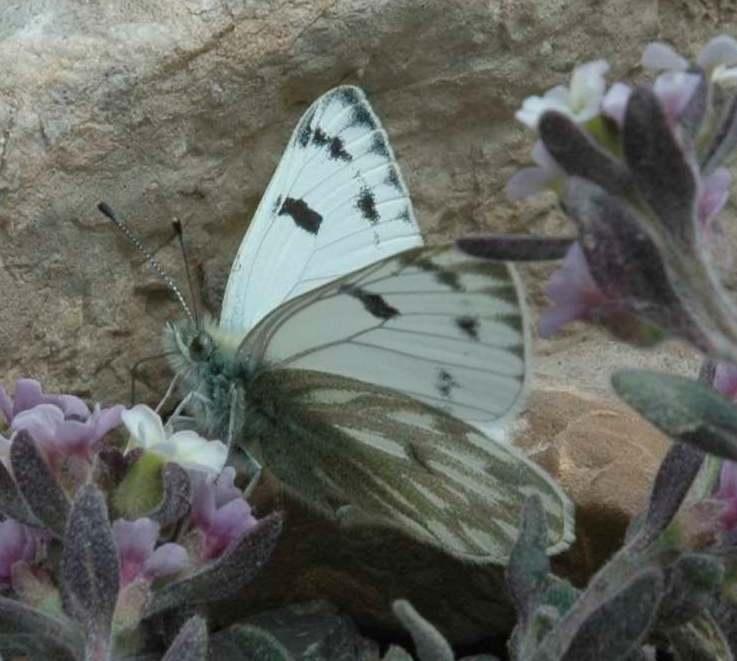
The Eastern Bath White (Pontia edusa) is a small to medium-sized butterfly belonging to the family Pieridae, order Lepidoptera and class Insecta. It occurs in open grassy and flowery areas and in stony and rocky places, from southeastern Europe through central Europe to the Middle East, including Iran and Iraq. It has white upper wing surfaces marked with black stains and greenish-grey spots on the undersides of the hindwings, with a wingspan reaching approximately 45 mm.
Written 26 November 2026 from the sources listed below. Each statement was checked against the passage it cites; statements that could not be supported were removed.
Appearance
The Eastern Bath White has white upper wing surfaces marked with black stains on both the forewings and hindwings. The undersides of the hindwings have greenish-grey spots.[1][2]
The wingspan reaches approximately 45 mm.[3]
Habitat
The species occurs in open grassy and flowery areas and inhabits stony and rocky places. It occurs at elevations up to 1,500 metres and occasionally higher.[4][5][6]
It is particularly associated with locations where its host plants grow. These locations are recorded at elevations between 0 and 2,300 metres.[7][8]
The species occurs from southeastern Europe through central Europe to the Middle East, including Iran and Iraq. Migrating individuals have been recorded in Belgium, the Netherlands, northern Germany, Poland, the Baltic states, southern Sweden and Norway.[9][10][11]
The subspecies Pontia edusa edusa is recorded from Finland, northeastern and southeastern Central Europe, Italy, Turkey, the Caucasus, Ukraine and Russia. Pontia edusa persica is recorded from Iran and Afghanistan, while Pontia edusa nubicola is recorded from Turkestan.[12][13][14]
Pontia edusa amphimara is recorded from Szetschwan and Yunnan in China, and Pontia edusa praeclara from southwestern China. Pontia edusa moorei is recorded from Kashmir, Baluchistan, Tibet, Yunnan, southeastern China and Thailand.[15][16][17]
Pontia edusa avidia is recorded from southern China, with Korea listed as a possible occurrence. Pontia edusa davendra is recorded from the Ussuri region of Siberia.[18][19]
Diet
The larvae feed on plants belonging to the family Resedaceae.[20]
Behaviour
Adults fly between March and October. The species overwinters in the chrysalis stage.[21][22]
Reproduction and life cycle
Females lay their eggs individually rather than in groups. The eggs have an incubation period of seven days.[23][24]
The species produces between two and four generations, depending on latitude. Caterpillars are present from May.[25][26]
The caterpillars are greyish-greenish with black dots and broad yellow stripes.[27]
Similar species
Pontia edusa is nearly identical in appearance to Pontia daplidice. Its western distribution boundary is difficult to establish because of this similarity.[28][29]
Genital examination and DNA analysis are the only methods identified for distinguishing Pontia edusa from Pontia daplidice.[30]
The caterpillar resembles the larva of the cabbage butterfly, Pieris brassicae.[31]
Classification of the Eastern Bath White
| Kingdom | Animalia |
|---|---|
| Phylum | Arthropoda |
| Subphylum | Hexapoda |
| Class | Insecta (Insect) |
| Order | Lepidoptera |
| Superfamily | Papilionoidea |
| Family | Pieridae (Whites) |
| Genus | Pontia (Whites) |
| Species | Pontia edusa (Fabricius, 1777) |
Where the Eastern Bath White is found
Checklists and occurrence records place Pontia edusa in 58 countries. GBIF holds 29,528 georeferenced records of it.
Countries
- Aland Islands 3
- Albania 66
- Armenia 130
- Austria 1,600
- Azerbaijan 18
- Belarus 47
- Belgium 13
- Bosnia and Herzegovina 25
- Bulgaria 579
- China 492
- Croatia 376
- Cyprus 8
- Czechia 304
- Denmark 390
- Estonia 50
- Finland 3,433
- France 105
- Georgia 176
- Germany 2,376
- Greece 1,535
- Hungary 1,331
- India 31
- Iran 49
- Israel 12
- Italy 2,001
- Kazakhstan 210
- Kosovo 22
- Kyrgyzstan 80
- Lebanon 5
- Lithuania 121
- Malta 97
- Moldova 30
- Mongolia 19
- Montenegro 16
- Nepal 9
- North Korea 3
- North Macedonia 180
- Norway 4
- Pakistan 25
- Palestinian Territory 4
- Poland 430
- Romania 463
- Russia 1,941
- Serbia 1,774
- Slovakia 54
- Slovenia 72
- South Korea 26
- Spain 19
- Sweden 540
- Switzerland 5,168
- Syria 10
- Tajikistan 21
- The Netherlands 569
- Turkey 1,418
- Turkmenistan 27
- Ukraine 968
- Uzbekistan 47
- Yemen 6
Regions and cities with the most records
- Valais, Switzerland 4,638
- Sierre, Switzerland 3,172
- Sitten, Switzerland 1,839
- Lower Austria, Austria 837
- Myyrmäki, Finland 793
- Helsinki, Finland 764
- Martigny-Ville, Switzerland 761
- Vantaa, Finland 743
- Saxony, Germany 624
- Schwechat, Austria 603
- Brandenburg, Germany 551
- Mödling, Austria 544
- Vienna, Austria 449
- Monthey, Switzerland 429
- Baden, Austria 404
- Espoo, Finland 386
- Klosterneuburg, Austria 382
- Gotland, Sweden 367
- Burgenland, Austria 333
- Vienna, Austria 311
- Elst, The Netherlands 282
- Gelderland, The Netherlands 282
- Huissen, The Netherlands 282
- Arnhem, The Netherlands 281
- Velp, The Netherlands 281
- Csongrád, Hungary 280
- Duiven, The Netherlands 279
- Nijmegen, The Netherlands 276
- Zrenjanin, Serbia 270
- Mecklenburg-Vorpommern, Germany 247
- Saxony-Anhalt, Germany 242
- Veneto, Italy 242
- Sibbo, Finland 240
- Imatra, Finland 234
- Lombardy, Italy 233
- Svetogorsk, Russia 226
2 more countries have a few records outside this range
These countries hold a few records of Pontia edusa but lie outside the range the checklists give for it. Such records are often zoo or garden specimens, museum material or vagrants, so the species is not counted as occurring there.
A number beside a place is its count of GBIF occurrence records. A place without a number comes from a checklist alone. Records show where a species has been observed or collected, which can include escapes and vagrants.
Common names
English
- Eastern Bath White
- Bath White
Names in 25 other languages
- Catalan
- Pòntia europea
- Chinese
- 云粉蝶
- Croatian
- Istočni zeleni bijelac
- Czech
- bělásek rezedkový
- Danish
- Daplidice, Grønbroget kålsommerfugl, Grønplettet kålsommerfugl
- Dutch
- Oostelijk resedawitje
- Finnish
- sinappiperhonen
- French
- Marbré de Fabricius, Marbré vert oriental, Marbré-de-vert oriental
- German
- Reseda-Weißling, Resedafalter, Resedaweißling, Östlicher Resedafalter
- Hungarian
- Rezedalepke
- Italian
- Edusa
- Japanese
- チョウセンシロチョウ
- Korean
- 풀흰나비
- Lithuanian
- Stepinis Baltukas
- Luxembourgish
- Südleche Resedafalter
- Norwegian Bokmål
- vandrehvitvinge
- Norwegian Nynorsk
- vandrekvitveng
- Polish
- bielinek rukiewnik
- Russian
- Белянка рапсовая
- Serbian
- Зелени чипкавац
- Slovak
- mlynárik rezedový
- Slovenian
- katančev selec
- Swedish
- grönfläckig kålfjäril, grönfläckig vitfjäril
- Turkish
- Yeni Beneklimelek
- Ukrainian
- Білюх ріпаковий
Synonyms
6 other scientific names have been used for this species and are now treated as synonyms of Pontia edusa.
- Papilio bellidice Ochsenheimer, 1808
- Papilio edusa Fabricius, 1777
- Pieris bellidice (Ochsenheimer, 1808)
- Pieris daplidice bellidice (Ochsenheimer, 1808)
- Pieris daplidice misapplied
- Pontia daplidice s.auct. misapplied
Subspecies and varieties
- Pieris daplidice nitida subspecies
- Pontia edusa amphimara subspecies
Related species
-
 Checkered WhitePontia protodice
-
 Bath WhitePontia daplidice
-
 Desert WhitePontia glauconome
-
 Western WhitePontia occidentalis
-
 Lesser Bath WhitePontia chloridice
-
 Lofty Bath WhitePontia callidice
-
 Becker's WhitePontia beckerii
-
 Meadow WhitePontia helice
Compare
Questions and answers
What is the scientific name of the Eastern Bath White?
The scientific name of the Eastern Bath White is Pontia edusa. Written with its author, the full name is Pontia edusa (Fabricius, 1777).
Which family does the Eastern Bath White belong to?
Pontia edusa belongs to the family Pieridae, in the order Lepidoptera and the class Insecta.
Where is the Eastern Bath White found?
Checklists and occurrence records place Pontia edusa in 58 countries, including Switzerland, Finland, Germany, Italy, Russia and Serbia.
What other names does the Eastern Bath White have?
Pontia edusa is also known in English as Bath White.
What is the scientific name for a cabbage white butterfly?
The scientific name given for the cabbage butterfly is Pieris brassicae.[31]
Sources
Passages the profile rests on
- The butterfly has white upper wing surfaces marked with black stains on the forewings and hindwings. Source passage: “The upperside of the wings is white, with black stains on the top of the forewing and hindwing.” — English Wikipedia
- The undersides of the hindwings have greenish-grey spots. Source passage: “The hindwing undersides have greenish-grey spots.” — English Wikipedia
- The butterfly has a wingspan reaching approximately 45 mm. Source passage: “with a wingspan reaching about 45 mm.” — English Wikipedia
- The species occurs in open grassy and flowery areas. Source passage: “This species is found in any open grassy or flowery areas” — English Wikipedia
- The butterfly inhabits stony and rocky places. Source passage: “in stony or rocky places” — English Wikipedia
- The species occurs at elevations up to 1,500 metres and occasionally higher. Source passage: “at altitudes up to 1,500 metres (4,900 ft) and occasionally higher.” — English Wikipedia
- The species is particularly associated with locations where its host plants grow. Source passage: “It is found especially where the host plants grow” — English Wikipedia
- Locations supporting the host plants are recorded at elevations between 0 and 2,300 metres. Source passage: “at an altitude of 0–2,300 metres (0–7,546 ft).” — English Wikipedia
- The species occurs from southeastern Europe through central Europe to the Middle East, including Iran and Iraq. Source passage: “It is found from the south east of Europe (southern France, Italy, Corsica, Sardinia) up to central Europe and the Middle East in Iran and Iraq.” — English Wikipedia
- Migrating individuals have been recorded in Belgium, the Netherlands, northern Germany and Poland. Source passage: “which can also be encountered in Belgium, Holland, northern Germany and Poland” — English Wikipedia
- Migrating individuals have also been recorded in the Baltic states, southern Sweden and Norway. Source passage: “in the Baltic states and in southern Sweden and Norway.” — English Wikipedia
- The subspecies Pontia edusa edusa is recorded from Finland, northeastern and southeastern Central Europe, Italy, Turkey, the Caucasus, Ukraine and Russia. Source passage: “P. e. edusa (Fabricius, 1777) (Finland and north east and south east Central Europe, Italy, Turkey, the Caucasus, Ukraine, Russia)” — English Wikipedia
- The subspecies Pontia edusa persica is recorded from Iran and Afghanistan. Source passage: “P. e. persica (Bienert, 1869) (Iran, Afghanistan)” — English Wikipedia
- The subspecies Pontia edusa nubicola is recorded from Turkestan. Source passage: “P. e. nubicola (Fruhstorfer, 1908) (Turkestan)” — English Wikipedia
- The subspecies Pontia edusa amphimara is recorded from Szetschwan and Yunnan in China. Source passage: “P. e. amphimara (Fruhstorfer, 1908) (China (Szetschwan), Yunnan)” — English Wikipedia
- The subspecies Pontia edusa praeclara is recorded from southwestern China. Source passage: “P. e. praeclara (Fruhstorfer, 1910) (south west China)” — English Wikipedia
- The subspecies Pontia edusa moorei is recorded from Kashmir, Baluchistan, Tibet, Yunnan, southeastern China and Thailand. Source passage: “P. e. moorei (Röber, 1907) (Kashmir, Baluchistan, Tibet, Yunnan, south east China, Thailand)” — English Wikipedia
- The subspecies Pontia edusa avidia is recorded from southern China, with Korea listed as a possible occurrence. Source passage: “P. e. avidia (Fruhstorfer, 1908) (southern China, ? Korea)” — English Wikipedia
- The subspecies Pontia edusa davendra is recorded from the Ussuri region of Siberia. Source passage: “P. e. davendra (Hemming, 1934) (Siberia (Ussuri))” — English Wikipedia
- The larvae feed on plants belonging to the family Resedaceae. Source passage: “The larvae feed on Resedaceae species.” — English Wikipedia
- Adults fly between March and October. Source passage: “The adults fly from March to October” — English Wikipedia
- The species overwinters in the chrysalis stage. Source passage: “Pontia edusa hibernates in the chrysalis stage.” — English Wikipedia
- Females lay their eggs individually rather than in groups. Source passage: “The eggs are laid singly” — English Wikipedia
- The eggs have an incubation period of seven days. Source passage: “have an incubation period of seven days.” — English Wikipedia
- The species produces between two and four generations, depending on latitude. Source passage: “with two to four generations depending on the latitude.” — English Wikipedia
- Caterpillars are present from May. Source passage: “The caterpillars are present from May.” — English Wikipedia
- The caterpillars are greyish-greenish with black dots and broad yellow stripes. Source passage: “They are greyish-greenish, with black dots and broad yellow stripes” — English Wikipedia
- Pontia edusa is nearly identical in appearance to Pontia daplidice. Source passage: “The butterfly is nearly identical to Pontia daplidice” — English Wikipedia
- The western boundary of the species' distribution is difficult to establish because of its similarity to Pontia daplidice. Source passage: “making the western extent of its range difficult to ascertain.” — English Wikipedia
- Genital examination and DNA analysis are identified as the only methods for distinguishing Pontia edusa from Pontia daplidice. Source passage: “Investigations of the genitals and DNA analysis are the only way to distinguish between these two types.” — English Wikipedia
- The caterpillar resembles the larva of the cabbage butterfly, Pieris brassicae. Source passage: “quite similar to the larva of the cabbage butterfly (Pieris brassicae).” — English Wikipedia
Data
- Catalogue of Life, 2026-10-16 XR cc by
- Global Biodiversity Information Facility CC BY 4.0
- Wikidata CC0
- GeoNames CC BY 4.0
- Wikimedia Commons per image; credit shown with each image
- Within the Catalogue of Life, this name comes from Global Butterfly Information System cc by
This species in other databases
Page built on 28 November 2026. See how the catalog is made and all sources and licences.
Cite this page
ScientificNames.org. (2026). Pontia edusa (Eastern Bath White). Retrieved November 28, 2026, from https://scientificnames.org/species/pontia-edusa
“Pontia edusa (Eastern Bath White).” ScientificNames.org, 2026, scientificnames.org/species/pontia-edusa. Accessed 28 Nov. 2026.
ScientificNames.org. “Pontia edusa (Eastern Bath White).” Accessed November 28, 2026. https://scientificnames.org/species/pontia-edusa.
@misc{scientificnames_pontia_edusa_eastern_bath_white,
  author = {{ScientificNames.org}},
  title = {Pontia edusa (Eastern Bath White)},
  year = {2026},
  url = {https://scientificnames.org/species/pontia-edusa},
  note = {Accessed 2026-11-28}
}