Species · Mammals
White-fronted Surili Presbytis frontata
The scientific name of the White-fronted Surili is Presbytis frontata. It is a species of mammal in the family Cercopithecidae (old world monkey), order Primates. The name dates from 1838.
- Scientific name
- Presbytis frontata (Müller, 1838)
- Common name
- White-fronted Surili
- Genus
- Presbytis
- Family
- Cercopithecidae (Old World Monkey)
- Order
- Primates
- Class
- Mammalia
- Red List category
- VU Vulnerable
- Recorded in
- 2 countries
- Name status
- accepted in the Catalogue of Life

Overview
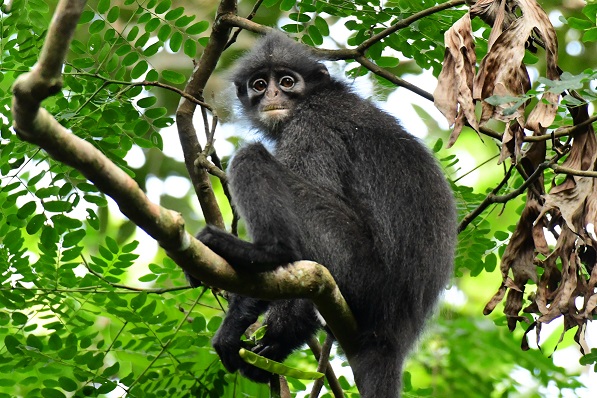
Presbytis frontata is endemic to the island of Borneo and occurs in southeastern Borneo, south of 3°N and east of the Barito River. It has a predominantly greyish-brown dorsal coat, a yellowish-brown underside and a distinctive white forehead spot.
Written 26 November 2026 from the sources listed below. Each statement was checked against the passage it cites; statements that could not be supported were removed.
Appearance
The White-fronted Surili has a predominantly greyish-brown dorsal coat and a yellowish-brown underside. Its forehead has a distinctive white spot, while its tail is yellowish grey and its hands, feet, brow, crown crest and cheeks are blackish.[1][2]
The species has a tall sagittal crest that angles forward, a deep jaw and a short, broad face. Its thumb is reduced, and its hindlimbs are longer than its forelimbs.[3][4][5]
The species has a sacculated stomach and enlarged salivary glands. Its incisors are narrow, and its molars have sharp, high crests.[6][7]
Adult males have an average body mass of 5.67 kg, while adult females have an average body mass of 5.56 kg.[8][9]
Two subspecies are recognized: P. f. frontata and P. f. nudifrons. The forehead spot of P. f. frontata is approximately triangular, while that of P. f. nudifrons is relatively square and divided by a vertical line of short black hairs.[10][11][12]
P. f. nudifrons has a dark greyish coat with blackish hands, feet and tail base. Its underparts are paler grey-brown, and it has a white throat.[13][14]
Habitat
The White-fronted Surili inhabits subtropical or tropical dry forests. It occurs in tall lowland and hill dipterocarp forests at elevations not exceeding 300 metres and has also been observed in riverine and hill forests.[15][16][17]
The species is endemic to the island of Borneo, occurring in Indonesia, Malaysia and possibly Brunei. Its distribution is restricted to southeastern Borneo, south of 3°N and east of the Barito River, with records between the Kayan River and Banjarmasin in the south.[18][19][20]
The subspecies P. f. nudifrons has been recorded in central Sarawak between the upper Rajang River and upper Batang Lupar. Its recorded range includes Lanjak Entimau Wildlife Sanctuary.[21][22]
Diet
The White-fronted Surili primarily eats leaves but also consumes fruits and seeds. It prefers immature leaves over mature leaves.[23][24]
Behaviour
The White-fronted Surili is active during daylight hours and lives in trees. It moves through forests by walking on all four limbs and by leaping.[25][26][27]
Groups typically contain between 10 and 15 individuals, although solitary males have also been observed. Males use loud calls to mark their group's territory.[28][29][30]
Individuals engage in social grooming as a form of tactile communication.[31]
Reproduction and life cycle
Females give birth to a single offspring at a time.[32]
Conservation
The White-fronted Surili is classified as vulnerable. Its population has declined by more than 30% over the last three generations, approximately 30 years.[33][34]
Hunting for meat and traditional medicine contributes to the species' decline. Habitat loss associated with oil palm plantations and other human-modified habitats also threatens the species.[35][36]
The species is protected under Indonesian law and is fully protected in Sarawak. At least seven protected areas are known within its range, including one in Malaysia.[37][38][39]
Classification of the White-fronted Surili
| Kingdom | Animalia |
|---|---|
| Phylum | Chordata |
| Subphylum | Vertebrata |
| Infraphylum | Gnathostomata |
| Parvphylum | Osteichthyes |
| Megaclass | Tetrapoda |
| Class | Mammalia (Mammal) |
| Subclass | Theria |
| Infraclass | Eutheria |
| Order | Primates (Primate) |
| Suborder | Haplorrhini |
| Infraorder | Simiiformes |
| Superfamily | Cercopithecoidea |
| Family | Cercopithecidae (Old World Monkey) |
| Subfamily | Colobinae (Colobines) |
| Tribe | Presbytini (Asian Colobines) |
| Genus | Presbytis (Surilis) |
| Species | Presbytis frontata (Müller, 1838) |
Where the White-fronted Surili is found
Checklists and occurrence records place Presbytis frontata in 2 countries across Asia. GBIF holds 88 georeferenced records of it.
Countries
Regions and cities with the most records
Range as the checklists state it
Southern Asia
A number beside a place is its count of GBIF occurrence records. A place without a number comes from a checklist alone. Records show where a species has been observed or collected, which can include escapes and vagrants.
Common names
English
- White-fronted Surili
- White-faced Langur
- White-fronted Langur
- White-fronted Leaf Monkey
Names in 12 other languages
- Arabic
- لنغور ابيض الوجه
- Czech
- hulman běločelý
- Dutch
- Witvoorhoofdlangoer
- Finnish
- valko-otsasureli
- French
- Semnopithèque à front blanc
- German
- Weißstirnlangur
- Italian
- Presbite dalla fronte bianca
- Japanese
- シロビタイリーフモンキー
- Norwegian Bokmål
- Hvitpannelangur
- Polish
- langur białoczelny
- Russian
- Гололобый лангур
- Spanish
- Langur De Frente Blanca, Surili Frentiblanco
Synonyms
3 other scientific names have been used for this species and are now treated as synonyms of Presbytis frontata.
- Presbytis nudifrons Elliot, 1909
- Semnopithecus frontatus Möller, 1838
- Semnopithecus frontatus S. Muller, 1838
Related species
-
 Raffles' Banded LangurPresbytis femoralis
-
 Miller's LangurPresbytis canicrus
-
 Javan SuriliPresbytis comata
-
 Maroon Leaf MonkeyPresbytis rubicunda
-
 Thomas's LangurPresbytis thomasi
-
 White-thighed SuriliPresbytis siamensis
-
 Sarawak SuriliPresbytis chrysomelas
- Mentawai LangurPresbytis potenziani
Compare
Questions and answers
What is the scientific name of the White-fronted Surili?
The scientific name of the White-fronted Surili is Presbytis frontata. Written with its author, the full name is Presbytis frontata (Müller, 1838).
Which family does the White-fronted Surili belong to?
Presbytis frontata belongs to the family Cercopithecidae, in the order Primates and the class Mammalia.
Where is the White-fronted Surili found?
Checklists and occurrence records place Presbytis frontata in 2 countries: Indonesia and Malaysia.
What is the conservation status of the White-fronted Surili?
The IUCN Red List category recorded for Presbytis frontata is Vulnerable (VU).
What other names does the White-fronted Surili have?
Presbytis frontata is also known in English as White-faced Langur, White-fronted Langur and White-fronted Leaf Monkey.
Sources
Passages the profile rests on
- The species has a predominantly greyish-brown dorsal coat and a yellowish-brown underside, with a distinctive white forehead spot. Source passage: “This species' dorsal body is mainly greyish brown and ventral side is yellowish brown in coloration, with a distinct white spot on the forehead.” — English Wikipedia
- Its tail is yellowish grey, while its hands, feet, brow, crown crest and cheeks are blackish. Source passage: “The tail is yellowish grey, with blackish coloration of hands, feet, brow, crown crest and cheeks.” — English Wikipedia
- The species has a tall sagittal crest that angles forward. Source passage: “The white-fronted surili has a tall sagittal crest that leans forward.” — English Wikipedia
- The species has a deep jaw and a short, broad face. Source passage: “The jaw is deep and the face is short and broad.” — English Wikipedia
- Its thumb is reduced, and its hindlimbs are longer than its forelimbs. Source passage: “The thumb is reduced and the hindlimbs are longer than the forelimbs.” — English Wikipedia
- The species has a sacculated stomach and enlarged salivary glands. Source passage: “This species has a sacculated stomach to assist in the breakdown of cellulose and also has enlarged salivary glands.” — English Wikipedia
- Its incisors are narrow, and its molars have sharp, high crests. Source passage: “The incisors are narrow and the molars have a sharp, high crest.” — English Wikipedia
- Adult males have an average body mass of 5.67 kg. Source passage: “The average body mass for the adult male is 5.67 kg” — English Wikipedia
- Adult females have an average body mass of 5.56 kg. Source passage: “and for adult females is 5.56 kg.” — English Wikipedia
- Two subspecies are recognized: P. f. frontata and P. f. nudifrons. Source passage: “There are two subspecies, P. f. frontata and P. f. nudifrons.” — English Wikipedia
- The forehead spot of P. f. frontata is approximately triangular. Source passage: “The white spot on the forehead is roughly triangular in shape.” — English Wikipedia
- The forehead spot of P. f. nudifrons is relatively square and divided by a vertical line of short black hairs. Source passage: “The white spot on the forehead is rather square compared to P. f. frontata and is divided by a vertical line of short black hairs.” — English Wikipedia
- P. f. nudifrons has a dark greyish coat with blackish hands, feet and tail base. Source passage: “P. f. nudifrons is dark greyish with blackish hands, feet and base of tail.” — English Wikipedia
- P. f. nudifrons has paler grey-brown underparts and a white throat. Source passage: “The underparts and the distal end of the tail are paler grey-brown and the throat is white.” — English Wikipedia
- The species inhabits subtropical or tropical dry forests. Source passage: “Its natural habitat is subtropical or tropical dry forests.” — English Wikipedia
- The species occurs in tall lowland and hill dipterocarp forests at elevations not exceeding 300 metres. Source passage: “P. frontata can be found in tall lowland and hill dipterocarp forests, not above 300 meters.” — English Wikipedia
- The species has also been observed in riverine and hill forests. Source passage: “This species has also been observed in riverine and hill forest.” — English Wikipedia
- The species is endemic to the island of Borneo, occurring in Indonesia, Malaysia and possibly Brunei. Source passage: “It is endemic to the large international island of Borneo, in Indonesia, Malaysia, and possibly Brunei.” — English Wikipedia
- The species' distribution is restricted to southeastern Borneo, south of 3°N and east of the Barito River. Source passage: “P. frontata is endemic to Borneo, and restricted to the south-east of Borneo, below 3°N and east of Barito River.” — English Wikipedia
- The species has been recorded between the Kayan River and Banjarmasin in the south. Source passage: “It was recorded in the east between the Kayan River and Banjarmasin in the south.” — English Wikipedia
- The subspecies P. f. nudifrons has been recorded in central Sarawak between the upper Rajang River and upper Batang Lupar. Source passage: “P. f. nudifrons was recorded from central Sarawak between the upper Rajang River and upper Batang Lupar, including Lanjak Entimau Wildlife Sanctuary.” — English Wikipedia
- The recorded range of P. f. nudifrons includes Lanjak Entimau Wildlife Sanctuary. Source passage: “including Lanjak Entimau Wildlife Sanctuary.” — English Wikipedia
- The species primarily eats leaves but also consumes fruits and seeds. Source passage: “It is also primarily a folivorous species, but also consumes fruits and seeds.” — English Wikipedia
- The species prefers immature leaves over mature leaves. Source passage: “This species prefers to eat immature leaves to more mature ones.” — English Wikipedia
- The species is active during daylight hours. Source passage: “This species is diurnal and arboreal.” — English Wikipedia
- The species lives in trees. Source passage: “This species is diurnal and arboreal.” — English Wikipedia
- The species moves through forests by walking on all four limbs and by leaping. Source passage: “The white-fronted surili moves through the forest quadrupedally. This species also moves through the forest by leaping.” — English Wikipedia
- Groups of this species typically contain between 10 and 15 individuals. Source passage: “The group sizes range from 10 to 15 individuals.” — English Wikipedia
- Solitary males have been observed in the species. Source passage: “In the population, solitary males have been observed in this species.” — English Wikipedia
- Males use loud calls to mark their group's territory. Source passage: “For communication, the males use loud calls to demarcate the group's territory.” — English Wikipedia
- Individuals engage in social grooming as a form of tactile communication. Source passage: “There is also tactile communication, which is social grooming.” — English Wikipedia
- Females give birth to a single offspring at a time. Source passage: “For reproduction, they only give birth to a single offspring.” — English Wikipedia
- The species is classified as vulnerable. Source passage: “This species is listed as vulnerable” — English Wikipedia
- The population has declined by more than 30% over the last three generations, approximately 30 years. Source passage: “because the population trends are decreasing to more than 30% over the last three generation (approximately 30 years).” — English Wikipedia
- Hunting for meat and traditional medicine contributes to the species' decline. Source passage: “This is due to the hunting for the meat and traditional medicine, as well as habitat loss.” — English Wikipedia
- Habitat loss associated with oil palm plantations and other human-modified habitats threatens the species. Source passage: “The forest habitat is being loss rapidly, especially due to oil palm plantations and other anthropogenic habitats.” — English Wikipedia
- The species is protected under Indonesian law. Source passage: “For conservation, this species is protected Indonesian law” — English Wikipedia
- The species is fully protected in Sarawak. Source passage: “and is totally protected in Sarawak.” — English Wikipedia
- At least seven protected areas are known within the species' range, including one in Malaysia. Source passage: “There are at least seven protected areas known, which only one in Malaysia, Lanjak-Entimau Wildlife Sanctuary.” — English Wikipedia
Data
- Catalogue of Life, 2026-10-16 XR cc by
- Global Biodiversity Information Facility CC BY 4.0
- Wikidata CC0
- GeoNames CC BY 4.0
- Wikimedia Commons per image; credit shown with each image
- Within the Catalogue of Life, this name comes from The Integrated Taxonomic Information System cc0
References
- Tijdschr. Nat. Gesch. Physiol. vol.5 p.136 where the name was published
- Wilson, Don E., and DeeAnn M. Reeder, eds. (1993). Mammal Species of the World: A Taxonomic and Geographic Reference, 2nd Ed., 3rd Printing.
- Wilson, Don E., and F. Russell Cole. (2000). Common Names of Mammals of the World.
- Wilson, Don E., and DeeAnn M. Reeder, eds. (2005). Mammal Species of the World: A Taxonomic and Geographic Reference, 3rd Ed., Vol. 1.
- Mittermeier, Rusell A., Anthony B. Rylands, and Don E. Wilson, eds. (2013). Handbook of the Mammals of the World. Volume 3. Primates.
This species in other databases
Page built on 27 November 2026. See how the catalog is made and all sources and licences.
Cite this page
ScientificNames.org. (2026). Presbytis frontata (White-fronted Surili). Retrieved November 27, 2026, from https://scientificnames.org/species/presbytis-frontata
“Presbytis frontata (White-fronted Surili).” ScientificNames.org, 2026, scientificnames.org/species/presbytis-frontata. Accessed 27 Nov. 2026.
ScientificNames.org. “Presbytis frontata (White-fronted Surili).” Accessed November 27, 2026. https://scientificnames.org/species/presbytis-frontata.
@misc{scientificnames_presbytis_frontata_white_fronted_surili,
  author = {{ScientificNames.org}},
  title = {Presbytis frontata (White-fronted Surili)},
  year = {2026},
  url = {https://scientificnames.org/species/presbytis-frontata},
  note = {Accessed 2026-11-27}
}