Species · Insects
Proctophanes scrubensis
Proctophanes scrubensis has no English name on record in the checklists used here. It is a species of insect in the family Scarabaeidae (dung beetles), order Coleoptera. The name dates from 1995.
- Scientific name
- Proctophanes scrubensis Stebnicka & Howden, 1995
- Genus
- Proctophanes
- Family
- Scarabaeidae (Dung Beetles)
- Order
- Coleoptera
- Class
- Insecta
- Recorded in
- 1 country
- Name status
- accepted in the Catalogue of Life
Overview
The species occurs in Queensland, Australia. Adults have a glossy, dark chestnut-coloured body, with some lighter portions of the head, wing cases and legs.
Written 28 November 2026 from the sources listed below. Each statement was checked against the passage it cites; statements that could not be supported were removed.
Appearance
Adults have a glossy, dark chestnut-coloured body. Portions of the head, wing cases and legs are somewhat lighter.[1]
Classification of Proctophanes scrubensis
| Kingdom | Animalia |
|---|---|
| Phylum | Arthropoda |
| Subphylum | Hexapoda |
| Class | Insecta (Insect) |
| Order | Coleoptera (Beetle) |
| Suborder | Polyphaga |
| Series | Staphyliniformia |
| Superfamily | Scarabaeoidea |
| Family | Scarabaeidae (Dung Beetles) |
| Subfamily | Aphodiinae |
| Tribe | Aphodiini |
| Subtribe | Proctophanina |
| Genus | Proctophanes |
| Species | Proctophanes scrubensis Stebnicka & Howden, 1995 |
Where Proctophanes scrubensis is found
Checklists and occurrence records place Proctophanes scrubensis in 1 country. GBIF holds 4 georeferenced records of it.
Countries
Range as the checklists state it
Australian(Queensland)
A number beside a place is its count of GBIF occurrence records. A place without a number comes from a checklist alone. Records show where a species has been observed or collected, which can include escapes and vagrants.
Related species
- Proctophanes sculptus
- Proctophanes heterodoxus
- Proctophanes minor
- Proctophanes caldwellensis
- Proctophanes metasternalis
- Proctophanes anneae
- Proctophanes distinguendus
-
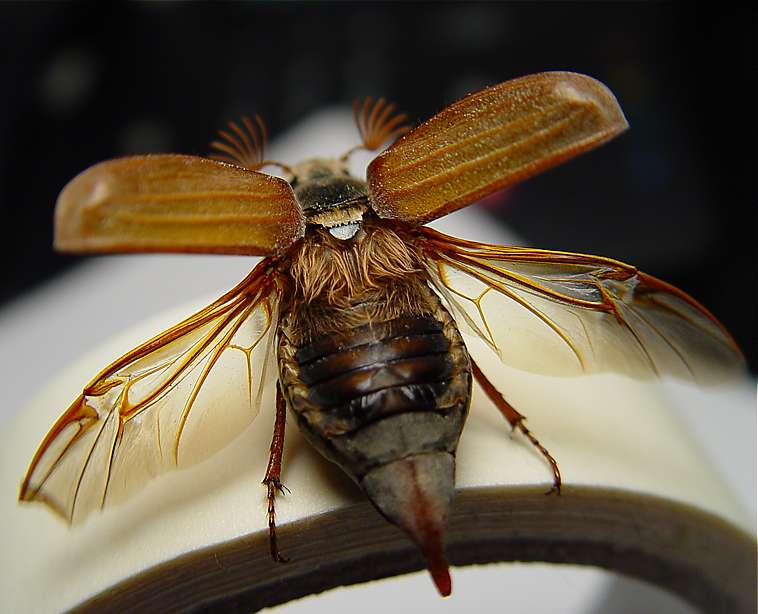 CockchaferMelolontha melolontha
Compare
Questions and answers
How large are adult Proctophanes scrubensis?
Adult individuals measure approximately 2.8–3.2 mm in length.[2]
Where does Proctophanes scrubensis occur?
The species occurs in Queensland, Australia.[3]
What colour is Proctophanes scrubensis?
Adults have a glossy, dark chestnut-coloured body, with portions of the head, wing cases and legs being somewhat lighter.[1]
Sources
Passages the profile rests on
- Adults have a glossy, dark chestnut-coloured body, with portions of the head, wing cases and legs being somewhat lighter. Source passage: “They have a shining dark castaneous body, with part of the head, the elytra and legs somewhat lighter.” — English Wikipedia
- Adult individuals measure approximately 2.8–3.2 mm in length. Source passage: “Adults reach a length of about 2.8–3.2 mm (0.11–0.13 in).” — English Wikipedia
- The species occurs in Queensland, Australia. Source passage: “It is found in Australia (Queensland).” — English Wikipedia
Data
- Catalogue of Life, 2026-10-16 XR cc by
- Global Biodiversity Information Facility CC BY 4.0
- Wikidata CC0
- GeoNames CC BY 4.0
- Within the Catalogue of Life, this name comes from World Scarabaeidae Database cc by
References
- Stebnicka, Z., & Howden, H. (1995). Revision of Australian genera in the tribes Aphodiini, Aegialiini and Proctophanini (Coleoptera: Scarabaeidae: Aphodiinae). Invertebrate Taxonomy 9(4):709-766. https://doi.org/10.1071/it9950709 Link where the name was published
This species in other databases
Page built on 29 November 2026. See how the catalog is made and all sources and licences.
Cite this page
ScientificNames.org. (2026). Proctophanes scrubensis. Retrieved November 29, 2026, from https://scientificnames.org/species/proctophanes-scrubensis
“Proctophanes scrubensis.” ScientificNames.org, 2026, scientificnames.org/species/proctophanes-scrubensis. Accessed 29 Nov. 2026.
ScientificNames.org. “Proctophanes scrubensis.” Accessed November 29, 2026. https://scientificnames.org/species/proctophanes-scrubensis.
@misc{scientificnames_proctophanes_scrubensis,
  author = {{ScientificNames.org}},
  title = {Proctophanes scrubensis},
  year = {2026},
  url = {https://scientificnames.org/species/proctophanes-scrubensis},
  note = {Accessed 2026-11-29}
}