Species · Insects
14-spot Ladybird Propylea quatuordecimpunctata
The scientific name of the 14-spot Ladybird is Propylea quatuordecimpunctata. It is a species of insect in the family Coccinellidae (ladybird beetles), order Coleoptera. The name dates from 1758.
- Scientific name
- Propylea quatuordecimpunctata (Linnaeus, 1758)
- Common name
- 14-spot Ladybird
- Genus
- Propylea
- Family
- Coccinellidae (Ladybird Beetles)
- Order
- Coleoptera
- Class
- Insecta
- Recorded in
- 61 countries
- Name status
- accepted in the Catalogue of Life

Overview
The 14-spot Ladybird is a small lady beetle belonging to the family Coccinellidae. It occurs in habitats ranging from lowlands to subalpine areas and is distributed across the Palearctic region, Europe, North Africa, and parts of Asia and North America. It exhibits more than 100 color and pattern variations, most commonly with 14 black, nearly rectangular spots on cream, yellow, or light orange elytra.
Written 26 November 2026 from the sources listed below. Each statement was checked against the passage it cites; statements that could not be supported were removed.
Appearance
The 14-spot Ladybird exhibits more than 100 different color and pattern variations. Its background coloration ranges from cream through yellow to light orange, excluding red, and its elytra usually bear 14 black, nearly rectangular spots.[1][2][3]
The elytral spots commonly fuse into larger markings, particularly along the midline, sometimes forming a pattern resembling an anchor. Some individuals have an almost entirely black body with 12 pale yellow spots.[4][5][6]
Its pronotum is whitish or pale yellow with four to eight black spots, while its antennae and legs are yellowish-brown. Adults measure 3.5–4.5 millimeters in length.[7][8][9]
Similar species
Some color forms of the 14-spot Ladybird were initially mistaken for separate species because of their differences in appearance.[10]
Habitat
The 14-spot Ladybird occurs in habitats ranging from lowlands to subalpine areas. Its habitats include broadleaf forests, mixed forests, and meadows in Western Europe, as well as fields, forests, and other life zones of central Europe.[11][12][13]
It can be found in gardens and parks and inhabits grasses, herbaceous plants, bushes, and trees. It also occurs in forest litter, brushwood, and coarse woody debris.[14][15][16]
Additional recorded habitats include moss, straw in sheds, detritus, and alluvial soil. The species also occurs in rotten plant residues and compost.[17][18]
The species is native to the Palearctic region and occurs northward to the Arctic Circle. It is common in Europe and North Africa, with a recorded range extending across Cyprus, European Russia, the Caucasus, Siberia, and the Russian Far East.[19][20][21]
Its recorded range also includes Belarus, Ukraine, Moldova, Transcaucasia, Kazakhstan, Western Asia, Pakistan, and Mongolia. Its Asian range includes temperate China, Korea, and Japan.[22][23][24]
The species is adventive and widespread in North America, from southeastern Canada to the Great Lakes and Florida. Its North American distribution is still expanding.[25][26]
Diet
The 14-spot Ladybird is insect-eating, and its recorded prey includes aphids. Its diet also includes members of the Aleyrodidae family and the Coccoidea superfamily.[27][28][29][30]
It consumes larvae and eggs of some beetles and butterflies.[31]
Behaviour
Adult beetles overwinter twice.[32]
Reproduction and life cycle
Females lay approximately 400 eggs. High larval mortality is reported as a reason for the large number of eggs laid by females.[33][34]
Uses
Initial introductions of the species in the United States were intended to control the Russian wheat aphid.[35]
Classification of the 14-spot Ladybird
| Kingdom | Animalia |
|---|---|
| Phylum | Arthropoda |
| Subphylum | Hexapoda |
| Class | Insecta (Insect) |
| Order | Coleoptera (Beetle) |
| Suborder | Polyphaga |
| Series | Cucujiformia |
| Superfamily | Coccinelloidea |
| Family | Coccinellidae (Ladybird Beetles) |
| Subfamily | Coccinellinae |
| Tribe | Coccinellini |
| Genus | Propylea |
| Species | Propylea quatuordecimpunctata (Linnaeus, 1758) |
This name was added to the Catalogue of Life from a contributing dataset by automated merging and has not yet been reviewed by its editors.
Where the 14-spot Ladybird is found
Checklists and occurrence records place Propylea quatuordecimpunctata in 61 countries across Africa, Asia and North America. GBIF holds 201,737 georeferenced records of it.
Countries
- Aland Islands 66
- Armenia 6
- Austria 2,432
- Azerbaijan 15
- Bangladesh 8
- Belarus 146
- Belgium 8,795
- Bosnia and Herzegovina 7
- Bulgaria 49
- Canada 4,075
- China 29
- Croatia 54
- Czechia 322
- Denmark 3,400
- Estonia 764
- Finland 3,048
- France 9,402
- Georgia 74
- Germany 19,580
- Greece 33
- Guernsey 4
- Hungary 681
- India 6
- Iran 5
- Ireland 338
- Isle of Man 62
- Israel 20
- Italy 877
- Japan 240
- Jersey 60
- Kazakhstan 32
- Kyrgyzstan 12
- Latvia 92
- Liechtenstein 8
- Lithuania 303
- Luxembourg 370
- Moldova 5
- Mongolia 57
- Montenegro 4
- North Macedonia 5
- Norway 2,642
- Pakistan 23
- Poland 1,567
- Portugal 388
- Romania 134
- Russia 3,645
- Saint Pierre and Miquelon 3
- Serbia 618
- Slovakia 88
- Slovenia 21
- South Korea 32
- Spain 1,507
- Sweden 9,364
- Switzerland 4,392
- Syria 7
- The Netherlands 59,390
- Turkey 52
- Ukraine 911
- United Kingdom 52,740
- United States 8,720
- Uzbekistan 7
Regions and cities with the most records
- England, United Kingdom 48,323
- Gelderland, The Netherlands 9,459
- Berkel en Rodenrijs, The Netherlands 5,986
- Pijnacker, The Netherlands 5,928
- Bergschenhoek, The Netherlands 5,901
- North Rhine-Westphalia, Germany 5,826
- Benthuizen, The Netherlands 5,755
- Zoetermeer, The Netherlands 5,554
- Nootdorp, The Netherlands 5,447
- Beuningen, The Netherlands 5,270
- Elst, The Netherlands 5,244
- Delft, The Netherlands 5,155
- Ypenburg, The Netherlands 5,115
- Utrecht, The Netherlands 5,060
- Rotterdam, The Netherlands 5,008
- Nijmegen, The Netherlands 4,945
- Voorburg, The Netherlands 4,878
- Limburg, The Netherlands 4,840
- Voorschoten, The Netherlands 4,815
- Waddinxveen, The Netherlands 4,808
- Zeist, The Netherlands 4,768
- Huissen, The Netherlands 4,724
- Driebergen-Rijsenburg, The Netherlands 4,706
- Bilthoven, The Netherlands 4,678
- Utrecht, The Netherlands 4,637
- Capelle aan den IJssel, The Netherlands 4,548
- Boskoop, The Netherlands 4,506
- Schiedam, The Netherlands 4,505
- Rijswijk, The Netherlands 4,461
- Alphen aan den Rijn, The Netherlands 4,459
- The Hague, The Netherlands 4,432
- Leiderdorp, The Netherlands 4,408
- Krimpen aan den IJssel, The Netherlands 4,365
- Wassenaar, The Netherlands 4,334
- Nieuw-Vennep, The Netherlands 4,258
- Wijchen, The Netherlands 4,206
Range as the checklists state it
Europe & Northern Asia (excluding China)
North America
Southern Asia
Africa
A number beside a place is its count of GBIF occurrence records. A place without a number comes from a checklist alone. Records show where a species has been observed or collected, which can include escapes and vagrants.
Common names
English
- 14-spot Ladybird
- 14-spot Ladybird Beetle
- 14-spotted Lady Beetle
- 14-spotted Ladybird
- 14-spotted Ladybird Beetle
- Checkerspot Ladybeetle
- Fourteen-spotted Lady Beetle
- Fourteen-spotted Ladybug
- Fourteen-spotted Ladybird
- P14
Names in 24 other languages
- Asturian
- catasol de catorce puntos
- Belarusian
- Кароўка чатырнаццацікропкавая
- Catalan
- Marieta de catorze punts, Poriol Groc de Catorze Punts
- Chinese
- 方斑瓢虫
- Croatian
- Četrnaestotočkasta bubamara
- Czech
- slunéčko čtrnáctitečné
- Danish
- Fjortenprikket mariehøne, Skakbræt
- Dutch
- Schaakbordlieveheersbeestje, Veertienstippelig lieveheersbeestje
- Estonian
- Ankurtriinu
- Finnish
- ruutupirkko
- French
- Coccinelle à damier, Coccinelle à quatorze points
- German
- Schachbrett-Marienkäfer, Schwarzgefleckter Marienkäfer, Vierzehnpunkt-Marienkäfer
- Hungarian
- tizennégypettyes füsskata
- Japanese
- コカメノコテントウ
- Korean
- 큰꼬마남생이무당벌레
- Latvian
- rakstainā mārīte
- Lithuanian
- Juodasiūlė boružė
- Norwegian Bokmål
- sjakkbrettmarihøne
- Polish
- Wrzeciążka
- Russian
- Четырнадцатиточечная коровка
- Slovak
- lienka štrnásťbodková
- Slovenian
- štirinajstpikčasta polonica
- Swedish
- fjortonprickig nyckelpiga, schackbrädspiga
- Ukrainian
- Сонечко чотирнадцятикрапкове
Synonyms
7 other scientific names have been used for this species and are now treated as synonyms of Propylea quatuordecimpunctata.
- Calvia quatuordecimpunctata (Linnaeus, 1758)
- Coccinella quatuordecimpunctata Linnaeus, 1758
- Coccinula quatuordecimpunctata (Linnaeus, 1758)
- Halyzia quatuordecimpunctata (Linnaeus, 1758)
- Propylaea quatuordecimpunctata (Linnaeus, 1758)
- Propylea quattuordecempunctata (Linnaeus, 1758)
- Propylea quatuordecimpunctata f. weisei
Related species
-
 Turtle Vein LadybugPropylea japonica
- Propylea luteopustulata
- Propylea dissecta
- Harmonia axyridis
-
 Seven-spot LadybirdCoccinella septempunctata
-
 Twice-stabbed Lady BeetleChilocorus stigma
-
 Pink Spotted Lady BeetleColeomegilla maculata
-
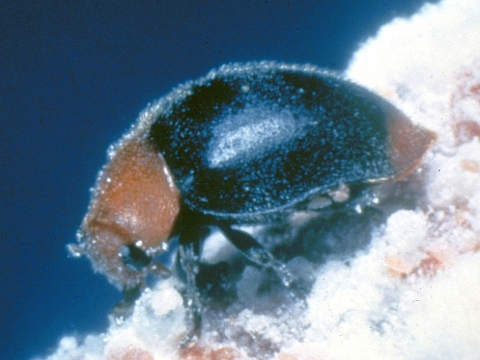 Mealybug DestroyerCryptolaemus montrouzieri
Compare
Questions and answers
What is the scientific name of the 14-spot Ladybird?
The scientific name of the 14-spot Ladybird is Propylea quatuordecimpunctata. Written with its author, the full name is Propylea quatuordecimpunctata (Linnaeus, 1758).
Which family does the 14-spot Ladybird belong to?
Propylea quatuordecimpunctata belongs to the family Coccinellidae, in the order Coleoptera and the class Insecta.
Where is the 14-spot Ladybird found?
Checklists and occurrence records place Propylea quatuordecimpunctata in 61 countries, including The Netherlands, United Kingdom, Germany, France, Sweden and Belgium.
What other names does the 14-spot Ladybird have?
Propylea quatuordecimpunctata is also known in English as 14-spot Ladybird Beetle, 14-spotted Lady Beetle, 14-spotted Ladybird, 14-spotted Ladybird Beetle, Checkerspot Ladybeetle and Fourteen-spotted Lady Beetle.
Sources
Passages the profile rests on
- The species exhibits more than 100 different color and pattern variations. Source passage: “well over 100 color and pattern variations.” — English Wikipedia
- Its background coloration ranges from cream through yellow to light orange, excluding red. Source passage: “The background coloration ranges from cream through yellow to light orange, but not red.” — English Wikipedia
- Its elytra usually bear 14 black, nearly rectangular spots. Source passage: “Usually there are 14 black, almost rectangular spots on the elytra” — English Wikipedia
- The elytral spots commonly fuse into larger markings, particularly along the midline. Source passage: “Most commonly, several of the spots are fused into larger markings, particularly along the midline” — English Wikipedia
- Fused elytral markings can form a pattern resembling an anchor. Source passage: “where they often create a shape resembling an anchor” — English Wikipedia
- Some individuals have an almost entirely black body with 12 pale yellow spots. Source passage: “rendering the body almost entirely black except for 12 pale yellow spots.” — English Wikipedia
- Its pronotum is whitish or pale yellow and bears four to eight black spots. Source passage: “The pronotum is whitish or pale yellow, with four to eight black spots.” — English Wikipedia
- Its antennae and legs are yellowish-brown. Source passage: “The antennae and legs are yellowish-brown.” — English Wikipedia
- Adults measure 3.5–4.5 millimeters in length. Source passage: “The beetles are 3.5 to 4.5 millimeters long” — English Wikipedia
- Some color forms were initially mistaken for separate species because of their differences in appearance. Source passage: “Some of these color forms differ to the extent that at first they were thought to be separate species.” — English Wikipedia
- The species occurs in habitats ranging from lowlands to subalpine areas. Source passage: “These beetles live in numerous different habitats, from lowlands to subalpine areas (Prealps)” — English Wikipedia
- Its habitats include broadleaf forests, mixed forests, and meadows in Western Europe. Source passage: “Western European broadleaf forests, mixed forests and meadows” — English Wikipedia
- The species occurs in fields, forests, and other life zones of central Europe. Source passage: “in fields, forests, and other Life zones of central Europe.” — English Wikipedia
- It can be found in gardens and parks. Source passage: “They can be found in gardens and parks” — English Wikipedia
- It inhabits grasses, herbaceous plants, bushes, and trees. Source passage: “on grasses and herbaceous plants, in bushes, and trees.” — English Wikipedia
- It also occurs in forest litter, brushwood, and coarse woody debris. Source passage: “in forest litter, on brushwood, on coarse woody debris” — English Wikipedia
- Additional recorded habitats include moss, straw in sheds, detritus, and alluvial soil. Source passage: “in moss, in straw in sheds, in detritus and alluvial soil” — English Wikipedia
- The species also occurs in rotten plant residues and compost. Source passage: “in rotten plant residues, and also in compost.” — English Wikipedia
- The species is native to the Palearctic region and occurs northward to the Arctic Circle. Source passage: “This species is native and widespread in the Palearctic north to the Arctic Circle.” — English Wikipedia
- It is common in Europe and North Africa. Source passage: “It is a common species in Europe, North Africa” — English Wikipedia
- Its recorded range includes Cyprus, European Russia, the Caucasus, Siberia, and the Russian Far East. Source passage: “Cyprus, European Russia, the Caucasus, Siberia, the Russian Far East” — English Wikipedia
- Its recorded range includes Belarus, Ukraine, Moldova, and Transcaucasia. Source passage: “Belarus, Ukraine, Moldova, Transcaucasia” — English Wikipedia
- The species occurs in Kazakhstan, Western Asia, Pakistan, and Mongolia. Source passage: “Kazakhstan, Western Asia, Pakistan, Mongolia” — English Wikipedia
- Its Asian range includes temperate China, Korea, and Japan. Source passage: “temperate China (Tarim Basin deciduous forests and steppe), Korea and Japan.” — English Wikipedia
- The species is adventive and widespread in North America, from southeastern Canada to the Great Lakes and Florida. Source passage: “The species is adventive and widespread in North America (southeastern Canada to the Great Lakes and Florida)” — English Wikipedia
- Its North American distribution is still expanding. Source passage: “and is still spreading.” — English Wikipedia
- The species is insect-eating. Source passage: “Propylea 14-punctata is entomophagous (insect-eating).” — English Wikipedia
- Its recorded prey includes aphids. Source passage: “It feeds on aphids, Aleyrodidae, Coccoidea” — English Wikipedia
- Its diet includes members of the Aleyrodidae family. Source passage: “It feeds on aphids, Aleyrodidae, Coccoidea” — English Wikipedia
- Its diet includes members of the Coccoidea superfamily. Source passage: “It feeds on aphids, Aleyrodidae, Coccoidea” — English Wikipedia
- It consumes larvae and eggs of some beetles and butterflies. Source passage: “and on the larvae and eggs of some beetles and butterflies” — English Wikipedia
- Adult beetles overwinter twice. Source passage: “The adult beetles overwinter twice.” — English Wikipedia
- Females lay approximately 400 eggs. Source passage: “The females lay about 400 eggs” — English Wikipedia
- High larval mortality is reported as a reason for the large number of eggs laid by females. Source passage: “this is necessary as there is often a high mortality among the larvae.” — English Wikipedia
- Initial introductions of the species in the United States were intended to control the Russian wheat aphid. Source passage: “The initial introductions of this species in the United States were intended as a controlling agent for the Russian wheat aphid” — English Wikipedia
Data
- Catalogue of Life, 2026-10-16 XR cc by
- Global Biodiversity Information Facility CC BY 4.0
- Wikidata CC0
- GeoNames CC BY 4.0
- Wikimedia Commons per image; credit shown with each image
- Within the Catalogue of Life, this name comes from The Integrated Taxonomic Information System cc0
References
- Mulsant, E. (1846) Securipalpes. Vol. 4. Histoire Naturelle des Coleopteres de France, Paris, 380 pp., 1 pl. where the name was published
This species in other databases
Page built on 27 November 2026. See how the catalog is made and all sources and licences.
Cite this page
ScientificNames.org. (2026). Propylea quatuordecimpunctata (14-spot Ladybird). Retrieved November 27, 2026, from https://scientificnames.org/species/propylea-quatuordecimpunctata
“Propylea quatuordecimpunctata (14-spot Ladybird).” ScientificNames.org, 2026, scientificnames.org/species/propylea-quatuordecimpunctata. Accessed 27 Nov. 2026.
ScientificNames.org. “Propylea quatuordecimpunctata (14-spot Ladybird).” Accessed November 27, 2026. https://scientificnames.org/species/propylea-quatuordecimpunctata.
@misc{scientificnames_propylea_quatuordecimpunctata_14_spot_ladybird,
  author = {{ScientificNames.org}},
  title = {Propylea quatuordecimpunctata (14-spot Ladybird)},
  year = {2026},
  url = {https://scientificnames.org/species/propylea-quatuordecimpunctata},
  note = {Accessed 2026-11-27}
}