Species · Fishes
Blackspotted Croaker Protonibea diacanthus
The scientific name of the Blackspotted Croaker is Protonibea diacanthus. It is a species of fish in the family Sciaenidae (drums), order Perciformes. The name dates from 1802.
- Scientific name
- Protonibea diacanthus (Lacepède, 1802)
- Common name
- Blackspotted Croaker
- Genus
- Protonibea
- Family
- Sciaenidae (Drums)
- Order
- Perciformes
- Class
- Teleostei
- Red List category
- NT Near Threatened
- Environment
- brackish, marine
- Recorded in
- 12 countries
- Name status
- accepted in the Catalogue of Life

Overview
Blackspotted Croaker is a large marine fish. It inhabits coastal waters across the Indo-Pacific region, from the Persian Gulf eastward into the Pacific Ocean. It has three to five broad, dark vertical body bands and numerous small black spots on its head, upper body and fins.
Written 26 November 2026 from the sources listed below. Each statement was checked against the passage it cites; statements that could not be supported were removed.
Appearance
The Blackspotted Croaker has three to five broad, dark vertical bands across its body. Numerous small black spots occur on the head, upper body, dorsal fin and caudal fin.[1][2]
Its dark body markings become less distinct as it grows larger. The pectoral, pelvic, anal and lower caudal fins are dark in colour.[3][4]
The dorsal fin has nine or ten spines before its incision, followed by one spine and 22 to 25 soft rays behind it. The anal fin is supported by two spines and seven soft rays.[5][6]
The frontmost pores on its chin are close to the tip of the lower jaw and connected by a groove. Its swim bladder is carrot-shaped, with branched appendages along both sides.[7][8]
Habitat
The species inhabits coastal waters, generally at depths of up to 60 metres. It occurs across the Indo-Pacific region, from the Persian Gulf eastward into the Pacific Ocean.[9][10]
Its northern distribution extends to Japan, while its southern range reaches northern Australia. In Australia, it occurs from Onslow in Western Australia around the northern tropical coast to Mackay in Queensland.[11][12]
The species occurs in the wet–dry tropics of northern Australia.[13]
Behaviour
The Blackspotted Croaker occasionally moves from coastal waters into estuaries and tidal sections of rivers.[14][15]
Uses
The species is valued by recreational, traditional and commercial fishing sectors in northern Australia. It is regarded as a delicacy.[16][17]
The species is prized in East Asia partly because some people believe its organs have medicinal properties. It commands high prices in Singapore, Malaysia, Indonesia, Hong Kong and Japan.[18][19]
A pharmaceutical company purchased a 22 kg specimen caught by Odisha fishermen in 2020 for ₹8,000 per kilogram. A 10 kg specimen caught in Odisha in 2019 sold for ₹10,000 per kilogram.[20][21]
A specimen weighing approximately 25.36 kg was caught in the Sundarbans, Bangladesh, in 2024 and fetched a negotiated price of ৳375,000 to ৳400,000.[22]
Gujarat designated the Blackspotted Croaker as its state fish in 2023.[23]
Conservation
The species is considered Least Concern in the Persian Gulf.[24]
Classification of the Blackspotted Croaker
| Kingdom | Animalia |
|---|---|
| Phylum | Chordata |
| Subphylum | Vertebrata |
| Infraphylum | Gnathostomata |
| Parvphylum | Osteichthyes |
| Gigaclass | Actinopterygii |
| Superclass | Actinopteri |
| Class | Teleostei (Teleost) |
| Order | Perciformes |
| Suborder | Percoidei |
| Family | Sciaenidae (Drums) |
| Genus | Protonibea |
| Species | Protonibea diacanthus (Lacepède, 1802) |
Where the Blackspotted Croaker is found
Checklists and occurrence records place Protonibea diacanthus in 12 countries. GBIF holds 1,637 georeferenced records of it.
Countries
- Australia 1,434
- Bangladesh 53
- China 10
- India 41
- Indonesia 33
- Iran 3
- Malaysia 10
- Pakistan 12
- Papua New Guinea 10
- Taiwan 19
- Thailand 8
- Vietnam 4
Regions and cities with the most records
- Mackay, Australia 683
- Queensland, Australia 30
- Gladstone, Australia 23
- Cilacap, Indonesia 21
- Wangon, Indonesia 12
- Northern Territory, Australia 11
- Darwin, Australia 7
- Karachi, Pakistan 7
- Sindh, Pakistan 7
- Erlin, Taiwan 6
- Mumbai, India 5
- Palmerston, Australia 5
- Taiwan, Taiwan 5
- Western Australia, Australia 5
- Maharashtra, India 4
- Rakhine, Myanmar 4
- Uran, India 4
- Chanaje, India 3
- Pitou, Taiwan 3
- West Bengal, India 3
- Xihu, Taiwan 3
A number beside a place is its count of GBIF occurrence records. A place without a number comes from a checklist alone. Records show where a species has been observed or collected, which can include escapes and vagrants.
Common names
English
- Blackspotted Croaker
- Black Croaker
- Black Jewfish
- Black Mulloway
- Black-spotted Croaker
- Blotched Croaker
- Croaker
- Jew Fish
- Slate-cod Croaker
- Speckled Drum
- Spotted Croaker
- Two-spined Jewfish
Names in 10 other languages
- Chinese
- 雙棘原黃姑魚, 鮸仔魚
- Czech
- smuha černoskvrnná
- French
- Courbine Pintade
- Japanese
- Goma-nibe, ゴマニベ
- Malay
- Gelama Tengkerong
- Malayalam
- Kooral
- Portuguese
- Corvina-branca-do-Indo-Pacífico
- Russian
- Протонибея, Пятнистый горбыль
- Spanish
- Corvina Pintada
- Thai
- ปลาจวดดำ, ปลาจวดลาย
Synonyms
14 other scientific names have been used for this species and are now treated as synonyms of Protonibea diacanthus.
- Corvina catalea (Cuvier, 1829)
- Corvina nigromaculata Borodin, 1930
- Corvina platycephala Cuvier, 1830
- Johnius cataleus Cuvier, 1829
- Johnius diacanthus (Lacepède, 1802)
- Johnius valenciennii Eydoux & Souleyet, 1850
- Lutianus diacanthus Lacépède, 1802
- Lutjanus diacanthus Lacepède, 1802
- Nibea diacanthus (Lacepède, 1802)
- Protonibea diacantha (Lacepède, 1802)
- Pseudosciaena diacanthus (Lacepède, 1802)
- Sciaena antarctica rex Whitley, 1945
- Sciaena diacanthus (Lacepède, 1802)
- Sciaena goma Tanaka, 1915
Related species
-
 Red DrumSciaenops ocellatus
-
 TotoabaTotoaba macdonaldi
-
 Freshwater DrumAplodinotus grunniens
-
 Atlantic CroakerMicropogonias undulatus
-
 MeagreArgyrosomus regius
-
 MullowayArgyrosomus japonicus
-
 Black DrumPogonias cromis
-
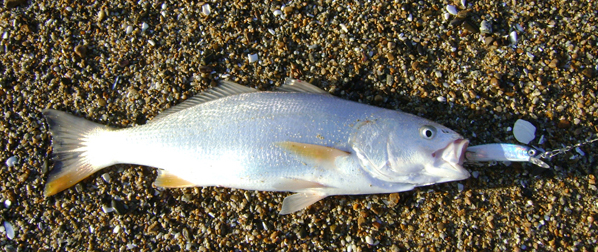 Corvina DrumCilus gilberti
Compare
Questions and answers
What is the scientific name of the Blackspotted Croaker?
The scientific name of the Blackspotted Croaker is Protonibea diacanthus. Written with its author, the full name is Protonibea diacanthus (Lacepède, 1802).
Which family does the Blackspotted Croaker belong to?
Protonibea diacanthus belongs to the family Sciaenidae, in the order Perciformes and the class Teleostei.
Where is the Blackspotted Croaker found?
Checklists and occurrence records place Protonibea diacanthus in 12 countries, including Australia, Bangladesh, India, Indonesia, Taiwan and Pakistan.
What is the conservation status of the Blackspotted Croaker?
The IUCN Red List category recorded for Protonibea diacanthus is Near Threatened (NT).
What other names does the Blackspotted Croaker have?
Protonibea diacanthus is also known in English as Black Croaker, Black Jewfish, Black Mulloway, Black-spotted Croaker, Blotched Croaker and Croaker.
Is croaker a good fish to eat?
The Blackspotted Croaker is regarded as a delicacy and is valued by recreational, traditional and commercial fishing sectors in northern Australia.[16][17]
Why is croaker fish expensive?
The Blackspotted Croaker is prized in East Asia partly because some people believe its organs have medicinal properties. It commands high prices in Singapore, Malaysia, Indonesia, Hong Kong and Japan.[18][19]
How big do croaker fish get?
The Blackspotted Croaker reaches a maximum total length of 180 cm.[25]
Sources
Passages the profile rests on
- The species has three to five broad, dark vertical bands across its body. Source passage: “There are between 3 and 5 broad dark vertical bands on the body” — English Wikipedia
- Numerous small black spots occur on the head, upper body, dorsal fin and caudal fin. Source passage: “numerous small black spots on the head, dorsal part of the body and the dorsal and caudal fins.” — English Wikipedia
- Its dark body markings become less distinct as the fish grows larger. Source passage: “These marking fade as the fish grows larger.” — English Wikipedia
- The pectoral, pelvic, anal and lower caudal fins are dark in colour. Source passage: “The pectoral, pelvic, anal and lower caudal fin are dark.” — English Wikipedia
- The dorsal fin has nine or ten spines before its incision and one spine followed by 22 to 25 soft rays behind it. Source passage: “9 or 10 spines supporting the fin to the front of the incision and a single spine and 22 to 25 soft rays supporting the fin to the rear of the incision.” — English Wikipedia
- The anal fin is supported by two spines and seven soft rays. Source passage: “The anal fin has 2 spines and 7 soft rays supporting it.” — English Wikipedia
- The frontmost pores on its chin are close to the tip of the lower jaw and connected by a groove. Source passage: “The blackspotted croaker has the frontmost pores on its chin very close to the tip of the lower jaw and they are joined by a groove.” — English Wikipedia
- Its swim bladder is carrot-shaped and has branched appendages along both sides. Source passage: “The swimbladder has a shape like a carrot and has branched appendages along the whole of both its sides” — English Wikipedia
- The species inhabits coastal waters, generally at depths of up to 60 metres. Source passage: “It is found in coastal waters, usually no deeper then 60 m (200 ft)” — English Wikipedia
- The species occurs across the Indo-Pacific region, from the Persian Gulf eastward into the Pacific Ocean. Source passage: “a wide Indo-Pacific distribution from the Persian Gulf (where it is considered Least Concern) east into the Pacific Ocean” — English Wikipedia
- Its northern distribution extends to Japan, while its southern range reaches northern Australia. Source passage: “where it extends north to Japan and south to northern Australia.” — English Wikipedia
- In Australia, the species occurs from Onslow in Western Australia around the northern tropical coast to Mackay in Queensland. Source passage: “In Australia their range extends from Onslow, Western Australia, around the northern tropical coast as far as Mackay, Queensland.” — English Wikipedia
- The species occurs in the wet–dry tropics of northern Australia. Source passage: “Protonibea diacanthus is distributed in the wet–dry tropics of northern Australia” — pmc.ncbi.nlm.nih.gov
- The species occasionally enters estuaries and tidal sections of rivers. Source passage: “It occasionally enters estuaries and the tidal reaches of rivers.” — English Wikipedia
- The species occasionally moves from coastal waters into estuaries and tidal river reaches. Source passage: “It occasionally enters estuaries and the tidal reaches of rivers.” — English Wikipedia
- The species is valued by recreational, traditional and commercial fishing sectors in northern Australia. Source passage: “The black-spotted croaker Protonibea diacanthus (Teleostei: Sciaenidae) is a large marine fish species of considerable value to recreational, traditional and commercial fishing sectors of northern Australia” — pmc.ncbi.nlm.nih.gov
- The species is regarded as a delicacy. Source passage: “The fish is considered a delicacy” — English Wikipedia
- The species is prized in East Asia partly because some people believe its organs have medicinal properties. Source passage: “it is prized in East Asia because even though there is no evidence, some people actually think its organs are medicinal.” — English Wikipedia
- The species commands high prices in Singapore, Malaysia, Indonesia, Hong Kong and Japan. Source passage: “The fish are most expensive in countries like Singapore, Malaysia, Indonesia, Hong Kong and Japan.” — English Wikipedia
- A pharmaceutical company purchased a 22 kg specimen caught by Odisha fishermen in 2020 for ₹8,000 per kilogram. Source passage: “In 2020, fishermen from Odisha caught one weighing around 22 kg (48 lb 8 oz). A pharmaceutical company purchased it ₹8000 per kg in an auction.” — English Wikipedia
- A 10 kg specimen caught in Odisha in 2019 sold for ₹10,000 per kilogram. Source passage: “In 2019, another fishermen from Odisha caught a 10 kg (22 lb) fish and was sold ₹10,000 per kg.” — English Wikipedia
- A specimen weighing approximately 25.36 kg was caught in the Sundarbans, Bangladesh, in 2024 and fetched a negotiated price of ৳375,000 to ৳400,000. Source passage: “In 2024, a Blackspotted croaker weighing around 25.36 kg (55 lb 15 oz) was caught in the Sundarbans, Bangladesh. This exceptional catch garnered interest and fetched a high price, negotiated between ৳375,000 to ৳400,000.” — English Wikipedia
- Gujarat designated the blackspotted croaker as its state fish in 2023. Source passage: “In 2023, Gujarat announced Blackspotted croaker as the state fish.” — English Wikipedia
- The species is considered Least Concern in the Persian Gulf. Source passage: “the Persian Gulf (where it is considered Least Concern)” — English Wikipedia
- The species reaches a maximum total length of 180 cm. Source passage: “This species reaches a maximum total length of 180 cm (71 in).” — English Wikipedia
Data
- Catalogue of Life, 2026-10-16 XR cc by
- Global Biodiversity Information Facility CC BY 4.0
- Wikidata CC0
- GeoNames CC BY 4.0
- Wikimedia Commons per image; credit shown with each image
- Within the Catalogue of Life, this name comes from World Register of Marine Species cc by
This species in other databases
- Catalogue of Life 4N6GF
- Wikidata Q2639323
- iNaturalist 465777
- WoRMS urn:lsid:marinespecies.org:taxname:282382
- ITIS 646519
Page built on 28 November 2026. See how the catalog is made and all sources and licences.
Cite this page
ScientificNames.org. (2026). Protonibea diacanthus (Blackspotted Croaker). Retrieved November 28, 2026, from https://scientificnames.org/species/protonibea-diacanthus
“Protonibea diacanthus (Blackspotted Croaker).” ScientificNames.org, 2026, scientificnames.org/species/protonibea-diacanthus. Accessed 28 Nov. 2026.
ScientificNames.org. “Protonibea diacanthus (Blackspotted Croaker).” Accessed November 28, 2026. https://scientificnames.org/species/protonibea-diacanthus.
@misc{scientificnames_protonibea_diacanthus_blackspotted_croaker,
  author = {{ScientificNames.org}},
  title = {Protonibea diacanthus (Blackspotted Croaker)},
  year = {2026},
  url = {https://scientificnames.org/species/protonibea-diacanthus},
  note = {Accessed 2026-11-28}
}