Species · Reptiles
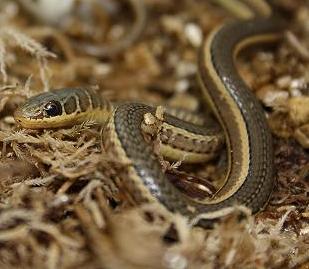
Link-marked Sand Snake Psammophis biseriatus
The scientific name of the Link-marked Sand Snake is Psammophis biseriatus. It is a species of reptile in the family Psammophiidae (sand snakes), order Squamata. The name dates from 1881.
- Scientific name
- Psammophis biseriatus Peters, 1881
- Common name
- Link-marked Sand Snake
- Genus
- Psammophis
- Family
- Psammophiidae (Sand Snakes)
- Order
- Squamata
- Class
- Reptilia
- Red List category
- LC Least Concern
- Recorded in
- 6 countries
- Name status
- accepted in the Catalogue of Life

Overview
Psammophis biseriatus, commonly known as the link-marked sand snake or two-striped sand racer, is a slender, swift, and mildly venomous colubrid snake found in the dry thornbush and arid regions of East Africa and the Horn of Africa.
Classification of the Link-marked Sand Snake
| Kingdom | Animalia |
|---|---|
| Phylum | Chordata |
| Subphylum | Vertebrata |
| Infraphylum | Gnathostomata |
| Parvphylum | Osteichthyes |
| Megaclass | Tetrapoda |
| Class | Reptilia (Reptile) |
| Order | Squamata (Snakes) |
| Suborder | Serpentes (Snakes) |
| Infraorder | Alethinophidia |
| Family | Psammophiidae (Sand Snakes) |
| Genus | Psammophis (Old World Sand Snakes) |
| Species | Psammophis biseriatus Peters, 1881 |
Where the Link-marked Sand Snake is found
Checklists and occurrence records place Psammophis biseriatus in 6 countries across Africa. GBIF holds 289 georeferenced records of it.
Countries
Regions and cities with the most records
- Taita Taveta, Kenya 54
- Watamu, Kenya 36
- Kilifi County, Kenya 32
- Voi, Kenya 22
- Malindi, Kenya 20
- Samburu County, Kenya 19
- Kitui County, Kenya 15
- Makueni County, Kenya 13
- Turkana County, Kenya 12
- Wajir County, Kenya 11
- Mandera County, Kenya 10
- Kajiado County, Kenya 8
- Wajir, Kenya 8
- Isiolo County, Kenya 7
- Ramu, Kenya 7
- Kakuma, Kenya 6
- Kilifi, Kenya 6
- Isiolo, Kenya 5
- Kitui, Kenya 5
- Kwale County, Kenya 4
- Lower Juba, Somalia 4
- Makindu, Kenya 4
- Matuga, Kenya 4
- Mogadishu, Somalia 4
- Tana River County, Kenya 4
- Ukunda, Kenya 4
- Arusha, Tanzania 3
- Banaadir, Somalia 3
- Beled Hawo, Somalia 3
- Jilib, Somalia 3
- Mandera, Kenya 3
- Marsabit County, Kenya 3
- Meru County, Kenya 3
- Murang'A, Kenya 3
- Murang’a, Kenya 3
Range as the checklists state it
S Somalia, Kenya, NE Tanzania, Republic of South Sudan (RSS), Ethiopia, Uganda
A number beside a place is its count of GBIF occurrence records. A place without a number comes from a checklist alone. Records show where a species has been observed or collected, which can include escapes and vagrants.
Common names
English
- Link-marked Sand Snake
- Two-striped Sand Racer
Related species
-
 Schokari Sand RacerPsammophis schokari
-
 Steppe Ribbon RacerPsammophis lineolatus
-
 Olive Grass SnakePsammophis mossambicus
-
 Western Yellow-bellied Sand SnakePsammophis subtaeniatus
-
 Hissing Sand SnakePsammophis sibilans
-
 Cape Sand SnakePsammophis leightoni
-
 Sand SnakePsammophis condanarus
-
 Sand SnakePsammophis punctulatus
Compare
Questions and answers
What is the scientific name of the Link-marked Sand Snake?
The scientific name of the Link-marked Sand Snake is Psammophis biseriatus. Written with its author, the full name is Psammophis biseriatus Peters, 1881.
Which family does the Link-marked Sand Snake belong to?
Psammophis biseriatus belongs to the family Psammophiidae, in the order Squamata and the class Reptilia.
Where is the Link-marked Sand Snake found?
Checklists and occurrence records place Psammophis biseriatus in 6 countries: Kenya, Somalia, Tanzania, Ethiopia, Uganda and South Sudan.
What is the conservation status of the Link-marked Sand Snake?
The IUCN Red List category recorded for Psammophis biseriatus is Least Concern (LC).
What other names does the Link-marked Sand Snake have?
Psammophis biseriatus is also known in English as Two-striped Sand Racer.
Sources
Data
- Catalogue of Life, 2026-10-16 XR cc by
- Global Biodiversity Information Facility CC BY 4.0
- Wikidata CC0
- English Wikipedia CC BY-SA 4.0
- GeoNames CC BY 4.0
- Wikimedia Commons per image; credit shown with each image
- Within the Catalogue of Life, this name comes from The Reptile Database cc by
References
- Peters, & Wilhem Carl Hartwig. (1881). Herpetologische Mittheilungen (Excrescenzen des Männchens von Rana gigas Blyth in der Paarungszeit, Psammophis biseriatus und breviceps, Dinodon cancellatum Dum. Bibr. = Lycodon rufozonatus Cantor, Lycodon napei Dum. Bibr. = Lycodon striatus Shaw, bau des Schädels von Uraeotyphlus oxyurus (Dum. Bibr.). Sitzungsber. Ges. Naturf. Freunde Berlin 1881 (6): 87-91.
- Fischer, J. G. (1884). Über einige afrikanische Reptilien, Amphibien und Fische des Naturhistorischen Museums I. Über die von Herrn Dr. G.A. Fischer in Massai Gebiete (Ost Afrika) auf seiner in Veranlassung der geographischen Gesellschaft in Hamburg unternommenen Expedition gesammelten Reptilien, Amphibien und Fische. Jahrb. Hamburg Wiss. Anst. 1: 1-32.
- Boulenger, G. A. (1891). On some Reptiles collected by Sig. L. Bricchetti Robecchi in Somaliland. Ann. Mus. St. Nat. Genova (2) 12: 5-15 [1892?].
- Boulenger, G. A. (1895). On the reptiles and batrachians obtained by Mr. E. Lort-Phillips in Somaliland. Ann. Mag. Nat. Hist. (6) 16: 165-169.
- Calabresi, & Enrica. (1916). Batraci e Rettili raccolti nella Somalia meridionale dai Dott. Stefanini e Paoli. Moni. Zool. Ital. Jour. Zool. 27 (2): 33-45.
- Loveridge, & Arthur. (1929). East African reptiles and amphibians in the United States National Museum. Bull. US Natl. Mus. (151): 1-135.
- Loveridge, A. (1936). African reptiles and amphibians in the Field Museum of Natural History. Zool. Ser. Field Mus. Nat. Hist., Chicago, 22 (1): 1-122.
- Scortecci, G. (1939). Spedizione zoologica del Marchese Saverio patrizi nel Basso Giuba e nell’Oltre Giuba. Giugno-agosto 1934. XII. Rettili Ofidi. Annali Mus. Civ. Stor. Nat. Giacomo Doria 58: 263-291.
- Bogert, Charles M. (1942). Snakes secured by the Snyder East African Expedition in Kenya Colony and Tanganyika Territory. American Museum Novitates (1178): 1-5.
- Gans, C.; Laurent, R.F. & PANDIT, H. (1965). Notes on a herpetological collection from the Somali Republic. Ann. Mus. Roy. Afr. Centr., Sér. 8vo, Tervuren, (80) Zool., (134): 1-93.
- Lanza, B. (1990). Amphibians and reptiles of the Somali Democratic Republic: check list and biogeography. Biogeographia, 14: 407-465 [1988].
- Broadley, D. G., & HOWELL, K. M. (1991). A check list of the reptiles of Tanzania, with synoptic keys. Syntarsus 1: 1—70.
- Largen, M. J., & Rasmussen, J. B. (1993). Catalogue of the snakes of Ethiopia (Reptilia Serpentes), including identification keys. Tropical Zoology 6: 313-434.
- Bauer, A.M.; Günther,R. & Klipfel,M. (1995). The herpetological contributions of Wilhelm C.H. Peters (1815-1883). SSAR Facsimile Reprints in Herpetology, 714 Pp.
- Largen, M. J. (1997). An annotated checklist of the amphibians and reptiles of Eritrea, with keys for their identification. Tropical Zoology 10: 63-115.
- Spawls, S.; Howell, K.; Drewes, R.C. & Ashe, J. (2002). A field guide to the reptiles of East Africa. Academic Press, 543 Pp. [Reviews in HR 34: 396 and Afr. J. Herp. 51; 147].
- Largen, M. J., & Spawls, S. (2010). Amphibians and Reptiles of Ethiopia and Eritrea. Edition Chimaira, Frankfurt, 694 Pp.
- Muchai, Vincent, & Patrick Malonza. (2011). The reptiles and amphibians of Kibwezi Forest, Ngulia and Chyulu Hills. Kenya Past and Present (39): 45-49.
- Wallach, Van; Kenneth L. Williams, Jeff Boundy. (2014). Snakes of the World: A Catalogue of Living and Extinct Species. [type catalogue]. Taylor and Francis, CRC Press, 1237 Pp.
- Spawls, Steve; Kim Howell, Harald Hinkel, Michele Menegon. (2018). Field Guide to East African Reptiles. Bloomsbury, 624 Pp.
- Šmíd J, Fernández SM, Elmi HSA, & Mazuch T. (2023). Diversity of Sand Snakes (Psammophiidae, Psammophis) in the Horn of Africa, with the description of a new species from Somalia. Zoosystematics and Evolution 99(2): 345-361.
- Kirchhof S, Wasonga V, Mazuch T, Spawls S, Malonza KP. (2023). An annotated checklist of the herpetofauna of the Sibiloi National Park in northern Kenya based on field surveys. Amphibian & Reptile Conservation 17(1/2) [General Section]: 1–18 (E324).
- Spawls, Stephen; Tomáš Mazuch & Abubakr Mohammad. (2023). Handbook of Amphibians and Reptiles of North-east Africa. Bloomsbury, 640 Pp.
- Amir, O. G., & Mumin, D. H. (2026). CHECKLIST OF THE AMPHIBIANS AND REPTILES OF SOMALIA. Somali National Museum [No Year given, but Released Online in 2026].
This species in other databases
Page built on 26 November 2026. See how the catalog is made and all sources and licences.
Cite this page
ScientificNames.org. (2026). Psammophis biseriatus (Link-marked Sand Snake). Retrieved November 26, 2026, from https://scientificnames.org/species/psammophis-biseriatus
“Psammophis biseriatus (Link-marked Sand Snake).” ScientificNames.org, 2026, scientificnames.org/species/psammophis-biseriatus. Accessed 26 Nov. 2026.
ScientificNames.org. “Psammophis biseriatus (Link-marked Sand Snake).” Accessed November 26, 2026. https://scientificnames.org/species/psammophis-biseriatus.
@misc{scientificnames_psammophis_biseriatus_link_marked_sand_snake,
  author = {{ScientificNames.org}},
  title = {Psammophis biseriatus (Link-marked Sand Snake)},
  year = {2026},
  url = {https://scientificnames.org/species/psammophis-biseriatus},
  note = {Accessed 2026-11-26}
}