Species · Reptiles
Pakistan Sand Racer Psammophis leithii
The scientific name of the Pakistan Sand Racer is Psammophis leithii. It is a species of reptile in the family Psammophiidae (sand snakes), order Squamata. The name dates from 1869.
- Scientific name
- Psammophis leithii Günther, 1869
- Common name
- Pakistan Sand Racer
- Genus
- Psammophis
- Family
- Psammophiidae (Sand Snakes)
- Order
- Squamata
- Class
- Reptilia
- Red List category
- LC Least Concern
- Recorded in
- 3 countries
- Name status
- accepted in the Catalogue of Life
Overview
The Pakistan Sand Racer (Psammophis leithii Günther, 1869) is a reptile belonging to the family Psammophiidae, order Squamata, class Reptilia, and genus Psammophis. Its recorded distribution includes eastern Afghanistan, western India, and Pakistan. It has a pale greyish or yellowish upper surface marked with black dots or four longitudinal brown bands, usually bordered by black.
Written 26 November 2026 from the sources listed below. Each statement was checked against the passage it cites; statements that could not be supported were removed.
Appearance
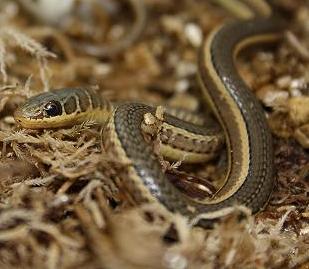
The upper surface is pale greyish or yellowish, with black dots or four longitudinal brown bands, usually bordered by black. The outer brown bands extend through the eyes.[1][2]
The underside is white and may be uniformly colored, spotted, or marked with grey or olive in the middle.[3]
The species has 17 rows of dorsal scales at midbody, between 177 and 188 ventral scales, and between 82 and 138 subcaudal scales. It usually has an undivided anal scale and eight or nine upper labial scales, with the fourth and fifth or fifth and sixth entering the eye.[4][5][6][7][8]
Its total length can reach approximately 99 cm, including a tail measuring approximately 30 cm.[9]
Habitat
The Pakistan Sand Racer inhabits deserts, grasslands, shrublands, forests, freshwater wetlands, and agricultural fields. It occurs at elevations between 10 and 600 metres.[10][11]
Diet
The species feeds on small lizards, including geckos and skinks, as well as birds.[12]
Behaviour
The Pakistan Sand Racer is primarily terrestrial. It climbs low bushes to raid birds' nests.[13][14]
The species is rear-fanged and possesses mild venom. Its venom is delivered to prey through enlarged, grooved teeth at the rear of the upper jaws.[15][16][17]
Its venom is not usually harmful to humans, and the species is described as harmless to humans.[18][19]
Reproduction and life cycle
The species reproduces by laying eggs.[20]
Classification of the Pakistan Sand Racer
| Kingdom | Animalia |
|---|---|
| Phylum | Chordata |
| Subphylum | Vertebrata |
| Infraphylum | Gnathostomata |
| Parvphylum | Osteichthyes |
| Megaclass | Tetrapoda |
| Class | Reptilia (Reptile) |
| Order | Squamata (Snakes) |
| Suborder | Serpentes (Snakes) |
| Infraorder | Alethinophidia |
| Family | Psammophiidae (Sand Snakes) |
| Genus | Psammophis (Old World Sand Snakes) |
| Species | Psammophis leithii Günther, 1869 |
Where the Pakistan Sand Racer is found
Checklists and occurrence records place Psammophis leithii in 3 countries across Asia. GBIF holds 91 georeferenced records of it.
Countries
Regions and cities with the most records
- Gujarat, India 8
- Sindh, Pakistan 5
- Amreli, India 4
- Balochistan, Pakistan 3
- Madhya Pradesh, India 1
- Maharashtra, India 1
- Rajasthan, India 1
- Andhra Pradesh, India
- Himachal Pradesh, India
- Punjab, India
- Uttar Pradesh, India
Range as the checklists state it
Pakistan, Afghanistan (LEVITON 1959: 461), western India (Himachal Pradesh, Gujarat, Rajasthan, Uttar Pradesh, Punjab, Jammu, Kashmir, Madhya Pradesh, Maharashtra, Andhra Pradesh)
A number beside a place is its count of GBIF occurrence records. A place without a number comes from a checklist alone. Records show where a species has been observed or collected, which can include escapes and vagrants.
Common names
English
- Pakistan Sand Racer
- Leith's Sand Snake
- Pakistani Ribbon Snake
Names in 4 other languages
- German
- Pakistanische Sandrennnatter
- Marathi
- लीथचा रेतीसर्प
- Portuguese
- Corredora-da-areia-do-Paquistão
- Russian
- Пакистанская песчаная змея
Related species
-
 Schokari Sand RacerPsammophis schokari
-
 Steppe Ribbon RacerPsammophis lineolatus
-
 Olive Grass SnakePsammophis mossambicus
-
 Western Yellow-bellied Sand SnakePsammophis subtaeniatus
-
 Hissing Sand SnakePsammophis sibilans
-
 Cape Sand SnakePsammophis leightoni
-
 Indian Sand SnakePsammophis condanarus
-
 Speckled Sand RacerPsammophis punctulatus
Compare
Questions and answers
What is the scientific name of the Pakistan Sand Racer?
The scientific name of the Pakistan Sand Racer is Psammophis leithii. Written with its author, the full name is Psammophis leithii Günther, 1869.
Which family does the Pakistan Sand Racer belong to?
Psammophis leithii belongs to the family Psammophiidae, in the order Squamata and the class Reptilia.
Where is the Pakistan Sand Racer found?
Checklists and occurrence records place Psammophis leithii in 3 countries: Pakistan, India and Afghanistan.
What is the conservation status of the Pakistan Sand Racer?
The IUCN Red List category recorded for Psammophis leithii is Least Concern (LC).
What other names does the Pakistan Sand Racer have?
Psammophis leithii is also known in English as Leith's Sand Snake and Pakistani Ribbon Snake.
Sources
Passages the profile rests on
- The species has a pale greyish or yellowish upper surface marked with black dots or four longitudinal brown bands, usually bordered by black. Source passage: “P. leithii is pale greyish or yellowish above, with black dots or four longitudinal brown bands which are usually edged with black” — English Wikipedia
- The outer longitudinal brown bands extend through the eyes. Source passage: “the outer passing through the eyes.” — English Wikipedia
- Its underside is white and may be uniformly colored, spotted, or marked with grey or olive in the middle. Source passage: “The lower parts are white, uniform or spotted or marked with grey or olive in the middle” — English Wikipedia
- The species has 17 rows of dorsal scales at midbody. Source passage: “The dorsal scales are in 17 rows at midbody.” — English Wikipedia
- Its ventral scales number between 177 and 188. Source passage: “The ventrals number 177–188.” — English Wikipedia
- The species has between 82 and 138 subcaudal scales. Source passage: “the subcaudals number 82–138.” — English Wikipedia
- It usually has an undivided anal scale. Source passage: “The anal is usually entire” — English Wikipedia
- It has eight or nine upper labial scales, with the fourth and fifth or fifth and sixth entering the eye. Source passage: “There are 8 or 9 upper labials, the fourth and fifth (or fifth and sixth) entering the eye.” — English Wikipedia
- The species can reach a total length of approximately 99 cm, including a tail measuring approximately 30 cm. Source passage: “It may attain a total length of 3 feet 3 inches (99 cm), which includes a tail 1 ft (30 cm) long.” — English Wikipedia
- The species inhabits deserts, grasslands, shrublands, forests, freshwater wetlands, and agricultural fields. Source passage: “P. leithii is found in a variety of habitats, including desert, grassland, shrubland, forest, freshwater wetlands, and agricultural fields” — English Wikipedia
- It occurs at elevations between 10 and 600 metres. Source passage: “at altitudes from 10–600 m (33–1,969 ft).” — English Wikipedia
- The species feeds on small lizards, including geckos and skinks, as well as birds. Source passage: “P. leithii preys upon small lizards, such as geckos and skinks, as well as birds.” — English Wikipedia
- The species is primarily terrestrial. Source passage: “P. leithii is terrestrial” — English Wikipedia
- It climbs low bushes to raid birds' nests. Source passage: “it will climb low bushes to raid birds' nests.” — English Wikipedia
- The species is rear-fanged. Source passage: “a species of rear-fanged, mildly venomous snake” — English Wikipedia
- The species possesses mild venom. Source passage: “Like all species in the genus Psammophis, P. leithii possess a mild venom” — English Wikipedia
- Its venom is delivered to prey through enlarged, grooved teeth at the rear of the upper jaws. Source passage: “which is delivered to prey by means of enlarged, grooved teeth at the rear of the snake's upper jaws.” — English Wikipedia
- Its venom is not usually harmful to humans. Source passage: “The venom is not usually harmful to humans.” — English Wikipedia
- The species is described as harmless to humans. Source passage: “It is harmless to humans.” — English Wikipedia
- The species reproduces by laying eggs. Source passage: “P. leithii is oviparous.” — English Wikipedia
Data
- Catalogue of Life, 2026-10-16 XR cc by
- Global Biodiversity Information Facility CC BY 4.0
- Wikidata CC0
- GeoNames CC BY 4.0
- Within the Catalogue of Life, this name comes from The Reptile Database cc by
References
- Report on two collections of Indian Reptiles. (1869). Proceedings of the Zoological Society, 1869, 500–507. https://doi.org/10.1111/j.1469-7998.1869.tb07359.x Link where the name was published
- Günther, A. (1869). Report on two collections of Indian reptiles. Proc. Zool. Soc. London 1869: 500-507.
- Boulenger, G. A. (1887). A list of the reptiles and batrachians obtained near Muscat, Arabia, and presented to the British Museum by Surgeon-Major A.S.G. Jayakar. Ann. Mag. Nat. Hist. (5) 20: 407-408.
- Boulenger, George A. (1890). The Fauna of British India, Including Ceylon and Burma. Reptilia and Batrachia. Taylor & Francis, London, Xviii, 541 Pp.
- Boulenger, G. A. (1896). Catalogue of the snakes in the British Museum, Vol. 3. London (Taylor & Francis), Xiv + 727 Pp.
- Nikolsky, A. M. (1897). Les reptiles, amphibiens et poissons recueillis (part.) Mr. N. Zaroudny dans la Perse orientale [in Russian]. Annuaire Musée Zoologique de l’Académie Impériale Des Sciences de St.-Pétersbourg 2: 306-348.
- Wall, F. (1907). Notes on Snakes collected in Fyzabad. J. Bombay Nat. Hist. Soc. 18: 101-129.
- Wall, F. (1907). Extension of the Habitat of the Sand Snake (Psammophis leithii). J. Bombay Nat. Hist. Soc. 18: 203.
- Wall, F. (1911). Remarks on a snake collection in the Quetta museum. J. Bombay Nat. Hist. Soc. 20: 1033-1042.
- Smith, M. A. (1943). The Fauna of British India, Ceylon and Burma, Including the Whole of the Indo-Chinese Sub-Region. Reptilia and Amphibia. 3 (Serpentes). Taylor and Francis, London. 583 Pp.
- Constable, JOHN D. (1949). Reptiles from the Indian Peninsula in the Museum of Comparative Zoology. Bull. Mus. Comp. Zool. Harvard 103: 59-160.
- Leviton, A. E. (1959). Systematics and Zoogeography of Philippine Snakes. Unpublished PhD Thesis.
- Kral, B. (1969). Notes on the herpetofauna of certain provinces of Afghanistan. Zoologiske Listy 18, 55-66.
- Khan, M. S. (2002). Die Schlangen Pakistans [English edition as “A Guide to the snakes of Pakistan”]. Edition Chimaira (Frankfurt Am Main), 265 Pp. [Review in HR 34: 400, Russ J Herp 12: 79].
- Sharma, R. C. (2004). Handbook Indian Snakes. AKHIL BOOKS, New Delhi, 292 Pp.
- Vyas, & Raju. (2007). Present conservation scenario of reptile fauna in Gujarat State, India. Indian Forester, Oct 2007: 1381-1394.
- Saikia, U.; Sharma, D.K. & Sharma, R.M. (2007). Checklist of the Reptilian fauna of Himachal Pradesh, India. Reptile Rap (8): 6-9.
- Baig, KJ, Masroor, R., and Arshad, M. (2008). Biodiversity and ecology of the herpetofauna of Cholistan Desert, Pakistan. Russ. J. Herpetol. 15 (3): 193-205.
- Murthy, T. S. N. (2010). The reptile fauna of India. B.R. Publishing, New Delhi, 332 Pp.
- Beolens, B., & Michael Watkins, a. M. G. (2011). The Eponym Dictionary of Reptiles. Johns Hopkins University Press, Baltimore, USA.
- Ingle, Mukesh and Anil Sarsavan. (2013). First record of Leith’s Sand Snake (Psammophis leithii, Gunther, 1869) from Sheopur district, Madhya Pradesh, India. International Journal of Environment & Animal Conservation 2 (1): 1-4.
- Wallach, Van; Kenneth L. Williams, Jeff Boundy. (2014). Snakes of the World: A Catalogue of Living and Extinct Species. [type catalogue]. Taylor and Francis, CRC Press, 1237 Pp.
- Patel, Harshil; Raju Vyas, Vaibhav Naik, Bhautik Dudhatra & Shantilal K. Tank. (2018). Herpetofauna of the Northern Western Ghats of Gujarat, India. Zoology and Ecology, DOI: 10.1080/21658005.2018.1499237.
- Faiz, A. H., Bagaturov, M. F., Hassan, M. u., Tariq, G., Malik, I. U., & Faiz, L. Z. (2018). Distribution of Reptiles in Tolipir National Park, Pakistan. Journal of Bioresource Management, 5 (2).
- Harrington, Sean M; Jordyn M de Haan, Lindsey Shapiro, Sara Ruane. (2018). Habits and characteristics of arboreal snakes worldwide: arboreality constrains body size but does not affect lineage diversification. Biological Journal of the Linnean Society 125 (1): 61–71.
This species in other databases
Page built on 29 November 2026. See how the catalog is made and all sources and licences.
Cite this page
ScientificNames.org. (2026). Psammophis leithii (Pakistan Sand Racer). Retrieved November 29, 2026, from https://scientificnames.org/species/psammophis-leithii
“Psammophis leithii (Pakistan Sand Racer).” ScientificNames.org, 2026, scientificnames.org/species/psammophis-leithii. Accessed 29 Nov. 2026.
ScientificNames.org. “Psammophis leithii (Pakistan Sand Racer).” Accessed November 29, 2026. https://scientificnames.org/species/psammophis-leithii.
@misc{scientificnames_psammophis_leithii_pakistan_sand_racer,
  author = {{ScientificNames.org}},
  title = {Psammophis leithii (Pakistan Sand Racer)},
  year = {2026},
  url = {https://scientificnames.org/species/psammophis-leithii},
  note = {Accessed 2026-11-29}
}