Species · Reptiles
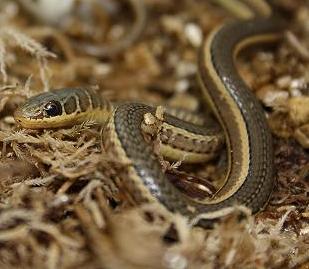
Eastern Stripe-bellied Sand Snake Psammophis orientalis
The scientific name of the Eastern Stripe-bellied Sand Snake is Psammophis orientalis. It is a species of reptile in the family Psammophiidae (sand snakes), order Squamata. The name dates from 1977.
- Scientific name
- Psammophis orientalis Broadley, 1977
- Common name
- Eastern Stripe-bellied Sand Snake
- Genus
- Psammophis
- Family
- Psammophiidae (Sand Snakes)
- Order
- Squamata
- Class
- Reptilia
- Red List category
- LC Least Concern
- Recorded in
- 5 countries
- Name status
- accepted in the Catalogue of Life

Overview
Psammophis orientalis occurs predominantly in East Africa. It has a slender body profile and is fast-moving and diurnal.
Written 27 November 2026 from the sources listed below. Each statement was checked against the passage it cites; statements that could not be supported were removed.
Appearance
The Eastern Stripe-bellied Sand Snake has a slender body profile.[1]
Behaviour
The Eastern Stripe-bellied Sand Snake is active during the daytime and is diurnal. It hunts actively during daylight hours.[2][3][4]
The species is fast-moving.[5]
Conservation
The Eastern Stripe-bellied Sand Snake was most recently assessed for the IUCN Red List in 2014.[6]
Classification of the Eastern Stripe-bellied Sand Snake
| Kingdom | Animalia |
|---|---|
| Phylum | Chordata |
| Subphylum | Vertebrata |
| Infraphylum | Gnathostomata |
| Parvphylum | Osteichthyes |
| Megaclass | Tetrapoda |
| Class | Reptilia (Reptile) |
| Order | Squamata (Snakes) |
| Suborder | Serpentes (Snakes) |
| Infraorder | Alethinophidia |
| Family | Psammophiidae (Sand Snakes) |
| Genus | Psammophis (Old World Sand Snakes) |
| Species | Psammophis orientalis Broadley, 1977 |
Where the Eastern Stripe-bellied Sand Snake is found
Checklists and occurrence records place Psammophis orientalis in 5 countries across Africa. GBIF holds 490 georeferenced records of it.
Countries
Regions and cities with the most records
- Kwale County, Kenya 40
- Kilifi County, Kenya 34
- Sofala, Mozambique 34
- Morogoro, Tanzania 28
- Inhambane Province, Mozambique 24
- Pwani, Tanzania 22
- Ukunda, Kenya 20
- Malindi, Kenya 19
- Mtwapa, Kenya 19
- Watamu, Kenya 19
- Nampula, Mozambique 17
- Cabo Delgado Province, Mozambique 16
- Tete, Mozambique 15
- Lilongwe, Malawi 14
- Manica, Mozambique 14
- Zambezia Province, Mozambique 13
- Morogoro, Tanzania 11
- Matuga, Kenya 10
- Niassa Province, Mozambique 10
- Nhamatanda, Mozambique 9
- Salima, Malawi 9
- Kibaha, Tanzania 7
- Mapinga, Tanzania 7
- Blantyre, Malawi 6
- Dodoma, Tanzania 6
- Gorongosa, Mozambique 6
- Iringa, Tanzania 6
- Vilankulo, Mozambique 6
- Jomvu, Kenya 5
- Kilifi, Kenya 5
- Liwonde, Malawi 5
- Mvomero, Tanzania 5
- Zanzibar North, Tanzania 5
- Dar es Salaam, Tanzania 4
- Machipanda, Mozambique 4
- Manica, Mozambique 4
Range as the checklists state it
E Kenya, Tanzania, Malawi, Mozambique, E Zimbabwe. May extend north to S Sudan and Ethiopia (fide BROADLEY & HOWELL 1991)
A number beside a place is its count of GBIF occurrence records. A place without a number comes from a checklist alone. Records show where a species has been observed or collected, which can include escapes and vagrants.
Common names
English
- Eastern Stripe-bellied Sand Snake
Names in 5 other languages
- Chinese
- 東方花條蛇
- Danish
- Østlig Bugstribet Sandsnog
- German
- Östliche Sandrennnatter
- Italian
- Serpente di sabbia dal ventre striato orientale
- Portuguese
- Cobra-de-barriga-listada
Synonyms
One other scientific name has been used for this species and is now treated as a synonym of Psammophis orientalis.
- Psammophis subtaeniatus orientalis Broadley, 1977
Related species
-
 Schokari Sand RacerPsammophis schokari
-
 Steppe Ribbon RacerPsammophis lineolatus
-
 Olive Grass SnakePsammophis mossambicus
-
 Western Yellow-bellied Sand SnakePsammophis subtaeniatus
-
 Hissing Sand SnakePsammophis sibilans
-
 Cape Sand SnakePsammophis leightoni
-
 Indian Sand SnakePsammophis condanarus
-
 Speckled Sand RacerPsammophis punctulatus
Compare
Questions and answers
What is the scientific name of the Eastern Stripe-bellied Sand Snake?
The scientific name of the Eastern Stripe-bellied Sand Snake is Psammophis orientalis. Written with its author, the full name is Psammophis orientalis Broadley, 1977.
Which family does the Eastern Stripe-bellied Sand Snake belong to?
Psammophis orientalis belongs to the family Psammophiidae, in the order Squamata and the class Reptilia.
Where is the Eastern Stripe-bellied Sand Snake found?
Checklists and occurrence records place Psammophis orientalis in 5 countries: Mozambique, Kenya, Malawi, Tanzania and Zimbabwe.
What is the conservation status of the Eastern Stripe-bellied Sand Snake?
The IUCN Red List category recorded for Psammophis orientalis is Least Concern (LC).
Sources
Passages the profile rests on
- The species has a slender body profile. Source passage: “recognized for its slender profile” — English Wikipedia
- The species is active during the daytime. Source passage: “a fast-moving, diurnal reptile” — English Wikipedia
- The species hunts actively during daylight hours. Source passage: “highly active daytime hunting behaviors” — English Wikipedia
- The species is diurnal. Source passage: “a fast-moving, diurnal reptile” — inaturalist.org
- The species is fast-moving. Source passage: “a fast-moving, diurnal reptile” — inaturalist.org
- The species was most recently assessed for the IUCN Red List in 2014. Source passage: “has most recently been assessed for The IUCN Red List of Threatened Species in 2014.” — iucnredlist.org
Data
- Catalogue of Life, 2026-10-16 XR cc by
- Global Biodiversity Information Facility CC BY 4.0
- Wikidata CC0
- GeoNames CC BY 4.0
- Wikimedia Commons per image; credit shown with each image
- Within the Catalogue of Life, this name comes from The Reptile Database cc by
References
- Broadley DG (1977) A review of the genus Psammophis in southern Africa (Serpentes: Colubridae). Arnoldia Rhodhesia 8 (12): 1-29 where the name was published
- Broadley, D. G. (1977). A review of the genus Psammophis in southern Africa (Serpentes: Colubridae). Arnoldia 8 (12): 1-29.
- Broadley D G. (1990). The herpetofaunas of the islands off the coast of south Mocambique. Arnoldia Zimbabwe 9 (35): 469-493.
- Broadley, D. G., & HOWELL, K. M. (1991). A check list of the reptiles of Tanzania, with synoptic keys. Syntarsus 1: 1—70.
- Spawls, S.; Howell, K.; Drewes, R.C. & Ashe, J. (2002). A field guide to the reptiles of East Africa. Academic Press, 543 Pp. [Reviews in HR 34: 396 and Afr. J. Herp. 51; 147].
- Broadley, D. G. (2002). A review of the species of Psammophis Boie found south of Latitude 12° S (Serpentes: Psammophiinae). African Journal of Herpetology 51 (2): 83-119.
- Cimatti, E. (2005). Zanzibar - Zala Zoological Park. Reptilia (GB) (39): 62-68.
- Malonza, Patrick K.; Victor D. Wasonga, Vincent Muchai , Damaris Rotich, Beryl A. Bwong; A.M. Bauer. (2006). DIVERSITY AND BIOGEOGRAPHY OF HERPETOFAUNA OF THE TANA RIVER PRIMATE NATIONAL RESERVE, KENYA. Journal of East African Natural History 95(2): 95–109.
- Jacobsen, Niels H.G.; Errol W. Pietersen & Darren W. Pietersen. (2010). A preliminary herpetological survey of the Vilanculos Coastal Wildlife Sanctuary on the San Sebastian Peninsula, Vilankulo, Mozambique. Herpetology Notes 3: 181-193.
- Broadley, D. & Blaylock. (2013). The Snakes of Zimbabwe and Botswana. Chimaira, Frankfurt, 387 Pp. [Book Review in Sauria 35 (2): 59 and Copeia 2014: 388].
- Wallach, Van; Kenneth L. Williams, Jeff Boundy. (2014). Snakes of the World: A Catalogue of Living and Extinct Species. [type catalogue]. Taylor and Francis, CRC Press, 1237 Pp.
- Conradie, Werner; Gabriela B. Bittencourt-Silva, Hanlie M. Engelbrecht, Simon P. Loader, Michele Menegon, Cristóvão Nanvonamuquitxo, Michael Scott, Krystal A. Tolley. (2016). Exploration into the hidden world of Mozambique’s sky island forests: new discoveries of reptiles and amphibians. Zoosyst. Evol. 92 (2): 163–180, DOI 10.3897/Zse.92.9948.
- Malonza, Patrick K.; David M. Mulwa, Joash O. Nyamache, Georgina Jones. (2017). Biogeography of the Shimba Hills ecosystem herpetofauna in Kenya. Zoological Research 38(5): 1-11.
- Bates, Michael F. (2018). Catalogue of reptiles from Mozambique in the collection of the National Museum, Bloemfontein, South Africa. Indago 34 (2): 135–147.
- Spawls, Steve; Kim Howell, Harald Hinkel, Michele Menegon. (2018). Field Guide to East African Reptiles. Bloomsbury, 624 Pp.
- HUGHES, B. (2018). THE SNAKES OF DODOMA. African Herp News (67): 8.
- Trape, Jean-François; Pierre-André Crochet, Donald G. Broadley, Patricia Sourouille, Youssouph Mané, Marius Burger, Wolfgang Böhme, Mostafa Saleh, Anna Karan, Benedetto Lanza & Oleg Mediannikov. (2019). On the Psammophis sibilans group (Serpentes, Lamprophiidae, Psammophiinae) north of 12°S, with the description of a new species from West Africa. Bonn Zoological Bulletin 68 (1): 61–91.
- Pietersen, Darren, Verburgt, Luke, Davies, & John. (2021). Snakes and other reptiles of Zambia and Malawi. Struik Nature / Penguin Random House South Africa, 376 Pp., ISBN 9781775847373.
- Farooq, Harith; Cristóvão Nanvonamuquitxo, Bibiana Nassongole, Werner Conradie, Roger Bills, Amadeu Soares, and Alexandre Antonelli. (2022). Shedding Light on a Biodiversity Dark Spot: Survey Of Amphibians and Reptiles of Pemba Region in Northern Mozambique. Herpetological Conservation and Biology 17 (2):
- Šmíd J, Fernández SM, Elmi HSA, & Mazuch T. (2023). Diversity of Sand Snakes (Psammophiidae, Psammophis) in the Horn of Africa, with the description of a new species from Somalia. Zoosystematics and Evolution 99(2): 345-361.
- Spawls, Stephen; Tomáš Mazuch & Abubakr Mohammad. (2023). Handbook of Amphibians and Reptiles of North-east Africa. Bloomsbury, 640 Pp.
- Miguel, A. R., Kaiser, H., Vargas, N. D., & Borges-Martins, M. (2024). Diversity and natural history of reptiles from coastal environments in Gilé National Park, northern Mozambique. Herpetology Notes 17: 173-199.
- Buruwate, T. C., & Lloyd-Jones, D. J. (2024). Amphibian and Reptile Diversity of Niassa Special Reserve, Northern Mozambique. Journal of East African Natural History, 113(1), 1-18.
- Wyk, Kurt M van; Bryan Maritz & Bruce W Clegg. (2025). Distribution and status of reptile species in south-eastern Zimbabwe. African Journal of Herpetology, 74:2, 210-270,.
- Miguel, A. R., Sitole, B. I., Calonga, N. A., Duarte, C. H., Armando, D., Nanvonamuquitxo, C. J., & Kaiser, H. (2025). Beyond the asymptote: a near-complete reptile inventory in the Miombo woodland and on Mount Morué, Mocuba Municipality, with a major range extension for the lizard Nucras boulengeri Neumann, 1900. Herpetology Notes 18: 1051-1071.
This species in other databases
Page built on 28 November 2026. See how the catalog is made and all sources and licences.
Cite this page
ScientificNames.org. (2026). Psammophis orientalis (Eastern Stripe-bellied Sand Snake). Retrieved November 28, 2026, from https://scientificnames.org/species/psammophis-orientalis
“Psammophis orientalis (Eastern Stripe-bellied Sand Snake).” ScientificNames.org, 2026, scientificnames.org/species/psammophis-orientalis. Accessed 28 Nov. 2026.
ScientificNames.org. “Psammophis orientalis (Eastern Stripe-bellied Sand Snake).” Accessed November 28, 2026. https://scientificnames.org/species/psammophis-orientalis.
@misc{scientificnames_psammophis_orientalis_eastern_stripe_bellied_sand_snake,
  author = {{ScientificNames.org}},
  title = {Psammophis orientalis (Eastern Stripe-bellied Sand Snake)},
  year = {2026},
  url = {https://scientificnames.org/species/psammophis-orientalis},
  note = {Accessed 2026-11-28}
}