Species · Amphibians
Red-crowned Toadlet Pseudophryne australis
The scientific name of the Red-crowned Toadlet is Pseudophryne australis. It is a species of amphibian in the family Myobatrachidae (australian frogs), order Anura. The name dates from 1835.
- Scientific name
- Pseudophryne australis (Gray, 1835)
- Common name
- Red-crowned Toadlet
- Genus
- Pseudophryne
- Family
- Myobatrachidae (Australian Frogs)
- Order
- Anura
- Class
- Amphibia
- Red List category
- NT Near Threatened
- Recorded in
- 1 country
- Name status
- accepted in the Catalogue of Life

Overview
Pseudophryne australis inhabits temporary creeks and soaks in sandstone woodland, heathland and dry sclerophyll forest in the Sydney Basin. It has a dark brown or black upper body with a bright red T-shaped marking on its head.
Written 26 November 2026 from the sources listed below. Each statement was checked against the passage it cites; statements that could not be supported were removed.
Appearance
The Red-crowned Toadlet has a dark brown or black upper body with a bright red T-shaped marking on its head. Red markings or a red wash extend across its back, with another red marking near its vent.[1][2]
Its sides are blue-grey, with white markings in the armpits and on the thighs. Its underside has strongly contrasting black-and-white marbling, sometimes with bluish areas between the colours.[3][4]
Adults reach approximately 30 mm in length. Its bright red markings serve as warning colours that signal toxicity to predators.[5][6]
Habitat
The Red-crowned Toadlet inhabits temporary creeks and soaks in sandstone woodland, heathland and dry sclerophyll forest in the Sydney Basin. It is associated with gutters, seepages and shallow pools that form after rainfall.[7][8]
It shelters beneath leaf litter, rocks and logs, and in sandstone crevices. It occurs in sandstone bushland reserves including Lane Cove National Park.[9][10]
Diet
The Red-crowned Toadlet is carnivorous and feeds on small invertebrates living in leaf litter, including termites, ants, thrips and springtails.[11][12]
Behaviour
Males produce a short call described as an ark call or a squelching sound. Their calls can be heard throughout the year when conditions are damp, particularly after rain.[13][14]
The species spends much of its time concealed beneath leaf litter, rocks, logs and sandstone crevices. During dry periods, individuals can dig into moist soil using their hind feet.[15][16]
Reproduction and life cycle
Breeding usually occurs during spring and summer following rainfall. Males call from nest sites beneath leaf litter and rocks in areas likely to become flooded, generally after heavy rainfall.[17][18][19]
Females lay small clutches of jelly-like eggs on damp land rather than directly in water. Eggs are deposited in damp leaf litter, soil hollows or spaces beneath logs near areas that may flood.[20][21]
Tadpoles begin developing inside the eggs before they enter water, and males remain with the eggs in the nest. Heavy rainfall floods nest sites and allows developed tadpoles to enter temporary pools, where they complete their development.[22][23][24]
After entering water, tadpoles develop legs and lungs, lose their tails and undergo metamorphosis into young frogs.[25]
Conservation
The Red-crowned Toadlet has declined because of urbanisation around Sydney. It is classified as vulnerable in New South Wales.[26][27]
Protecting sandstone gullies, leaf litter, temporary pools and clean waterways helps conserve its habitat. Its toxic skin and red warning colours provide protection against many predators.[28][29]
Classification of the Red-crowned Toadlet
| Kingdom | Animalia |
|---|---|
| Phylum | Chordata |
| Subphylum | Vertebrata |
| Infraphylum | Gnathostomata |
| Parvphylum | Osteichthyes |
| Megaclass | Tetrapoda |
| Class | Amphibia (Amphibians) |
| Order | Anura (Frogs) |
| Superfamily | Myobatrachoidea |
| Family | Myobatrachidae (Australian Frogs) |
| Genus | Pseudophryne (Crowned Toadlets) |
| Species | Pseudophryne australis (Gray, 1835) |
Where the Red-crowned Toadlet is found
Checklists and occurrence records place Pseudophryne australis in 1 country. GBIF holds 6,678 georeferenced records of it.
Countries
Regions and cities with the most records
- New South Wales, Australia 6,408
- Hornsby, Australia 2,805
- Sydney, Australia 1,478
- Central Coast, Australia 887
- Parramatta, Australia 719
- Wollongong, Australia 130
- Liverpool, Australia 100
- Cessnock, Australia 8
A number beside a place is its count of GBIF occurrence records. A place without a number comes from a checklist alone. Records show where a species has been observed or collected, which can include escapes and vagrants.
Common names
English
- Red-crowned Toadlet
- Hawksburgy Toadlet
- Red-crowned Brood Frog
Names in 5 other languages
- Czech
- paropucha korunková
- German
- Australische Scheinkröte, Rotkronen-Scheinkrötchen
- Japanese
- タンチョウヒキガエルモドキ
- Polish
- Korobora jaskrawogłowa
- Russian
- Яркоголовая ложная жаба
Synonyms
6 other scientific names have been used for this species and are now treated as synonyms of Pseudophryne australis.
- Bombinator australis Gray, 1835
- Buffonella crucigera Girard, 1853
- Bufonella crucifera Girard, 1853
- Phryniscus albifrons Duméril, Bibron & Duméril, 1854
- Phryniscus australis (Gray, 1835)
- Pseudophryne bibroni australis (Gray, 1835)
Related species
-
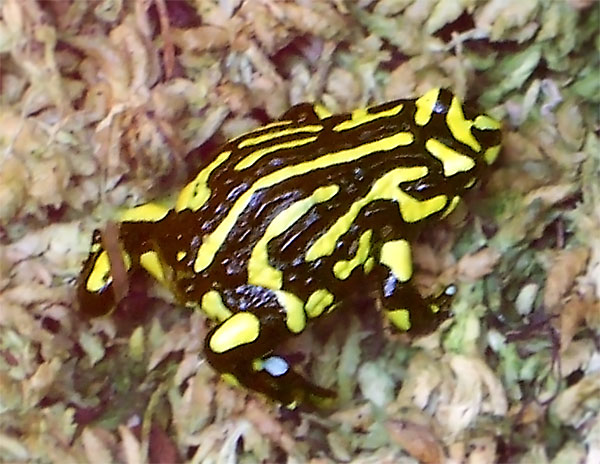 Southern Corroboree FrogPseudophryne corroboree
-
 Northern Corroboree FrogPseudophryne pengilleyi
-
 Bibron's ToadletPseudophryne bibronii
-
 Red-backed ToadletPseudophryne coriacea
-
 Southern ToadletPseudophryne semimarmorata
-
 Magnificent Brood FrogPseudophryne covacevichae
-
 Günther's ToadletPseudophryne guentheri
-
 Dendy's ToadletPseudophryne dendyi
Compare
Questions and answers
What is the scientific name of the Red-crowned Toadlet?
The scientific name of the Red-crowned Toadlet is Pseudophryne australis. Written with its author, the full name is Pseudophryne australis (Gray, 1835).
Which family does the Red-crowned Toadlet belong to?
Pseudophryne australis belongs to the family Myobatrachidae, in the order Anura and the class Amphibia.
Where is the Red-crowned Toadlet found?
Checklists and occurrence records place Pseudophryne australis in 1 country: Australia.
What is the conservation status of the Red-crowned Toadlet?
The IUCN Red List category recorded for Pseudophryne australis is Near Threatened (NT).
What other names does the Red-crowned Toadlet have?
Pseudophryne australis is also known in English as Hawksburgy Toadlet and Red-crowned Brood Frog.
Sources
Passages the profile rests on
- The species has a dark brown or black upper body with a bright red T-shaped marking on its head. Source passage: “It is characterised by the red T-shaped mark on its head. It is dark brown or black above” — English Wikipedia
- The species has red markings or a red wash across its back and a red marking near its vent. Source passage: “with a red wash or spots over its back, and a red mark near the vent.” — English Wikipedia
- Its sides are blue-grey, with white markings in the armpits and on the thighs. Source passage: “The sides are a blue-grey and there is a white mark in the armpits and thighs.” — English Wikipedia
- Its underside has strongly contrasting black-and-white marbling, sometimes with bluish areas between the colours. Source passage: “The ventral surface is very strongly marbled black and white, with a bluish colour in some areas between the black and white.” — English Wikipedia
- Its bright red markings serve as warning colours that signal toxicity to predators. Source passage: “Their bright red markings are warning colours that signal to predators that the frog is toxic.” — fieldofmar-e.schools.nsw.gov.au
- Adults reach approximately 30 mm in length. Source passage: “reaching 30 mm in length.” — English Wikipedia
- The species inhabits temporary creeks and soaks in sandstone woodland, heathland and dry sclerophyll forest in the Sydney Basin. Source passage: “This species is only found around temporary creeks and soaks in sandstone habitats in woodland, heathland and dry sclerophyll forest around the Sydney basin.” — English Wikipedia
- The species is associated with temporary creeks, soaks, gutters, seepages and shallow pools that form after rainfall. Source passage: “They are strongly connected to temporary creeks, soaks, gutters, seepages and shallow pools that form after rain.” — fieldofmar-e.schools.nsw.gov.au
- The species shelters beneath leaf litter, rocks, logs and in sandstone crevices. Source passage: “They shelter under leaf litter, rocks, logs and in small sandstone crevices.” — fieldofmar-e.schools.nsw.gov.au
- The species occurs in sandstone bushland reserves including Lane Cove National Park. Source passage: “In Sydney, red-crowned toadlets are associated with sandstone bushland such as Lane Cove National Park and other protected bushland reserves.” — fieldofmar-e.schools.nsw.gov.au
- The species feeds on small invertebrates living in leaf litter, including termites, ants, thrips and springtails. Source passage: “They eat small leaf litter invertebrates such as termites, ants, thrips and springtails.” — fieldofmar-e.schools.nsw.gov.au
- The species is carnivorous. Source passage: “Red-crowned toadlets are carnivores.” — fieldofmar-e.schools.nsw.gov.au
- Males produce a short call described as an ark call or a squelching sound. Source passage: “Male red-crowned toadlets make a short “arkâ€� or squelching call.” — fieldofmar-e.schools.nsw.gov.au
- Male calls can be heard throughout the year when conditions are damp, particularly after rain. Source passage: “Their call can be heard throughout the year when conditions are damp, especially after rain.” — fieldofmar-e.schools.nsw.gov.au
- The species spends much of its time concealed beneath leaf litter, rocks, logs and sandstone crevices. Source passage: “They spend much of their time hidden under leaf litter, rocks, logs and sandstone crevices.” — fieldofmar-e.schools.nsw.gov.au
- During dry periods, individuals can dig into moist soil using their hind feet. Source passage: “During dry periods they can dig down into moist soil using their strong hind feet.” — fieldofmar-e.schools.nsw.gov.au
- Males call from nest sites beneath leaf litter and rocks in areas likely to become flooded. Source passage: “Males make an ark call from nest sites under leaf litter and rocks, in areas likely to be inundated” — English Wikipedia
- Males generally call from their nest sites after heavy rainfall. Source passage: “generally only after heavy rain.” — English Wikipedia
- Breeding usually occurs during spring and summer following rainfall. Source passage: “Red-crowned toadlets usually breed in spring and summer after rain.” — fieldofmar-e.schools.nsw.gov.au
- Females lay eggs on damp land rather than directly in water. Source passage: “Unlike many frogs, they lay their eggs on land instead of directly in water.” — fieldofmar-e.schools.nsw.gov.au
- Females deposit small clutches of jelly-like eggs in damp leaf litter, soil hollows or spaces beneath logs near areas that may flood. Source passage: “Females lay small clutches of jelly-like eggs in damp leaf litter, soil hollows or small spaces under logs near places that may flood after rain.” — fieldofmar-e.schools.nsw.gov.au
- Tadpoles begin developing inside the eggs before they enter water. Source passage: “Eggs are laid under leaf litter and tadpoles begin developing inside the egg” — English Wikipedia
- Males remain with the eggs in the nest. Source passage: “the males stays with the eggs in the nest.” — English Wikipedia
- Heavy rainfall floods nest sites and allows developed tadpoles to enter temporary pools, where they complete their development. Source passage: “Once heavy rain floods the nest site the eggs hatch and the tadpoles (already fairly developed) finish their development in the temporary pools.” — English Wikipedia
- After entering water, tadpoles develop legs and lungs, lose their tails and undergo metamorphosis into young frogs. Source passage: “They continue growing, develop legs and lungs, lose their tails and change into young frogs.” — fieldofmar-e.schools.nsw.gov.au
- The species has declined because of urbanisation around Sydney. Source passage: “This species has declined due to urbanisation around Sydney.” — English Wikipedia
- The species is classified as vulnerable in New South Wales. Source passage: “Because red-crowned toadlets are vulnerable in NSW” — fieldofmar-e.schools.nsw.gov.au
- Protecting sandstone gullies, leaf litter, temporary pools and clean waterways helps conserve the species' habitat. Source passage: “Protecting sandstone gullies, leaf litter, temporary pools and clean waterways helps protect many other plants and animals that share the same environment.” — fieldofmar-e.schools.nsw.gov.au
- The species' toxic skin and red warning colours provide protection against many predators. Source passage: “although their toxic skin and red warning colours help protect them from many predators.” — fieldofmar-e.schools.nsw.gov.au
Data
- Catalogue of Life, 2026-10-16 XR cc by
- Global Biodiversity Information Facility CC BY 4.0
- Wikidata CC0
- GeoNames CC BY 4.0
- Wikimedia Commons per image; credit shown with each image
- Within the Catalogue of Life, this name comes from The Integrated Taxonomic Information System cc0
This species in other databases
Page built on 26 November 2026. See how the catalog is made and all sources and licences.
Cite this page
ScientificNames.org. (2026). Pseudophryne australis (Red-crowned Toadlet). Retrieved November 26, 2026, from https://scientificnames.org/species/pseudophryne-australis
“Pseudophryne australis (Red-crowned Toadlet).” ScientificNames.org, 2026, scientificnames.org/species/pseudophryne-australis. Accessed 26 Nov. 2026.
ScientificNames.org. “Pseudophryne australis (Red-crowned Toadlet).” Accessed November 26, 2026. https://scientificnames.org/species/pseudophryne-australis.
@misc{scientificnames_pseudophryne_australis_red_crowned_toadlet,
  author = {{ScientificNames.org}},
  title = {Pseudophryne australis (Red-crowned Toadlet)},
  year = {2026},
  url = {https://scientificnames.org/species/pseudophryne-australis},
  note = {Accessed 2026-11-26}
}