Species · Amphibians
Mud Salamander Pseudotriton montanus
The scientific name of the Mud Salamander is Pseudotriton montanus. It is a species of amphibian in the family Plethodontidae (lungless salamanders), order Caudata. The name dates from 1850.
- Scientific name
- Pseudotriton montanus Baird, 1850
- Common name
- Mud Salamander
- Genus
- Pseudotriton
- Family
- Plethodontidae (Lungless Salamanders)
- Order
- Caudata
- Class
- Amphibia
- Red List category
- LC Least Concern
- Environment
- freshwater, terrestrial
- Recorded in
- 1 country
- Name status
- accepted in the Catalogue of Life

Overview
Pseudotriton montanus occurs from southern New York to northern Florida, with its western distribution extending to Kentucky and Tennessee. Adults are generally reddish-brown with distinct round black spots on their backs, while juveniles can be bright red.
Written 26 November 2026 from the sources listed below. Each statement was checked against the passage it cites; statements that could not be supported were removed.
Appearance
Its coloration becomes darker as it ages. Adults typically have 16 to 17 costal grooves along their dorsal sides, dark brown eyes, and a short snout.[1][2][3]
Adult Mud Salamanders have between 30 and 40 distinct round black spots on their backs. They typically measure between 7.5 and 16 centimeters in length, and females tend to be larger than males.[4][5][6]
Habitat
The Mud Salamander inhabits freshwater wetlands, including swamps, bogs, springs, and streams. It favors freshwater habitats with muddy areas suitable for burrowing and is generally found at elevations below 700 meters.[7][8][9]
It sometimes occupies abandoned crayfish burrows. It also shelters beneath leaf litter, logs, stones, and bark.[10][11]
In North Carolina, Mud Salamanders primarily inhabit muddy, lowland habitats.[12]
Diet
Mud Salamanders are thought to eat earthworms, insects, and other arthropods. They may also consume other salamanders.[13][14]
Behaviour
Mud Salamanders are not migratory and generally remain near water sources and burrowing sites. They forage outside their burrows at night and retreat into their burrows when threatened.[15][16][17]
During the hottest summer months, Mud Salamanders may retreat deep underground.[18]
Reproduction and life cycle
Mud Salamanders breed during the warmer months of the year. Females generally deposit eggs during autumn or early winter and generally reproduce every other year.[19][20][21]
Males may mate several times per year with different females. During courtship, males perform a tail-undulation display.[22][23]
Female Mud Salamanders may remain with their egg clutches during incubation. Clutches contain between 65 and 200 eggs, which typically hatch after an incubation period of three or more months, between January and March.[24][25][26][27]
Females may reach reproductive maturity at four to five years of age. Males reach sexual maturity at approximately 2.5 years of age.[28][29]
Conservation
Mud Salamanders are considered globally secure but are regarded as endangered in Virginia because of their rarity there. They are not currently thought to be threatened, although habitat loss and declining water quality are potential threats.[30][31]
Uses
No positive or negative economic importance of Mud Salamanders to humans is known.[32][33]
Classification of the Mud Salamander
| Kingdom | Animalia |
|---|---|
| Phylum | Chordata |
| Subphylum | Vertebrata |
| Infraphylum | Gnathostomata |
| Parvphylum | Osteichthyes |
| Megaclass | Tetrapoda |
| Class | Amphibia (Amphibians) |
| Order | Caudata (Salamanders) |
| Family | Plethodontidae (Lungless Salamanders) |
| Subfamily | Hemidactyliinae |
| Genus | Pseudotriton (Mud Salamanders) |
| Species | Pseudotriton montanus Baird, 1850 |
Where the Mud Salamander is found
Checklists and occurrence records place Pseudotriton montanus in 1 country across North America. GBIF holds 2,047 georeferenced records of it.
Countries
Regions and cities with the most records
- North Carolina, United States 790
- South Carolina, United States 348
- Clemson, United States 267
- Raleigh, United States 213
- Cary, United States 207
- Garner, United States 204
- Morrisville, United States 203
- Apex, United States 197
- Florida, United States 158
- Virginia, United States 109
- Pinehurst, United States 100
- Durham, United States 97
- Carrboro, United States 95
- Chapel Hill, United States 95
- Georgia, United States 83
- Ohio, United States 66
- Boone, United States 44
- Maryland, United States 44
- Kentucky, United States 25
- Wake Forest, United States 25
- Williamsburg, United States 23
- Havelock, United States 22
- Hillcrest Heights, United States 21
- Leland, United States 21
- Asheville, United States 20
- Lake Ridge, United States 20
- Laurinburg, United States 20
- Camp Springs, United States 19
- Holly Springs, United States 19
- Lorton, United States 19
- West Springfield, United States 19
- Wilmington, United States 19
- Woodlawn, United States 19
- Annandale, United States 18
- Burke, United States 18
- Franconia, United States 18
Range as the checklists state it
North America
A number beside a place is its count of GBIF occurrence records. A place without a number comes from a checklist alone. Records show where a species has been observed or collected, which can include escapes and vagrants.
Common names
English
- Mud Salamander
- Eastern Mud Salamander
- Gulf Coast Mud Salamander
- Midland Mud Salamander
- Mountain Triton
- Rusty Mud Salamander
Names in 5 other languages
- Czech
- mločík náhorní
- Dutch
- Moddersalamander
- French
- Pseudotriton des vasières
- Russian
- Горный ложный тритон
- Spanish
- Salamandra de Barro
Synonyms
10 other scientific names have been used for this species and are now treated as synonyms of Pseudotriton montanus.
- Eurycea montana (Baird, 1850)
- Geotriton rubra montanus (Baird, 1850)
- Geotriton rubra sticticeps (Baird in Cope, 1889)
- Gyrinophilus montanus montanus (Baird, 1850)
- Pseudotriton montanum Baird, 1850
- Pseudotriton montanus montanus Baird, 1850
- Spelerpes montana (Baird, 1850)
- Spelerpes montanus (Baird, 1850)
- Spelerpes ruber montanus (Baird, 1850)
- Spelerpes ruber sticticeps Baird in Cope, 1889
Related species
-
 Red SalamanderPseudotriton ruber
- Midland Mud SalamanderPseudotriton diastictus
- Rusty Mud SalamanderPseudotriton flavissimus
-
 Red-backed SalamanderPlethodon cinereus
-
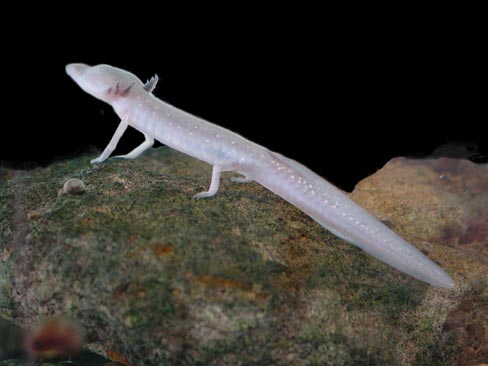 Texas Blind SalamanderEurycea rathbuni
- Blanco Blind SalamanderEurycea robusta
-
 Northern Two-lined SalamanderEurycea bislineata
-
 EnsatinaEnsatina eschscholtzii
Compare
Questions and answers
What is the scientific name of the Mud Salamander?
The scientific name of the Mud Salamander is Pseudotriton montanus. Written with its author, the full name is Pseudotriton montanus Baird, 1850.
Which family does the Mud Salamander belong to?
Pseudotriton montanus belongs to the family Plethodontidae, in the order Caudata and the class Amphibia.
Where is the Mud Salamander found?
Checklists and occurrence records place Pseudotriton montanus in 1 country: United States.
What is the conservation status of the Mud Salamander?
The IUCN Red List category recorded for Pseudotriton montanus is Least Concern (LC).
What other names does the Mud Salamander have?
Pseudotriton montanus is also known in English as Eastern Mud Salamander, Gulf Coast Mud Salamander, Midland Mud Salamander, Mountain Triton and Rusty Mud Salamander.
Sources
Passages the profile rests on
- The coloration of mud salamanders becomes darker as they age. Source passage: “Color becomes darker with age.” — animaldiversity.org
- Adult mud salamanders typically have 16 to 17 costal grooves along their dorsal sides. Source passage: “Mud salamanders generally have 16 to 17 costal grooves found along the dorsal side.” — animaldiversity.org
- Adult mud salamanders have dark brown eyes and a short snout. Source passage: “the mud salamander has dark brown eyes and a short snout” — English Wikipedia
- Adult mud salamanders have between 30 and 40 distinct round black spots on their backs. Source passage: “They have between 30 and 40 distinct round black spots on their backs by the time they reach adulthood.” — English Wikipedia
- Mud salamanders typically measure between 7.5 and 16 centimeters in length. Source passage: “range in length from 7.5 to 16 cm.” — animaldiversity.org
- Females tend to be larger than males. Source passage: “Females tend to be larger than males.” — animaldiversity.org
- Mud salamanders inhabit freshwater wetlands, including swamps, bogs, springs, and streams. Source passage: “including swamps, bogs, springs and streams” — animaldiversity.org
- Mud salamanders favor freshwater habitats with muddy areas suitable for burrowing. Source passage: “provide a muddy regions for burrowing.” — animaldiversity.org
- Mud salamanders are generally found at elevations below 700 meters. Source passage: “Present at elevations below 700 m” — animaldiversity.org
- Mud salamanders sometimes occupy abandoned crayfish burrows. Source passage: “these salamanders sometimes inhabit unoccupied crayfish holes.” — animaldiversity.org
- Mud salamanders shelter beneath leaf litter, logs, stones, and bark. Source passage: “seeks shelter in burrows beneath leaf litter, logs, stones, or bark.” — English Wikipedia
- Mud salamanders primarily inhabit muddy, lowland habitats in North Carolina. Source passage: “Found primarily in muddy, lowland habitats across North Carolina” — ncwildlife.gov
- Mud salamanders are thought to eat earthworms, insects, and other arthropods. Source passage: “This species is thought to eat earthworms, insects, and arthropods.” — animaldiversity.org
- Mud salamanders may consume other salamanders. Source passage: “Mud salamanders may also eat other salamanders.” — animaldiversity.org
- Mud salamanders are not migratory and generally remain near water sources and burrowing sites. Source passage: “Mud salamanders are not migratory. They tend to stay near water sources and places where they can burrow.” — animaldiversity.org
- Mud salamanders retreat into their burrows when threatened. Source passage: “These animals stay at the entrance of the burrow, retreating when threatened.” — animaldiversity.org
- Mud salamanders forage outside their burrows at night. Source passage: “They come out of these burrows at night and forage in the surrounding area.” — English Wikipedia
- Mud salamanders may retreat deep underground during the hottest summer months. Source passage: “Both larval and adult mud salamanders go deep underground during the hottest months of the summer” — English Wikipedia
- Mud salamanders breed during the warmer months of the year. Source passage: “Breeding occurs during the warmer months of the year.” — animaldiversity.org
- Female mud salamanders generally deposit eggs during autumn or early winter. Source passage: “Egg deposition is normally during autumn or early winter.” — animaldiversity.org
- Female mud salamanders generally reproduce every other year. Source passage: “Sexually mature females breed every other year.” — animaldiversity.org
- Male mud salamanders may mate several times per year with different females. Source passage: “Males may mate several times per year with different females.” — animaldiversity.org
- Male mud salamanders perform a tail-undulation display during courtship. Source passage: “the male performs a tail undulation display.” — animaldiversity.org
- Female mud salamanders may remain with their egg clutches during incubation. Source passage: “A female may stay with her eggs to aid the incubation process.” — animaldiversity.org
- Mud salamander eggs typically hatch after an incubation period of three or more months. Source passage: “Incubation typically lasts three or more months” — animaldiversity.org
- Mud salamander clutches contain between 65 and 200 eggs. Source passage: “Clutches range in size between 65 and 200.” — animaldiversity.org
- Mud salamander eggs hatch between January and March. Source passage: “hatch between January and March.” — animaldiversity.org
- Female mud salamanders may reach reproductive maturity at four to five years of age. Source passage: “females may not become reproductive until they are 4 or 5 years old.” — animaldiversity.org
- Male mud salamanders reach sexual maturity at approximately 2.5 years of age. Source passage: “Males reach sexual maturity at about 2.5 years” — animaldiversity.org
- Mud salamanders are not currently thought to be threatened, although habitat loss and declining water quality are potential threats. Source passage: “The species is not thought to be threatened, but degradation of water quality and habitat loss are possible threats to mud salamanders.” — animaldiversity.org
- Mud salamanders are considered globally secure but are regarded as endangered in Virginia because of their rarity there. Source passage: “The Virginia Herpetological Society regards this species to be secure globally, but in danger in Virginia because of its extreme rarity there.” — English Wikipedia
- No positive economic importance of mud salamanders to humans is known. Source passage: “There is no known positive economic importance of P. montanus for humans.” — animaldiversity.org
- No negative economic importance of mud salamanders to humans is known. Source passage: “There is no known negative economic importance of P. montanus for humans.” — animaldiversity.org
- Aquatic mud salamander larvae feed on small aquatic invertebrates. Source passage: “As aquatic larvae the mud salamander feeds on small aquatic invertebrates.” — dwr.virginia.gov
Data
- Catalogue of Life, 2026-10-16 XR cc by
- Global Biodiversity Information Facility CC BY 4.0
- Wikidata CC0
- GeoNames CC BY 4.0
- Wikimedia Commons per image; credit shown with each image
- Within the Catalogue of Life, this name comes from The Integrated Taxonomic Information System cc0
References
- Baird, S. F. (1850 "1849"). Revision of the North American tailed-batrachia, with descriptions of new genera and species. Journal of the Academy of Natural Sciences of Philadelphia. Series 2, 1: 281–294. where the name was published
- Crother, Brian I., Jeff Boundy, Jonathan A. Campbell, et al. / Moriarty, John J., ed. (2000). Scientific and Standard English Names of Amphibians and Reptiles of North America North of Mexico, with Comments Regarding Confidence in Our Understanding. Herpetological Circular, No. 29.
- Crother, Brian I., Jeff Boundy, Frank T. Burbrink, et al. / Moriarty, John J., ed. (2008). Scientific and Standard English Names of Amphibians and Reptiles of North America North of Mexico, With Comments Regarding Confidence in Our Understanding, Sixth Ed. Herpetological Circular No. 37.
This species in other databases
- Catalogue of Life 6WHM9
- Wikidata Q2247390
- iNaturalist 134316
- WoRMS urn:lsid:marinespecies.org:taxname:1369401
Page built on 27 November 2026. See how the catalog is made and all sources and licences.
Cite this page
ScientificNames.org. (2026). Pseudotriton montanus (Mud Salamander). Retrieved November 27, 2026, from https://scientificnames.org/species/pseudotriton-montanus
“Pseudotriton montanus (Mud Salamander).” ScientificNames.org, 2026, scientificnames.org/species/pseudotriton-montanus. Accessed 27 Nov. 2026.
ScientificNames.org. “Pseudotriton montanus (Mud Salamander).” Accessed November 27, 2026. https://scientificnames.org/species/pseudotriton-montanus.
@misc{scientificnames_pseudotriton_montanus_mud_salamander,
  author = {{ScientificNames.org}},
  title = {Pseudotriton montanus (Mud Salamander)},
  year = {2026},
  url = {https://scientificnames.org/species/pseudotriton-montanus},
  note = {Accessed 2026-11-27}
}