Species · Mosses and liverworts
Ciliated Fringewort Ptilidium ciliare
The scientific name of the Ciliated Fringewort is Ptilidium ciliare. It is a species of bryophyte in the family Ptilidiaceae, order Ptilidiales.
- Scientific name
- Ptilidium ciliare (L.) Hampe
- Common name
- Ciliated Fringewort
- Genus
- Ptilidium
- Family
- Ptilidiaceae
- Order
- Ptilidiales
- Class
- Jungermanniopsida
- Recorded in
- 31 countries
- Name status
- accepted in the Catalogue of Life

Overview
Ptilidium ciliare occurs in Canada, the northeastern United States and occasionally as far south as northern Italy. It forms loose tufts with pinnately or bipinnately branched stems and leaves with finely serrated or ciliated margins.
Written 27 November 2026 from the sources listed below. Each statement was checked against the passage it cites; statements that could not be supported were removed.
Appearance
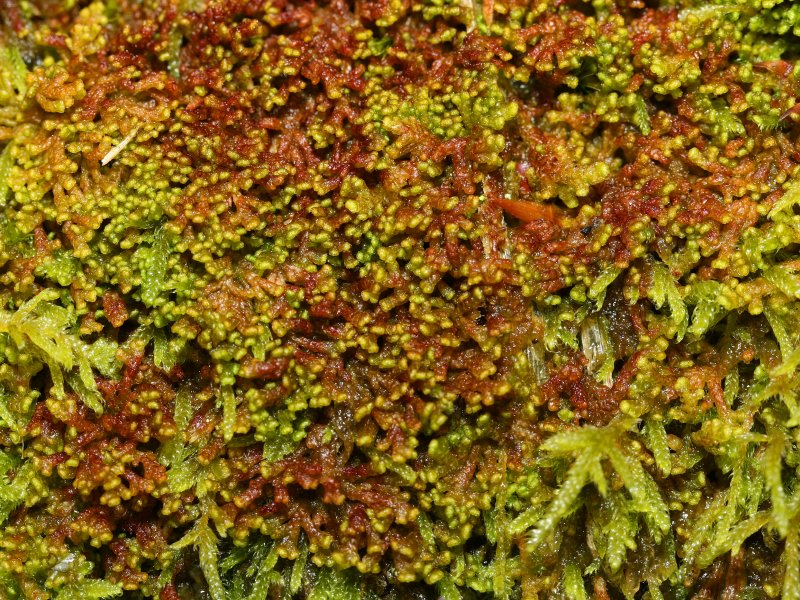
Ciliated Fringewort forms loose tufts ranging in colour from reddish-brown to yellow-green. Individual shoots can reach 3 mm in width.[1][2]
Its stems have pinnate or bipinnate branching and are covered by short, dense clusters of overlapping leaves. The leaves can reach 2.8 mm in width.[3][4][5]
The leaf margins are finely serrated or ciliated and extend into fringe-like rows of thin teeth. These dense marginal teeth make the bilobed structure of the leaves difficult to distinguish.[6][7][8]
Habitat
Ciliated Fringewort occurs in acidic grassland habitats and grows in heathy woodlands. It is found in habitats ranging from lowlands to uplands.[9][10][11]
It usually grows among a mixture of other bryophyte species. It prefers well-drained, acidic substrates.[12][13][14]
It only rarely grows on fallen logs and branches.[15]
Reproduction and life cycle
Sexual reproductive structures are observed very rarely in this species.[16]
Similar species
Stunted specimens of Ciliated Fringewort can be confused with Ptilidium pulcherrimum. Ptilidium pulcherrimum is smaller and more compact and almost always grows close to bark.[17][18][19]
Mastigophora woodsii is more robust than Ciliated Fringewort and has longer, attenuated branches. Its leaf size gradually decreases toward the branch tips.[20][21][22]
Classification of the Ciliated Fringewort
| Kingdom | Plantae |
|---|---|
| Subkingdom | Bryobiotina |
| Phylum | Marchantiophyta |
| Class | Jungermanniopsida |
| Subclass | Jungermanniidae |
| Order | Ptilidiales |
| Family | Ptilidiaceae |
| Genus | Ptilidium |
| Species | Ptilidium ciliare (L.) Hampe |
Where the Ciliated Fringewort is found
Checklists and occurrence records place Ptilidium ciliare in 31 countries. GBIF holds 32,778 georeferenced records of it.
Countries
- Aland Islands 11
- Austria 148
- Belarus 6
- Belgium 314
- Canada 2,999
- Czechia 585
- Denmark 1,383
- Estonia 394
- Faroe Islands 6
- Finland 2,765
- France 748
- Germany 551
- Greenland 103
- Iceland 327
- Ireland 85
- Isle of Man 14
- Italy 14
- Latvia 31
- Liechtenstein 8
- Norway 3,048
- Poland 1,262
- Russia 937
- Saint Pierre and Miquelon 3
- Slovakia 22
- Spain 51
- Svalbard and Jan Mayen 223
- Sweden 6,425
- Switzerland 512
- The Netherlands 1,071
- United Kingdom 6,034
- United States 2,698
Regions and cities with the most records
- England, United Kingdom 2,124
- Scotland, United Kingdom 1,868
- Wales, United Kingdom 1,794
- Norrbotten, Sweden 680
- Södermanland, Sweden 664
- Alaska, United States 618
- Västra Götaland, Sweden 582
- Västerbotten, Sweden 520
- Quebec, Canada 446
- Ontario, Canada 427
- Auvergne-Rhône-Alpes, France 384
- Stockholm, Sweden 376
- Gelderland, The Netherlands 326
- British Columbia, Canada 321
- Uppsala, Sweden 310
- Jämtland, Sweden 291
- Kangasala, Finland 232
- Bolesławiec, Poland 226
- Oslo, Norway 225
- Maine, United States 220
- Northwest Territories, Canada 215
- Central Jutland, Denmark 209
- Uppsala, Sweden 203
- Lapland, Finland 202
- Akershus, Norway 199
- Murmansk, Russia 199
- Kalmar, Sweden 193
- Drenthe, The Netherlands 191
- Bangor, United Kingdom 188
- Dalarna, Sweden 187
- Nordland, Norway 185
- Svalbard, Svalbard and Jan Mayen 175
- Barneveld, The Netherlands 174
- Ebbw Vale, United Kingdom 174
- Møre og Romsdal, Norway 174
- Shrewsbury, United Kingdom 172
7 more countries have a few records outside this range
These countries hold a few records of Ptilidium ciliare but lie outside the range the checklists give for it. Such records are often zoo or garden specimens, museum material or vagrants, so the species is not counted as occurring there.
A number beside a place is its count of GBIF occurrence records. A place without a number comes from a checklist alone. Records show where a species has been observed or collected, which can include escapes and vagrants.
Common names
English
- Ciliated Fringewort
- Northern Naugehyde Liverwort
Names in 14 other languages
- Czech
- brvitec chlupatý
- Danish
- Almindelig frynsemos
- Dutch
- Heidefranjemos
- Estonian
- harilik narmik
- Finnish
- isokorallisammal
- French
- ptilidie cilié, ptilidie des rochers
- German
- Großes Federchenmoos
- Japanese
- ケテガタゴケ
- Lithuanian
- Plačiaskiautė blakstienė
- Norwegian Bokmål
- bakkefrynse
- Polish
- Rzęsiak pospolity
- Russian
- Птилидиум реснитчатый
- Slovak
- páperovka brvitá
- Swedish
- frans-levermossa, franslevermossa, stor fransmossa, vanlig franslevermossa
Synonyms
39 other scientific names have been used for this species and are now treated as synonyms of Ptilidium ciliare.
- Blepharozia ciliaris (L.) Dumort.
- Blepharozia ciliaris f. ericetorum (Nees) C.E.O. Jensen
- Blepharozia ciliaris f. speciosa (Nees) Bernet
- Blepharozia ciliaris var. ciliaris
- Blepharozia ciliaris var. heteromalla (Dumort.) Dumort.
- Blepharozia hoffmannii (Wallr.) Cogn.
- Blepharozia leersii (Roth) Trevis.
- Jungermannia ciliaris L.
- Jungermannia ciliaris Leers
- Jungermannia ciliaris var. ciliaris
- Jungermannia ciliaris var. ericetorum (Nees) Hartm.
- Jungermannia ciliaris var. fluitans Fr.
- Jungermannia ciliaris var. heteromalla Dumort.
- Jungermannia ciliaris var. uliginosa Moug. & Nestl.
- Jungermannia ciliata L. ex Lam. & Mirb.
- Jungermannia hoffmannii Wallr.
- Jungermannia leersii Roth
- Ptilidium ciliare f. brunnescens Schiffn.
- Ptilidium ciliare f. ciliare
- Ptilidium ciliare f. ericetorum Nees
- Ptilidium ciliare f. heteromallum (Dumort.) Nees
- Ptilidium ciliare f. hodgsoniae (Allison) R.M. Schust.
- Ptilidium ciliare f. inundatum (Schiffn.) Macvicar
- Ptilidium ciliare f. polare R.M. Schust.
- Ptilidium ciliare f. speciosum Nees
- Ptilidium ciliare f. uliginosum (Moug. & Nestl.) Loeske
- Ptilidium ciliare f. viride E. Bauer
- Ptilidium ciliare subsp. ciliare
- Ptilidium ciliare subsp. ericetorum (Nees) Ångstr.
- Ptilidium ciliare var. ciliare
- Ptilidium ciliare var. ericetorum (Nees) Meyl.
- Ptilidium ciliare var. ericetorum (Nees) Gottsche et al.
- Ptilidium ciliare var. heteromallum (Dumort.) Nees
- Ptilidium ciliare var. heteromallum (Dumort.) Gottsche et al.
- Ptilidium ciliare var. inundatum Schiffn.
- Ptilidium ciliare var. speciosum (Nees) Debat
- Ptilidium ciliare var. tenue Meyl.
- Ptilidium ciliare var. uliginosum (Moug. & Nestl.) Boulay
- Ptilidium hodgsoniae Allison
Related species
Compare
Questions and answers
What is the scientific name of the Ciliated Fringewort?
The scientific name of the Ciliated Fringewort is Ptilidium ciliare. Written with its author, the full name is Ptilidium ciliare (L.) Hampe.
Which family does the Ciliated Fringewort belong to?
Ptilidium ciliare belongs to the family Ptilidiaceae, in the order Ptilidiales and the class Jungermanniopsida.
Where is the Ciliated Fringewort found?
Checklists and occurrence records place Ptilidium ciliare in 31 countries, including Sweden, United Kingdom, Norway, Canada, Finland and United States.
What other names does the Ciliated Fringewort have?
Ptilidium ciliare is also known in English as Northern Naugehyde Liverwort.
Sources
Passages the profile rests on
- The species forms loose tufts ranging in colour from reddish-brown to yellow-green. Source passage: “Ptilidium ciliare grows in loose, reddish-brown to yellow-green tufts” — English Wikipedia
- Individual shoots can reach 3 mm in width. Source passage: “individual shoots up to 3 mm wide.” — English Wikipedia
- Its stems have pinnate or bipinnate branching. Source passage: “Its stems are pinnate or bipinnate” — English Wikipedia
- Its stems are covered by short, dense clusters of overlapping leaves. Source passage: “with short stubby branching clusters of dense overlapping leaves covering its stem.” — English Wikipedia
- Its leaves can reach 2.8 mm in width. Source passage: “The leaves are up to 2.8 mm wide” — English Wikipedia
- Its leaves have finely serrated or ciliated margins. Source passage: “the leaves are finely serrated or ciliated” — English Wikipedia
- Its leaf margins extend into fringe-like rows of thin teeth. Source passage: “the margins extended as fringe-like rows of thin teeth.” — English Wikipedia
- The dense marginal teeth make the bilobed structure of its leaves difficult to distinguish. Source passage: “The teeth make it difficult to see that the leaves are bilobed.” — English Wikipedia
- The species occurs in acidic grassland habitats. Source passage: “such as acidic grassland” — English Wikipedia
- The species grows in heathy woodlands. Source passage: “and heathy woodlands.” — English Wikipedia
- The species occurs in habitats ranging from lowlands to uplands. Source passage: “commonly found in lowland to upland habitats” — English Wikipedia
- The species usually grows among a mixture of other bryophyte species. Source passage: “It is usually seen growing amongst a mixture of other bryophyte species.” — English Wikipedia
- Well-drained substrates are preferred by this species. Source passage: “Well-drained and acidic substrates are the preferred growth medium of this species.” — English Wikipedia
- Acidic substrates are preferred by this species. Source passage: “Well-drained and acidic substrates are the preferred growth medium of this species.” — English Wikipedia
- The species only rarely grows on fallen logs and branches. Source passage: “It rarely grows on fallen logs and branches.” — English Wikipedia
- Sexual reproductive structures are observed very rarely in this species. Source passage: “Sexual reproductive structures are very rarely observed on this species.” — English Wikipedia
- Stunted specimens of this species can be confused with Ptilidium pulcherrimum. Source passage: “Stunted forms of P. ciliare could be mistaken for the species P. pulcherrimum” — English Wikipedia
- Ptilidium pulcherrimum is smaller and more compact than Ptilidium ciliare. Source passage: “P. pulcherrimum is smaller, and more compact” — English Wikipedia
- Ptilidium pulcherrimum almost always grows close to bark. Source passage: “almost always growing closely to bark.” — English Wikipedia
- Mastigophora woodsii is more robust than Ptilidium ciliare. Source passage: “Mastigophora woodsii is a more robust plant” — English Wikipedia
- Mastigophora woodsii has longer, attenuated branches than Ptilidium ciliare. Source passage: “with longer, attenuated branches” — English Wikipedia
- The leaf size of Mastigophora woodsii gradually decreases toward the branch tips. Source passage: “on which the leaf size gradually tapers towards the tips.” — English Wikipedia
Data
- Catalogue of Life, 2026-10-16 XR cc by
- Global Biodiversity Information Facility CC BY 4.0
- Wikidata CC0
- GeoNames CC BY 4.0
- Wikimedia Commons per image; credit shown with each image
- Within the Catalogue of Life, this name comes from Bryophyte Nomenclator cc by
References
- Hampe, E. (1836). In Prodromus Florae Hercyniae. Gedruckt in der Gebauerschen Buchdruckerei, Halle. https://www.tropicos.org/reference/9019749 Link where the name was published
- Söderström, L.; Hagborg, A.; von Konrat, M.; Bartholomew-Began, S. E.; Bell, D.; Briscoe, L.; Brown, E. A.; Cargill, D. C.; Costa, D. P. da; Crandall-Stotler, B. J.; Cooper, E. D.; Dauphin, G.; Engel, J. J.; Feldberg, K.; Glenny, D. S.; Gradstein, S. R.; He, X.-L.; Heinrichs, J.; Hentschel, J.; Ilkiu-Borges, A. L.; Katagiri, T.; Konstantinova, N. A.; Larraín, J.; Long, D. G.; Nebel, M.; Pócs, T.; Puche, F.; Reiner-Drehwald, M. E.; Renner, M. A. M.; Sass-Gyarmati, A. A.; Schäfer-Verwimp, A.; Segarra-Moragues, J. G.; Stotler, R. E.; Sukkharak, P.; Thiers, B. M.; Uribe-M., J.; Váňa, J.; Villarreal A., J. C.; Wigginton, M. J.; Zhang, L.; Zhu, R.-L. (2016). World checklist of hornworts and liverworts. PhytoKeys, 59(1–2), 1–828. https://www.tropicos.org/reference/100022291 Link
This species in other databases
- Catalogue of Life 4Q7M8
- Wikidata Q1394485
- iNaturalist 167557
- World Flora Online wfo-0001196705
- ITIS 14281
Page built on 27 November 2026. See how the catalog is made and all sources and licences.
Cite this page
ScientificNames.org. (2026). Ptilidium ciliare (Ciliated Fringewort). Retrieved November 27, 2026, from https://scientificnames.org/species/ptilidium-ciliare
“Ptilidium ciliare (Ciliated Fringewort).” ScientificNames.org, 2026, scientificnames.org/species/ptilidium-ciliare. Accessed 27 Nov. 2026.
ScientificNames.org. “Ptilidium ciliare (Ciliated Fringewort).” Accessed November 27, 2026. https://scientificnames.org/species/ptilidium-ciliare.
@misc{scientificnames_ptilidium_ciliare_ciliated_fringewort,
  author = {{ScientificNames.org}},
  title = {Ptilidium ciliare (Ciliated Fringewort)},
  year = {2026},
  url = {https://scientificnames.org/species/ptilidium-ciliare},
  note = {Accessed 2026-11-27}
}