Species · Mosses and liverworts
Tree Fringewort Ptilidium pulcherrimum
The scientific name of the Tree Fringewort is Ptilidium pulcherrimum. It is a species of bryophyte in the family Ptilidiaceae, order Ptilidiales.
- Scientific name
- Ptilidium pulcherrimum (Weber) Vain.
- Common name
- Tree Fringewort
- Genus
- Ptilidium
- Family
- Ptilidiaceae
- Order
- Ptilidiales
- Class
- Jungermanniopsida
- Recorded in
- 31 countries
- Name status
- accepted in the Catalogue of Life
Overview
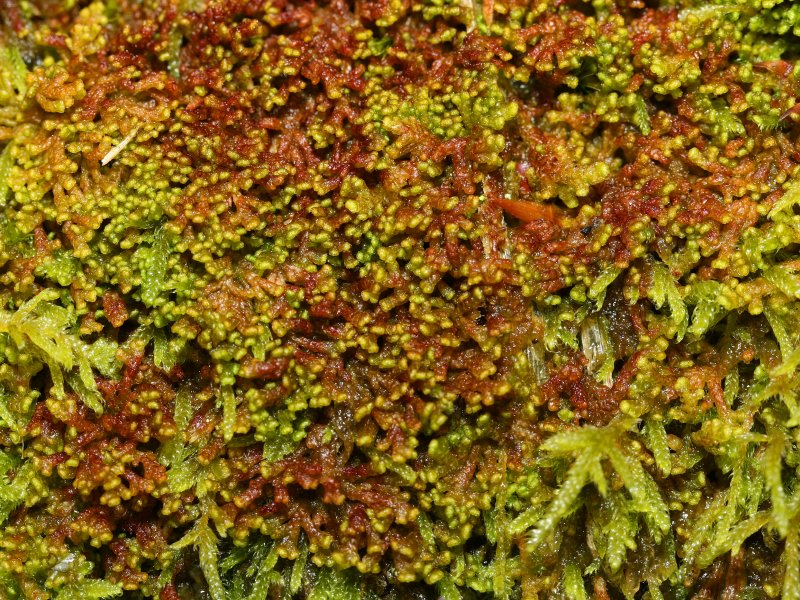
Ptilidium pulcherrimum occurs across North America, Northern Europe, and Asia. It has reddish to yellowish-green coloration, deeply divided leaves, and pinnate branching growth.
Written 27 November 2026 from the sources listed below. Each statement was checked against the passage it cites; statements that could not be supported were removed.
Appearance
Tree Fringewort has reddish to yellowish-green coloration and a pinnate branching growth pattern. Its stems are usually hidden by overlapping leaves.[1][2][3]
Its leaves have deeply divided margins and measure 1.8 mm in width and 1.4 mm in length.[4][5][6]
It grows closely against tree bark in dense patches.[7]
Habitat
Tree Fringewort typically grows on the trunks and branches of living trees and shrubs.[8][9]
Similar species
Tree Fringewort can be confused with Ptilidium ciliare. It is more commonly found on wood and grows more tightly against its substrate.[12][13][14]
Its leaves have deeper divisions than those of Ptilidium ciliare.[15]
Classification of the Tree Fringewort
| Kingdom | Plantae |
|---|---|
| Subkingdom | Bryobiotina |
| Phylum | Marchantiophyta |
| Class | Jungermanniopsida |
| Subclass | Jungermanniidae |
| Order | Ptilidiales |
| Family | Ptilidiaceae |
| Genus | Ptilidium |
| Species | Ptilidium pulcherrimum (Weber) Vain. |
Where the Tree Fringewort is found
Checklists and occurrence records place Ptilidium pulcherrimum in 31 countries. GBIF holds 25,632 georeferenced records of it.
Countries
- Aland Islands 5
- Austria 197
- Belarus 36
- Belgium 506
- Canada 2,930
- Czechia 207
- Denmark 319
- Estonia 827
- Finland 2,001
- France 451
- Germany 346
- Hungary 5
- Italy 4
- Japan 389
- Latvia 43
- Liechtenstein 11
- Lithuania 116
- Luxembourg 29
- Norway 1,501
- Poland 865
- Romania 5
- Russia 1,944
- Slovakia 16
- Slovenia 8
- Spain 13
- Sweden 7,805
- Switzerland 297
- The Netherlands 57
- Ukraine 10
- United Kingdom 893
- United States 3,796
Regions and cities with the most records
- Södermanland, Sweden 1,573
- Västra Götaland, Sweden 690
- Uppsala, Sweden 676
- British Columbia, Canada 656
- Ontario, Canada 623
- Stockholm, Sweden 574
- England, United Kingdom 559
- Katrineholm, Sweden 509
- Uppsala, Sweden 491
- Kalmar, Sweden 428
- Västerbotten, Sweden 406
- Quebec, Canada 400
- Komi, Russia 335
- New York, United States 299
- Kronoberg, Sweden 298
- Michigan, United States 280
- Wisconsin, United States 260
- Dalarna, Sweden 254
- Akershus, Norway 251
- Norrbotten, Sweden 249
- Gävleborg, Sweden 239
- Nyköping, Sweden 231
- Massachusetts, United States 222
- Auvergne-Rhône-Alpes, France 218
- Stockholm, Sweden 217
- Huddinge, Sweden 214
- Jönköping, Sweden 212
- Oslo, Norway 209
- Maine, United States 207
- Sundbyberg, Sweden 205
- Tullinge, Sweden 205
- Vermont, United States 204
- Nacka, Sweden 201
- Nova Scotia, Canada 201
- Trångsund, Sweden 201
- Västernorrland, Sweden 201
3 more countries have a few records outside this range
These countries hold a few records of Ptilidium pulcherrimum but lie outside the range the checklists give for it. Such records are often zoo or garden specimens, museum material or vagrants, so the species is not counted as occurring there.
A number beside a place is its count of GBIF occurrence records. A place without a number comes from a checklist alone. Records show where a species has been observed or collected, which can include escapes and vagrants.
Common names
English
- Tree Fringewort
- Naugehyde Liverwort
Names in 15 other languages
- Czech
- brvitec překrásný
- Danish
- Stub-frynsemos
- Dutch
- Boomfranjemos
- Estonian
- kaunis narmik
- Finnish
- sirokorallisammal
- French
- ptilidie des forêts
- German
- Schönes Federchenmoos
- Japanese
- テガタゴケ
- Lithuanian
- Paprastoji blakstienė
- Norwegian Bokmål
- barkfrynse
- Norwegian Nynorsk
- borkfrynse
- Polish
- Rzęsiak piękny
- Russian
- Птилидиум красивейший
- Slovak
- páperovka nádherná
- Swedish
- tät franslevermossa, tät fransmossa
Synonyms
28 other scientific names have been used for this species and are now treated as synonyms of Ptilidium pulcherrimum.
- Blepharozia ciliaris f. wallrothiana (Nees) Bernet
- Blepharozia ciliaris var. bradypus (Huebener) Dumort.
- Blepharozia ciliaris var. pulcherrima (Weber) Carrington
- Blepharozia ciliaris var. wallrothiana (Nees) Carrington
- Blepharozia laciniosa (Michx.) Trevis.
- Blepharozia pulcherrima (Weber) Lindb.
- Jungermannia ciliaris var. bradypus Huebener
- Jungermannia ciliaris var. pulchra (Nees) Dalla Torre
- Jungermannia laciniosa Michx.
- Jungermannia pulcherrima Weber
- Ptilidium ciliare f. commune Nees
- Ptilidium ciliare f. pulchrum Nees
- Ptilidium ciliare f. wallrothianum Nees
- Ptilidium ciliare var. bradypus (Huebener) P. Syd.
- Ptilidium ciliare var. pulcherrimum (Weber) Hoffm. ex Pfeiff.
- Ptilidium ciliare var. wallrothianum (Nees) Nees
- Ptilidium ciliare var. wallrothianum (Nees) Gottsche et al.
- Ptilidium jishibae Steph.
- Ptilidium laciniosum (Michx.) Nees
- Ptilidium pulcherrimum f. corticola Müll. Frib.
- Ptilidium pulcherrimum f. densum Müll. Frib.
- Ptilidium pulcherrimum f. gracile Müll. Frib.
- Ptilidium pulcherrimum f. pulcherrimum
- Ptilidium pulcherrimum f. rupicola Schiffn.
- Ptilidium pulcherrimum var. pulcherrimum
- Ptilidium pulcherrimum var. subpinnatum Jørg.
- Ptilidium pulcherrimum var. wallrothianum Husn.
- Ptilidium pulchrum Corda
Related species

Compare
Questions and answers
What is the scientific name of the Tree Fringewort?
The scientific name of the Tree Fringewort is Ptilidium pulcherrimum. Written with its author, the full name is Ptilidium pulcherrimum (Weber) Vain..
Which family does the Tree Fringewort belong to?
Ptilidium pulcherrimum belongs to the family Ptilidiaceae, in the order Ptilidiales and the class Jungermanniopsida.
Where is the Tree Fringewort found?
Checklists and occurrence records place Ptilidium pulcherrimum in 31 countries, including Sweden, United States, Canada, Finland, Russia and Norway.
What other names does the Tree Fringewort have?
Ptilidium pulcherrimum is also known in English as Naugehyde Liverwort.
Where does Tree Fringewort grow?
It typically grows on the trunks and branches of living trees and shrubs, and can also grow on fallen logs and boulders.[8][9][10][11]
Where is Tree Fringewort found?
It occurs across North America, Northern Europe, and Asia.[16]
Sources
Passages the profile rests on
- Ptilidium pulcherrimum has reddish to yellowish-green coloration. Source passage: “with a reddish to yellowish-green coloration” — English Wikipedia
- It has a pinnate branching growth pattern. Source passage: “exhibits a pinnate branching growth pattern.” — English Wikipedia
- Its stems are usually hidden by overlapping leaves. Source passage: “Its stems are usually obscured by its overlapping leaves” — English Wikipedia
- Its leaves have deeply divided margins. Source passage: “distinct deeply divided leaf margins” — English Wikipedia
- Its leaves measure 1.8 mm in width. Source passage: “measured at 1.8 mm (0.07 in) in width” — English Wikipedia
- Its leaves measure 1.4 mm in length. Source passage: “and 1.4 mm (0.06 in) in length.” — English Wikipedia
- It grows closely against tree bark in dense patches. Source passage: “It grows closely to tree bark in dense patches” — English Wikipedia
- It typically grows on the trunks of living trees and shrubs. Source passage: “typically found on the trunks or branches of living trees and shrubs” — English Wikipedia
- It typically grows on the branches of living trees and shrubs. Source passage: “typically found on the trunks or branches of living trees and shrubs” — English Wikipedia
- It can also grow on fallen logs. Source passage: “but can also be found on fallen logs or boulders.” — English Wikipedia
- It can also grow on boulders. Source passage: “but can also be found on fallen logs or boulders.” — English Wikipedia
- Ptilidium pulcherrimum can be confused with Ptilidium ciliare. Source passage: “P. pulcherrimum can be easily confused with P. ciliare.” — English Wikipedia
- Ptilidium pulcherrimum is more commonly found on wood than Ptilidium ciliare. Source passage: “P. pulcherrimum is more commonly found on wood” — English Wikipedia
- Ptilidium pulcherrimum grows more tightly against its substrate than Ptilidium ciliare. Source passage: “grows more tightly to the substrate than P. ciliare.” — English Wikipedia
- Its leaves have deeper divisions than those of Ptilidium ciliare. Source passage: “It also has deeper divisions in its leaves compared to P. ciliare.” — English Wikipedia
- It occurs across North America, Northern Europe, and Asia. Source passage: “It is found across North America, Northern Europe, and Asia.” — English Wikipedia
Data
- Catalogue of Life, 2026-10-16 XR cc by
- Global Biodiversity Information Facility CC BY 4.0
- Wikidata CC0
- GeoNames CC BY 4.0
- Wikimedia Commons per image; credit shown with each image
- Within the Catalogue of Life, this name comes from Bryophyte Nomenclator cc by
References
- Vainio, E. A. (1878). Florula Tavastiae Orientalis. Havainnoita Itä-Hämeen Kasvistosta. Meddelanden Af Societas pro Fauna et Flora Fennica, 3, 1–121. https://www.tropicos.org/reference/100053079 Link where the name was published
- Söderström, L.; Hagborg, A.; von Konrat, M.; Bartholomew-Began, S. E.; Bell, D.; Briscoe, L.; Brown, E. A.; Cargill, D. C.; Costa, D. P. da; Crandall-Stotler, B. J.; Cooper, E. D.; Dauphin, G.; Engel, J. J.; Feldberg, K.; Glenny, D. S.; Gradstein, S. R.; He, X.-L.; Heinrichs, J.; Hentschel, J.; Ilkiu-Borges, A. L.; Katagiri, T.; Konstantinova, N. A.; Larraín, J.; Long, D. G.; Nebel, M.; Pócs, T.; Puche, F.; Reiner-Drehwald, M. E.; Renner, M. A. M.; Sass-Gyarmati, A. A.; Schäfer-Verwimp, A.; Segarra-Moragues, J. G.; Stotler, R. E.; Sukkharak, P.; Thiers, B. M.; Uribe-M., J.; Váňa, J.; Villarreal A., J. C.; Wigginton, M. J.; Zhang, L.; Zhu, R.-L. (2016). World checklist of hornworts and liverworts. PhytoKeys, 59(1–2), 1–828. https://www.tropicos.org/reference/100022291 Link
This species in other databases
- Catalogue of Life 4Q7M9
- Wikidata Q1394507
- iNaturalist 167558
- World Flora Online wfo-0001196706
- ITIS 14283
Page built on 29 November 2026. See how the catalog is made and all sources and licences.
Cite this page
ScientificNames.org. (2026). Ptilidium pulcherrimum (Tree Fringewort). Retrieved November 29, 2026, from https://scientificnames.org/species/ptilidium-pulcherrimum
“Ptilidium pulcherrimum (Tree Fringewort).” ScientificNames.org, 2026, scientificnames.org/species/ptilidium-pulcherrimum. Accessed 29 Nov. 2026.
ScientificNames.org. “Ptilidium pulcherrimum (Tree Fringewort).” Accessed November 29, 2026. https://scientificnames.org/species/ptilidium-pulcherrimum.
@misc{scientificnames_ptilidium_pulcherrimum_tree_fringewort,
  author = {{ScientificNames.org}},
  title = {Ptilidium pulcherrimum (Tree Fringewort)},
  year = {2026},
  url = {https://scientificnames.org/species/ptilidium-pulcherrimum},
  note = {Accessed 2026-11-29}
}