Species · Flowering plants
Pomegranate Punica granatum
The scientific name of the Pomegranate is Punica granatum. It is a species of flowering plant in the family Lythraceae (loosestrife family), order Myrtales.
- Scientific name
- Punica granatum L.
- Common name
- Pomegranate
- Genus
- Punica
- Family
- Lythraceae (Loosestrife Family)
- Order
- Myrtales
- Class
- Magnoliopsida
- Red List category
- LC Least Concern
- Recorded in
- 159 countries
- Name status
- accepted in the Catalogue of Life

Overview
Pomegranate originated in the region spanning the Caucasus and Iranian plateau to Pakistan and is cultivated across West Asia, South Asia, Central Asia, northern and sub-Saharan Africa, the Mediterranean basin, the drier parts of Southeast Asia, the United States, and Chile.
Written 24 November 2026 from the sources listed below. Each statement was checked against the passage it cites; statements that could not be supported were removed.
Appearance
Its leaves are glossy, narrow, oblong, and have smooth, entire margins. They measure 1.9–5 cm long and 0.8–1.5 cm wide.[1][2]
Its flowers are bright red or white, have three to seven petals, and measure at least 3 cm in diameter.[3][4]
Its fruit has a red-purple husk, a hard outer pericarp, and a spongy inner mesocarp. Botanically classified as a berry, it contains edible seeds and pulp, including numerous arils with deep red, juicy contents.[5][6][7]
Wild pomegranate fruits measure 2–8 cm in diameter, while some cultivated varieties reach 12 cm. A fruit can contain between 200 and approximately 1,400 seeds.[8][9]
Habitat
Pomegranate tolerates dry environments with either Mediterranean winter rainfall or summer rainfall climates. It can also grow in wetter environments but may develop root decay caused by fungal diseases.[10][11]
Wild pomegranate occurs at elevations of 1,000–2,000 metres in western Pakistan.[12]
Pomegranate originated in the region spanning the Caucasus and Iranian plateau to Pakistan. It is cultivated across West Asia, South Asia, Central Asia, northern and sub-Saharan Africa, the Mediterranean basin, the drier parts of Southeast Asia, the United States, and Chile.[13][14]
Pomegranate is found in Central Asia, the Himalayas, the Mediterranean, and the Middle East. It grows well in California, Arizona, South Asia, the Mediterranean, and the Middle East.[15][16]
Behaviour
Pomegranate is drought-tolerant and tolerates moderate frost temperatures down to approximately −12 °C.[17][18]
Reproduction and life cycle
Pomegranate reproduces sexually under natural conditions but can also be propagated asexually. Asexual propagation methods include layering, hardwood cuttings, softwood cuttings, and tissue culture.[19][20]
Rooting of pomegranate cuttings requires warm temperatures of 18–29 °C and a semihumid environment.[21]
Pomegranate flowers are pollinated by Eastern and Western honey bees, bumblebees, carpenter ants, and lemon butterflies. The anthers close around the stigma until the flower reaches maturity.[22][23]
Uses
Pomegranate is cultivated for its fruit and as an ornamental shrub or tree in parks and gardens. Its fruit and juice are used in baking, cooking, juice blends, garnishes, nonalcoholic drinks, and cocktails.[24][25]
Pomegranate molasses is used in traditional Persian dishes, including fesenjān, kabab torsh, and zeytoon parvardeh. Its seeds are used in Turkish salads and as garnishes for desserts such as güllaç.[26][27]
Pomegranate peel is used to stain wool and silk in the carpet industry. The peel also contains phenolic compounds used in dietary supplements and food preservatives.[28][29]
Pomegranate bark and fruit are used in traditional medicine to treat dysentery, diarrhea, and intestinal parasites. Its seeds are used as a tonic for throat infections and heart diseases.[30][31]
Pomegranate has been used in traditional and modern medicine for various therapeutic applications.[32]
Pomegranate fruit juice contains polyphenols, including ellagitannins. Anthocyanins are responsible for the red pigmentation of the juice.[33][34]
Classification of the Pomegranate
| Kingdom | Plantae |
|---|---|
| Subkingdom | Pteridobiotina |
| Phylum | Tracheophyta |
| Class | Magnoliopsida |
| Order | Myrtales |
| Family | Lythraceae (Loosestrife Family) |
| Subfamily | Punicoideae |
| Genus | Punica (Pomegranate) |
| Species | Punica granatum L. |
Where the Pomegranate is found
Checklists and occurrence records place Punica granatum in 159 countries across Africa, Asia, Europe, North America, Oceania and South America. GBIF holds 51,571 georeferenced records of it.
Countries where it is native or its origin is not stated
- Afghanistan 16
- Albania 118
- Algeria 128
- Anguilla
- Antigua and Barbuda 10
- Argentina 44
- Armenia 76
- Aruba 4
- Australia 213
- Austria 23
- Azerbaijan 228
- Bahamas 9
- Bangladesh 12
- Barbados 21
- Belgium 14
- Belize 6
- Benin 13
- Bhutan 29
- Bolivia 27
- Bonaire, Saint Eustatius and Saba 6
- Bosnia and Herzegovina 110
- Brazil 1,184
- Bulgaria 73
- Burkina Faso 9
- Cabo Verde 4
- Cambodia 12
- Cameroon 6
- Canada 8
- Cayman Islands 3
- Chad 2
- Chile 44
- China 1,209
- Christmas Island 5
- Colombia 111
- Cook Islands 5
- Costa Rica 17
- Croatia 1,281
- Cuba 14
- Curacao 4
- Cyprus 63
- Democratic Republic of the Congo 10
- Dominica 5
- Dominican Republic 31
- Ecuador 130
- Egypt 48
- El Salvador 15
- Ethiopia 22
- Fiji 18
- France 16,783
- French Guiana 3
- French Polynesia 59
- Georgia 304
- Germany 53
- Ghana 6
- Grenada 3
- Guadeloupe 37
- Guam 7
- Guatemala 33
- Haiti 13
- Honduras 21
- Hong Kong 70
- Hungary 28
- India 3,003
- Indonesia 87
- Iran 143
- Iraq 34
- Israel 409
- Italy 5,759
- Ivory Coast 5
- Jamaica 30
- Japan 206
- Jordan 11
- Kenya 21
- Kyrgyzstan 5
- Laos 2
- Lebanon 16
- Libya 6
- Macao 21
- Madagascar 3
- Malaysia 46
- Maldives 12
- Malta 41
- Martinique 21
- Mauritius 7
- Mayotte 5
- Mexico 478
- Monaco 8
- Montenegro 366
- Montserrat 2
- Morocco 234
- Mozambique 6
- Myanmar 4
- Namibia 7
- Nepal 20
- New Caledonia 14
- New Zealand 35
- Nicaragua 12
- Niger 5
- Nigeria 12
- Niue 2
- North Macedonia 16
- Northern Mariana Islands 10
- Oman 40
- Pakistan 53
- Palau 1
- Palestinian Territory 6
- Panama 24
- Paraguay 5
- Peru 52
- Philippines 32
- Portugal 1,160
- Puerto Rico 50
- Reunion 113
- Romania 112
- Russia 173
- Rwanda 5
- Saint Barthelemy 4
- Saint Kitts and Nevis 8
- Saint Martin 6
- Samoa 3
- Saudi Arabia 10
- Senegal 3
- Serbia 55
- Seychelles 11
- Singapore 9
- Sint Maarten 3
- Slovenia 46
- Somalia 2
- South Africa 230
- South Korea 162
- Spain 9,011
- Sri Lanka 36
- Suriname 3
- Sweden 151
- Switzerland 566
- Taiwan 15
- Tajikistan 18
- Tanzania 46
- Thailand 79
- The Netherlands 8
- Tonga 1
- Trinidad and Tobago 10
- Tunisia 58
- Turkey 765
- Turkmenistan 81
- U.S. Virgin Islands 22
- Uganda 4
- Ukraine 30
- United Arab Emirates 35
- United Kingdom 12
- United States 2,384
- Uzbekistan 36
- Vanuatu 4
- Venezuela 21
- Vietnam 17
- Yemen 7
- Zambia 3
- Zimbabwe 4
Countries where it has been introduced
Regions and cities with the most records
- Occitanie, France 4,507
- Provence-Alpes-Côte d'Azur, France 3,169
- Catalonia, Spain 2,491
- Auvergne-Rhône-Alpes, France 2,380
- Valencia, Spain 2,333
- Pays de la Loire, France 1,341
- Kerala, India 1,312
- Texas, United States 1,033
- Île-de-France, France 993
- Paris, France 885
- Paris 05 Panthéon, France 885
- Paris 13 Gobelins, France 883
- Paris 14 Observatoire, France 882
- Gare, France 881
- Maison Blanche, France 881
- Paris 07 Palais-Bourbon, France 878
- Paris 15 Vaugirard, France 877
- Paris 10 Entrepôt, France 875
- Paris 09 Opéra, France 873
- Ivry-sur-Seine, France 872
- Paris 16 Passy, France 870
- Issy-les-Moulineaux, France 868
- Lombardy, Italy 868
- Villejuif, France 864
- Paris 18 Buttes-Montmartre, France 863
- Clichy, France 862
- Paris 17 Batignolles-Monceau, France 862
- Clamart, France 855
- Paris 11 Popincourt, France 851
- Levallois-Perret, France 848
- Neuilly-sur-Seine, France 843
- Paris 12 Reuilly, France 839
- Boulogne-Billancourt, France 837
- Antony, France 834
- Paris 20 Ménilmontant, France 833
- Suresnes, France 830
Range as the checklists state it
Portugal [c]; Spain [c]; Baleares [c]; France [c]; Monaco [c]; Corsica [c]; Sardinia [c]; Italy [c]; Sicily [c]; Pantelleria [c]; Isole Pelagie [c] (Lampedusa [c]); Malta [c]; Slovenia [c]; Croatia [c]; Bosnia & Hercegovina [c]; North Macedonia [c]; Albania [c]; Bulgaria [c]; Greece [I] (incl. Kiklades [I]); Crete [I]; European Russia [c]; Morocco [c]; Algeria [c]; Tunisia [c]; Libya [c]; Canary Isl. [c] (Fuerteventura [c], Gran Canaria [c], Tenerife [c], La Gomera [c], Hierro [c], La Palma [c], Lanzarote [c]) USA [c] (Alabama [c], California [I], Florida [c], Louisiana [c], North Carolina [c], Utah [c], Texas [I]); Burkina Faso [c]; Benin [c]; Cameroon [c]; Bioko Isl. [Fernando Poo] [c]; São Tomé [c]; Chad [c]; Somalia [c]; Mozambique [c]; South Africa [c]; Mauritius [c]; La Réunion [c]; Rodrigues [c]; Turkmenistan [c]; Uzbekistan [c]; Kyrgyzstan [c]; Tajikistan [c]; Northern Caucasus [c]; Georgia [Caucasus] [c]; Armenia; East Aegaean Isl. [c] (incl. Rhodos [c]); Turkey [c]; Iraq [c]; Iran (EC-Iran, N-Iran, Iranian Aserbaijan, S-Iran, W-Iran); Afghanistan [c]; China [c] (Anhui [c], Beijing [c], Fujian [c], Gansu [c], Guangdong [c], Guangxi [c], Guizhou [c], Hainan [c], Hebei [c], Heilongjiang [c], Henan [c], Hongkong [c], Hubei [c], Hunan [c], Jiangsu [c], Jiangxi [c], Jilin [c], Liaoning [c], Macao [c], Nei Mongol [c], Ningxia [c], Qinghai [c], Shaanxi [c], Shandong [c], Shanghai [c], Shanxi [c], Sichuan [c], Tianjin [c], Xinjiang [c], Yunnan [c], Zhejiang [c]); Tibet [c]; South Korea [c]; Ogasawara Isl. [c] (Chichijima [c]); Taiwan [c]; Pakistan [c]; Nepal [c]; Bhutan [c]; India [c]; Lakshadweep Isl. [Laccadives] [c]; Maldives [c]; Sri Lanka [c]; Bangladesh [c]; Andaman Isl. [c] (South Andaman Isl. [c]); Nicobar Isl. [c] (Great Nicobar Isl. [c]); Myanmar [c]; Thailand [c]; Laos [c]; Cambodia [c]; Vietnam [c]; South China Sea Isl. [c]; Philippines [c]; Jawa [c]; Australia [c] (Queensland [c]); Lord Howe Isl. [c]; New Caledonia [c]; Rotuma Isl. [c]; Tonga [c]; Niue [c]; Fiji [c]; Cook Isl. [c] (Rarotonga [c], Mangaia [c], Aitutaki [c], Atiu [c]); Society Isl. [c] (Tahiti [c], Raiatea [c]); Austral Isl. [c] (Tubuai [c]); Palau [c]; Northern Marianas [c] (Saipan [c], Rota [c]); Guam [c]; Fed. States of Micronesia [c] (Yap [c]); Marshall Isl. [c] (Jaluit [c]); Mexico [c]; Belize [c]; Honduras [c]; Nicaragua [c]; Costa Rica [c]; Bahamas [c]; Turks & Caicos Isl. [c]; Jamaica [c]; Puerto Rico [c]; Virgin Isl. [c]; Anguilla [c]; St. Martin/St. Maarten [c]; St. Barthélémy [c]; Saba [c]; St. Eustatius [c]; St. Kitts [c]; Antigua [c]; Montserrat [c]; Guadeloupe [c]; Martinique [c]; St. Lucia [c]; St. Vincent [c]; Barbados [c]; Trinidad & Tobago [c]; San Andrés y Providencia [c] (San Andrés [c]); Colombia [c]; Venezuela [c]; Ecuador [c]; Galápagos [c]; Bolivia [c]; Brazil [c]
A number beside a place is its count of GBIF occurrence records. A place without a number comes from a checklist alone. Records show where a species has been observed or collected, which can include escapes and vagrants.
Common names
English
- Pomegranate
- Pomegranate Tree
Names in 49 other languages
- Afrikaans
- granaat
- Arabic
- الرمان, رمان
- Armenian
- Nur
- Asturian
- almingranal
- Belarusian
- Гранат звычайны
- Bengali
- বেদানা
- Catalan
- Magraner
- Chinese
- shi liu, 安石榴, 甜石榴, 白石榴, 白石榴根, 白石榴花, 石榴, 石榴叶
- Croatian
- Mogranj, Nar, Šipak
- Czech
- granátové jablko, marhaník granátový, marhaník obecný
- Danish
- Granatæble
- Dutch
- Granaatappel
- Esperanto
- Granato
- Estonian
- harilik granaadipuu
- Finnish
- granaattiomena
- French
- Grenadier commun, grenadier
- German
- Granatapfel, Granatapfelbaum, Granatapfelstrauch
- Greek
- Ροδιά, Ρόδι
- Hebrew
- רימון מצוי
- Hindi
- dalima
- Hungarian
- Gránátalma
- Indonesian
- Delima
- Italian
- Il frutto del melograno, melograna, melograno
- Japanese
- zakuro, ザクロ
- Korean
- seogrjunamu, 석류나무
- Latvian
- Parastais granātābols
- Lithuanian
- Paprastasis granatmedis
- Luxembourgish
- Granatapel
- Mongolian
- анар
- Norwegian Bokmål
- granateple
- Persian
- انار
- Polish
- Granat właściwy, Granatowiec właściwy
- Portuguese
- Romãzeira, romanzeiro, romeira, romeira-da-granada, romã, romã-de-flor-dobrada
- Russian
- Гранат обыкновенный
- Sinhala
- දෙලුම්, දෙළුම්
- Slovak
- granátovník púnsky
- Slovenian
- granatno jabolko, granatovec
- Spanish
- Granada, granada cordelina, granado, mangrano
- Swedish
- granatäpple
- Thai
- ทับทิม
- Ukrainian
- Гранат звичайний
- Vietnamese
- Quả lựu
- Welsh
- Grawnafal
- arg
- Minglanera
- cha
- Granåda
- mnw
- သတ်ဒလန်၊ သတ်မမၞိက်
- pau
- Keralladang
- srn
- granakibon
- vec
- Malgaragno, Malgaragno/Magragno, Pomoingranà/Pomogranà
Synonyms
37 other scientific names have been used for this species and are now treated as synonyms of Punica granatum.
- Granatum punicum (L.) St.-Lag.
- Punica florida Salisb.
- Punica granatum f. albescens (DC.) Rehder
- Punica granatum f. flavescens (Sweet) Rehder
- Punica granatum f. legrelliae (Lem.) Rehder
- Punica granatum f. multiplex (Sweet) Rehder
- Punica granatum f. plena Voss
- Punica granatum f. pleniflora (Hayne) Rehder
- Punica granatum var. acidula Risso
- Punica granatum var. alba Risso
- Punica granatum var. albescens DC.
- Punica granatum var. flava Loudon
- Punica granatum var. flavescens Sweet
- Punica granatum var. frutescens Siebold & Zucc.
- Punica granatum var. legrelliae Lem.
- Punica granatum var. lutea Risso
- Punica granatum var. macrocarpa Risso
- Punica granatum var. microcarpa Risso
- Punica granatum var. militensis Risso
- Punica granatum var. multiplex Sweet
- Punica granatum var. nana (L.) Pers.
- Punica granatum var. parvifolia Risso
- Punica granatum var. pleniflora Hayne
- Punica granatum var. pumila Weinm.
- Punica granatum var. sanguinea Risso
- Punica granatum var. sativum K.Malý
- Punica granatum var. semiplena Risso
- Punica granatum var. semperflorens Risso
- Punica granatum var. variegata Risso
- Punica granatum var. vulgaris Risso
- Punica grandiflora Steud.
- Punica legrellei J.N.Haage & E.Schmidt
- Punica multiflora hort.
- Punica multiflora Voss
- Punica nana L.
- Punica spinosa Lam.
- Rhoea punica St.-Lag.
Related species
-
 Socotran PomegranatePunica protopunica
-
 Water CaltropTrapa natans
-
 Crape-myrtleLagerstroemia indica
-
 CamphireLawsonia inermis
-
 Purple LoosestrifeLythrum salicaria
-
 False HeatherCuphea hyssopifolia
-
 Sun OpenerHeimia salicifolia
-
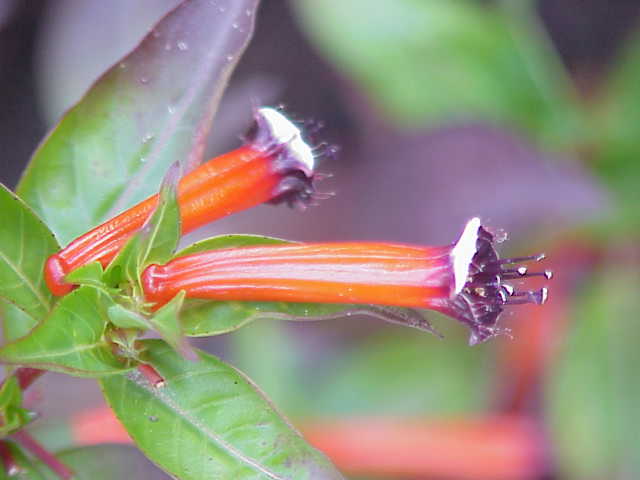 Cigar PlantCuphea ignea
Compare
Questions and answers
What is the scientific name of the Pomegranate?
The scientific name of the Pomegranate is Punica granatum. Written with its author, the full name is Punica granatum L..
Which family does the Pomegranate belong to?
Punica granatum belongs to the family Lythraceae, in the order Myrtales and the class Magnoliopsida.
Where is the Pomegranate found?
Checklists and occurrence records place Punica granatum in 159 countries, including France, Spain, Italy, India, United States and Croatia.
What is the conservation status of the Pomegranate?
The IUCN Red List category recorded for Punica granatum is Least Concern (LC).
What other names does the Pomegranate have?
Punica granatum is also known in English as Pomegranate Tree.
Sources
Passages the profile rests on
- Its leaves are glossy, narrow, oblong, and have smooth, entire margins. Source passage: “The leaves are opposite or subopposite, glossy, narrow oblong, entire” — English Wikipedia
- Its leaves measure 1.9–5 cm long and 0.8–1.5 cm wide. Source passage: “1.9–5 cm (0.7–2.0 in) long, and 0.8–1.5 cm (0.3–0.6 in) broad.” — English Wikipedia
- Its flowers are bright red or white and have three to seven petals. Source passage: “The flowers are bright red or white, and 3 cm (1+1⁄4 in) or more in diameter, with three to seven petals.” — English Wikipedia
- Its flowers measure at least 3 cm in diameter. Source passage: “The flowers are bright red or white, and 3 cm (1+1⁄4 in) or more in diameter” — English Wikipedia
- Its fruit has a red-purple husk with a hard outer pericarp and a spongy inner mesocarp. Source passage: “The pomegranate fruit husk is red-purple with an outer, hard pericarp, and an inner, spongy mesocarp” — English Wikipedia
- The fruit is botanically classified as a berry containing edible seeds and pulp. Source passage: “Botanically, the fruit is a berry with edible seeds and pulp produced from the ovary of a single flower.” — English Wikipedia
- The fruit contains numerous arils with deep red, juicy contents. Source passage: “This fruit is a spherical grenade, encompassing numerous arils filled with deep red, juicy content.” — pmc.ncbi.nlm.nih.gov
- Wild pomegranate fruits measure 2–8 cm in diameter, while some cultivated varieties reach 12 cm. Source passage: “The fruit is variable in size, from 2–8 cm (1–3 in) in diameter in wild plants (to 12 cm (4.7 in) in some cultivars)” — English Wikipedia
- A pomegranate fruit can contain between 200 and approximately 1,400 seeds. Source passage: “The number of seeds in a pomegranate can vary from 200 to about 1,400.” — English Wikipedia
- Pomegranate tolerates dry environments with either Mediterranean winter rainfall or summer rainfall climates. Source passage: “Pomegranates are drought-tolerant, and can be grown in dry areas with either a Mediterranean winter rainfall climate or a summer rainfall climate.” — English Wikipedia
- Pomegranate can grow in wetter environments but may develop root decay caused by fungal diseases. Source passage: “In wetter areas, they can be prone to root decay from fungal diseases.” — English Wikipedia
- Wild pomegranate occurs at elevations of 1,000–2,000 metres in western Pakistan. Source passage: “In Pakistan, it grows wild between 1,000 and 2,000 metres altitude, mainly in the western part of the country.” — English Wikipedia
- Pomegranate originated in the region spanning the Caucasus and Iranian plateau to Pakistan. Source passage: “it originated in the region spanning the Caucasus and the Iranian plateau—including modern-day Iran, Turkmenistan and Afghanistan—and down to Pakistan.” — English Wikipedia
- Pomegranate is cultivated across West Asia, South Asia, Central Asia, northern and sub-Saharan Africa, the Mediterranean basin, the drier parts of Southeast Asia, the United States, and Chile. Source passage: “it is also nowadays cultivated across West Asia, South Asia, Central Asia, north and Sub-Saharan Africa, the drier parts of Southeast Asia, the Mediterranean basin, United States and Chile.” — English Wikipedia
- Pomegranate is found in Central Asia, the Himalayas, the Mediterranean, and the Middle East. Source passage: “It is found in Central Asia, the Himalayas, the Mediterranean, and the Middle East.” — pmc.ncbi.nlm.nih.gov
- Pomegranate grows well in California, Arizona, South Asia, the Mediterranean, and the Middle East. Source passage: “It grows well in California and Arizona and in South Asia, the Mediterranean, and the Middle East” — pmc.ncbi.nlm.nih.gov
- Pomegranate is drought-tolerant. Source passage: “Pomegranates are drought-tolerant” — English Wikipedia
- Pomegranate tolerates moderate frost temperatures down to approximately −12 °C. Source passage: “They can tolerate moderate frost, down to about −12 °C (10 °F).” — English Wikipedia
- Pomegranate reproduces sexually under natural conditions but can also be propagated asexually. Source passage: “P. granatum reproduces sexually in nature, but can be propagated asexually.” — English Wikipedia
- Asexual propagation methods include layering, hardwood cuttings, softwood cuttings, and tissue culture. Source passage: “Propagation methods include layering, hardwood cuttings, softwood cuttings, and tissue culture.” — English Wikipedia
- Rooting of pomegranate cuttings requires warm temperatures of 18–29 °C and a semihumid environment. Source passage: “Required conditions for rooting cuttings include warm temperatures within the 18–29 °C (65–85 °F) range and a semihumid environment.” — English Wikipedia
- Pomegranate flowers are pollinated by Eastern and Western honey bees, bumblebees, carpenter ants, and lemon butterflies. Source passage: “Pomegranate flowers are pollinated by Eastern and Western honey bees, bumblebees, carpenter ants and lemon butterflies.” — English Wikipedia
- The anthers close around the stigma until the flower reaches maturity. Source passage: “The flower's anthers close around the stigma until maturity” — English Wikipedia
- Pomegranate is cultivated for its fruit and as an ornamental shrub or tree in parks and gardens. Source passage: “P. granatum is grown for its fruit crop, and as ornamental trees and shrubs in parks and gardens.” — English Wikipedia
- Pomegranate fruit and juice are used in baking, cooking, juice blends, garnishes, nonalcoholic drinks, and cocktails. Source passage: “The pomegranate and its juice are variously used in baking, cooking, juice blends, garnishes, nonalcoholic drinks, and cocktails.” — English Wikipedia
- Pomegranate molasses is used in traditional Persian dishes, including fesenjān, kabab torsh, and zeytoon parvardeh. Source passage: “Pomegranate molasses is a key ingredient in traditional Persian cuisine, where it is used to add a rich sweet-sour flavour to dishes such as stews, sauces, and marinades, most notably in classic recipes like fesenjān, kabab torsh and zeytoon parvardeh.” — English Wikipedia
- Pomegranate seeds are used in Turkish salads and as garnishes for desserts such as güllaç. Source passage: “In Turkey, pomegranate seeds are used in salads and sometimes as garnish for desserts such as güllaç.” — English Wikipedia
- Pomegranate peel is used to stain wool and silk in the carpet industry. Source passage: “Pomegranate peels may be used to stain wool and silk in the carpet industry.” — English Wikipedia
- Pomegranate peel contains phenolic compounds that are used in dietary supplements and food preservatives. Source passage: “The higher phenolic content of the peel yields extracts for use in dietary supplements and food preservatives.” — English Wikipedia
- Pomegranate bark and fruit are used in traditional medicine to treat dysentery, diarrhea, and intestinal parasites. Source passage: “Pomegranate bark and fruit treat dysentery, diarrhea, and intestinal parasites.” — pmc.ncbi.nlm.nih.gov
- Pomegranate seeds are used as a tonic for throat infections and heart diseases. Source passage: “Seeds are used as a tonic for throat infections and heart diseases.” — pmc.ncbi.nlm.nih.gov
- Pomegranate has been used in traditional and modern medicine for various therapeutic applications. Source passage: “This review article aims to provide a comprehensive overview of the remedial uses of pomegranate in traditional and modern medicine.” — pmc.ncbi.nlm.nih.gov
- Pomegranate fruit juice contains polyphenols, including ellagitannins. Source passage: “The most abundant phytochemicals in pomegranate juice are polyphenols, including the hydrolyzable tannins called ellagitannins” — English Wikipedia
- Anthocyanins are responsible for the red pigmentation of pomegranate juice. Source passage: “Anthocyanins are responsible for the vibrant red color of pomegranate juice (PJ).” — pmc.ncbi.nlm.nih.gov
Data
- Catalogue of Life, 2026-10-16 XR cc by
- Global Biodiversity Information Facility CC BY 4.0
- Wikidata CC0
- GeoNames CC BY 4.0
- Wikimedia Commons per image; credit shown with each image
- iNaturalist per image; credit shown with each image
- Within the Catalogue of Life, this name comes from Synonymic Checklists of the Vascular Plants of the World cc by
References
- L. (1753). Sp. Pl. [Linnaeus] 1: 472 (1753). where the name was published
This species in other databases
Page built on 24 November 2026. See how the catalog is made and all sources and licences.
Cite this page
ScientificNames.org. (2026). Punica granatum (Pomegranate). Retrieved November 24, 2026, from https://scientificnames.org/species/punica-granatum
“Punica granatum (Pomegranate).” ScientificNames.org, 2026, scientificnames.org/species/punica-granatum. Accessed 24 Nov. 2026.
ScientificNames.org. “Punica granatum (Pomegranate).” Accessed November 24, 2026. https://scientificnames.org/species/punica-granatum.
@misc{scientificnames_punica_granatum_pomegranate,
  author = {{ScientificNames.org}},
  title = {Punica granatum (Pomegranate)},
  year = {2026},
  url = {https://scientificnames.org/species/punica-granatum},
  note = {Accessed 2026-11-24}
}