Species · Birds
Fringe-backed Fire-eye Pyriglena atra
The scientific name of the Fringe-backed Fire-eye is Pyriglena atra. It is a species of bird in the family Thamnophilidae (antbird), order Passeriformes. The name dates from 1825.
- Scientific name
- Pyriglena atra (Swainson, 1825)
- Common name
- Fringe-backed Fire-eye
- Genus
- Pyriglena
- Family
- Thamnophilidae (Antbird)
- Order
- Passeriformes
- Class
- Aves
- Red List category
- NT Near Threatened
- Recorded in
- 1 country
- Name status
- accepted in the Catalogue of Life

Overview
Pyriglena atra inhabits lowland evergreen forest in southeastern Sergipe and coastal northeastern Bahia, Brazil. Males have predominantly glossy black plumage and a conspicuous black-and-white feather patch between the scapulars, while females have yellowish-brown plumage and lack this patch.
Written 27 November 2026 from the sources listed below. Each statement was checked against the passage it cites; statements that could not be supported were removed.
Similar species
The Fringe-backed Fire-eye has previously been treated as conspecific with the White-shouldered Fire-eye (Pyriglena leucoptera).[1]
Appearance
Adult individuals of both sexes have bright red irises, while immature individuals have orange irises.[2][3]
Males have predominantly glossy black plumage, a conspicuous black-and-white feather patch between the scapulars, and blackish gray underwing coverts.[4][5][6]
Females have yellowish-brown upperparts and wings without an interscapular patch. Their tail is brownish-black, and their face is olive-tinged gray, with black lores and a black line extending above and behind the eye.[7][8][9]
The female has a white chin and throat, a light yellowish olive-brown breast, and a belly that is a lighter shade of olive-brown.[10][11][12]
The female's flanks, crissum, and underwing coverts are dark gray-tinged olive-brown.[13]
The species measures between 16 and 18 cm in length and is described as a medium-sized antbird. One recorded individual weighed 32 g.[14][15][16]
Habitat
The Fringe-backed Fire-eye inhabits dense understory vegetation in lowland evergreen forest. It occurs mainly along primary forest edges, in mature secondary forest, and in clearings created by fallen trees.[17][18]
The species avoids sunlit habitats such as open woodland with sparse understory. It occurs from near sea level to approximately 250 m elevation.[19][20]
The species is associated with a narrow belt of Atlantic forest near Salvador in coastal Bahia, west of Santo Amaro.[21]
Diet
The Fringe-backed Fire-eye eats insects, including cockroaches, grasshoppers, and winged ants. It also consumes spiders and centipedes.[22][23]
Its diet also includes small vertebrates, including geckos and frogs.[24]
Behaviour
The Fringe-backed Fire-eye is a year-round resident throughout its geographic range. Individuals typically forage alone, in pairs, or in family groups.[25][26]
The species usually forages on the ground and within approximately 3 m above it, but can forage as high as 10 m. While foraging, it hops between short feeding stops and pumps its tail.[27][28]
The species captures prey through gleaning, reaching, jumping, lunging from perches, and tossing aside leaf litter. It occasionally makes short aerial sallies to glean or capture flying prey.[29][30]
The species frequently follows army ant swarms to capture prey disturbed by the ants. It sometimes participates in mixed-species feeding flocks.[31][32]
Reproduction and life cycle
The breeding season includes November and December, although its full timing is unknown.[33]
The first described nest was a ball of dry leaves lined with palm fibers. It was positioned on the ground and surrounded and partly covered by dry leaves, and contained two eggs.[34][35][36]
The incubation period lasts at least 18 days, and chicks fledge 13 days after hatching.[37][38]
Both parents incubate the clutch during the day, while the female incubates alone at night. Both parents brood and provision the nestlings.[39][40]
Conservation
The Fringe-backed Fire-eye was assessed as Near Threatened in 2025. The reassessment cited its occurrence across several sites within its small range and evidence that its population is not particularly fragmented.[41][42]
The species has an estimated geographic range of 5,000 km², although its occurrence within that range is patchy. Its population size is unknown and is believed to be decreasing.[43][44]
The United States Fish and Wildlife Service listed the species as endangered in 2010. It is classified as Endangered under Brazilian law.[45][46]
Classification of the Fringe-backed Fire-eye
| Kingdom | Animalia |
|---|---|
| Phylum | Chordata |
| Subphylum | Vertebrata |
| Infraphylum | Gnathostomata |
| Parvphylum | Osteichthyes |
| Megaclass | Tetrapoda |
| Class | Aves (Bird) |
| Order | Passeriformes (Passerine) |
| Family | Thamnophilidae (Antbird) |
| Genus | Pyriglena (Fire-eye) |
| Species | Pyriglena atra (Swainson, 1825) |
Where the Fringe-backed Fire-eye is found
Checklists and occurrence records place Pyriglena atra in 1 country across South America. GBIF holds 416 georeferenced records of it.
Countries
Regions and cities with the most records
- Bahia, Brazil 284
- Sergipe, Brazil 84
- Indiaroba, Brazil 82
- Estância, Brazil 74
- Catu, Brazil 45
- Pojuca, Brazil 45
- São Sebastião do Passé, Brazil 45
- Mata de São João, Brazil 42
- Conde, Brazil 27
- Acajutiba, Brazil 21
- Esplanada, Brazil 19
- Rio Real, Brazil 18
- Cristinápolis, Brazil 12
- Candeias, Brazil 8
- Santo Amaro, Brazil 7
- São Francisco do Conde, Brazil 7
- Areia Branca, Brazil 5
- Itabaiana, Brazil 5
- Aporá, Brazil 4
- Itaporanga d'Ajuda, Brazil 4
- Laranjeiras, Brazil 4
- Salgado, Brazil 4
- Cachoeira, Brazil 3
- Camaçari, Brazil 3
- Dias d'Ávila, Brazil 3
- Ipirá, Brazil 3
- Maragogipe, Brazil 3
- Muritiba, Brazil 3
- Nossa Senhora do Socorro, Brazil 3
- Umbaúba, Brazil 3
Range as the checklists state it
South America
A number beside a place is its count of GBIF occurrence records. A place without a number comes from a checklist alone. Records show where a species has been observed or collected, which can include escapes and vagrants.
Common names
English
- Fringe-backed Fire-eye
- Swainson's Fire-eye
Names in 25 other languages
- Catalan
- ull de foc de Bahia
- Chinese
- 鐮背火眼鳥, 镶背红眼蚁鸟
- Croatian
- sergipska mravarica
- Czech
- ohniočko bahijské
- Danish
- Skælrygget Ildøje
- Dutch
- Swainsons Vuuroog
- Esperanto
- franĝa formikulo
- Finnish
- bahiantulisilmä
- French
- Alapi noir, Batara à manteau tacheté
- German
- Fleckenmantel-Feuerauge, Fleckmantel-Feuerauge, Weißrücken-Ameisenvogel
- Hungarian
- bahiai hangyászgébics
- Italian
- Occhio di fuoco dorsostriato
- Japanese
- ウロコアカメアリドリ
- Lithuanian
- juodoji ugniaakė
- Norwegian
- frynseryggloøye
- Polish
- węglarz czarny
- Portuguese
- Olho-de-fogo-rendado, olho-de-fogo-baiano, papa-taoca-da-bahia
- Russian
- Пятнистоспинная огнеглазка
- Serbian
- Crna vatrooka mravarka
- Slovak
- ohňoočko čierne
- Spanish
- Ojodefuego de Bahía
- Swedish
- fjällryggigt eldöga
- Turkish
- Bahia Alev Karıncakuşu
- Ukrainian
- вогнеок багійський
- Welsh
- llygatgoch Swainson
Synonyms
One other scientific name has been used for this species and is now treated as a synonym of Pyriglena atra.
- Drymophila atra Swainson, 1825
Related species
-
 White-shouldered Fire-eyePyriglena leucoptera
-
 Western Fire-eyePyriglena maura
-
 East Amazonian Fire-eyePyriglena leuconota
- Tapajos Fire-eyePyriglena similis
-
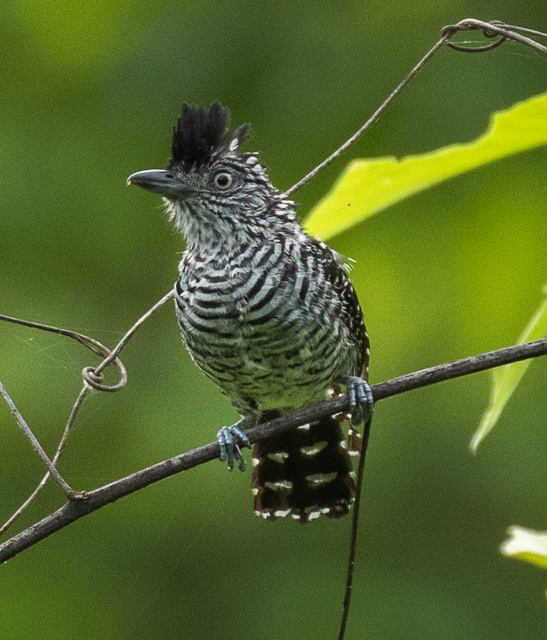 Barred AntshrikeThamnophilus doliatus
-
 Great AntshrikeTaraba major
-
 Black-crowned AntshrikeThamnophilus atrinucha
-
 Ocellated AntbirdPhaenostictus mcleannani
Compare
Questions and answers
What is the scientific name of the Fringe-backed Fire-eye?
The scientific name of the Fringe-backed Fire-eye is Pyriglena atra. Written with its author, the full name is Pyriglena atra (Swainson, 1825).
Which family does the Fringe-backed Fire-eye belong to?
Pyriglena atra belongs to the family Thamnophilidae, in the order Passeriformes and the class Aves.
Where is the Fringe-backed Fire-eye found?
Checklists and occurrence records place Pyriglena atra in 1 country: Brazil.
What is the conservation status of the Fringe-backed Fire-eye?
The IUCN Red List category recorded for Pyriglena atra is Near Threatened (NT).
What other names does the Fringe-backed Fire-eye have?
Pyriglena atra is also known in English as Swainson's Fire-eye.
Where is the Fringe-backed Fire-eye found?
The species is endemic to Brazil and occurs in southeastern Sergipe and coastal northeastern Bahia.[47][48]
What are the English and Brazilian Portuguese names of the species?
Its English name is Fringe-backed Fire-eye, and it is called papa-taoca-da-bahia in Brazilian Portuguese.[49]
Sources
Passages the profile rests on
- The species has previously been treated as conspecific with the White-shouldered Fire-eye (Pyriglena leucoptera). Source passage: “The species at times has been treated as conspecific with the white-shouldered fire-eye (P. lecucoptera)” — English Wikipedia
- Adult individuals of both sexes have bright red irises. Source passage: “Adults of both sexes have bright red irises;” — English Wikipedia
- Immature individuals have orange irises. Source passage: “those of immature birds are orange.” — English Wikipedia
- Male plumage is predominantly glossy black. Source passage: “Males are mostly glossy black” — English Wikipedia
- Males have a conspicuous black-and-white feather patch between their scapulars. Source passage: “with a large patch of black and white feathers between their scapulars” — English Wikipedia
- Male underwing coverts are blackish gray. Source passage: “and blackish gray underwing coverts.” — English Wikipedia
- Females have yellowish-brown upperparts and wings without an interscapular patch. Source passage: “Females have yellowish brown upperparts and wings with no interscapular patch.” — English Wikipedia
- The female has a brownish-black tail. Source passage: “Their tail is brownish black.” — English Wikipedia
- The female's face is olive-tinged gray, with black lores and a black line extending above and behind the eye. Source passage: “Their face is olive-tinged gray with black lores and a black line above and behind the eye.” — English Wikipedia
- The female has a white chin and throat. Source passage: “Their chin and throat are white” — English Wikipedia
- The female's breast is light yellowish olive-brown. Source passage: “their breast light yellowish olive-brown” — English Wikipedia
- The female's belly is a lighter shade of olive-brown than her breast. Source passage: “their belly a lighter olive-brown” — English Wikipedia
- The female's flanks, crissum, and underwing coverts are dark gray-tinged olive-brown. Source passage: “their flanks, crissum, and underwing coverts dark gray-tinged olive-brown.” — English Wikipedia
- The species measures between 16 and 18 cm in length. Source passage: “The fringe-backed fire-eye is 16 to 18 cm (6.3 to 7.1 in) long;” — English Wikipedia
- One recorded individual weighed 32 g. Source passage: “one individual weighed 32 g (1.1 oz).” — English Wikipedia
- The species is described as a medium-sized antbird. Source passage: “Medium-sized antbird.” — ebird.org
- The species inhabits dense understory vegetation in lowland evergreen forest. Source passage: “It inhabits dense understorey vegetation in lowland evergreen forest.” — English Wikipedia
- The species occurs mainly along primary forest edges, in mature secondary forest, and in clearings created by fallen trees. Source passage: “It mostly occurs at the edges of primary forest, in mature secondary forest, and in clearings such as those caused by fallen trees.” — English Wikipedia
- The species avoids sunlit habitats such as open woodland with sparse understory. Source passage: “It shuns sunlit areas such as open woodland with little undergrowth.” — English Wikipedia
- The species occurs from near sea level to approximately 250 m elevation. Source passage: “In elevation it ranges from near sea level to about 250 m (800 ft).” — English Wikipedia
- The species is associated with a narrow belt of Atlantic forest near Salvador in coastal Bahia, west of Santo Amaro. Source passage: “This species is known from the narrow belt of Atlantic forest in the vicinity of Salvador, coastal Bahia (west of the town of Santo Amaro)” — datazone.birdlife.org
- The species eats insects including cockroaches, grasshoppers, and winged ants. Source passage: “The fringe-backed fire-eye feeds on insects (e.g. cockroaches, grasshoppers, and winged ants)” — English Wikipedia
- The species also consumes spiders and centipedes. Source passage: “other arthropods such as spiders and centipedes” — English Wikipedia
- The species also feeds on small vertebrates, including geckos and frogs. Source passage: “and small vertebrates such as geckos and frogs.” — English Wikipedia
- The species is a year-round resident throughout its geographic range. Source passage: “The fringe-backed fire-eye is a year-round resident throughout its range.” — English Wikipedia
- Individuals typically forage alone, in pairs, or in family groups. Source passage: “It typically forages singly, in pairs, or in family groups in dense vegetation” — English Wikipedia
- The species usually forages on the ground and within approximately 3 m above it, but can forage as high as 10 m. Source passage: “mostly on the ground and within about 3 m (10 ft) above it but as high as 10 m (33 ft).” — English Wikipedia
- While foraging, the species hops between short feeding stops and pumps its tail. Source passage: “It hops between short feeding stops, pumping its tail.” — English Wikipedia
- The species captures prey through gleaning, reaching, jumping, lunging from perches, and tossing aside leaf litter. Source passage: “It captures prey by gleaning, reaching, jumping (upward and to the ground), lunging from a perch, and by tossing aside leaf litter on the ground.” — English Wikipedia
- The species occasionally makes short aerial sallies to glean or capture flying prey. Source passage: “Much less frequently it makes short sallies to glean or capture prey on the wing.” — English Wikipedia
- The species frequently follows army ant swarms to capture prey disturbed by the ants. Source passage: “It frequently follows army ant swarms to capture prey disturbed by the ants” — English Wikipedia
- The species sometimes participates in mixed-species feeding flocks. Source passage: “It sometimes joins mixed-species feeding flocks.” — English Wikipedia
- The breeding season includes November and December, although its full timing is unknown. Source passage: “The fringe-backed fire-eye's breeding season is not fully known but includes November and December.” — English Wikipedia
- The first described nest was a ball of dry leaves lined with palm fibers. Source passage: “The first nest to be described was a ball of dry leaves lined with palm fibers.” — English Wikipedia
- The described nest was positioned on the ground and surrounded and partly covered by dry leaves. Source passage: “It was on the ground and surrounded and partially covered with dry leaves.” — English Wikipedia
- The first described nest contained two eggs. Source passage: “When found it contained two eggs.” — English Wikipedia
- The incubation period lasts at least 18 days. Source passage: “Their incubation period was at least 18 days” — English Wikipedia
- Chicks fledge 13 days after hatching. Source passage: “and the chicks fledged 13 days after hatch.” — English Wikipedia
- Both parents incubate the clutch during the day, while the female incubates alone at night. Source passage: “Both parents incubated the clutch during the day and the female alone at night.” — English Wikipedia
- Both parents brood and provision the nestlings. Source passage: “Both parents brooded and provisioned the nestlings.” — English Wikipedia
- The species was assessed as Near Threatened in 2025. Source passage: “As of 2025, it has been downlisted to Near Threatened” — English Wikipedia
- The 2025 reassessment cited the species' occurrence across several sites within its small range and evidence that its population is not particularly fragmented. Source passage: “due to its occurrence over several sites within its small range and new data indicating its population is not particularly fragmented.” — English Wikipedia
- The species has an estimated geographic range of 5,000 km², although its occurrence within that range is patchy. Source passage: “Its range is estimated at 5,000 km2 (1,900 sq mi) though it occurs only patchily within it.” — English Wikipedia
- The species' population size is unknown and is believed to be decreasing. Source passage: “Its population size is unknown, but believed to be decreasing.” — English Wikipedia
- The United States Fish and Wildlife Service listed the species as endangered in 2010. Source passage: “The United States Fish and Wildlife Service listed it as an endangered species in 2010.” — English Wikipedia
- The species is classified as Endangered under Brazilian law. Source passage: “It is considered Endangered under Brazilian law.” — English Wikipedia
- The species is endemic to Brazil. Source passage: “It is endemic to Brazil.” — English Wikipedia
- The species occurs in southeastern Sergipe and coastal northeastern Bahia, Brazil. Source passage: “it is found in southeastern Sergipe and coastal northeastern Bahia.” — English Wikipedia
- The species is called papa-taoca-da-bahia in Brazilian Portuguese. Source passage: “In Brazilian Portuguese it is called papa-taoca-da-bahia.” — English Wikipedia
- The species' song consists of a hurried descending series of approximately six notes. Source passage: “The fringe-backed fire-eye's song is a "hurried, descending series of about 6 'peeh---' notes".” — English Wikipedia
- The species' call is a very high-pitched piped note. Source passage: “Its call is a "very high, piped 'peek' ".” — English Wikipedia
Data
- Catalogue of Life, 2026-10-16 XR cc by
- Global Biodiversity Information Facility CC BY 4.0
- Wikidata CC0
- GeoNames CC BY 4.0
- Wikimedia Commons per image; credit shown with each image
- Within the Catalogue of Life, this name comes from The Integrated Taxonomic Information System cc0
References
- Gill, Frank, & and Minturn Wright. (2006). Birds of the World: Recommended English Names.
- Fish and Wildlife Service, U. S. (2010). Endangered and Threatened Wildlife and Plants; Listing Seven Brazilian Bird Species as Endangered Throughout Their Range. Federal Register, Vol. 75, No. 248.
This species in other databases
Page built on 27 November 2026. See how the catalog is made and all sources and licences.
Cite this page
ScientificNames.org. (2026). Pyriglena atra (Fringe-backed Fire-eye). Retrieved November 27, 2026, from https://scientificnames.org/species/pyriglena-atra
“Pyriglena atra (Fringe-backed Fire-eye).” ScientificNames.org, 2026, scientificnames.org/species/pyriglena-atra. Accessed 27 Nov. 2026.
ScientificNames.org. “Pyriglena atra (Fringe-backed Fire-eye).” Accessed November 27, 2026. https://scientificnames.org/species/pyriglena-atra.
@misc{scientificnames_pyriglena_atra_fringe_backed_fire_eye,
  author = {{ScientificNames.org}},
  title = {Pyriglena atra (Fringe-backed Fire-eye)},
  year = {2026},
  url = {https://scientificnames.org/species/pyriglena-atra},
  note = {Accessed 2026-11-27}
}