Species · Birds
White-shouldered Fire-eye Pyriglena leucoptera
The scientific name of the White-shouldered Fire-eye is Pyriglena leucoptera. It is a species of bird in the family Thamnophilidae (antbird), order Passeriformes. The name dates from 1818.
- Scientific name
- Pyriglena leucoptera (Vieillot, 1818)
- Common name
- White-shouldered Fire-eye
- Genus
- Pyriglena
- Family
- Thamnophilidae (Antbird)
- Order
- Passeriformes
- Class
- Aves
- Red List category
- LC Least Concern
- Recorded in
- 4 countries
- Name status
- accepted in the Catalogue of Life

Overview
The White-shouldered Fire-eye (Pyriglena leucoptera) is a bird in the family Thamnophilidae, order Passeriformes, and class Aves. It occurs in Argentina, Brazil, and Paraguay. Adults of both sexes have bright red irises, and males have predominantly glossy black plumage with distinctive white wing markings.
Written 27 November 2026 from the sources listed below. Each statement was checked against the passage it cites; statements that could not be supported were removed.
Appearance
Adult White-shouldered Fire-eyes measure 16–18 cm in length and weigh 25–34 g. Adults of both sexes have bright red irises.[1][2][3]
Males have predominantly glossy black plumage and a white patch between their scapulars. Their lesser wing coverts are white, their median and greater wing coverts have white tips, and their underwing coverts are blackish gray.[4][5][6][7][8]
Females have yellowish brown to chestnut crowns, upperparts, and wings, and lack an interscapular patch. Their tails are brownish black, their faces are olive-tinged gray with black lores, and their chins and throats are white.[9][10][11][12][13]
Females have light yellowish olive-brown breasts and whiter olive-brown bellies. Their flanks, crissums, and underwing coverts are olive-brown with dark gray tinges.[14][15][16]
Similar species
The White-shouldered Fire-eye has sometimes been classified as conspecific with the fringe-backed fire-eye (Pyriglena atra). It has also sometimes been treated as conspecific with the white-backed fire-eye (Pyriglena leuconota).[17][18]
The White-shouldered Fire-eye is classified as a monotypic species.[19]
Habitat
The White-shouldered Fire-eye inhabits dense understory vegetation in lowland evergreen forest. It mostly occupies primary forest edges, mature secondary forest, and clearings created by fallen trees.[20][21]
It also occurs in selectively logged forests and plantations. It favors habitats with dense thickets, vine tangles, and extensive bamboo stands.[22][23]
The species avoids sunlit habitats such as open woodland with sparse understory. It occurs from near sea level to approximately 1,300 m elevation.[24][25]
Behaviour
The White-shouldered Fire-eye is believed to remain in its range throughout the year. It typically forages alone, in pairs, or in family groups.[26][27]
It usually forages on the ground and within approximately 3 m above it, occasionally reaching heights of 10 m. While foraging, it hops between short feeding stops and pumps its tail.[28][29]
The species captures prey through gleaning, reaching, jumping, lunging from perches, and searching ground leaf litter. It occasionally makes short aerial sallies to glean or capture prey.[30][31]
The White-shouldered Fire-eye frequently follows army ant swarms to catch prey disturbed by the ants. It sometimes briefly participates in mixed-species feeding flocks.[32][33]
Diet
The White-shouldered Fire-eye feeds on insects including cockroaches, beetles, and ants. It also eats spiders and small vertebrates including geckos.[34][35][36]
Reproduction and life cycle
The breeding season extends from September through December.[37]
The documented Argentine nest contained two white eggs marked with rufous and chestnut. Both parents incubated the clutch during daylight hours.[38][39]
Other nests recorded in Brazil were similarly shaped and made from comparable materials. They were placed at ground level or on low stumps.[40]
Conservation
The IUCN classifies the White-shouldered Fire-eye as Least Concern. Its population size is unknown and is believed to be declining.[41][42]
No immediate threats to the species have been identified. Its distribution includes numerous protected areas.[43][44]
Some local populations may be threatened by rapid forest clearance for agriculture. The species survives well in selectively logged forests.[45][46]
The species appears to colonize eucalyptus plantations readily, particularly where native plants form an understory. It was assessed for the IUCN Red List in 2024.[47][48]
Classification of the White-shouldered Fire-eye
| Kingdom | Animalia |
|---|---|
| Phylum | Chordata |
| Subphylum | Vertebrata |
| Infraphylum | Gnathostomata |
| Parvphylum | Osteichthyes |
| Megaclass | Tetrapoda |
| Class | Aves (Bird) |
| Order | Passeriformes (Passerine) |
| Family | Thamnophilidae (Antbird) |
| Genus | Pyriglena (Fire-eye) |
| Species | Pyriglena leucoptera (Vieillot, 1818) |
Where the White-shouldered Fire-eye is found
Checklists and occurrence records place Pyriglena leucoptera in 4 countries across South America. GBIF holds 40,279 georeferenced records of it.
Countries
Regions and cities with the most records
- São Paulo, Brazil 16,033
- Rio de Janeiro, Brazil 5,474
- Minas Gerais, Brazil 4,715
- Misiones, Argentina 4,607
- Santa Catarina, Brazil 3,205
- Paraná, Brazil 1,978
- Puerto Iguazú, Argentina 1,891
- Bahia, Brazil 1,703
- Itatiaia, Brazil 1,434
- Salesópolis, Brazil 1,431
- Resende, Brazil 1,368
- Ubatuba, Brazil 1,261
- Espírito Santo, Brazil 1,254
- Guapiara, Brazil 1,219
- Bertioga, Brazil 1,120
- Cubatão, Brazil 1,083
- Rio Grande da Serra, Brazil 1,049
- Ribeirão Pires, Brazil 1,035
- Paraty, Brazil 979
- Foz do Iguaçu, Brazil 978
- Biritiba Mirim, Brazil 916
- Juquitiba, Brazil 869
- Embu-Guaçu, Brazil 792
- Presidente Franco, Paraguay 767
- Nova Friburgo, Brazil 762
- Mogi das Cruzes, Brazil 752
- Mairiporã, Brazil 729
- Teresópolis, Brazil 719
- São Pedro, Brazil 718
- Pirapora do Bom Jesus, Brazil 669
- Guarulhos, Brazil 661
- Raposos, Brazil 642
- Vila Galvão, Brazil 637
- São Lourenço da Serra, Brazil 635
- Santa Bárbara, Brazil 626
- Cachoeiras de Macacu, Brazil 623
Range as the checklists state it
South America
A number beside a place is its count of GBIF occurrence records. A place without a number comes from a checklist alone. Records show where a species has been observed or collected, which can include escapes and vagrants.
Common names
English
- White-shouldered Fire-eye
Names in 24 other languages
- Catalan
- ull de foc alablanc
- Chinese
- 白肩火眼鳥, 白肩红眼蚁鸟
- Croatian
- blistava mravarica
- Czech
- ohniočko trojpáskované
- Danish
- Hvidskuldret Ildøje
- Dutch
- Witschoudervuuroog
- Esperanto
- tristria formikulo
- Finnish
- pikkutulisilmä
- French
- Alapi demoiselle, Batara demoiselle
- German
- Weißbinden-Ameisenvogel, Weißschulter-Feuerauge
- Italian
- Occhio di fuoco spallebianche
- Japanese
- カタジロアカメアリドリ
- Lithuanian
- baltapetė ugniaakė
- Norwegian
- hvitvingegloøye
- Polish
- węglarz białoskrzydły
- Portuguese
- olho-de-fogo-d'asa-branca, papa-taoca-do-sul
- Russian
- Белоплечая огнеглазка
- Serbian
- Belokrila vatrooka mravarka
- Slovak
- ohňoočko bieloplecé
- Spanish
- Batará negro, Ojodefuego aliblanco
- Swedish
- vitskuldrat eldöga
- Turkish
- Ak Kanatlı Alev Karıncakuşu
- Ukrainian
- вогнеок східний
- Welsh
- llygatgoch ysgwyddwyn
Synonyms
6 other scientific names have been used for this species and are now treated as synonyms of Pyriglena leucoptera.
- Drymophila trifasciata Swainson, WJ, 1825
- Lanius notodela Lesson, 1831
- Lanius notodelos Sclater, PL, 1858
- Myiothera domicilla Wied-Neuwied, M, 1831
- Myrmeciza melanura Strickland, HE, 1844
- Turdus leucopterus Vieillot, 1818
Related species
-
 Western Fire-eyePyriglena maura
-
 East Amazonian Fire-eyePyriglena leuconota
-
 Fringe-backed Fire-eyePyriglena atra
- Tapajos Fire-eyePyriglena similis
-
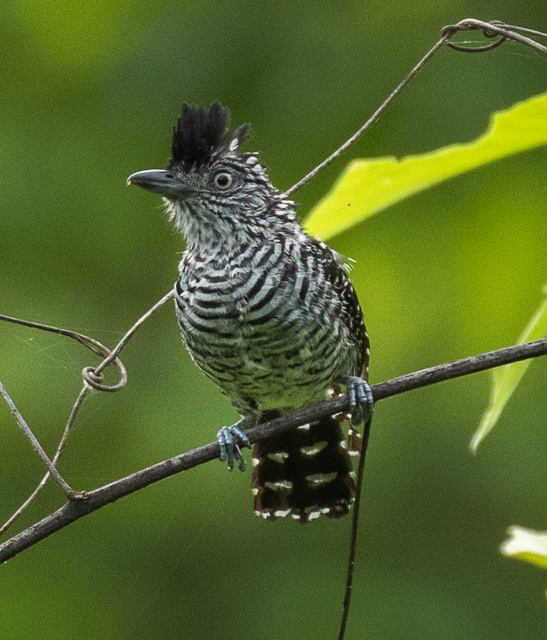 Barred AntshrikeThamnophilus doliatus
-
 Great AntshrikeTaraba major
-
 Black-crowned AntshrikeThamnophilus atrinucha
-
 Ocellated AntbirdPhaenostictus mcleannani
Compare
Questions and answers
What is the scientific name of the White-shouldered Fire-eye?
The scientific name of the White-shouldered Fire-eye is Pyriglena leucoptera. Written with its author, the full name is Pyriglena leucoptera (Vieillot, 1818).
Which family does the White-shouldered Fire-eye belong to?
Pyriglena leucoptera belongs to the family Thamnophilidae, in the order Passeriformes and the class Aves.
Where is the White-shouldered Fire-eye found?
Checklists and occurrence records place Pyriglena leucoptera in 4 countries: Brazil, Argentina, Paraguay and Bolivia.
What is the conservation status of the White-shouldered Fire-eye?
The IUCN Red List category recorded for Pyriglena leucoptera is Least Concern (LC).
Sources
Passages the profile rests on
- Adult White-shouldered Fire-eyes measure 16–18 cm in length. Source passage: “The white-shouldered fire-eye is 16 to 18 cm (6.3 to 7.1 in) long” — English Wikipedia
- Adult White-shouldered Fire-eyes weigh 25–34 g. Source passage: “weighs 25 to 34 g (0.88 to 1.2 oz).” — English Wikipedia
- Adults of both sexes have bright red irises. Source passage: “Adults of both sexes have bright red irises.” — English Wikipedia
- Male White-shouldered Fire-eyes have predominantly glossy black plumage. Source passage: “Males are mostly glossy black.” — English Wikipedia
- Males have a white patch between their scapulars. Source passage: “They have a white patch between their scapulars” — English Wikipedia
- Male White-shouldered Fire-eyes have white lesser wing coverts. Source passage: “white lesser wing coverts” — English Wikipedia
- Male White-shouldered Fire-eyes have white-tipped median and greater wing coverts. Source passage: “white-tipped median and greater wing coverts” — English Wikipedia
- Male White-shouldered Fire-eyes have blackish gray underwing coverts. Source passage: “and blackish gray underwing coverts.” — English Wikipedia
- Females have yellowish brown to chestnut crowns, upperparts, and wings. Source passage: “Females have yellowish brown to chestnut crown, upperparts, and wings” — English Wikipedia
- Female White-shouldered Fire-eyes lack an interscapular patch. Source passage: “with no interscapular patch.” — English Wikipedia
- Females have brownish black tails. Source passage: “Their tail is brownish black.” — English Wikipedia
- Females have olive-tinged gray faces and black lores. Source passage: “Their face is olive-tinged gray with black lores.” — English Wikipedia
- Females have white chins and throats. Source passage: “Their chin and throat are white” — English Wikipedia
- Female White-shouldered Fire-eyes have light yellowish olive-brown breasts. Source passage: “their breast light yellowish olive-brown” — English Wikipedia
- Females have whiter olive-brown bellies. Source passage: “their belly a whiter olive-brown” — English Wikipedia
- Females have dark gray-tinged olive-brown flanks, crissums, and underwing coverts. Source passage: “their flanks, crissum, and underwing coverts dark gray-tinged olive-brown.” — English Wikipedia
- The species has sometimes been classified as conspecific with the fringe-backed fire-eye (Pyriglena atra). Source passage: “The species at times has been treated as conspecific with the fringe-backed fire-eye (P. atra)” — English Wikipedia
- The species has sometimes been treated as conspecific with the white-backed fire-eye (Pyriglena leuconota). Source passage: “and what was at the time the white-backed fire-eye (P. leuconota)” — English Wikipedia
- The White-shouldered Fire-eye is classified as a monotypic species. Source passage: “The white-shouldered fire-eye is monotypic.” — English Wikipedia
- The species inhabits dense understory vegetation in lowland evergreen forest. Source passage: “It inhabits dense understorey vegetation in lowland evergreen forest.” — English Wikipedia
- The species mostly occupies primary forest edges, mature secondary forest, and clearings created by fallen trees. Source passage: “It mostly occurs at the edges of primary forest, in mature secondary forest, and in clearings such as those caused by fallen trees.” — English Wikipedia
- The species also occurs in selectively logged forests and plantations. Source passage: “It also occurs in selectively logged forest and in plantations.” — English Wikipedia
- The species favors habitats containing dense thickets, vine tangles, and extensive bamboo stands. Source passage: “It favors areas with dense thickets, vine tangles, and large stands of bamboo.” — English Wikipedia
- The species avoids sunlit habitats such as open woodland with sparse understory. Source passage: “It shuns sunlit areas such as open woodland with little undergrowth.” — English Wikipedia
- The species occurs from near sea level to approximately 1,300 m elevation. Source passage: “In elevation it ranges from near sea level to about 1,300 m (4,300 ft).” — English Wikipedia
- The White-shouldered Fire-eye is believed to remain in its range throughout the year. Source passage: “The white-shouldered fire-eye is believed to be a year-round resident throughout its range.” — English Wikipedia
- The species typically forages alone, in pairs, or in family groups. Source passage: “It typically forages singly, in pairs, or in family groups” — English Wikipedia
- The species usually forages on the ground and within approximately 3 m above it, occasionally reaching heights of 10 m. Source passage: “mostly on the ground and within about 3 m (10 ft) above it but as high as 10 m (33 ft).” — English Wikipedia
- While foraging, the species hops between short feeding stops and pumps its tail. Source passage: “It hops between short feeding stops, pumping its tail.” — English Wikipedia
- The species captures prey through gleaning, reaching, jumping, lunging from perches, and searching ground leaf litter. Source passage: “It captures prey by gleaning, reaching, jumping (upward and to the ground), lunging from a perch, and by searching leaf litter on the ground.” — English Wikipedia
- The species occasionally makes short aerial sallies to glean or capture prey. Source passage: “Much less frequently it makes short sallies to glean or capture prey on the wing.” — English Wikipedia
- The species frequently follows army ant swarms to catch prey disturbed by the ants. Source passage: “It frequently follows army ant swarms to capture prey disturbed by the ants.” — English Wikipedia
- The species sometimes briefly participates in mixed-species feeding flocks. Source passage: “It sometimes briefly joins mixed-species feeding flocks.” — English Wikipedia
- The species feeds on insects including cockroaches, beetles, and ants. Source passage: “The white-shouldered fire-eye feeds on insects (e.g. cockroaches, beetles, and ants)” — English Wikipedia
- The species also eats arthropods such as spiders. Source passage: “other arthropods such as spiders” — English Wikipedia
- The species consumes small vertebrates including geckos. Source passage: “and small vertebrates such as geckos.” — English Wikipedia
- The breeding season extends from September through December. Source passage: “The white-shouldered fire-eye's breeding season spans from September to December.” — English Wikipedia
- The documented Argentine nest contained two white eggs marked with rufous and chestnut. Source passage: “contained two eggs which were white with rufous and chestnut markings.” — English Wikipedia
- Both parents incubated the clutch during daylight hours. Source passage: “Both parents incubated the clutch during the day.” — English Wikipedia
- Other nests recorded in Brazil were similarly shaped and made from comparable materials, with ground-level or low-stump placement. Source passage: “Other nests found in Brazil were of similar shape, constructed of similar materials, and placed on the ground or a low stump.” — English Wikipedia
- The IUCN classifies the White-shouldered Fire-eye as Least Concern. Source passage: “The IUCN has assessed the white-shouldered fire-eye as being of Least Concern.” — English Wikipedia
- The species' population size is unknown and is believed to be declining. Source passage: “Its population size is not known and is believed to be decreasing.” — English Wikipedia
- No immediate threats to the species have been identified. Source passage: “No immediate threats have been identified.” — English Wikipedia
- The species' distribution includes numerous protected areas. Source passage: “Its range includes many protected areas.” — English Wikipedia
- Some local populations may be threatened by rapid forest clearance for agriculture. Source passage: “[S]ome populations may be endangered at local level as a result of rapid clearance of forest for agriculture.” — English Wikipedia
- The species survives well in selectively logged forests. Source passage: “survives well in selectively logged forest” — English Wikipedia
- The species appears to colonize eucalyptus plantations readily, particularly where native plants form an understory. Source passage: “and appears to colonize eucalyptus (Eucalyptus) plantations readily, especially if these contain an understorey of native plants.” — English Wikipedia
- The species was assessed for the IUCN Red List in 2024. Source passage: “has most recently been assessed for The IUCN Red List of Threatened Species in 2024.” — iucnredlist.org
Data
- Catalogue of Life, 2026-10-16 XR cc by
- Global Biodiversity Information Facility CC BY 4.0
- Wikidata CC0
- GeoNames CC BY 4.0
- Wikimedia Commons per image; credit shown with each image
- Within the Catalogue of Life, this name comes from The Integrated Taxonomic Information System cc0
References
- Gill, Frank, & and Minturn Wright. (2006). Birds of the World: Recommended English Names.
This species in other databases
Page built on 29 November 2026. See how the catalog is made and all sources and licences.
Cite this page
ScientificNames.org. (2026). Pyriglena leucoptera (White-shouldered Fire-eye). Retrieved November 29, 2026, from https://scientificnames.org/species/pyriglena-leucoptera
“Pyriglena leucoptera (White-shouldered Fire-eye).” ScientificNames.org, 2026, scientificnames.org/species/pyriglena-leucoptera. Accessed 29 Nov. 2026.
ScientificNames.org. “Pyriglena leucoptera (White-shouldered Fire-eye).” Accessed November 29, 2026. https://scientificnames.org/species/pyriglena-leucoptera.
@misc{scientificnames_pyriglena_leucoptera_white_shouldered_fire_eye,
  author = {{ScientificNames.org}},
  title = {Pyriglena leucoptera (White-shouldered Fire-eye)},
  year = {2026},
  url = {https://scientificnames.org/species/pyriglena-leucoptera},
  note = {Accessed 2026-11-29}
}