Species · Flowering plants
Iberian Pear Pyrus bourgaeana
The scientific name of the Iberian Pear is Pyrus bourgaeana. It is a species of flowering plant in the family Rosaceae (rose family), order Rosales.
- Scientific name
- Pyrus bourgaeana Decne.
- Common name
- Iberian Pear
- Genus
- Pyrus
- Family
- Rosaceae (Rose Family)
- Order
- Rosales
- Class
- Magnoliopsida
- Red List category
- LC Least Concern
- Recorded in
- 4 countries
- Name status
- accepted in the Catalogue of Life

Overview
The Iberian pear is a small tree. The species occurs widely across the southern Iberian Peninsula and northern Morocco. It produces globose, indehiscent pomes with green or brown skin and numerous lenticels.
Written 26 November 2026 from the sources listed below. Each statement was checked against the passage it cites; statements that could not be supported were removed.
Uses
In southern Spain, the species has been used as rootstock for grafting pear cultivars. Its fruit is described as inedible for people.[1][2]
Similar species
The common pear (Pyrus communis) is a close relative of the Iberian pear. The species coexists with the common pear, Plymouth pear, almond-leaved pear, and snow pear.[3][4]
Fruit peduncle width, petal size, leaf width, and petiole length distinguish the species from other Pyrus species.[5]
Appearance
The Iberian pear is a small tree that typically reaches a height of 3–6 metres.[6][7]
The species produces hermaphroditic flowers that are white or occasionally tinged pink. The flowers measure 2–3 cm in diameter and have five petals.[8][9]
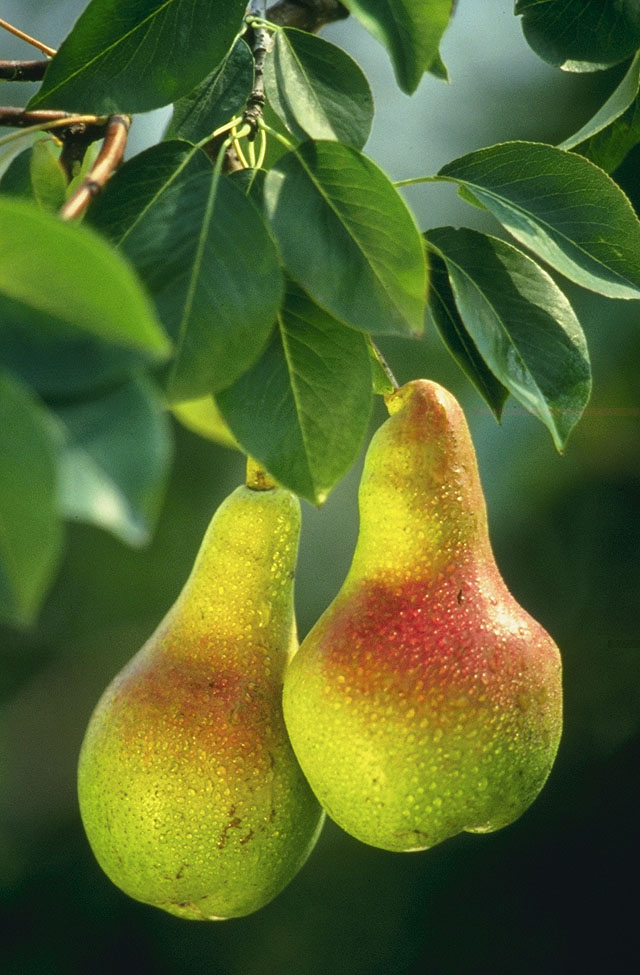
Its fruits are globose, indehiscent pomes. Their skin is green or brown and inconspicuous to birds, and numerous lenticels allow scent to emanate.[10][11][12]
The species is monoecious.[13]
Habitat
Within the Iberian Peninsula, the species grows in small, isolated patches of Mediterranean scrubland. Its populations are fragmented and occur at low tree densities.[14][15]
Mature trees within habitat patches frequently occur in clusters of approximately 8–10 individuals.[16]
The species experiences heavy browsing by red deer in Doñana National Park in Andalusia.[17]
Diet
European badgers and red foxes consume whole fallen fruits of the species. Red deer and wild boar also generally consume whole fallen fruits.[18][19]
European rabbits and some birds consume portions of the fruit pulp. Rodents consume exposed seeds remaining in partially eaten fruits.[20][21]
Behaviour
Mammalian carnivores disperse viable seeds after ingesting the fruits. European rabbits and some birds leave uneaten seeds beneath fruiting trees.[22][23]
Red deer and wild boar act mainly as seed predators because they grind the seeds they ingest.[24]
Rhizome sprouting in response to disturbance may contribute to the clustering of individuals.[25]
Reproduction and life cycle
The species flowers between February and March. Its flowers are pollinated by insects including bees, flies, and beetles.[26][27]
Each individual produces approximately 200–450 fruits. The fruits ripen between September and December before falling to the ground.[28][29]
Each fruit usually contains between two and four fully developed seeds.[30]
The seeds germinate above ground, either shortly after dispersal or inside fallen fruits. They do not appear to persist in the soil seed bank.[31][32]
Seedlings emerge from winter through early spring. Young seedlings experience substantial mortality from summer droughts and fungal infections.[33][34]
Conservation
The species is more frequently killed by storms and high winds than by diseases.[35]
Urbanization and agricultural development are identified as major threats to the species.[36]
Classification of the Iberian Pear
| Kingdom | Plantae |
|---|---|
| Subkingdom | Pteridobiotina |
| Phylum | Tracheophyta |
| Class | Magnoliopsida |
| Order | Rosales |
| Family | Rosaceae (Rose Family) |
| Subfamily | Amygdaloideae |
| Tribe | Maleae |
| Subtribe | Malinae |
| Genus | Pyrus (Pear) |
| Species | Pyrus bourgaeana Decne. |
Where the Iberian Pear is found
Checklists and occurrence records place Pyrus bourgaeana in 4 countries across Africa and Europe. GBIF holds 2,198 georeferenced records of it.
Countries
Regions and cities with the most records
- Faro, Portugal 256
- Madrid, Spain 210
- Colmenar Viejo, Spain 181
- Tres Cantos, Spain 179
- El Goloso, Spain 173
- Extremadura, Spain 165
- Alcobendas, Spain 151
- San Sebastián de los Reyes, Spain 150
- Beja, Portugal 146
- Évora, Portugal 125
- Loulé, Portugal 90
- Laranjeiro, Portugal 78
- Quelfes, Portugal 77
- Olhão, Portugal 71
- Setúbal, Portugal 69
- Faro, Portugal 66
- Torrelodones, Spain 59
- Tavira, Portugal 54
- Leiria, Portugal 49
- Quarteira, Portugal 46
- Caldas da Rainha, Portugal 42
- Castelo Branco, Portugal 42
- Peniche, Portugal 41
- Andújar, Spain 39
- Chamartín, Spain 33
- Almonte, Spain 32
- Ayamonte, Spain 32
- Portimão, Portugal 31
- Pozoblanco, Spain 31
- Évora, Portugal 31
- Ciudad Lineal, Spain 29
- Algete, Spain 27
- Sidi Allal El Bahraoui, Morocco 24
- Bouknadel, Morocco 23
- Las Rozas de Madrid, Spain 23
- Salé Al Jadida, Morocco 23
1 more country has a few records outside this range
These countries hold a few records of Pyrus bourgaeana but lie outside the range the checklists give for it. Such records are often zoo or garden specimens, museum material or vagrants, so the species is not counted as occurring there.
Range as the checklists state it
Portugal; W-Spain; Morocco
A number beside a place is its count of GBIF occurrence records. A place without a number comes from a checklist alone. Records show where a species has been observed or collected, which can include escapes and vagrants.
Common names
English
- Iberian Pear
- Iberian Wild Pear Tree
Names in 3 other languages
- Finnish
- Espanjanpäärynä
- Portuguese
- Catapereiro, Pereira-brava, Pereiro-bravo
- Spanish
- Peral de monte, Piruétano
Synonyms
21 other scientific names have been used for this species and are now treated as synonyms of Pyrus bourgaeana.
- Pyrus bourgaeana f. triloba (P.Silva & Fontes) P.Silva
- Pyrus bourgaeana subsp. mamorensis (Trab.) Rivas Mart. & Quézel
- Pyrus bourgaeana subsp. mamorensis (Trab.) Rivas Mart., Molero Mesa, Marfíl & G.Benítez
- Pyrus communis f. triloba P.Silva & Fontes
- Pyrus communis prol. bourgaeana (Decne.) Asch. & Graebn.
- Pyrus communis prol. mariana (Willk.) Asch. & Graebn.
- Pyrus communis subsp. bourgaeana (Decne.) Nyman
- Pyrus communis subsp. bourgaeana L.
- Pyrus communis subsp. mamorensis (Trab.) Maire
- Pyrus communis subsp. mamorensis L.
- Pyrus communis subsp. mariana (Willk.) Asch. & Graebn.
- Pyrus communis subsp. mariana L.
- Pyrus communis subsp. marmorensis (Trab.) Maire
- Pyrus communis var. bourgaeana (Decne.) Laguna
- Pyrus communis var. mariana Willk.
- Pyrus communis var. marianica Willk. ex Rivas Goday
- Pyrus mamorensis Trab.
- Pyrus mamorensis var. brevipes Emb. & Maire
- Pyrus mamorensis var. eumamorensis Maire
- Pyrus pyraster subsp. mariana (Willk.) Terpó
- Pyrus communis var. brevipes (Emb. & Maire) Maire ambiguous synonym
Related species
-
 Bradford PearPyrus calleryana
-
 Asian PearPyrus pyrifolia
-
 PearPyrus communis
-
 Wild PearPyrus pyraster
-
 Pyrus × BretschneideriPyrus bretschneideri
-
 Snow PearPyrus nivalis
-
 Ussurian PearPyrus ussuriensis
-
 Willow-Leaved PearPyrus salicifolia
Compare
Questions and answers
What is the scientific name of the Iberian Pear?
The scientific name of the Iberian Pear is Pyrus bourgaeana. Written with its author, the full name is Pyrus bourgaeana Decne..
Which family does the Iberian Pear belong to?
Pyrus bourgaeana belongs to the family Rosaceae, in the order Rosales and the class Magnoliopsida.
Where is the Iberian Pear found?
Checklists and occurrence records place Pyrus bourgaeana in 4 countries: Spain, Portugal, Morocco and Algeria.
What is the conservation status of the Iberian Pear?
The IUCN Red List category recorded for Pyrus bourgaeana is Least Concern (LC).
What other names does the Iberian Pear have?
Pyrus bourgaeana is also known in English as Iberian Wild Pear Tree.
What type of fruit is a pear classified as?
The Iberian pear produces globose, indehiscent pomes.[10]
Sources
Passages the profile rests on
- In southern Spain, the species has been used as rootstock for grafting pear cultivars. Source passage: “In southern Spain, the Iberian pear has been used as rootstock for grafting pear cultivars.” — English Wikipedia
- The fruit is described as inedible for people. Source passage: “The fruit is not edible for people.” — English Wikipedia
- The common pear (Pyrus communis) is a close relative of the Iberian pear. Source passage: “a close relative of the common pear (Pyrus communis).” — English Wikipedia
- The species coexists with the common pear, Plymouth pear, almond-leaved pear, and snow pear. Source passage: “where it coexists with four other Pyrus species: common pear, Plymouth pear (P. cordata), almond-leaved pear (P. spinosa), and snow pear (P. nivalis).” — English Wikipedia
- Fruit peduncle width, petal size, leaf width, and petiole length distinguish the species from other Pyrus species. Source passage: “Characteristics to discriminate these species are the width of fruit peduncle, petal size, leaf width and petiole length.” — English Wikipedia
- The Iberian pear is a small tree. Source passage: “This small tree (typically 3–6 m high)” — English Wikipedia
- The Iberian pear typically reaches a height of 3–6 metres. Source passage: “typically 3–6 m high” — English Wikipedia
- The species produces hermaphroditic flowers that are white or occasionally tinged pink. Source passage: “hermaphrodite flowers are white, rarely tinted pink” — English Wikipedia
- Its flowers measure 2–3 cm in diameter and have five petals. Source passage: “2–3 cm diameter, and have five petals.” — English Wikipedia
- Its fruits are globose, indehiscent pomes. Source passage: “Fruits are non-dehiscent globose pomes” — English Wikipedia
- The fruit skin is green or brown and inconspicuous to birds. Source passage: “with green or brown skin inconspicuous to birds” — English Wikipedia
- The fruits have numerous lenticels that allow scent to emanate. Source passage: “copious lenticels permitting scent to emanate” — English Wikipedia
- The species is described as monoecious. Source passage: “This monoecious small tree ...” — inaturalist.org
- Within the Iberian Peninsula, the species grows in small, isolated patches of Mediterranean scrubland. Source passage: “small patches of Mediterranean scrubland that are isolated from each other” — English Wikipedia
- Populations within the Iberian Peninsula are fragmented and occur at low tree densities. Source passage: “distribution is very fragmented with trees occurring at low densities” — English Wikipedia
- Mature trees within habitat patches frequently occur in clusters of approximately 8–10 individuals. Source passage: “mature trees often are aggregated in small clusters of 8-10 individuals” — English Wikipedia
- The species experiences heavy browsing by red deer in Doñana National Park in Andalusia. Source passage: “In Doñana National Park of Andalusia, P. bourgaeana experience heavy browsing by red deer” — English Wikipedia
- European badgers and red foxes consume whole fallen fruits of the species. Source passage: “mammalian carnivores (European badgers Meles meles, red foxes Vulpes vulpes, etc.) often ingest whole fruits fallen to the ground” — English Wikipedia
- Red deer and wild boar generally consume whole fallen fruits. Source passage: “Ungulates (red deer Cervus elaphus, wild boar Sus scrofa) generally ingest whole fallen fruits” — English Wikipedia
- European rabbits and some birds consume portions of the fruit pulp. Source passage: “European rabbits (Oryctolagus cunniculus) and some birds also feed on the fruit, eating only parts of the fruit pulp” — English Wikipedia
- Rodents consume exposed seeds remaining in partially eaten fruits. Source passage: “Rodents often depredate the uncovered seeds in those partially eaten fruits.” — English Wikipedia
- Mammalian carnivores disperse viable seeds after ingesting the fruits. Source passage: “disperse ingested seeds away from conspecifics with the capacity of germination.” — English Wikipedia
- European rabbits and some birds leave uneaten seeds beneath fruiting trees. Source passage: “but leaving the uneaten seeds under fruiting trees.” — English Wikipedia
- Red deer and wild boar act mainly as seed predators because they grind the seeds they ingest. Source passage: “they grind ingested seeds and thus act mostly as seed predators.” — English Wikipedia
- Rhizome sprouting in response to disturbance may contribute to the clustering of individuals. Source passage: “rhizome sprouting in response to disturbance could result in clustering” — English Wikipedia
- The species flowers between February and March. Source passage: “The Iberian pear flowers during February–March.” — English Wikipedia
- Its flowers are pollinated by insects including bees, flies, and beetles. Source passage: “It is pollinated by a wide variety of insects, such as bees, flies, and beetles.” — English Wikipedia
- Each individual produces approximately 200–450 fruits. Source passage: “Each individual produces between 200–450 fruits” — English Wikipedia
- The fruits ripen between September and December before falling to the ground. Source passage: “that ripen from September to December, when they fall to the ground.” — English Wikipedia
- Each fruit usually contains between two and four fully developed seeds. Source passage: “Each fruit usually contains 2-4 full seeds.” — English Wikipedia
- The seeds germinate above ground, either shortly after dispersal or inside fallen fruits. Source passage: “Seeds germinate epigeally either shortly after dispersal, or even within fallen fruits” — English Wikipedia
- The seeds do not appear to persist in the soil seed bank. Source passage: “and do not appear to persist in the soil seed bank.” — English Wikipedia
- Seedlings emerge from winter through early spring. Source passage: “Seedlings emerge from winter to early spring” — English Wikipedia
- Young seedlings experience substantial mortality from summer droughts and fungal infections. Source passage: “extensive mortality occurs on young seedlings due to summer droughts and fungal infection.” — English Wikipedia
- The species is more frequently killed by storms and high winds than by diseases. Source passage: “they are more often killed by storms or high winds than by sickness.” — English Wikipedia
- Urbanization and agricultural development are identified as major threats to the species. Source passage: “The major threats are urbanization and agricultural development.” — English Wikipedia
Data
- Catalogue of Life, 2026-10-16 XR cc by
- Global Biodiversity Information Facility CC BY 4.0
- Wikidata CC0
- GeoNames CC BY 4.0
- Wikimedia Commons per image; credit shown with each image
- Within the Catalogue of Life, this name comes from Synonymic Checklists of the Vascular Plants of the World cc by
References
- Decne. (1871). Jard. Fruit. [Decaisne] 1: t. 2 (1871). where the name was published
This species in other databases
- Catalogue of Life 4QWKC
- Wikidata Q3285189
- iNaturalist 63954
- World Flora Online wfo-0001018703
- GRIN 316049
Page built on 27 November 2026. See how the catalog is made and all sources and licences.
Cite this page
ScientificNames.org. (2026). Pyrus bourgaeana (Iberian Pear). Retrieved November 27, 2026, from https://scientificnames.org/species/pyrus-bourgaeana
“Pyrus bourgaeana (Iberian Pear).” ScientificNames.org, 2026, scientificnames.org/species/pyrus-bourgaeana. Accessed 27 Nov. 2026.
ScientificNames.org. “Pyrus bourgaeana (Iberian Pear).” Accessed November 27, 2026. https://scientificnames.org/species/pyrus-bourgaeana.
@misc{scientificnames_pyrus_bourgaeana_iberian_pear,
  author = {{ScientificNames.org}},
  title = {Pyrus bourgaeana (Iberian Pear)},
  year = {2026},
  url = {https://scientificnames.org/species/pyrus-bourgaeana},
  note = {Accessed 2026-11-27}
}