Species · Birds
Andaman Crake Rallina canningi
The scientific name of the Andaman Crake is Rallina canningi. It is a species of bird in the family Rallidae (rail), order Gruiformes. The name dates from 1863.
- Scientific name
- Rallina canningi (Blyth, 1863)
- Common name
- Andaman Crake
- Genus
- Rallina
- Family
- Rallidae (Rail)
- Order
- Gruiformes
- Class
- Aves
- Red List category
- LC Least Concern
- Recorded in
- 1 country
- Name status
- accepted in the Catalogue of Life

Overview
Rallina canningi is endemic to the Andaman Islands in the eastern Indian Ocean and is recorded from North, Middle and South Andaman islands. It has glossy chestnut plumage, boldly barred underparts, an apple-green bill and olive-green legs and feet.
Written 26 November 2026 from the sources listed below. Each statement was checked against the passage it cites; statements that could not be supported were removed.
Appearance
The Andaman Crake has glossy chestnut plumage and extensive bold barring on its underparts. Its undertail-coverts are unbarred, and pale wing barring is restricted to the outer primaries and the greater and medium coverts.[1][2][3][4]
Its bill is relatively bright apple-green, and its legs and feet are olive-green. It has a relatively long, fluffy tail and measures approximately 34 cm in length.[5][6][7][8]
Juveniles have duller, paler plumage and less prominent barring than adults. Immature birds have dark grey-brown barred areas with a chestnut tinge, narrow dirty-white bands and streaks.[9][10][11]
The species is described as relatively large and rust-colored, with a pale bill and barred black-and-white underparts. It is the largest member of the genus Rallina.[12][13]
Habitat
The Andaman Crake inhabits marshland within subtropical or tropical moist lowland forests. It also inhabits subtropical or tropical mangrove forests.[14][15]
Diet
The Andaman Crake feeds on small fish, molluscs and worms. Its insect prey includes beetles, grasshoppers and caterpillars.[16][17][18][19]
Behaviour
The Andaman Crake is very shy and skulks in dense woodland while foraging. It shakes and batters large grasshoppers before swallowing them.[20][21]
Its vocalization is a deep croak. It gives a sharp clicking sound as an alarm call.[22][23]
Reproduction and life cycle
The Andaman Crake breeds between June and August. It nests at the bases of large buttressed trees or beneath tangled forest undergrowth.[24][25]
Its preferred nesting trees include Terminalia, Tetrameles nudiflora and Pterocarpus. These trees may be located near waterbodies.[26][27]
Its eggs resemble those of the banded crake but are larger, whiter and glossier. They measure approximately 40 by 30 mm, and both sexes participate in incubation.[28][29][30]
Similar species
Other Rallina species and the ruddy-breasted crake are similar-looking birds. Other similar-looking crakes are smaller and lack green bills and legs.[31][32]
Conservation
Habitat loss is a threat to the Andaman Crake, and introduced predators are identified as a potential threat. BirdLife International estimates its population at between 10,000 and 25,000 individuals.[33][34][35]
Classification of the Andaman Crake
| Kingdom | Animalia |
|---|---|
| Phylum | Chordata |
| Subphylum | Vertebrata |
| Infraphylum | Gnathostomata |
| Parvphylum | Osteichthyes |
| Megaclass | Tetrapoda |
| Class | Aves (Bird) |
| Order | Gruiformes (Rails) |
| Family | Rallidae (Rail) |
| Genus | Rallina (Red-legged Crakes) |
| Species | Rallina canningi (Blyth, 1863) |
Where the Andaman Crake is found
Checklists and occurrence records place Rallina canningi in 1 country across Asia. GBIF holds 1,403 georeferenced records of it.
Countries
Regions and cities with the most records
- Andaman and Nicobar, India 1,372
- Port Blair, India 1,164
- Diglipur, India 27
- Rangat, India 27
- Māyābandar, India 14
Range as the checklists state it
Southern Asia
A number beside a place is its count of GBIF occurrence records. A place without a number comes from a checklist alone. Records show where a species has been observed or collected, which can include escapes and vagrants.
Common names
English
- Andaman Crake
Names in 28 other languages
- Arabic
- مرعة أندامان
- Catalan
- Rasclet de les Andaman, rasclet de les illes Andaman
- Chinese
- 安达曼秧鸡, 安達曼斑秧雞
- Croatian
- andamanska vizlinica
- Czech
- chřástal andamanský
- Danish
- Andaman Kastanjerikse
- Dutch
- Andamanenral
- Esperanto
- andamana ralo
- Estonian
- andamani metsruik
- Finnish
- andamaanienräikkä
- French
- Râle des Andaman
- German
- Andamanen-Ralle, Andamanenralle
- Hungarian
- andamáni guvat
- Italian
- Rallina delle Andamane
- Japanese
- アンダマンオオクイナ
- Lithuanian
- andamaninė dryžoji vištelė
- Norwegian
- andamanrikse
- Polish
- kureczka wielka, rudokurka wielka
- Portuguese
- franga-d'água-das-andamão, franga-de-água-das-andamão, sanã-de-andamã
- Russian
- Андаманский пастушок, Андаманский полосатый погоныш
- Serbian
- Andamanski šumski petlić
- Slovak
- chriašteľ andamanský
- Spanish
- Polluela de Andamán
- Swedish
- andamanrall, andamansumphöna
- Turkish
- Andaman Kestane Yelvesi
- Ukrainian
- погонич андаманський
- Welsh
- rhegen Andaman
- pnb
- اینڈامین کریک
Synonyms
One other scientific name has been used for this species and is now treated as a synonym of Rallina canningi.
- Euryzona canningi Blyth, 1863
Related species
-
 Slaty-legged CrakeRallina eurizonoides
-
 Red-necked CrakeRallina tricolor
-
 Red-legged CrakeRallina fasciata
-
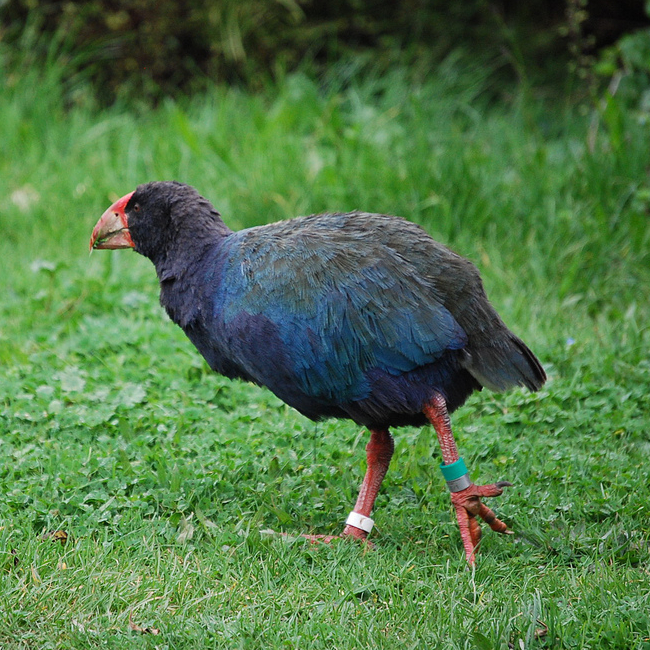 TakahēPorphyrio hochstetteri
-
 Australasian SwamphenPorphyrio melanotus
-
 American CootFulica americana
-
 Eurasian CootFulica atra
-
 Common MoorhenGallinula chloropus
Compare
Questions and answers
What is the scientific name of the Andaman Crake?
The scientific name of the Andaman Crake is Rallina canningi. Written with its author, the full name is Rallina canningi (Blyth, 1863).
Which family does the Andaman Crake belong to?
Rallina canningi belongs to the family Rallidae, in the order Gruiformes and the class Aves.
Where is the Andaman Crake found?
Checklists and occurrence records place Rallina canningi in 1 country: India.
What is the conservation status of the Andaman Crake?
The IUCN Red List category recorded for Rallina canningi is Least Concern (LC).
Sources
Passages the profile rests on
- The Andaman Crake has glossy chestnut plumage. Source passage: “It has a glossy chestnut plumage” — English Wikipedia
- Its underparts have extensive bold barring. Source passage: “extensive bold barring on underparts” — English Wikipedia
- Its undertail-coverts are unbarred. Source passage: “unbarred undertail-coverts” — English Wikipedia
- Pale wing barring is restricted to the outer primaries and the greater and medium coverts. Source passage: “It also has pale barring on wings confined to outer primaries and greater and medium coverts.” — English Wikipedia
- Its bill is relatively bright apple-green. Source passage: “relatively bright apple-green bill” — English Wikipedia
- Its tail is relatively long and fluffy. Source passage: “relatively long and fluffy tail” — English Wikipedia
- Its legs and feet are olive-green. Source passage: “legs and feet are olive-green.” — English Wikipedia
- The Andaman Crake measures approximately 34 cm in length. Source passage: “measuring about 34 cm in length.” — English Wikipedia
- Juveniles have duller plumage and less prominent barring than adults. Source passage: “Juveniles are duller and less prominently barred.” — English Wikipedia
- Immature birds have dark grey-brown barred areas with a chestnut tinge and narrow dirty-white bands and streaks. Source passage: “the barred areas being dark grey-brown with a chestnut tinge, narrowly banded and streaked dirty white.” — English Wikipedia
- Juvenile birds are paler than adults. Source passage: “Juvenile birds are paler than adult.” — English Wikipedia
- The species is described as relatively large, rust-colored and pale-billed, with barred black-and-white underparts. Source passage: “A relatively large, rust-colored crake with a pale bill and barred black-and-white underparts.” — ebird.org
- It is the largest member of the genus Rallina. Source passage: “This is the largest Rallina” — English Wikipedia
- The species inhabits marshland within subtropical or tropical moist lowland forests. Source passage: “Its natural habitat is marshland inside subtropical or tropical moist lowland forests” — English Wikipedia
- The species also inhabits subtropical or tropical mangrove forests. Source passage: “subtropical or tropical mangrove forests.” — English Wikipedia
- The Andaman Crake feeds on small fish. Source passage: “it feeds on small fish, molluscs, worms and insects” — English Wikipedia
- Its diet includes molluscs. Source passage: “it feeds on small fish, molluscs, worms and insects” — English Wikipedia
- Its diet includes worms. Source passage: “it feeds on small fish, molluscs, worms and insects” — English Wikipedia
- Its insect prey includes beetles, grasshoppers and caterpillars. Source passage: “insects (beetles, grasshoppers and caterpillars).” — English Wikipedia
- The species shakes and batters large grasshoppers before swallowing them. Source passage: “Large grasshoppers shaken about and battered before swallowing.” — English Wikipedia
- The species is very shy and skulks in dense woodland while foraging. Source passage: “Very shy and skulking in dense woodland, where it forages on ...” — ebird.org
- Its vocalization is a deep croak. Source passage: “Voice is a deep croak.” — English Wikipedia
- It gives a sharp clicking sound as an alarm call. Source passage: “It utters a sharp click as an alarm call.” — English Wikipedia
- The Andaman Crake breeds between June and August. Source passage: “It breeds between June and August.” — English Wikipedia
- It nests at the bases of large buttressed trees or beneath tangled forest undergrowth. Source passage: “It nests at the bottom of large trees with buttresses or under tangled undergrowth in forests.” — English Wikipedia
- Its nesting tree preferences include Terminalia, Tetrameles nudiflora and Pterocarpus. Source passage: “the species preferred trees such as Terminalia, Tetrameles nudiflora or Pterocarpus” — English Wikipedia
- Its preferred nesting trees may be located near waterbodies. Source passage: “possibly near waterbodies.” — English Wikipedia
- Its eggs resemble those of the banded crake but are larger, whiter and glossier. Source passage: “Its eggs are similar to those of the banded crake but larger, whiter and more glossy.” — English Wikipedia
- Both sexes participate in incubating the eggs. Source passage: “Both sexes share in incubation.” — English Wikipedia
- The eggs measure approximately 40 by 30 mm. Source passage: “the eggs are about 40 by 30 mm (1.6 by 1.2 in).” — English Wikipedia
- Other Rallina species and the ruddy-breasted crake are identified as similar-looking birds. Source passage: “Other similar looking crakes include other Rallina and ruddy-breasted crake Porzana fusca.” — English Wikipedia
- Other similar-looking crakes are smaller and lack green bills and legs. Source passage: “They are smaller and do not have green bill and legs.” — English Wikipedia
- Habitat loss is identified as a threat to the species. Source passage: “It is threatened by habitat loss.” — English Wikipedia
- BirdLife International estimates the population at between 10,000 and 25,000 individuals. Source passage: “BirdLife International estimates the population to range between 10,000 and 25,000 individuals.” — English Wikipedia
- Introduced predators are identified as a potential threat to the species. Source passage: “Introduced predators may also pose a risk to the birds' population.” — English Wikipedia
- The Andaman Crake is endemic to the Andaman Islands in the eastern Indian Ocean. Source passage: “It is endemic to the Andaman Islands of the eastern Indian Ocean.” — English Wikipedia
- The species is endemic to the Andaman Islands in the Bay of Bengal, India. Source passage: “Rallina canningi is endemic to the Andaman Islands, in the Bay of Bengal, India” — datazone.birdlife.org
Data
- Catalogue of Life, 2026-10-16 XR cc by
- Global Biodiversity Information Facility CC BY 4.0
- Wikidata CC0
- GeoNames CC BY 4.0
- Wikimedia Commons per image; credit shown with each image
- Within the Catalogue of Life, this name comes from The Integrated Taxonomic Information System cc0
References
- Gill, Frank, & and Minturn Wright. (2006). Birds of the World: Recommended English Names.
- Dickinson, E. C., and J. V. Remsen Jr., eds. (2013). The Howard and Moore Complete Checklist of the Birds of the World, 4th Edition, Vol. 1 Non-Passerines.
This species in other databases
Page built on 29 November 2026. See how the catalog is made and all sources and licences.
Cite this page
ScientificNames.org. (2026). Rallina canningi (Andaman Crake). Retrieved November 29, 2026, from https://scientificnames.org/species/rallina-canningi
“Rallina canningi (Andaman Crake).” ScientificNames.org, 2026, scientificnames.org/species/rallina-canningi. Accessed 29 Nov. 2026.
ScientificNames.org. “Rallina canningi (Andaman Crake).” Accessed November 29, 2026. https://scientificnames.org/species/rallina-canningi.
@misc{scientificnames_rallina_canningi_andaman_crake,
  author = {{ScientificNames.org}},
  title = {Rallina canningi (Andaman Crake)},
  year = {2026},
  url = {https://scientificnames.org/species/rallina-canningi},
  note = {Accessed 2026-11-29}
}